
Many people know that improving the website loading speed by 0.5 sec is invisible to the users. But it’s still one of the essential search engine factors they use in their ranking algorithms. Also, many web users may use a slow Internet connection, even in the USA and Europe. That is why improving website loading speed is a high-priority task for web development teams. How to improve the website speed?
What is website speed?
Technically the term website loading speed is incorrect because it is about page loading speed.
In short, website loading speed refers to how quickly the content and UI elements of the specific page load when a user visits it.
Several factors can influence specific page speed:
- The amount and size of the images and videos are contained on the page
- UI animations
- Themes and plugins are installed on the site
- Front-end and server-side technologies are used
- The code quality
- Hosting or server
But you must know that the user’s Internet connection also affects the web page speed.
Start with website speed testing
You may start the website speed test with your smartphone and mobile Internet connection. Does your site load quickly enough? Does your site look mobile-friendly? This test helps you to identify critical speed issues and how responsive the design of your website is.
But using a smartphone test can’t tell about a website’s score in terms of the website loading speed. Also, it can’t help to identify the causes of slow website loading. That is why you should use tools to test and measure your website’s loading speed.
The most used tool is Google Pagespeed Insights. It is easy to use and provides you with the most critical information. Look at the snapshot for our website.
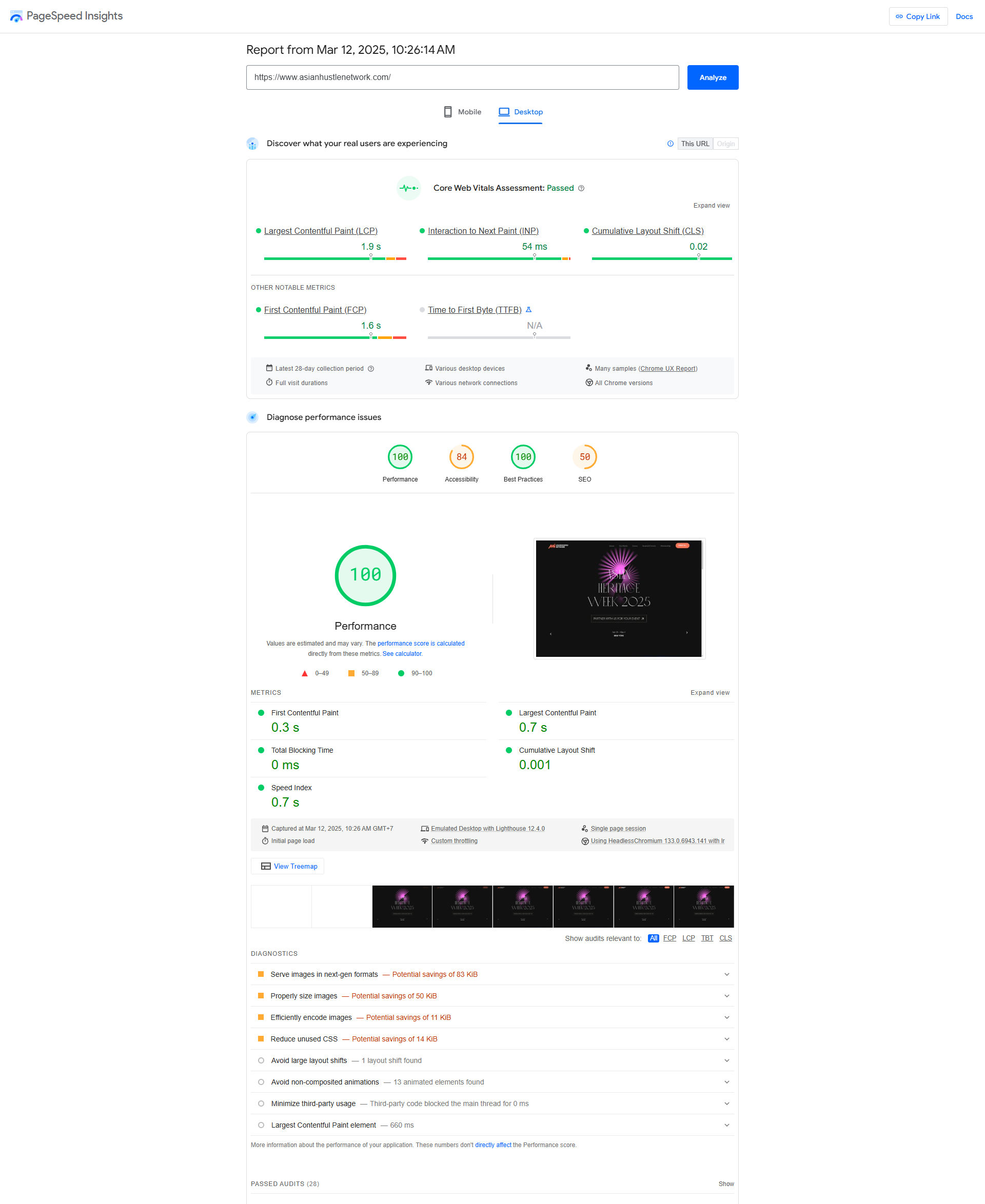
AHN’s team developed this site. You can see good scores and no critical issues that could affect the website loading speed.
If Google Pagespeed Insights identifies issues, it will provide recommendations for increasing the website’s performance.
This free tool allows testing the site’s mobile and desktop versions. You can use the Lighthouse tool that is built-in Chrome browser—Press F12 to run web developer tools and choose the Lighthouse tool to test the page.
Also, web developers may use other tools like GTmetrix, Pingdom, or Performance Budget Calculator.
Some tools are free, but other tools can be payable. Many web professionals use Lighthouse and Core Web Vitals reports because it is usually enough.
Guidelines to improve the website loading speed
The Lighthouse tool (Google Pagespeed Insights) assessed your site as poor (score is less than 50) or as a website that needs improvements (score from 50 to 89). A web developer must look at the tool’s recommendations and fix issues.
This guide will help you to understand which factors influence website speed and how to increase it.
Optimize the images
Surprisingly, images are one of the most common issues affecting website loading speed. The main reason is that content managers do not pay attention to the size and format of the images when uploading them to the website.
There is a typical image optimization process.
Reduce the image size.
Photos, images, or graphics on the web pages improve engagement. But if you use large files, the images slow down a website.
Compressing images using tools is one way to reduce image size without affecting quality. Another way to reduce the image size is to adjust the image size based on user display properties.
Choose the right image format.
Look at this image. It shows the difference between a zoomed-in vector image L and a raster image R.
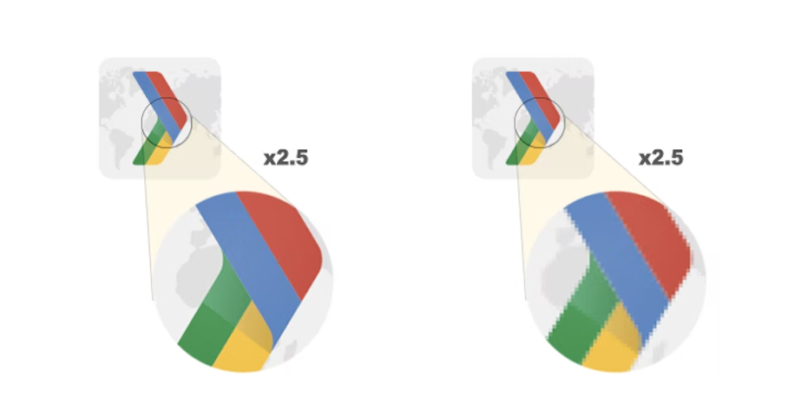
As you can see, vector images are preferable options as they are resolution-independent and always deliver excellent results.
If you use raster images, a web developer should serve different image sizes to other devices. But bear in mind that serving desktop-sized images to mobile phones can use 2–4x more data than needed.
Use WebP images
When Facebook switched to WebP, they noticed a 25-35% filesize savings for JPEGs and an 80% for PNGs.
How to convert images to WebP? Usually, web developers use the cwebp command-line tool (for simple projects) or the Imagemin WebP plugin(for complex projects).
Replace animated GIFs with video.
GIFs aren’t a good choice when you need a fast website because their size can be 10-15 MB.

It takes a lot of time to upload a GIF file. That is why web professionals convert GIFs into video files (MPEG or WebM).
Use image CDNs to optimize images.
Image content delivery networks (CDNs) specialize in transforming, optimizing, and delivering images. They are excellent at optimizing images and can yield a 40–80% savings in image file size. Image CDNs work like API, making it easy to create variations of an image for different use cases by indicating parameters like size, format, and quality.
Use lazy loading
Lazy loading is a technique that defers the loading of non-critical resources while the web page loads. In practice, the image lazy loading loads lightweight placeholder images at page load and replaces them with lazily-loaded images when they’re scrolled into the viewport.
Using lazy loading makes sense if you use many media files on your site.
Web developers can use a variety of ways to implement lazy loadings, such as browser-level lazy loading, Intersection Observer (JavaScript), or CSS. If your website is built on WordPress, you can use plugins.
Use a Content Delivery Network (CDN)
Content delivery networks (CDNs) improve site performance using web servers distributed across various locations. These servers retrieve content from the website server and provide website content to users with regard to their location. CDNs reduce server load and handle traffic spikes.
Also, CDNs allow caching resources on their servers. As a result, the resources are delivered more quickly. Cashing also reduces the load on the website server.
To choose a good CDN, you should focus on its performance, security, analytics features, support, and pricing.
You need to know that CDN performance can vary significantly depending on geography, time of day, and different events. That is why predicting the exact performance you’ll get from a CDN is difficult.
Choosing a good CDN depends on the type of your site (e-commerce, corporate website, blog), user locations, and your budget.
Prioritize loading resources
Not every website resource has the same degree of importance, which is why browsers attempt to make a guess at the most important resources to load first. The problem is browsers could use the wrong priority for website resources. For example, loading scripts before CSS.
Web developers can use different ways to influence browsers’ priority-making process.
If a web developer adds the <script> tag in the page’s <head>, Chrome will load at a high priority. But using the async attribute changes it to low priority.
Also, a web developer can use <link rel=”preload”> (informs the browser that a resource should start getting fetched as soon as possible), <link rel=”preconnect”> (informs the browser that you’d like the process to start as soon as possible), and <link rel=”prefetch”> (it tries to make something non-critical happen earlier if there’s a chance) for other resources.
To make everything right, a web developer should know the browser’s priority for each resource. For example, to know Chrome’s priority, you need to press F12 to run DevTools and find the Network panel.

These priorities help to understand how much relative importance the browser attributes to resources. A web developer can influence the browser to assign a different priority. For example, if an image is a part of the initial render, a web developer prioritizes it higher than an image that starts offscreen.
Optimize CSS code
CSS code must be loaded before the browser renders the website page because it is a render-blocking resource. If these web pages contain unnecessarily large CSS code, it takes longer to render them.
There are two main techniques that web developers use.
The first is deferring non-critical CSS. Many non-critical styles apply to content that’s not immediately visible, for example, paragraphs inside the accordions. A web developer can defer this non-critical code.
The second is minifying CSS. Minification CSS files is a technique that reduces unnecessary code, comments, whitespaces, and indentation in CSS files. A professional web developer can safely remove unnecessary characters and reduce CSS file size without affecting website rendering.
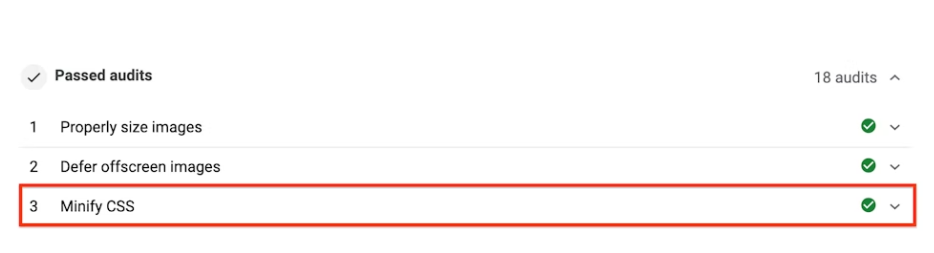
If web developers minify CSS files, you will see that recommendation “Minify CSS” moved to the “Passed Audits” section of the Lighthouse report.
Optimize JavaScript code
JavaScript code is a critical part of modern website design. On the other hand, using JavaScript code may slow down a website’s loading speed.
A web developer should analyze the Lighthouse report to fix JavaScript issues and speed up a website. There are most common issues and solutions.
First, the JavaScript code used on the website is a significant source of tasks. What is a task? A task is any discrete piece of work that the browser does and impacts the website’s performance. It can be rendering, parsing HTML and CSS, and running JavaScript code.
Some tasks can be too long (that take more than 50 milliseconds), and a web developer should break up such tasks. In other words, a web developer needs to divide a long task into smaller tasks that take less time using one of the task management strategies like the async attribute, manually defer code execution, yield only when necessary, and others. Choosing a strategy depends on the main website features you’d want to consider when managing tasks because it is about usability and how users interact with a website.
Minification JS code is another way to improve a website’s speed. To minify JS code a web developer should remove whitespace and any code that is not necessary to create a perfectly valid code file.
JS code compression is the process of modifying data using a specific algorithm. Most web developers use Gzip for server and client interactions, but Brotli is a newer compression algorithm that helps to achieve even better compression results than Gzip.
Also, we recommend using modern JavaScript to avoid reducing the website’s loading speed.
Modern JavaScript means syntax supported by all modern browsers such as Chrome, Edge, Firefox, and Safari. But using modern Java Script requires high-skilled web developers who have experience in advanced front-end and web app technologies.
Move a website to better hosting.
In some cases, the leading cause of slow website speed is hosting. A website owner must choose fast hosting to optimize the website’s performance.
Several solutions can be used to host a website.
Shared hosting is the most popular solution because it is cheap. But shared hosting means that you share the server’s CPU and RAM with many other sites that are also hosted on this server. If you need more RAM and CPU because your site attracts many visitors or use one of the modern frameworks, you need Virtual Private Servers (VPS) hosting or a dedicated server.
Virtual Private Servers (VPS) and dedicated servers are faster than shared hosting. VPS is fit needs of many business and e-commerce sites because it uses multiple servers for content distribution and provides your own part of the virtual server.
Using a dedicated server is the most expensive solution because you need to rent or buy a server and pay for the system administrator’s services.
Now alternative solutions are also available for website owners. You can use cloud solutions like Microsoft Azure, Google, or AWS. Cloud providers provide quality services that can scale on demand for your needs.
Another alternative option is the serverless approach.
Choosing a hosting provider is not easy but worth the effort.
Conclusions
Currently, a website’s loading speed is a vital factor that search engines assess, affecting website traffic and, as a result, business revenue.
You can test your website speed using one of the tools to know if improvements are needed. 89 score and below means your site’s performance needs to be improved. Image optimization and minification of CSS and JS can speed up a website. But as you can see, it is not an easy task.
Also, hiring skilled web developers who can write quality, optimized code is important. Because it is an almost impossible job to optimize a website that was created by low-skilled web specialists. Re-developing the website from scratch becomes easier, faster, and cheaper in this case.