Stories

October 25, 2023

SHARE:

For years, Cantonese Americans/Canadians like Sheldon Ho have struggled to learn Mandarin, feeling like existing language learning apps weren’t designed with them in mind.

Through the Canto to Mando Blueprint, there’s a solution that takes advantage of their existing Cantonese knowledge to help them master Mandarin in a fraction of the time.

The Canto to Mando Blueprint is the brainchild of Sheldon, who personally struggled for years with Mandarin learning. Not only has it helped countless Cantonese Americans reconnect with their Chinese culture, but it has also enabled them to learn more of their native tongue.

The success of this program speaks for itself – it has over 400 students and counting! It’s time for the world to take notice of this groundbreaking innovation in language learning. 

Read through as Sheldon shares more about his story and how the Canto to Mando Blueprint is changing the game for Cantonese Americans learning Mandarin.

FAILING TO LEARN CHINESE AS A KID

Growing up, I was really resentful of my culture.

I think having failed at learning Chinese as a kid made me detached from my Chinese culture and resent it. As a result, I grew up hating being Chinese and always felt it was uncool. It made me want to be “extra” Western. 

I would speak to my parents in English intentionally instead of Cantonese and as a result, my Cantonese became mediocre. I never realized this all came as a result of having failed Chinese as a kid but now that I’m older, I can see how things would have been different had I learned the language better when I was young. I would have learned more about my culture, and ancestors, and since the culture is naturally pretty cool, I would have definitely embraced it more.

AN ASIAN AMERICAN CHINESE LANGUAGE LEARNER’S PERSPECTIVE

The big thing plaguing the language learning industry is learning resources that are made for the mass market. I think that language learning businesses definitely cater to the mass market with good reason. ALL Americans Can benefit from one single Chinese learning resource made for English speakers. There’s a lot more money in that space because the market is a lot larger and they have the opportunity to help more people. Given that logic, there’s absolutely no incentive to make something for the Cantonese American market.

Another thing plaguing the language learning industry is having solely native speakers teaching the language. This is due to the curse of knowledge. It’s when you know too much in your brain and you can’t relate to your students as much anymore. They actually find it HARDER to learn from you. 

That’s why from an Asian American Chinese language learner’s perspective, I think representation is really important. I think having more Asian American teachers as opposed to pure Chinese teachers is really beneficial. 

When I was learning, all teachers were from China and while their Mandarin level was top-notch, there was a gap in their ability to relate to my struggles as a Chinese learner. This is because they have never been in my position as they grew up in a 100% Chinese environment. Employing techniques made for kids in China doesn’t work the same with us.

This is why most Asian Americans flunked out of Chinese school when they were kids. It’s made by native Chinese people who don’t understand the differences between the struggles of learning Chinese here in the West vs in China. In the same way, I also can’t relate to the struggles they may have faced learning English. I can confidently say that I’m probably not gonna be a good English teacher because I don’t understand the struggles ESL learners face. 

On the other hand, I understand very well what struggles Cantonese Americans may face when trying to learn Mandarin and improve their Cantonese. I literally went through all those struggles myself. I was the kid unable to write his own Chinese name.

THAT “YOU LOOK CHINESE BUT YOU CAN’T SPEAK CHINESE” MOMENT

I’ve tried countless times to learn Mandarin. I think I’ve had “I’m gonna learn Mandarin this year” as my new year’s resolution for like 10 years straight.

Each time I failed, I wasted MORE time but more importantly, it made me feel like more of a failure. I felt like maybe I was just too dumb to learn my language, maybe I was just too dumb overall. How many more tutors, apps, and university classes am I gonna waste time and money on?

I went through my lowest point when I was unable to talk to the family of the girl I was dating at the time. It was a really big “you look Chinese but you can’t speak Chinese” moment for me where I felt quite embarrassed.

It was a big mental hurdle that really messed with me. Things changed when I finally took time to think about how I could learn by leveraging my existing Cantonese. What if I just took my Cantonese and brought it over to Mandarin? Through an arduous process of figuring out how to do that, I finally learned Mandarin. 

Once I learned this, I realized how easy it is to learn this language for Cantonese speakers. I realized that we’ve been being taught wrong all our lives and that is the reason why we haven’t been able to learn. This motivated me to create this platform. I wanted to help Cantonese Americans finally get this Mandarin learning thing handled and hopefully through that, help them with embracing their culture.

CANTONESE AMERICANS ARE IN A WEIRD MIDDLE GROUND

I always felt that Mandarin was so hard to learn. It always baffled me that I was thrown into the same class as Craig, someone who had no Chinese background at all. 

I tried so many different learning apps and went to so many different Mandarin classes and tutors in college and it was ALWAYS the same. We always wasted WEEKS on basic stuff like “ni hao.” This felt stupid to me as a Cantonese person. I knew “ni hao.”

Cantonese Americans are in a weird middle ground. For the most part, we speak just enough Cantonese to have an advantage over people with no Chinese background – yet we can’t read Chinese, and aren’t good enough to take advantage of Mandarin resources meant for true native Canto people in Hong Kong which leverage your Cantonese. As a result, we have to stick with English resources made for white people.

So fundamentally, when setting up our program the only goal in mind was to create something for Cantonese Americans who can speak a little bit of Cantonese. We wanted to make something for the Cantonese American who spoke a little but couldn’t read or write Chinese. We’d teach them all the fundamentals while leveraging their existing Cantonese.

PLATFORMS MADE FOR PURE ENGLISH SPEAKERS CAN’T DO THIS

With our method, students improve their Cantonese while learning Mandarin. Most Cantonese speakers want to learn Mandarin but it’s also important to them that they improve in their heritage language. 

Because Mandarin and Cantonese have such similar structures – if you know how to leverage them, you can improve on both languages at the same time. This way, as your Cantonese gets better, so does your Mandarin, and vice versa.

Platforms made for pure English speakers can’t do this since they’re not made for Cantonese speakers. The next thing is the speed at which you learn. Our students start speaking literally from day 1 because we’re essentially just teaching you how to bring your Cantonese over to Mandarin in the beginning. 

There are a lot of tips and tricks that make things a lot faster. For example, the Cantonese ‘G’ becomes a Mandarin J about 80% of the time. This takes away a lot of the memorization work when it comes to learning Mandarin. 

So the main difference is just the speed of learning. It’s a lot faster. I don’t want to say the other apps or university courses don’t work because of course they do. But when you have to wait months for marginal results it’s really easy to get discouraged. That’s why we made it a PRIORITY to get people speaking from Day 1 so they see results right away.

SUCCESS STORIES

A large portion of our students happens to be in healthcare. There was this nurse who often felt ashamed at work. Chinese patients would reach out to her because she looked Chinese but when she couldn’t reply in Mandarin – she would feel sad for being unable to help her own people. This is what made her reach out to me and within the first couple weeks of doing the program, she shared with us how good it felt to be able to communicate with Chinese patients, and that was a big win. 

Another success story is about this girl who wanted to surprise her parents with her Mandarin. She started texting them on day one of the program, and it made them really happy.

But my favorite story is about one of our students who had been dating her Taiwanese boyfriend for 10 years. Each time she hung out with his family, it’d be in English. She would have very basic and shallow conversations with her boyfriend’s mom. Note that it’s been 10 years!

Recently, she told me that she had a full Mando conversation with her boyfriend’s mom and that she was so excited that she could finally speak Mandarin. If I could put it in her words, it was like the mom went from being almost mute to being the most talkative person in the world! Excitement grew on her face and she said “OMG I can take you to Taiwan now and show you everywhere!”

IT’S WHAT I WISH I HAD

What we have is a program and curriculum specifically designed for Cantonese Speakers to leverage their Cantonese (no matter what level) to learn Mandarin and improve their Cantonese. 

Along the way, we have tutors for support who are fluent in BOTH Cantonese, Mandarin, and English. From my experience, oftentimes, Mandarin tutors only speak one language. They speak Mandarin amazingly – but the lessons aren’t conveyed in the best way in English. They can’t convey certain concepts to English speakers. We make sure our tutors are able to do that, as well as in the Cantonese perspective. Lessons are all given with the Cantonese English Perspective in mind.

The truth is, in most cases, Mandarin tutors are overqualified in the wrong thing. Cantonese diaspora don’t need someone who studied classical chinese literature and classical chinese to teach them Mandarin. They just need someone who can speak good Mandarin, and understands how to convey that effectively in English to them.

We make sure our tutors have that. I took big a part in training our tutors on how to view things from a Cantonese-American perspective. 

I’ve been through the journey myself as a Cantonese Canadian who learned Mandarin. I pretty much know what each student will struggle with, where the pain points will be, and what type of questions everyone will have. I’ve poured that knowledge into the program and poured that knowledge into our tutors. 

An example is the simple understanding that Cantonese Americans can speak a little bit of Cantonese, but can’t read or write Chinese. How do you tailor-make something for that person? That’s what we sat down for months to figure out. It’s what I wish I had.

HOW THE COMMUNITY HAS RECEIVED THEM

The Cantonese American community has been really thankful to have something made for them.

A lot of people dealt with the same struggles I dealt with so I’ve received a lot of comments from people thanking our team for what we’re building as well. 

From the broader language learning community, there’s been a lot of intrigue about seeing a course that dives this deep into linguistics. We really dug into textbooks to find information like how Cantonese tones map to Mandarin and at what percentage. For instance, it’s really fascinating to know that you can map your Cantonese tones to Mandarin with about 80% accuracy. This means that Cantonese speakers can essentially skip memorizing Mandarin tones and still be right about 80% of the time. This is knowledge that takes YEARS off the Mandarin learning curve.

PROGRAM TAKEAWAYS

Three things that I hope users will take away from using our platform and learning Mandarin through our program:

  • How beautiful Chinese culture is and how great it feels to reconnect with it. If they can get a deeper sense of belonging and more interest in their roots, that’d be incredible.
  • A deeper love for Cantonese. Through our program, students will also improve their Cantonese. As they learn about the differences between Cantonese and Mandarin, they’ll see that Cantonese has its own writing system that makes it really unique. Through this, I hope they feel more pride as Cantonese speakers. I grew up resenting my Cantonese side because Mandarin is more popular – but ironically, as I learned more Mandarin, I grew to love Cantonese more and more.
  • A renewed sense of confidence in their ability to learn. A lot of people feel traumatized as kids because Chinese school was so ineffective. We feel that we’re failures because we couldn’t learn our native tongue and then make memes on subtle Asian traits to feel better about ourselves. I can confidently say that the way they teach Chinese in the West is not the best. I want to help people recover and feel better from that Chinese school trauma.

MANDO TO CANTO

I was surprised by how many Mandarin speakers are interested in learning Cantonese so I’m excited to share that the next big project we’re working on is Mando to Canto! We’re currently in the R&D phase.

CONNECT WITH SHELDON 

Instagram: @sheldonhoho
Related Articles

Image Source: Luis Sinco / Los Angeles Times

News, Stories

Enjoy Your Favorite Filipino Dishes Along With A Comedy Show at Eagle Rock’s Kusina Filipina

Big egg-shaped platters filled with famous egg noodle pancit, mouthwatering pork sisig, cold cans of beer, and blithe stand-up comic acts are offered as part of the restaurant’s unique dining experience.

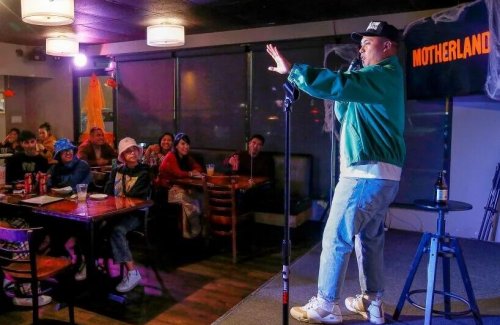
The brain behind the comedy events is Filipino-American C.J. Toledano, who was born with the background necessary for such lighthearted entertainment.

The Eagle Rock neighborhood of Filipino Americans is the ideal fusion in creating the weekly program that is so exceptionally Los Angeles.

The restaurant’s co-owners, Jun Miranda and Vener Ramos, greased the wheels to serve the dishes and beverages that the predominantly Filipino audience was clamoring for when actress and stand-up comedian Felicia Folkes performed.

Toledano recalled how the Wednesday show got started and said in the Los Angeles Times that Jun Miranda was all about it.

“He just said, ‘The restaurant is yours on Wednesday nights,” Toledano stated which was backed by Miranda saying “I immediately said yes. Of course, I wanted to help the Filipino community.”

Toledano, who co-hosts the program with Orolfo and Rob Haze, stressed that the event is not just for mutual benefit but that “I have a specific vision for the show and the comedians who do it. [I want] people I’m fans of,” he continued.

He added that the intensely vibrant, funky, and fatty flavors of Filipino cuisine at “Motherland”— including the crispy sisig,a deep-fried chopped pork belly flavored with a little of lemon juice, diced onion, bell pepper, ginger and, a little of chicken liver spread;  dinakdakan, a combination of grilled and boiled pork belly mixed with onions, peppers — and mayonnaise; chicken adobo with quail egg and fried potatoes; and halo-halo, among others—are just as electrifying as the acts on stage.

“I’m a Filipino guy who grew up in Pennsylvania. I didn’t have many Asian friends. So the show is really killing several birds with one stone — I’m in touch with a culture I was never close to. I’m seeing old friends. New comics. It’s exciting for me,” Toledano admitted.

116018653_728607294654083_6041310441211220664_n

Stories

Her Father Ignored Her For 8 Months When She No Longer Wanted To Be A Doctor

This may have happened to you (maybe not the musical writing part), or you may know someone from an Asian background who is currently struggling as their parents had strongly expected or already had chosen a job for them.

But how many of you have bravely rejected your parents’ desires, and followed your true passion? Take it from this courageous girl, Joy Regullano. You might remember her from the viral YouTube sketch called White Fetish, or various random acting gigs like the TV Series Crazy Ex-Girlfriend (her line was “Yeah, bitch!”) or Modern Family (with her line was “You fools!”).

That’s right, Joy is quite too far from wearing a white coat. She’s an actress, comedian, and writer — every Asian parents’ nightmare. So when she told her parents that she didn’t want to be a doctor anymore, her father didn’t talk to her for 8 months. Years later, she wrote a comedy musical about it, called Supportive White Parents.

“Working on this musical has been a major part of my healing journey (my parents are imperfect people who were just passing down intergenerational trauma) and maybe it can be part of yours too,” Joy expresses.

Read through as Joy shares how she has discovered her passion for comedy, and her journey to healing and acceptance through her musical.

MY WHOLE LIFE, I THOUGHT I WAS GOING TO BE A DOCTOR JUST LIKE MY PARENTS

My parents were born and raised in the Philippines. My dad grew up very poor in one of the provinces, but after scoring in the top percentage of all students across the country on an exam, he got a scholarship to a prestigious science high school in Manila that was all expenses paid. My parents met in medical school, and soon after graduating, they came to the US by way of New York. Eventually, they made their way across the country to Eagle Rock in LA and then Orange County, where I grew up. 

My whole life, I thought I was going to be a doctor just like my parents. I tried my best to be the perfect daughter. I got straight A’s and took piano lessons since I was 3 and violin lessons starting at 8. (Well, actually, I got one B+ in AP/IB Physics, but we don’t talk about that B+) I studied math outside of school at Kumon and played educational computer games because it was a productive use of my time. I read medical books my parents had lying around the house and had subscriptions to science magazines in high school, for fun.

But as I grew older, there was a part of me that was starting to love writing and making people laugh. For 7th-grade vocabulary exercises, I cared more about making my sentences funny than using the word right. My favorite part about English and Spanish group projects was writing the scripts and acting in them. I wrote bad high school poetry. But I didn’t think that was an acceptable thing to want to do with my life, so I shoved that part down, deep inside me. I did write for the school newspaper and compete in speech contests and debate teams, but that was about the extent of my (public) creative life. 

But as I grew older, there was a part of me that was starting to love writing and making people laugh.

-Joy Regullano

I LOVED FEELING LIKE I COULD MAKE THE AUDIENCE LAUGH AND CRY JUST BY TELLING AN HONEST STORY

I went to UC Berkeley pre-med and was planning to take over my dad’s clinic when he retired. But in the first semester of my freshman year, I got a B on my first math test and a C on my first chem test, and I panicked. After some soul-searching, I realized I wasn’t actually passionate about any of that and ended up cycling through a bunch of different majors before landing on Theater and Southeast Asian Studies.

I wrote a play in college about a friend who had passed away in high school, and when I put it up in front of an audience, I was hooked. I loved feeling like I could make the audience laugh and cry just by telling an honest story. Just by being myself. I wanted to do that for the rest of my life. I loved Tina Fey and Amy Poehler’s work so much that I couldn’t even watch them for a long time because it hurt that I wasn’t doing what they were doing. 

WHITE PARENTS: A MUSICAL INSPIRED BY MY LIFE

I wrote the book and the lyrics to a comedy musical called “Supportive White Parents” about an Asian girl who tells her parents she doesn’t want to be a doctor anymore, and when they’re disappointed, she wishes on a shooting star for supportive white parents. Eventually, she learns to love her Filipino parents for who they are. My friends Sam Johnides and Tony Gonzalez wrote the music.

The musical was inspired by my life. When I told my parents I didn’t want to be a doctor like them and take over my dad’s clinic, my dad yelled at me, called me selfish, and didn’t talk to me for 8 months. I was absolutely devastated, even though I knew that making people laugh and cry was what I had been put on this earth to do. 

I felt so jealous of my white theater classmates with their seemingly endlessly supportive white parents. And funny enough, they were jealous of me because I had something called “discipline”, played multiple instruments, and knew other languages. And thus, the seed of a musical was born.

Eventually, she learns to love her Filipino parents for who they are.

-Joy Regullano

LAUGHING AT OURSELVES CAN BE ONE OF THE BEST WAYS TO HEAL

There aren’t many Asian American musicals, let alone comedy Asian American musicals. One of my teachers says that comedy is the back door to the truth. I think that laughing at ourselves can be one of the best ways to heal, as well as realizing that we are not alone. 

We as a generation are going through this together, and also, we, as well as our parents, are the products of society and intergenerational trauma. We are all imperfect people who are trying the best we can with the tools we have. 

ACCEPTANCE IS THE QUICKEST WAY TO SANITY AND PEACE

I love the serenity prayer. There are some things that we can change, and we should do what we can to change those things. There are some things we can’t change, and it’ll drive you crazy trying to. You can’t control other people. You can only control yourself. The sooner you can accept other people are how they are, the sooner you’ll stop giving your energy away. 

Also, one thing I learned that blew my mind is that it’s actually not love, to wish that your parents or family were different than who they are. If what I was asking from them was to love me for exactly who I am, with all my imperfections, isn’t that what I should be giving them too? Unconditional love and acceptance? (That’s not to say that you shouldn’t have boundaries – that could be a whole other article.) But accepting things you can’t change is the quickest way to sanity and peace. 

If what I was asking from them was to love me for exactly who I am, with all my imperfections, isn’t that what I should be giving them too?

-Joy Regullano

It’s a daily practice. But try it! After reading “The Subtle Art of Not Giving a F*ck”, I tried to imagine that I only had one f– to give a day. How much energy would I be saving by only getting bent out of shape over the most important things!? I’m not really good at giving only one f– a day. But I’ll keep trying.

One more thing – some people need to be angry before they move to acceptance. I know I did, and I still feel angry sometimes. Accepting yourself and your feelings is part of the process too. Wherever you are in your journey is okay.

CONNECT WITH JOY

Instagram: @supportivewhiteparents @joyregullano

Twitter: @swpmusical @joyregullano

Website: www.supportivewhiteparents.com

Be on the lookout for the upcoming Supportive White Parent concept album, to be released in January 2023, with singles leading up to it! 

Image Source: Melissa Keomoungkhoun / Tatsu Dallas

News

Dallas Omakase Restaurant Makes Memorable Dining Experience For Deaf Couple With Staff Using ASL

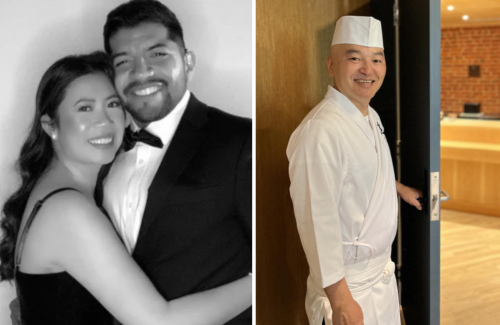
Victor Montiel and Melissa Keomoungkhoun were on the verge of tears as they expressed their gratitude to the Tatsu Dallas’ personnel for making their experience unforgettable.

The couple, who are both deaf, revealed in Today that they are used to getting ready in explaining themselves using their voices and American Sign Language, displaying texts from their phones, or even asking for pen and paper.

Melissa’s sister was worried that interaction with the staff would be difficult because she was aware that “omakase” means that diners receive meals that include foods chosen especially by the chef, which means more word-of-mouth discussion.

In advance of this, Melissa wrote Tatsu to inquire as to whether they could still enjoy the meal to its fullest without being able to hear the chef describe each course. She was shocked to learn that they had already gotten the tasting menu, which also listed the available drinks/cocktails, and that a complete menu will be available when they visited.

What surprised them more was the night of their reservation as they were greeted in American Sign Language (ASL) by the staff, including the Beverage Director who is the wife of the chef-owner.

Melissa was quoted saying that “With the staff signing at Tatsu, we didn’t feel left out even though it created some attention in the room.”

She also shared that they gazed in wonder at the excellent service that they received.

The excellent personnel and food service that Tatsu delivers to its guests were posted on Twitter by Melissa’s sister Nataly Keomoungkhoun, the online dining editor of D magazine. Her tweet received thousands of likes and retweets.

The chef-owner Tatsuya Sekiguchi, claims that when working in New York City, he had an encounter that solidified his resolve to always offer the best service he can, he stated “I believe that everyone and every day are unique.” He went on to clarify that his current objective is to just make every meal a special and memorable one.

In her tweet, Nataly put into words how Tatsu exceeded the couple’s expectations where they had the best experience possible.

Image Source: Michael Tran / FilmMagic file

News

Award-Winning Director Ang Lee To Direct Bruce Lee’s Latest Biopic With Son As Lead Role

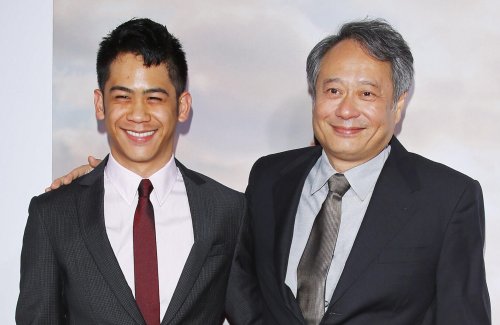
Multi-award-winning director Ang Lee is set to direct Bruce Lee’s latest biopic with his son Mason Lee playing the role.

The martial arts legend died young at 32 in 1973, a month before “Enter the Dragon,” the first Hollywood/Hong Kong film he co-produced, was set to premiere as mentioned in NBC News.

Since his passing, many biopics have been made like Dragon: The Bruce Lee Story, Bruce Lee: A Dragon Story, Bruce Lee: The Man, and many more.

And now, the Academy Award–winning director of “Brokeback Mountain” and “Life of Pi,” along with Lawrence Grey, Ben Everard, Brian Bell, and Shannon Lee, Bruce Lee’s daughter, will be directing and co–producing his newest biopic in honor of him as an actor, style icon, leader, and philosopher who brought martial arts to the global stage.

Ang’s son, Mason Lee, who is known for his roles in “Hangover Part II” and “Billy Lynn’s Long Halftime Walk,” will be playing the role.

“Accepted as neither fully American nor Fully Chinese, Bruce Lee was a bridge between East and West who introduced Chinese Gung Fu to the world, a scientist of combat and an iconic performing artist who revolutionized both the martial arts and action cinema,” Ang Lee was quoted saying.

He also said that he feels driven to share the story of this intelligent, singular human being who craved belonging, possessed incredible strength in a 135-pound frame, and through unrelenting hard work, converted impossible goals into reality.

Ang Lee is the first person of color to win the Oscar for best director and directed the 2000 martial arts film “Crouching Tiger, Hidden Dragon,” the highest-grossing foreign-language film in U.S. history. 

As an accomplished director, 12 of his 38 films which were nominated for Academy Awards won. 

Meanwhile, 3000 Pictures president Elizabeth Gabler said that Ang has long dreamed of directing Bruce Lee’s biopic, an inspirational tale of twists and turns, a story of the timeless premier real-life action hero.