Stories

July 4, 2023

SHARE:

In a time when the world seemed to close its doors, Los Angeles native and talented writer Kesia Eng found her inspiration for her  delightful children’s book titled “Baby Bao at Dim Sum.”

Kesia shares with Asian Hustle Network her motivation and experiences behind this captivating story that captures the essence of family bonds and the rich cultural heritage of East Asian cuisine.

Growing up, Kesia cherished her visits to dim sum restaurants with her family. The savory aroma, the clinking of chopsticks, and the joy of feasting on delicious food became the backdrop of countless treasured memories.

Dim sum not only brought her family together but also offered a window into her Chinese heritage, teaching her the values of respect, care, and love for others. Ultimately, these shaped her identity and inspired her to write this book.

The pandemic threatened to rob younger generations of the invaluable experiences Kesia cherished, making her determined to pass on the cultural significance of dim sum to kids and share it with others.

In her debut children’s book, “Baby Bao at Dim Sum,” Kesia beautifully weaves a tale that explores the importance of family, selflessness, and the joy of bonding over a delicious meal. This book serves as a tool for parents and children to read together, sparking meaningful conversations about the values embedded in East Asian culture.

Join us as we delve into the story behind “Baby Bao at Dim Sum” through an exclusive interview with Kesia Eng.

Dim sum helped me better understand and appreciate my parents and our Chinese culture. I think I can speak for many American kids who have immigrant parents: There aren’t a lot of things in common between our upbringing and theirs. But food is our shared connection.

Kesia Eng

KESIA’S INSPIRATION FOR WRITING “BABY BAO AT DIM SUM”

As with most recent creative endeavors, the idea for the book sprouted during the pandemic. Everything was closed. Schools were shut down. Sports games were canceled. Even my favorite Target store started closing at 8 p.m. The world truly was ending. But the most devastating thing? My beloved dim sum restaurants have stopped indoor dining.

I know it didn’t seem significant. There’s plenty of other food. Plus, we can still get takeout. But I grew up coming to these restaurants with my family. Going there was a real treat as a kid – taking in the savory aroma that fills the air, hearing the excited chatter and clinking of chopsticks all around you, and of course, feasting on all the varieties of delicious food. Every time I came back from college for the weekend, my parents would take me to eat dim sum – it was a huge part of our everyday life.

Most importantly, dim sum helped me better understand and appreciate my parents and our Chinese culture. I think I can speak for many American kids who have immigrant parents: There aren’t a lot of things in common between our upbringing and theirs. But food is our shared connection. Food isn’t just something you eat. When you look closely, the experience of dim sum is filled with the values of East Asian culture:

  • pouring tea for the oldest person at the table first, and your own cup last
  • serving food to others before yourself
  • keeping an eye on everyone’s cup so you can refill it for them
  • fighting to pay for the check (and never backing down, even if you have to chase down the waiter and force your Visa card into their hands) 
  • and so on

All of the above embody community-oriented respect, care, and love for others. It’s how my parents showed how deeply they loved our family, even through the mundane act of eating at a restaurant. When my mom saves the biggest and best dumpling for me, or when my dad reaches across the table to fill my teacup first, I know it’s because they love me. And it’s a way for me to show my love in return – pouring their tea first, giving the best dim sum piece to them, (and yes, now that I’m a post-grad adult, literally fighting to pay that check). It’s not just nostalgia – dim sum is an essential part of my heritage, shaping how I’ve grown up, who I am, and who I want to become.

With COVID, it seemed like the pandemic would take these valuable moments away from younger generations. To be honest, it made me sad because I didn’t want them to grow up without having that experience, and thus a practical understanding of their cultural background. It’s a learning moment I want to pass on to kids and share with other people too.

“BABY BAO IS ME”

Part of the reason why I chose to focus on the theme of family and selflessness is in reaction to a lot of Asian American stories today that center on the difficult relationships that kids have with their immigrant parents.

I think the current popular narrative sometimes pushes this idea of hyperindividualism; that it’s all about the self and what the self wants. I totally understand the heart behind where that narrative/story comes from but sometimes it can demonize our parents for being hateful because they don’t agree with everything we say or do what we expect. Granted, nobody is perfect. But I think it’s important to have empathy towards our parents who grew up in a different environment than we did. We can try to put ourselves in their shoes, imagine the upbringing they had, the hardships they went through, etc.

And to be honest, I wrote it because of my own revelation. Baby Bao is me. I wrote Baby Bao as myself because I definitely was not a self-sacrificial loving kid growing up. It wasn’t until college that I realized I had taken their love and care for granted. I think it’s easy for us to be selfish and maybe not consider what our parents would appreciate or how they care for us. They do love us, but maybe it isn’t expressed in the exact fashion we expect it to be. 

FULL CREATIVE CONTROL AS A SELF-PUBLISHER

I knew the route of traditional publishing was long and a bit arduous. I felt like there were many gatekeepers and I didn’t want the flow/speed of my project to be hindered because of it.

It kinda goes like this: after you do your due diligence on finding the appropriate literary agent, you have to keep cold-emailing them about your manuscript, hoping they’d want to support you and your book. And finally landing a literary agent could range from a few months to a few years. They’re the best resource to connect you to a traditional publisher who would get your book published. 

But why wait for someone to give me the green light when I could just get my book out directly to the audience? I like to think I have an entrepreneurial spirit , because when I really believe in something, I don’t want to wait for someone to give me approval to do it. I just want to go for it. So I decided to self-publish my idea.

I think what’s truly unique about this book is that the illustrations are not 2D animated artwork that’s common in picture books. I can’t draw to save my life and I didn’t have enough funds to hire an illustrator, so I brainstormed ways to figure out how I was going to make the visual part of the story come to life.

While rummaging through my bookshelf, I found an old book my parents bought when I was young, that taught simple Chinese words. The front cover looked so interesting to me – it was a claymation of a girl. That basically spawned the idea of using claymation/”stop-motion” as the illustrations of the book.

I made all the sets, characters, and mini items by hand with lots of construction paper, cardboard, and other materials. I then taught myself product lighting, photography, and photo editing. I also run all the social media accounts. And this is in addition to writing the story myself, so it was truly a one-woman production.

Fun fact: I gave my book to Netflix Bling Empire’s Christine Chiu!

WHAT KESIA HOPES THAT READERS WILL TAKE AWAY

If I can narrow it down to just 3 takeaways I hope parents and children get out of this book, it’s that (1) family is important (2) loving others often requires self-sacrifice but is definitely worth it and (3) dim sum is an avenue we can use to love and cherish our families more!

I wanted parents and their children to think deeply about the message together. And that desire played a huge part in why I decided to deliver that through the form of a children’s book. I think the nature of children’s books often necessitates parent-child bonding because parents often read to their kids who aren’t strong independent readers yet.

So the book, “Baby Bao at Dim Sum” is a great opportunity for parents to bond with their cute kiddos just by reading it together. It also leads parents to talk through the story more with their children by mentioning the cultural values of it, going over the universal value of family, and asking them insightful questions about what they learned or what they noticed. 

DIVERSITY AND REPRESENTATION IN CHILDREN’S LITERATURE

I’m seeing a lot of great Asian American children’s books recently and I envision “Baby Bao at Dim Sum” adding depth to the representation of the Asian American experience in children’s literature.

The book shows that parents and/or family relatives ought to be given importance as well.

Additionally, the book does a great job showing and not just telling how the cultural values common in East Asian culture (community-oriented respect, care, and love for others) are embedded into the subtle actions (pouring tea for the oldest person at the table first and your own cup last, serving food to others before yourself, and keeping an eye on everyone’s cup so you can refill it for them) during a traditional Chinese meal.

Representation is showing the authentic experience of something, and I think showing chicken feet, regardless of people’s initial reaction to it, is an important unfiltered experience of dim sum. So I made it a mission for myself to include the chicken feet dish in my children’s book (right on the first page) because it’s an iconic Chinese cultural food. I think just because it’s different from what most people outside of the culture may see, it doesn’t make it weird or gross. Walk into a dim sum restaurant and you see it on the tables of so many diners.

I hope the story is an easy and welcoming way for people unfamiliar with East Asian culture, to learn about it and get a glimpse of what really goes on during an authentic Chinese meal of dim sum. Additionally, I think it’s a perfect book for East Asian families to personally connect with those experiences and pass them down to younger generations. 

It really warms my heart to see so many parents message me that their little ones love the book, want to read it every night with them, or want to eat dim sum because of it. Seeing those comments and messages never gets old!

UPCOMING PROJECTS

I drafted several storylines for the next potential “Baby Bao” adventure, and have whittled it down to two options. I can’t reveal when this project is going to be done just yet, but it’s in the works! Many of my readers have expressed that they’d love to see more of Baby Bao, so I’m happy to continue working on more stories with him as the protagonist.

In terms of other work, I’m actually in the process of finalizing a manuscript for my next writing project: a satirical poetry book about early adulthood! I enjoy comedy and I enjoy satire, so of course, I had to try writing with that flair. The book is a witty take on young adult life and pokes fun at relatable moments we experience in careers, friendships, and love. Final touches are being added. Release date TBA but aiming for before this fall season. 

Readers can expect that I’ll be pursuing different writing projects because I want to build upon my writing skills and flex my creative muscle. I think I have a knack for knowing my audience well and crafting stories that are relatable to all of us on a human level. So I’m really excited to continue exploring various story ideas and styles of writing to see what I’m the best at and produce work that my readers would love.

CONNECT WITH KESIA / BABY BAO AT DIM SUM

Instagram: @babybaoatdimsum

Tiktok: @babybaoatdimsum

Amazon: BUY HERE

Email: babybaoatdimsum@gmail.com

Website: kesiaeng.com
Related Articles

How CMS Development Services Can Save You Time and Money

Development

How CMS Development Services Can Save You Time and Money?


Are you finding it hard to balance growing your business while managing your website? When you’re focused on scaling, the task of maintaining an up-to-date website can quickly become overwhelming. From marketing campaigns to team management and customer satisfaction, your plate is full. On top of that, your website—a core part of your digital presence—requires constant updates and attention. This is where CMS development services come in. They simplify website management, saving you time and cutting costs. Think of a Content Management System (CMS) as your virtual assistant, helping you organize, edit, and scale your website effortlessly without needing a developer at every turn.

By partnering with experts like AHN Group, you can ensure your CMS is tailored to your unique business needs. In this blog, we’ll explore how CMS development services streamline your processes, reduce expenses, and set your business up for long-term success.

What Are CMS Development Services?

CMS development services are focused on creating and customizing a Content Management System to meet the specific needs of your business. These services typically include:

Platform Selection: Choosing the right CMS (e.g., WordPress, Joomla, or Drupal) based on your goals.

Designing a User-Friendly Interface: Ensuring that the CMS is intuitive and easy to navigate.

Integrating Plugins & Tools: Adding necessary functionalities, such as SEO, social media sharing, or e-commerce.

Security & Scalability: Making sure your CMS is secure and can grow with your business.

By partnering with a professional web development company like AHN Group, you can create a CMS solution that is efficient and user-friendly for your team.

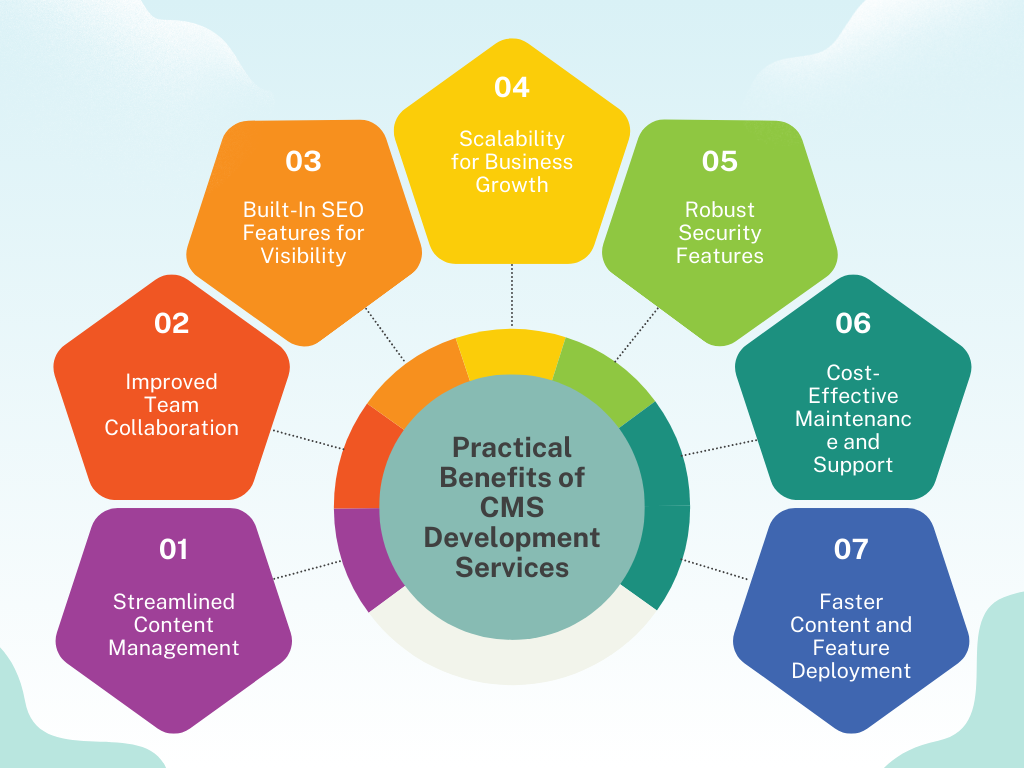
The Practical Benefits of CMS Development Services

Now that we’ve explored what CMS development services are, let’s dive into the specific benefits they offer your business. Each of these advantages helps save time, cut costs, and streamline your website management.

    1. Streamlined Content Management

    A CMS makes website updates simple, even for non-technical users. Whether adding a blog post, updating product descriptions, or changing images, you can do it all in just a few clicks.  

    Key Benefits:  

    • Instant Updates: Add or edit content whenever needed.  
    • Lower Costs: Reduce reliance on developers for routine changes.  
    • Ease of Use: Intuitive design makes it accessible for everyone.  

    With the right services, your platform will be tailored for efficiency, allowing you to focus on growing your business instead of worrying about website maintenance.  

      2. Improved Team Collaboration

      A CMS fosters teamwork by enabling multiple users to work on the website simultaneously. Departments can have distinct roles—marketing can post blogs while sales updates pricing—all without stepping on each other’s toes.  

      How It Helps:

      • Assign roles and permissions for better workflow.  
      • Reduce miscommunication between teams.  
      • Save time by centralizing content updates.  

      By using a professionally developed CMS, you ensure a smooth, collaborative process for all teams.

        3. Built-In SEO Features for Visibility

        Most CMS platforms come equipped with SEO tools to improve your website’s search rankings. From optimizing keywords to managing meta descriptions, these features are essential for driving organic traffic.  

        With CMS Development Services, You Can:

        • Automate key SEO tasks like creating XML sitemaps.  
        • Optimize for mobile responsiveness.  
        • Ensure page speed and performance are up to standards.  

        A web development company like AHN Group can fine-tune these features, helping you attract more visitors without spending heavily on paid ads.  

          4. Scalability for Business Growth

          Your business is evolving, and your website should keep up. A CMS lets you easily add new features, pages, or integrations as needed.  

          Why It Matters:

          • Avoid expensive website overhauls.  
          • Seamlessly add e-commerce or customer support portals.  
          • Stay competitive with the latest tools and trends.  

          With a scalable CMS, your website can grow alongside your business, saving you both time and future expenses.  

            5. Robust Security Features

            Cybersecurity is a top priority in the competitive digital market. CMS platforms offer built-in features to protect your website from potential threats.  

            Key Security Features Include:  

            • Automatic software updates.  
            • Two-factor authentication for added protection.  
            • Regular backups to safeguard your data.  

            When you partner with a web development company, they ensure these features are properly configured, giving you peace of mind without additional costs.  

              6. Cost-Effective Maintenance and Support

              Maintaining a website doesn’t have to drain your resources. A CMS automates many routine tasks, such as updates and security patches, reducing the need for constant technical support.  

              How CMS Saves on Maintenance:  

              • Handle basic updates yourself.  
              • Reduce dependency on external developers.  
              • Ensure smooth operation with automated processes.  

                7. Faster Content and Feature Deployment

                In a fast-moving digital world, agility is key. A CMS allows you to quickly adapt to market trends, deploy new content, and introduce features without delay.  

                Advantages: 

                • Speedy response to customer demands.  
                • Stay ahead of competitors by implementing updates faster.  
                • Save time by automating repetitive tasks.  

                This agility enables you to stay relevant and cost-effective in your industry.

                Why Choose AHN Group For Your CMS Needs?

                At AHN Group, we specialize in delivering tailored CMS development services that save you time and money. Our team works closely with you to:  

                • Understand your unique business needs.  
                • Develop a CMS that’s secure, scalable, and easy to use.  
                • Provide ongoing support to ensure optimal performance.  

                When you choose us, you’re not just getting a CMS—you’re gaining a partner dedicated to your success.  

                Conclusion

                If you want a website that feels like a trusted partner, AHN Group is here to help. We don’t just offer CMS development services—we provide tailored solutions designed to meet your business goals. As a leading web development company, we ensure your CMS is not only efficient and user-friendly but also a powerful tool for sustainable growth.

                It’s time to take the stress out of website management and focus on what matters most: scaling your business.

                Contact AHN Group today, and let’s create a website that works as hard as you do!

                graph-made-with-white-small-cards-jpg

                Ideas

                How much do web development services cost in 2025?

                Are you looking to build a new website or revamp an existing one in 2025? One of the first things to consider is the cost of web development services. The price can vary greatly depending on several factors, from the development team’s location and experience to the project’s complexity and scope. In this article, we’ll take a closer look at the average hourly rates for web development services in 2025, the factors that can affect the cost of a website project, and some tips for budgeting for ongoing maintenance and support. So, let’s dive in and find out exactly how much you can expect to pay for web development services in 2025.

                The Average Hourly Rates for Web Development Services in 2025

                In 2025, the average hourly rate for web development services can range anywhere from $20 to $150 per hour, depending on the development team’s location, their experience level, and the specific technologies and tools required for the project.

                Ukraine, Poland, and Belarus are some of the best countries to hire offshore developers. These countries offer some of the most affordable hourly rates for web development services, ranging from $20 to $50 per hour.

                In addition to the location of the development team, the specific technologies and tools required for the project can also affect the hourly rate for web development services. For example, developers with expertise in more specialized technologies such as React JS or Node JS may have a higher hourly rate than those with expertise in more standard and widely-used technologies such as PHP or HTML/CSS.

                The Cost of a Website Project: Basic vs Complex

                Basic websites, also known as informational websites, are typically smaller in scope and are designed to provide basic information about a company or organization, such as contact information and a list of services. These types of websites can often be built for as little as $1,000 to $5,000.

                On the other hand, complex websites are typically larger in scope and may include features such as e-commerce functionality, custom databases, and advanced user interfaces. These types of websites can often cost anywhere from $5,000 to $50,000 or even higher, depending on the specific requirements and features included.

                When determining the cost of a website project, it’s essential to consider the specific needs of your business and the types of features and functionality necessary for your website to succeed. While a basic website may be sufficient for some companies, others may require a more complex solution to meet their needs fully.

                Savvy Strategies for Cutting Costs on Web Development in 2025

                Web development can be a significant expense for any business, but there are ways to save money without compromising on quality. Here are 6 tips to help you cut costs when developing a website or application.

                1. Have a clear plan and scope of work: Define your project’s requirements, goals, and objectives before beginning development. This will help you identify the features and functionalities that are essential to your project and avoid unnecessary costs. I recommend you write a web design brief which is a document that outlines the specifics of a website design and development project.
                2. Use open-source software: Leverage open-source software, such as WordPress, Joomla, or Drupal, to reduce the development cost.
                3. Outsource to a cost-effective location: Outsourcing web development to countries such as Ukraine or Poland can be cost-effective and save you money on development costs.
                4. Use pre-designed templates and themes: Using pre-designed templates and themes can save you time and money on design costs.
                5. Avoid customizing unnecessary features: Only customize features that are essential to your project. Customizing unnecessary features will add to development costs.
                6. Use a project management tool: Using a project management tool to keep track of progress and timelines can save you money on development costs.

                Factors That Affect the Cost of Web Development Services

                Here are 8 factors that can affect the cost of web development services:

                1. Location of the development team: The cost of living and average wages in a given location can affect the hourly rate for web development services. Generally, web development services in countries with a higher cost of living, such as the US and Europe, tend to be more expensive than those in countries with a lower cost of living.
                2. The development team’s level of experience and expertise: Developers with more experience and expertise may charge a higher hourly rate for their services. On the other hand, full-stack web developers can spend less time on a project and provide more quality services that are essential for enterprise web projects.
                3. Specific technologies and tools required for the project: Projects that require specialized knowledge and experience in certain programming languages or frameworks may have a higher hourly rate compared to those that use more common and widely-used technologies.
                4. Project complexity and scope: The complexity and scope of the project can affect the amount of time and resources required to complete it, which can, in turn, affect the cost.
                5. Design and branding: The cost of web development services can be affected by the cost of design and branding elements, such as the cost of creating a custom logo, selecting color schemes and layouts, and other visual elements that are unique to the project.
                6. Third-party integrations: The cost of web development services can be affected by the cost of integrating third-party tools or services, such as payment gateways, analytics, and other features that are not included in the core development services.
                7. The level of customization required: Customized solutions will require more time and resources to develop, resulting in higher costs.
                8. The need for SEO and marketing: Implementing an SEO strategy and a marketing plan can add to the development costs. This may include optimizing website structure, content, and meta tags for search engines, building backlinks, developing an ongoing content marketing strategy to improve search engine rankings, and developing a marketing strategy to increase visibility and attract users to the website.

                Budgeting for Ongoing Maintenance and Support in Web Development Services

                Website maintenance is essential to keeping your online presence up to date and running smoothly. The cost of website maintenance can vary greatly depending on your website type and the level of maintenance required. In this case, we will explore the different types of websites and the corresponding maintenance costs you can expect to incur.

                1. Basic websites: These are simple websites that typically consist of a few pages, such as a home page, about us page, and contact page. The maintenance cost for these types of websites is usually low, averaging around $30 to $50 per month.
                2. E-commerce websites: These types of websites allow customers to purchase products or services online. The cost of maintenance for e-commerce websites is typically higher than basic brochure websites, averaging around $50 to $100 per month.
                3. Custom websites: Custom websites are tailored to a specific business or organization and often require more complex features and functionality. The cost of maintenance for custom websites can range from $100 to $200 per month.
                4. Content Management System (CMS) websites: CMS websites are built using platforms such as WordPress, Joomla, and Drupal. The maintenance cost for these types of websites can range from $50 to $100 per month.
                5. Social media websites: Websites that are focused on social media interactions, such as forums and message boards, require regular updates and maintenance to keep content fresh and users engaged. The maintenance cost for these types of websites can range from $50 to $150 per month.

                It is important to note that these costs are approximate and can vary depending on the specific needs of your website. Additionally, getting a quote from a website maintenance company is always recommended before committing to a contract. By understanding the different types of websites and the corresponding maintenance costs, you can make an informed decision when it comes to maintaining your online presence.

                Sum up

                In conclusion, the cost of web development services can vary greatly depending on several factors, including the development team’s location and experience, the project’s complexity and scope, and the specific technologies and tools required. In 2025, the average hourly rate for web development services can range anywhere from $20 to $150 per hour. Basic websites can often be built for as little as $1,000 to $5,000, while complex websites can cost anywhere from $5,000 to $50,000 or even higher. 

                To save money on web development costs, businesses can consider outsourcing to cost-effective locations, using open-source software and pre-designed templates and themes, and avoiding customizing unnecessary features. It is also essential to have a clear plan and scope of work before beginning development and use a project management tool to keep track of progress and timelines.

                Stopwatch on laptop keyboard. Deadline concept.

                Technologies

                How to improve the website loading speed

                Many people know that improving the website loading speed by 0.5 sec is invisible to the users. But it’s still one of the essential search engine factors they use in their ranking algorithms. Also, many web users may use a slow Internet connection, even in the USA and Europe. That is why improving website loading speed is a high-priority task for web development teams. How to improve the website speed?

                What is website speed?

                Technically the term website loading speed is incorrect because it is about page loading speed. 

                In short, website loading speed refers to how quickly the content and UI elements of the specific page load when a user visits it. 

                Several factors can influence specific page speed: 

                • The amount and size of the images and videos are contained on the page
                • UI animations
                • Themes and plugins are installed on the site
                • Front-end and server-side technologies are used
                • The code quality
                • Hosting or server

                But you must know that the user’s Internet connection also affects the web page speed.

                Start with website speed testing

                You may start the website speed test with your smartphone and mobile Internet connection. Does your site load quickly enough? Does your site look mobile-friendly? This test helps you to identify critical speed issues and how responsive the design of your website is.

                But using a smartphone test can’t tell about a website’s score in terms of the website loading speed. Also, it can’t help to identify the causes of slow website loading. That is why you should use tools to test and measure your website’s loading speed.

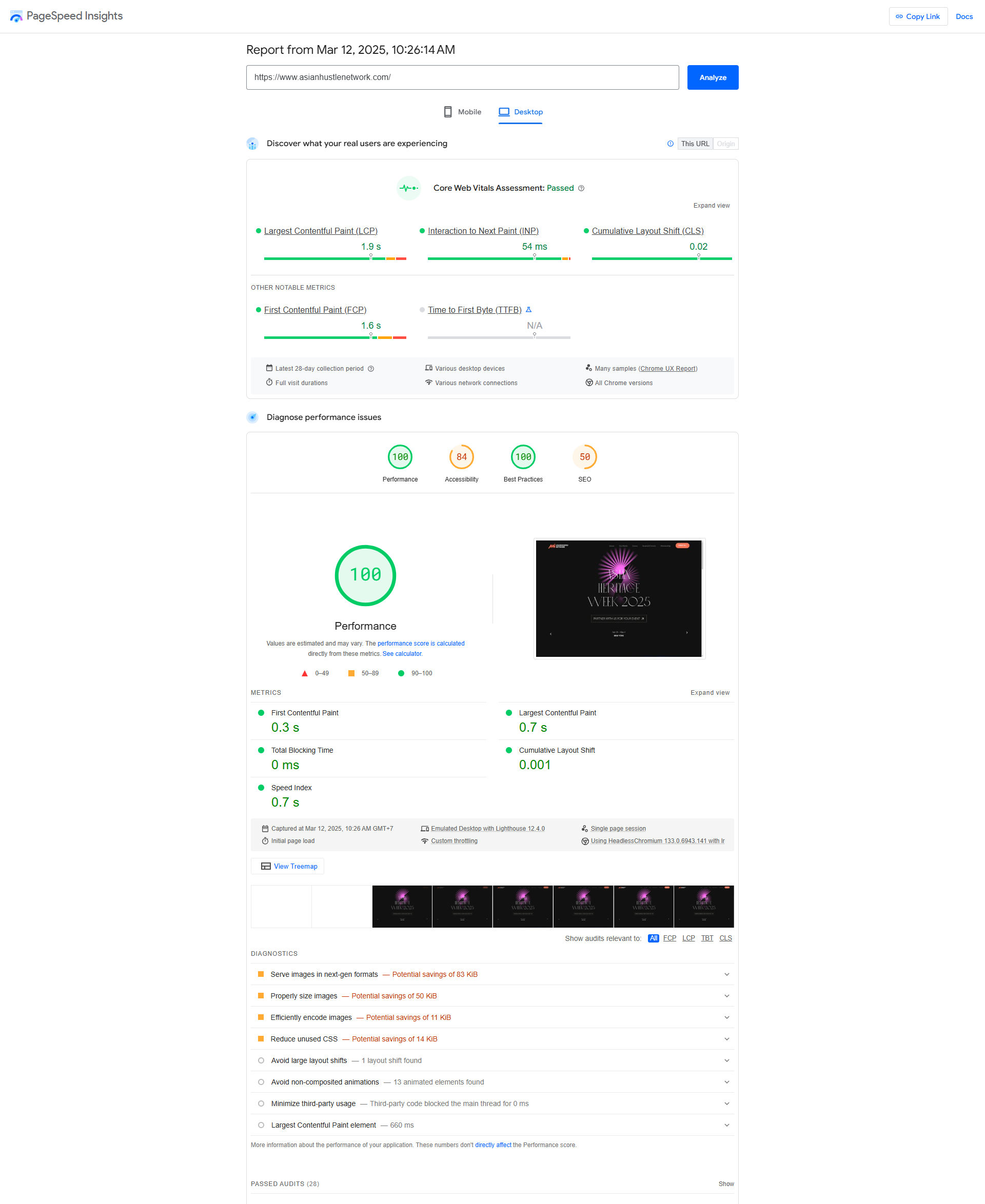
                The most used tool is Google Pagespeed Insights. It is easy to use and provides you with the most critical information. Look at the snapshot for our website.

                AHN’s team developed this site. You can see good scores and no critical issues that could affect the website loading speed.

                If Google Pagespeed Insights identifies issues, it will provide recommendations for increasing the website’s performance.

                This free tool allows testing the site’s mobile and desktop versions. You can use the Lighthouse tool that is built-in Chrome browser—Press F12 to run web developer tools and choose the Lighthouse tool to test the page.

                Also, web developers may use other tools like GTmetrix, Pingdom, or Performance Budget Calculator. 

                Some tools are free, but other tools can be payable. Many web professionals use Lighthouse and Core Web Vitals reports because it is usually enough.

                Guidelines to improve the website loading speed

                The Lighthouse tool (Google Pagespeed Insights) assessed your site as poor (score is less than 50) or as a website that needs improvements (score from 50 to 89). A web developer must look at the tool’s recommendations and fix issues. 

                This guide will help you to understand which factors influence website speed and how to increase it.

                Optimize the images

                Surprisingly, images are one of the most common issues affecting website loading speed. The main reason is that content managers do not pay attention to the size and format of the images when uploading them to the website.

                There is a typical image optimization process.

                Reduce the image size.

                Photos, images, or graphics on the web pages improve engagement. But if you use large files, the images slow down a website.

                Compressing images using tools is one way to reduce image size without affecting quality. Another way to reduce the image size is to adjust the image size based on user display properties.

                Choose the right image format.

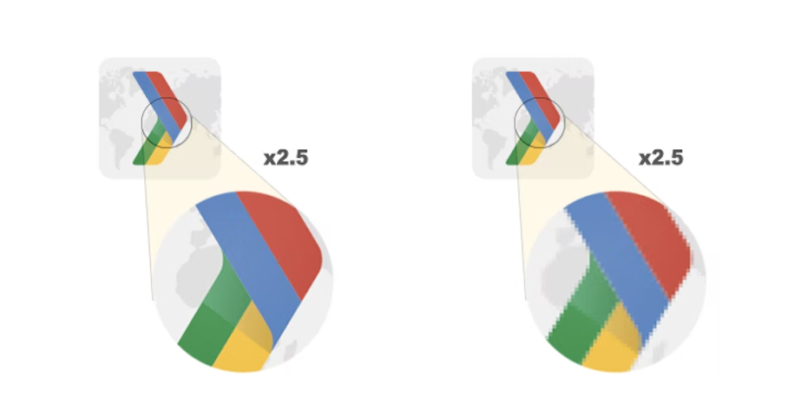
                Look at this image. It shows the difference between a zoomed-in vector image L and a raster image R.

                As you can see, vector images are preferable options as they are resolution-independent and always deliver excellent results.

                If you use raster images, a web developer should serve different image sizes to other devices. But bear in mind that serving desktop-sized images to mobile phones can use 2–4x more data than needed.

                Use WebP images

                When Facebook switched to WebP, they noticed a 25-35% filesize savings for JPEGs and an 80% for PNGs.

                How to convert images to WebP? Usually, web developers use the cwebp command-line tool (for simple projects) or the Imagemin WebP plugin(for complex projects).

                Replace animated GIFs with video.

                GIFs aren’t a good choice when you need a fast website because their size can be 10-15 MB.

                It takes a lot of time to upload a GIF file. That is why web professionals convert GIFs into video files (MPEG or WebM).

                Use image CDNs to optimize images.

                Image content delivery networks (CDNs) specialize in transforming, optimizing, and delivering images. They are excellent at optimizing images and can yield a 40–80% savings in image file size. Image CDNs work like API, making it easy to create variations of an image for different use cases by indicating parameters like size, format, and quality.

                Use lazy loading

                Lazy loading is a technique that defers the loading of non-critical resources while the web page loads. In practice, the image lazy loading loads lightweight placeholder images at page load and replaces them with lazily-loaded images when they’re scrolled into the viewport.

                Using lazy loading makes sense if you use many media files on your site.
                Web developers can use a variety of ways to implement lazy loadings, such as browser-level lazy loading, Intersection Observer (JavaScript), or CSS. If your website is built on WordPress, you can use plugins.

                Use a Content Delivery Network (CDN)

                Content delivery networks (CDNs) improve site performance using web servers distributed across various locations. These servers retrieve content from the website server and provide website content to users with regard to their location. CDNs reduce server load and handle traffic spikes. 

                Also, CDNs allow caching resources on their servers. As a result, the resources are delivered more quickly. Cashing also reduces the load on the website server.

                To choose a good CDN, you should focus on its performance, security, analytics features, support, and pricing. 

                You need to know that CDN performance can vary significantly depending on geography, time of day, and different events. That is why predicting the exact performance you’ll get from a CDN is difficult.

                Choosing a good CDN depends on the type of your site (e-commerce, corporate website, blog), user locations, and your budget.

                Prioritize loading resources

                Not every website resource has the same degree of importance, which is why browsers attempt to make a guess at the most important resources to load first. The problem is browsers could use the wrong priority for website resources. For example, loading scripts before CSS.

                Web developers can use different ways to influence browsers’ priority-making process.

                If a web developer adds the <script> tag in the page’s <head>, Chrome will load at a high priority. But using the async attribute changes it to low priority.

                Also, a web developer can use <link rel=”preload”> (informs the browser that a resource should start getting fetched as soon as possible), <link rel=”preconnect”> (informs the browser that you’d like the process to start as soon as possible), and <link rel=”prefetch”> (it tries to make something non-critical happen earlier if there’s a chance) for other resources.

                To make everything right, a web developer should know the browser’s priority for each resource. For example, to know Chrome’s priority, you need to press F12 to run DevTools and find the Network panel.

                These priorities help to understand how much relative importance the browser attributes to resources. A web developer can influence the browser to assign a different priority. For example, if an image is a part of the initial render, a web developer prioritizes it higher than an image that starts offscreen.

                Optimize CSS code

                CSS code must be loaded before the browser renders the website page because it is a render-blocking resource. If these web pages contain unnecessarily large CSS code, it takes longer to render them.

                There are two main techniques that web developers use.

                The first is deferring non-critical CSS. Many non-critical styles apply to content that’s not immediately visible, for example, paragraphs inside the accordions. A web developer can defer this non-critical code.

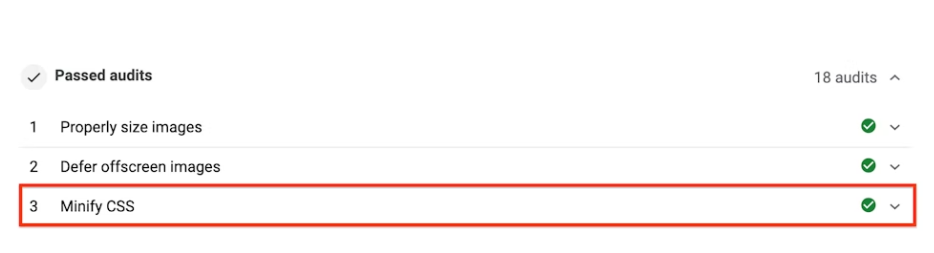
                The second is minifying CSS. Minification CSS files is a technique that reduces unnecessary code, comments, whitespaces, and indentation in CSS files. A professional web developer can safely remove unnecessary characters and reduce CSS file size without affecting website rendering. 

                If web developers minify CSS files, you will see that recommendation “Minify CSS” moved to the “Passed Audits” section of the Lighthouse report.

                Optimize JavaScript code

                JavaScript code is a critical part of modern website design. On the other hand, using JavaScript code may slow down a website’s loading speed.

                A web developer should analyze the Lighthouse report to fix JavaScript issues and speed up a website. There are most common issues and solutions.

                First, the JavaScript code used on the website is a significant source of tasks. What is a task? A task is any discrete piece of work that the browser does and impacts the website’s performance. It can be rendering, parsing HTML and CSS, and running JavaScript code.

                Some tasks can be too long (that take more than 50 milliseconds), and a web developer should break up such tasks. In other words, a web developer needs to divide a long task into smaller tasks that take less time using one of the task management strategies like the async attribute, manually defer code execution, yield only when necessary, and others. Choosing a strategy depends on the main website features you’d want to consider when managing tasks because it is about usability and how users interact with a website.

                Minification JS code is another way to improve a website’s speed. To minify JS code a web developer should remove whitespace and any code that is not necessary to create a perfectly valid code file.

                JS code compression is the process of modifying data using a specific algorithm. Most web developers use Gzip for server and client interactions, but Brotli is a newer compression algorithm that helps to achieve even better compression results than Gzip.

                Also, we recommend using modern JavaScript to avoid reducing the website’s loading speed.

                Modern JavaScript means syntax supported by all modern browsers such as Chrome, Edge, Firefox, and Safari. But using modern Java Script requires high-skilled web developers who have experience in advanced front-end and web app technologies.

                Move a website to better hosting.

                In some cases, the leading cause of slow website speed is hosting. A website owner must choose fast hosting to optimize the website’s performance.

                Several solutions can be used to host a website.

                Shared hosting is the most popular solution because it is cheap. But shared hosting means that you share the server’s CPU and RAM with many other sites that are also hosted on this server. If you need more RAM and CPU because your site attracts many visitors or use one of the modern frameworks, you need Virtual Private Servers (VPS) hosting or a dedicated server.

                Virtual Private Servers (VPS) and dedicated servers are faster than shared hosting. VPS  is fit needs of many business and e-commerce sites because it uses multiple servers for content distribution and provides your own part of the virtual server.

                Using a dedicated server is the most expensive solution because you need to rent or buy a server and pay for the system administrator’s services.

                Now alternative solutions are also available for website owners. You can use cloud solutions like Microsoft Azure, Google, or AWS. Cloud providers provide quality services that can scale on demand for your needs.

                Another alternative option is the serverless approach.

                Choosing a hosting provider is not easy but worth the effort.

                Conclusions

                Currently, a website’s loading speed is a vital factor that search engines assess, affecting website traffic and, as a result, business revenue.

                You can test your website speed using one of the tools to know if improvements are needed. 89 score and below means your site’s performance needs to be improved. Image optimization and minification of CSS and JS can speed up a website. But as you can see, it is not an easy task. 

                Also, hiring skilled web developers who can write quality, optimized code is important. Because it is an almost impossible job to optimize a website that was created by low-skilled web specialists. Re-developing the website from scratch becomes easier, faster, and cheaper in this case.

                1image3-jpg

                Stories

                Cheryl Mainland on Making Chinese Cool and Empowering the Next Generation

                “Over time, I realized that speaking and understanding Chinese wasn’t just a ‘useful skill’—it is my superpower and key to belonging,” says Cheryl Mainland, Founder & CEO of Dragon Academy. Her fluency in Chinese has been a source of identity and has played a key role in her journey—from understanding her cultural heritage to excelling at Harvard in East Asia Studies and negotiating successful global business deals.

                Recognizing the power of language to bridge cultures and connect with 1.3 billion native Chinese speakers, Cheryl is now committed to creating an engaging and interactive multi-media platform for children and adults worldwide to learn Chinese through Dragon Academy.

                At its core, Dragon Academy is an epic tale of nine multicultural teens journeying through six mystical realms brimming with ancient legends, mythical beasts, and dragons – all united in a quest to bridge worlds. This story is told across multiple media formats and channels, including a book series, social media content, an AI animation series, and other cultural initiatives. Complementing their adventure is a highly gamified app that transforms Chinese language learning into an exciting, immersive, (and even addictive) experience.

                A mother of three, serial entrepreneur, lifelong adventurer, and avid surfer, Cheryl has become an inspiration to many. She has been featured in top media outlets such as The Wall Street Journal, Financial Times, Vogue, Tatler, WWD, and numerous other prestigious publications.

                Cheryl Mainland, Founder & CEO, Dragon Academy (Image Source: Samanta Katz)

                The Struggle of Language and Identity

                Cheryl embodies the essence of a third-culture kid. Born in Taiwan, she is half-Chinese, half-American, and raised across Asia, she navigated the complexities of identity, language, and belonging from an early age.

                Cheryl with her maternal and paternal grandmothers Taipei, Taiwan, 1983 (Image Source: Cheryl Mainland)

                “Like many of us, I grew up straddling two worlds. The ultimate translator of languages, cultures, generations.  I carry with me the collective memory of (boring) Saturday Chinese school, the struggle of keeping up with my Chinese lessons, and the challenge of celebrating my heritage while forging my own path,” Cheryl says. “After having kids, I witnessed their similar struggles – nothing has changed.” She recognized that the traditional methods of learning Chinese – endless hours of copying hanzi characters on square grid paper (田字格) – have experienced minimal change over the centuries, relying on rote memorization rather than engagement.

                Not wanting her children to face the same language learning struggles she faced (and hundreds of thousands of other Chinese learners), Cheryl is embracing this as an opportunity to spark a cultural movement that breathes new life into the Chinese language and culture. Dragon Academy’s strategy ignites a passion for learning through an epic narrative delivered via a highly gamified app, an AI mini-series, a book series, social media content, and a future film adaptation. Each of the multimedia platform components captures the story-based enthusiasm, teaching Chinese through nine proprietary building block methods that make learning Chinese fun, engaging, and truly relevant.

                Dragon Academy Universe: the foundation of a highly gamified Chinese language learning app, book series, cartoons, feature films, documentaries, merchandise, and console games. (Image Source: Cheryl Mainland)

                Cheryl’s Entrepreneurial Journey: Empowering the Masses

                Throughout Cheryl’s entrepreneurial ventures, a constant theme has been empowering communities by identifying unmet needs and transforming the “uncool” into “cool” through innovative solutions. From dressing corporate women in clothes that boosted their self-confidence in the boardroom (The Fold London), to inspiring tweens and teens “to wear their invisible crown” on all special occasions (PromGirl.com), to reimagining sun-protective fashion—proving that staying safe in the sun doesn’t mean sacrificing style (Mott50)—her work consistently uplifts and inspires.


                Most recently, to celebrate the launch of Dragon Academy Book 1 during Lunar New Year 2025, Cheryl partnered with artist Archie Geotina to honor the 46 million-strong Chinese diaspora through Pearls, an art series. Chinese Pearls features three generations of female surfers from diverse Chinese heritage – Indonesian Chinese, Singaporean Chinese, mixed-Chinese families, adoptees, and expats – riding Bali’s iconic waves in modern QiPao, empowering the community and highlighting its resilience, heritage, and unity.

                A Future for the Community

                “As an Asian American entrepreneur, Asian American mom, and a lifelong advocate for bridging cultures, I resonate deeply with AHN’s mission to uplift and empower the global Asian diaspora,” Cheryl affirms.  

                She draws a parallel between Dragon Academy’s goal to reignite the next generation’s connection to their heritage and AHN’s commitment to rewriting narratives and celebrating Asian excellence. When asked about her future plans, Cheryl confidently states, “We are on an ambitious mission to increase the percentage of the world that speaks Chinese by 5% over the next five years.”

                An estimated 5 million people started learning Japanese because of Manga, 15 million took up Korean because of K-pop, Dragon Academy is set to start a Chinese language movement. By juxtaposing storytelling and technology, Dragon Academy is approaching Chinese language learning from an “obsess, learn, master” order. 

                “Imagine a world where kids want to learn Chinese because they see it as their ultimate superpower and key to belonging. That’s the future we’re building,” exclaims Cheryl.

                And the journey is just beginning. Dragon Academy Book 1 launched at the beginning of this year. The highly gamified learning app, immersive AI mini-series, and a host of exciting cultural initiatives are currently in development. The first round of external investment has commenced – seeking visionary, like-minded investors to join this transformative movement.  Dragon Academy is poised to redefine the landscape of Chinese language learning and cultural exploration.

                DRAGON ACADEMY “Traditional Scene.” The OG Dragon Keepers, ancestors of the 9 multicultural teenage protagonists of the Dragon Academy Universe. (Artist: Andrew Archer)

                Learn More about Dragon Academy

                Website: https://dragonacademy.com/

                Instagram: @dragonacademy_official

                Book 1: www.amazon.com/dp/B0DM4YDLL3

                Connect With Cheryl Mainland

                Instagram: @cherylmainland

                LinkedIn: Cheryl Mainland

                Email: Cheryl@dragonacademy.com