Understand Whether Your Website Is User-Friendly: 7 UX Pillars
Blogs, Development
July 10, 2025
SHARE:
User Experience, commonly referred to as UX, is a very broad term, which makes it hard to evaluate whether your website works with users.
As such, Peter Morville simplified UX into 7 core pillars, allowing a comprehensive evaluation of the UX:
Useful: It should have features that help users achieve certain goals easily.
Desirable: It should have add-on features that can cater to users’ specific wants.
Accessible: It should be usable by users with disabilities, and it is equally easy to use on mobile devices and laptops/PC.
Credible: It should be smooth, and there should not be any major bugs that disrupt the user experience.
Findable: It should showcase information clearly, allowing for easy navigation across the website.
Usable: As simple as it sounds, users should be able to use the website intuitively; the User Interface should be familiar.
Valuable: It should bring value to the user; it should help them save in some way, whether it is time, money, or effort. Simply, what do they gain by using your website (over going in-store, for example)?
Why Asian Hustle Solutions?
At AHS, we specialize in helping brands capture attention and inspire action — whether you’re launching a new product or scaling your business, we’ll guide you to marketing that resonates and delivers results.
What does UX stand for? Learn more about what UX means, why it’s so important and what defines good UX.
“UX” stands for “user experience.” It describes the quality of the experience an end user has with a specific product, service, company or brand.
Although it’s often talked about in relation to digital products, like apps and websites, UX can relate to anything that an end user can interact with or encounter.
Take the example of going into your local bank to open a new account. If the process is quick and simple with clear instructions, easy-to-find information and friendly customer service, you’d come away feeling like you had a good user experience.
The same goes for ordering something online or using an app on your phone. If you’re able to accomplish your desired tasks with minimal effort, you’ll find the user experience to be a pleasant one.
UX doesn’t relate to one specific thing. It’s the sum of all the smaller parts that determines whether the overall encounter between the product/service and the user is a positive one. You can think of it as the impression the user leaves with and whether or not they’d be keen to repeat the experience. To learn more, keep reading.
What is user experience (UX) design?
If UX describes the quality of a user’s encounter with a particular product or service, UX design is the process of creating and shaping these experiences, with the goal of making them positive, pleasant and valuable for the end user.
UX design isn’t about how a product looks; that’s just one aspect of the overall user experience. It’s about ensuring that the product is logical, functional, easy to navigate and generally user-friendly.
There are 5 elements of UX design to consider:
Strategy: Deciding which objectives the product should meet, including both end user goals and client/business stakeholder objectives.
Scope: Fleshing out the details of the product, determining which features and functionality it should offer.
Structure: Mapping out the structure of the product, considering how users will navigate from one point to the next and what information they’ll need to move around the product and accomplish their goals.
Skeleton: Drilling down to the finer details of how each page should be structured and which elements (buttons, menus and other content) will go where.
Surface: Considering the user’s sensory experience of the product, defining how the product will look in terms of colors, imagery, spacing, typography and so on. This is where UI design comes in.
Where does the term “UX” come from?
The term “UX” was invented by Donald Norman, a cognitive psychologist who started working at Apple in the early 1990s. He took on the role of User Experience Architect, making him the first (known) person in history to have UX in their job title.
Explaining the origins of UX, Donald Norman said:
“I invented the term because I thought human interface and usability were too narrow. I wanted to cover all aspects of the person’s experience with a system, including industrial design, graphics, the interface, the physical interaction and the manual.”
What is the difference between UX and UI?
If you’ve heard of UX, you’ve probably also heard of UI. The terms are often used together but it’s important to be clear on the difference between them.
UX is a much broader term, covering everything that influences how a user feels when they use a product or service. It’s a comprehensive discipline that involves research, analysis, and understanding user needs.
UI stands for “user interface”, which is the point of interaction between an end user and a digital product. It’s a more narrow discipline that involves the visual design of the screens, buttons and other touchpoints you might use to navigate an app or a website.
The way the user interface (UI) is designed has an impact on the overall user experience, so UI is an important part of UX.
UX
UI
Stands for “user experience”
Stands for “user interface”
A broad discipline
A narrow discipline
Involves the quality of the experience as a whole
Involves the design of the user interface
Concerned with research, analysis, and understanding user needs
Concerned with visual design
You can learn more about the difference between the two, as well as how they go hand-in-hand, in this guide to UX vs. UI.
Why is UX important?
UX is important for two reasons: business value and human value. Let’s look at both.
The business value of UX design
If you have a positive experience with a product or service, you’re more likely to use it again and become a loyal customer. You might even recommend it to friends and family. That’s great for the brand reputation, which ultimately determines whether or not the product or service is successful and profitable.
On the flip side, a negative user experience leaves a bad impression of the product, service or brand. If it’s less than satisfactory, you’ll be inclined to go elsewhere, like a competitor with better UX.
Wherever there are two similar products or services offering the same functionality, the one with the best UX will always win out. UX is therefore crucial for winning and keeping customers, developing a positive brand reputation and, ultimately, for driving profit and business growth.
In sum, the business value of UX design includes:
A competitive edge in the market
Increased sales and revenue
Higher conversion rates
Better word-of-mouth marketing
A strong brand reputation
Improved customer loyalty and retention
We compiled some interesting statistics about the business value of UX, like the fact that 66% of customers are willing to pay more for a great user experience.
The human value of UX design
In addition to being valuable to businesses, end users also value good UX even if they don’t know it. UX influences whether we enjoy an experience or not and whether products and services are efficient and easy or frustrating and difficult.
In addition, UX determines whether products are accessible and inclusive for as many users as possible. Whether they are disabled, come from a different place with different needs, or have different requirements, good UX make products and services accessible for all.
What defines good UX? The fundamental principles of UX design
Defining good UX can be tricky. It’s not down to one specific thing. There are seven principles of UX design that all designers should follow. They are:
User-centricity — Design products and services in a way that centres the user’s needs and helps to solve their problems.
Consistency — This can mean keeping your designs consistent across all pages, screens, and products within the same product family. It can also mean meeting the user’s expectations for the kind of product you’re designing.
Hierarchy — This includes putting more important elements in more prominent positions in both a site’s information architecture and in the visual hierarchy.
Context — Consider the circumstances in which your products of services will be used and how that will effect the user experience.
User control — Give the user the right amount of control over their interactions with a product, such as being able to reverse or undo errors to a text message without throwing the whole user experience into disarray.
Accessibility — Ensure your product or service is accessible to as many users as possible, including people with disabilities or in other environments.
Usability — Usability relates to how easy a given product is to use and it’s influenced by things like:
Learnability – how easy it is for a user to learn how to use the product for the first time.
Efficiency – how quickly and seamlessly the user is able to complete their goals and tasks.
Memorability – how easy it is for the user to jump back into the product after not using it for a while.
Errors – how many errors does a user typically make when using the product.
Satisfaction – how pleasant or enjoyable is the product to use.
What is the UX design process?
The UX design process focuses on identifying and solving a problem for a specific target audience. It includes:
Conducting user research to understand who you’re designing the experience for and what problems they need solving.
Narrowing it down to one problem and coming up with potential solutions.
Designing the chosen solution.
Making prototypes to test and validate the design, i.e. to make sure it will actually solve the user’s problem.
Developing the prototypes into a fully-fledged product or service which people can use.
Continuously improving the product/service (and thus the user experience) based on continuous testing and feedback.
While dealing with the rapid tempo of today’s digital market, online presence has to be considered crucial for developing businesses. Companies seeking a higher ROI should focus on two key factors: effective website development and strategic digital marketing. WordPress, being one of the most popular content management systems in the world, plays an important role in improving both. The combination of WordPress website development with proper digital marketing strategy will do a manifold increase in ROI for the business.
The Role of WordPress in Modern Website Development
With over 40% of websites across the earth powered by WordPress, that fact should say it all. Its flexible, ease of use, and has power-rich features. All these make it a go-to platform for businesses seeking to establish or improve their digital presence. Now, let’s get into detail as to why WordPress is an essential tool in website development.
Custom Web Development with WordPress: Every business differs; so does each business and its needs while considering website development. WordPress makes it easier to develop custom websites for any business. Be it a blog, an e-commerce platform, or corporate website; there’s no limit in the areas of customization in WordPress. To this end, web design companies ensure that businesses leverage all benefits of using WordPress by providing them with customized websites that are functional, user-friendly, and visually appealing.
E-commerce Capability: The easy integrability of WordPress with e-commerce solutions such as WooCommerce makes it suitable for every business involved in the selling of products or services online. E-commerce WordPress websites are highly customizable and performance optimized. WooCommerce can hence be used to track sales, manage inventory, or even introduce a payment gateway from a single point.
SEO-Friendly Design: One of the important things with WordPress is that it has an SEO-friendly structure. Optimizing websites for search engines is done at an advantage through WordPress, where such SEO plugins as Yoast SEO and All in One SEO dictate guiding the user in optimizing their site for better visibility. The cutting-edge functionality of editing meta tags, titles, and descriptions may help businesses improve their places in search engine rankings and hence drive more organic traffic.
Mobile-Friendly and Responsive: With mobile traffic surpassing desktop traffic, it is crucial that your website be responsive. There are hundreds of WordPress themes and plugins that automatically optimize your website for mobile devices. Increased user experience, better SEO for your site, and not losing potential customers on mobile devices-this is what business gets from having a mobile-friendly website.
Secure and scalable: WordPress gets updated on a routine basis to meet industry standards with security updates. For scaling businesses, WordPress sites can adapt to increased traffic and be able to add new features without reduced performance, making it a very sustainable option for website development.
How WordPress Improves Digital Marketing Strategies
Digital marketing strategies are indispensable for the development of businesses, while at the heart of every successful marketing strategy is an optimized WordPress site. Here’s how WordPress can help to improve your digital marketing campaigns.
SEO-friendly Structure: WordPress has been coded in clean code, which enables search engines to crawl and index your site efficiently. SEO plugins like Yoast SEO actually provide actionable insights to help you optimize those pages and posts for better rankings. With features such as XML sitemaps, meta tags, and alt attributes, WordPress helps businesses with search engine optimization to ultimately drive more organic traffic to their websites.
Content Marketing Made Easy: Content is king when it comes to digital marketing. WordPress will enable users to publish their blog posts, products, and landing pages without requiring thorough coding skills. It provides the opportunity to create content on a regular basis and publish it for better search engine ranking and attracting targeted traffic.
Smooth Integration with Social Media: WordPress integrates seamlessly with social media. Plugins like Social Warfare allow showing social sharing buttons on business pages for easy visitor content sharing. Social media integration improves the capability of businesses to extend their visibility and reach out more effectively to their audience.
Conversion Optimization: WordPress supports multiple tools to improve conversion rates, starting from simple contact forms up to advanced solutions, which include heatmaps and A/B testing. Additionally, companies can efficiently track the interactions of users, improve their digital marketing skills, and work on leads and sales.
Analytics and Data Tracking: Amongst the rest of the plugins, integrating Google Analytics or some other data-tracking software into WordPress is fairly easy. Data analytics are very important for refining digital marketing tactics, candidly knowing the users’ behavioral mentality, and improving ROI. In WordPress, it is easy to set up campaign success; similarly, data-driven decisions are also easy to make.
How WordPress Website Development and Digital Marketing Work Together for Better ROI
A combination of WordPress website development along with digital marketing strategies helps a business return on a higher investment. Herein lies the reason why:
Improved Visibility: WordPress has an SEO-friendly design, which makes it easy to rank high in search engines. A website that’s optimized will help businesses raise visibility without the paid advertising, which in turn means more organic traffic and drives up ROI.
Increased Conversions: A friendly and attractive WordPress site means great user experience, which directly influences conversions. Whether it is to generate leads, sell more, or even build an email list, WordPress sites are designed in a way to move users along the conversion funnel.
Affordable Marketing: WordPress allows seamless integrations of different marketing tools, ranging from email marketing platforms to CRM systems, not excluding social media plugins. This reduces the need for other software, which might be costly, hence giving businesses a chance to run effective marketing campaigns without spending an arm and a leg.
Scalability for Changing Trends: WordPress websites are immensely adaptable and scalable. This will enable businesses to respond swiftly to ever-evolving digital marketing trends. New features and functionalities can easily be added in with plugins and hence you keep your site relevant and competitive.
Why Choose AHN Group for Your Business Needs?
The selection of the right web development company is very crucial for your digital marketing success. At AHN Group, we offer custom WordPress development designed to meet the unique needs of your business.
Why AHN Group stands out:
Expertise in Custom WordPress Development: With our team, you are assured of custom WordPress website development backed by years of experience in implementing your business goals. Whether one is looking for a simple blog or a fully-fledged e-commerce site, we will cover it.
Focus on SEO Optimization: We prioritize SEO in each website we build. From clean code to optimized meta tags, our WordPress websites are designed to rank higher on search engines and attract more visitors.
Responsive and User-Friendly Design: We value the importance attached to mobile-friendly design. All our WordPress websites are fully responsive, prioritizing, an excellent user experience across all devices.
Full Digital Marketing Integration: At AHN Group, it’s not about building just websites, but creating a well-integrated digital platform that will be useful in executing your digital marketing strategies. Our WordPress website designs cater to your SEO, social media, and email marketing needs among others.
Ongoing Support: We provide ongoing support in order to keep your WordPress website updated, secure, and optimized for performance continuously.
Conclusion
WordPress website development and digital marketing prove to be indispensable means of business growth in today’s competitive market. By leveraging the power of WordPress and integrating smart digital marketing strategies, businesses can increase their return on investments. With AHN Group, one can design a custom WordPress website for the company that looks great but also drives real results. Working with AHN Group on WordPress website development is the right step toward digital success for businesses that want to increase their online presence and maximize ROI.
Still concerned about your business needs? Don’t wait any longer—contact us today and experience the magic for yourself by partnering with us as your digital guide!
Are you finding it hard to balance growing your business while managing your website? When you’re focused on scaling, the task of maintaining an up-to-date website can quickly become overwhelming. From marketing campaigns to team management and customer satisfaction, your plate is full. On top of that, your website—a core part of your digital presence—requires constant updates and attention. This is where CMS development services come in. They simplify website management, saving you time and cutting costs. Think of a Content Management System (CMS) as your virtual assistant, helping you organize, edit, and scale your website effortlessly without needing a developer at every turn.
By partnering with experts like AHN Group, you can ensure your CMS is tailored to your unique business needs. In this blog, we’ll explore how CMS development services streamline your processes, reduce expenses, and set your business up for long-term success.
What Are CMS Development Services?
CMS development services are focused on creating and customizing a Content Management System to meet the specific needs of your business. These services typically include:
Platform Selection: Choosing the right CMS (e.g., WordPress, Joomla, or Drupal) based on your goals.
Designing a User-Friendly Interface: Ensuring that the CMS is intuitive and easy to navigate.
Integrating Plugins & Tools: Adding necessary functionalities, such as SEO, social media sharing, or e-commerce.
Security & Scalability: Making sure your CMS is secure and can grow with your business.
By partnering with a professional web developmentcompany like AHN Group, you can create a CMS solution that is efficient and user-friendly for your team.
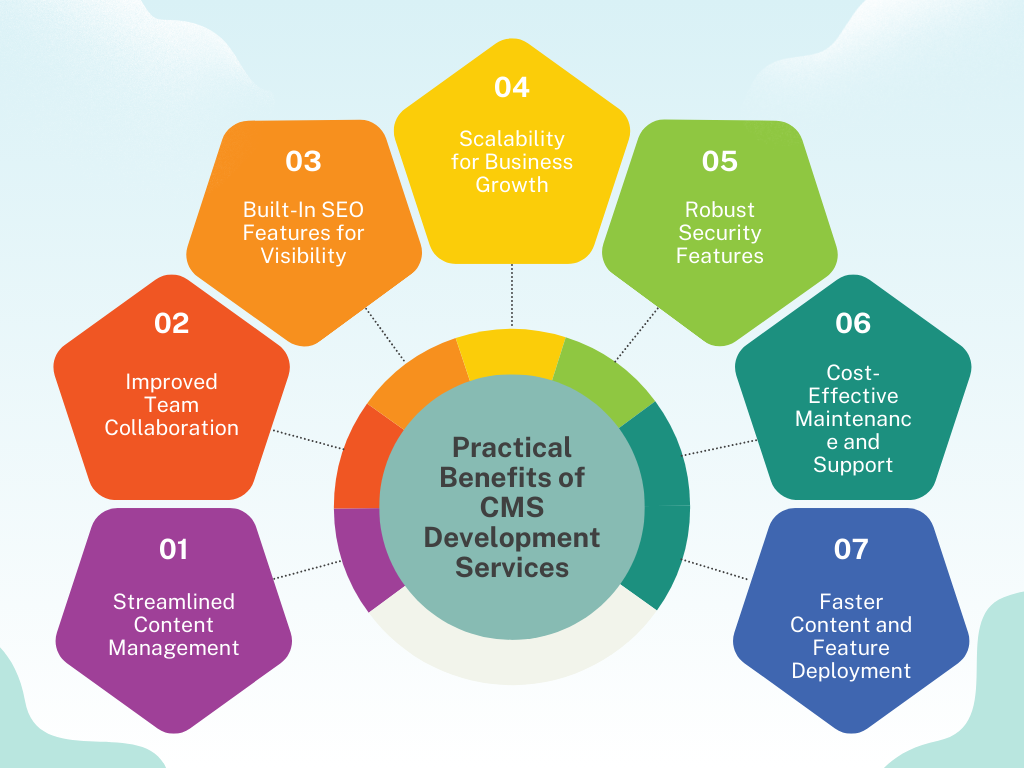
The Practical Benefits of CMS Development Services
Now that we’ve explored what CMS development services are, let’s dive into the specific benefits they offer your business. Each of these advantages helps save time, cut costs, and streamline your website management.
1. Streamlined Content Management
A CMS makes website updates simple, even for non-technical users. Whether adding a blog post, updating product descriptions, or changing images, you can do it all in just a few clicks.
Key Benefits:
Instant Updates: Add or edit content whenever needed.
Lower Costs: Reduce reliance on developers for routine changes.
Ease of Use: Intuitive design makes it accessible for everyone.
With the right services, your platform will be tailored for efficiency, allowing you to focus on growing your business instead of worrying about website maintenance.
2. Improved Team Collaboration
A CMS fosters teamwork by enabling multiple users to work on the website simultaneously. Departments can have distinct roles—marketing can post blogs while sales updates pricing—all without stepping on each other’s toes.
How It Helps:
Assign roles and permissions for better workflow.
Reduce miscommunication between teams.
Save time by centralizing content updates.
By using a professionally developed CMS, you ensure a smooth, collaborative process for all teams.
3. Built-In SEO Features for Visibility
Most CMS platforms come equipped with SEO tools to improve your website’s search rankings. From optimizing keywords to managing meta descriptions, these features are essential for driving organic traffic.
With CMS Development Services, You Can:
Automate key SEO tasks like creating XML sitemaps.
Optimize for mobile responsiveness.
Ensure page speed and performance are up to standards.
A web development company like AHN Group can fine-tune these features, helping you attract more visitors without spending heavily on paid ads.
4. Scalability for Business Growth
Your business is evolving, and your website should keep up. A CMS lets you easily add new features, pages, or integrations as needed.
Why It Matters:
Avoid expensive website overhauls.
Seamlessly add e-commerce or customer support portals.
Stay competitive with the latest tools and trends.
With a scalable CMS, your website can grow alongside your business, saving you both time and future expenses.
5. Robust Security Features
Cybersecurity is a top priority in the competitive digital market. CMS platforms offer built-in features to protect your website from potential threats.
Key Security Features Include:
Automatic software updates.
Two-factor authentication for added protection.
Regular backups to safeguard your data.
When you partner with a web development company, they ensure these features are properly configured, giving you peace of mind without additional costs.
6. Cost-Effective Maintenance and Support
Maintaining a website doesn’t have to drain your resources. A CMS automates many routine tasks, such as updates and security patches, reducing the need for constant technical support.
How CMS Saves on Maintenance:
Handle basic updates yourself.
Reduce dependency on external developers.
Ensure smooth operation with automated processes.
7. Faster Content and Feature Deployment
In a fast-moving digital world, agility is key. A CMS allows you to quickly adapt to market trends, deploy new content, and introduce features without delay.
Advantages:
Speedy response to customer demands.
Stay ahead of competitors by implementing updates faster.
Save time by automating repetitive tasks.
This agility enables you to stay relevant and cost-effective in your industry.
Why Choose AHN Group For Your CMS Needs?
At AHN Group, we specialize in delivering tailored CMS development services that save you time and money. Our team works closely with you to:
Understand your unique business needs.
Develop a CMS that’s secure, scalable, and easy to use.
Provide ongoing support to ensure optimal performance.
When you choose us, you’re not just getting a CMS—you’re gaining a partner dedicated to your success.
Conclusion
If you want a website that feels like a trusted partner, AHN Group is here to help. We don’t just offer CMS development services—we provide tailored solutions designed to meet your business goals. As a leading web development company, we ensure your CMS is not only efficient and user-friendly but also a powerful tool for sustainable growth.
It’s time to take the stress out of website management and focus on what matters most: scaling your business.
Contact AHN Group today, and let’s create a website that works as hard as you do!
Are you looking to build a new website or revamp an existing one in 2025? One of the first things to consider is the cost of web development services. The price can vary greatly depending on several factors, from the development team’s location and experience to the project’s complexity and scope. In this article, we’ll take a closer look at the average hourly rates for web development services in 2025, the factors that can affect the cost of a website project, and some tips for budgeting for ongoing maintenance and support. So, let’s dive in and find out exactly how much you can expect to pay for web development services in 2025.
The Average Hourly Rates for Web Development Services in 2025
In 2025, the average hourly rate for web development services can range anywhere from $20 to $150 per hour, depending on the development team’s location, their experience level, and the specific technologies and tools required for the project.
Ukraine, Poland, and Belarus are some of the best countries to hire offshore developers. These countries offer some of the most affordable hourly rates for web development services, ranging from $20 to $50 per hour.
In addition to the location of the development team, the specific technologies and tools required for the project can also affect the hourly rate for web development services. For example, developers with expertise in more specialized technologies such as React JS or Node JS may have a higher hourly rate than those with expertise in more standard and widely-used technologies such as PHP or HTML/CSS.
The Cost of a Website Project: Basic vs Complex
Basic websites, also known as informational websites, are typically smaller in scope and are designed to provide basic information about a company or organization, such as contact information and a list of services. These types of websites can often be built for as little as $1,000 to $5,000.
On the other hand, complex websites are typically larger in scope and may include features such as e-commerce functionality, custom databases, and advanced user interfaces. These types of websites can often cost anywhere from $5,000 to $50,000 or even higher, depending on the specific requirements and features included.
When determining the cost of a website project, it’s essential to consider the specific needs of your business and the types of features and functionality necessary for your website to succeed. While a basic website may be sufficient for some companies, others may require a more complex solution to meet their needs fully.
Savvy Strategies for Cutting Costs on Web Development in 2025
Web development can be a significant expense for any business, but there are ways to save money without compromising on quality. Here are 6 tips to help you cut costs when developing a website or application.
Have a clear plan and scope of work: Define your project’s requirements, goals, and objectives before beginning development. This will help you identify the features and functionalities that are essential to your project and avoid unnecessary costs. I recommend you write a web design brief which is a document that outlines the specifics of a website design and development project.
Use open-source software: Leverage open-source software, such as WordPress, Joomla, or Drupal, to reduce the development cost.
Outsource to a cost-effective location:Outsourcing web development to countries such as Ukraine or Poland can be cost-effective and save you money on development costs.
Use pre-designed templates and themes: Using pre-designed templates and themes can save you time and money on design costs.
Avoid customizing unnecessary features: Only customize features that are essential to your project. Customizing unnecessary features will add to development costs.
Use a project management tool: Using a project management tool to keep track of progress and timelines can save you money on development costs.
Factors That Affect the Cost of Web Development Services
Here are 8 factors that can affect the cost of web development services:
Location of the development team: The cost of living and average wages in a given location can affect the hourly rate for web development services. Generally, web development services in countries with a higher cost of living, such as the US and Europe, tend to be more expensive than those in countries with a lower cost of living.
The development team’s level of experience and expertise: Developers with more experience and expertise may charge a higher hourly rate for their services. On the other hand, full-stack web developers can spend less time on a project and provide more quality services that are essential for enterprise web projects.
Specific technologies and tools required for the project: Projects that require specialized knowledge and experience in certain programming languages or frameworks may have a higher hourly rate compared to those that use more common and widely-used technologies.
Project complexity and scope: The complexity and scope of the project can affect the amount of time and resources required to complete it, which can, in turn, affect the cost.
Design and branding: The cost of web development services can be affected by the cost of design and branding elements, such as the cost of creating a custom logo, selecting color schemes and layouts, and other visual elements that are unique to the project.
Third-party integrations: The cost of web development services can be affected by the cost of integrating third-party tools or services, such as payment gateways, analytics, and other features that are not included in the core development services.
The level of customization required: Customized solutions will require more time and resources to develop, resulting in higher costs.
The need for SEO and marketing: Implementing an SEO strategy and a marketing plan can add to the development costs. This may include optimizing website structure, content, and meta tags for search engines, building backlinks, developing an ongoing content marketing strategy to improve search engine rankings, and developing a marketing strategy to increase visibility and attract users to the website.
Budgeting for Ongoing Maintenance and Support in Web Development Services
Website maintenance is essential to keeping your online presence up to date and running smoothly. The cost of website maintenance can vary greatly depending on your website type and the level of maintenance required. In this case, we will explore the different types of websites and the corresponding maintenance costs you can expect to incur.
Basic websites: These are simple websites that typically consist of a few pages, such as a home page, about us page, and contact page. The maintenance cost for these types of websites is usually low, averaging around $30 to $50 per month.
E-commerce websites: These types of websites allow customers to purchase products or services online. The cost of maintenance for e-commerce websites is typically higher than basic brochure websites, averaging around $50 to $100 per month.
Custom websites: Custom websites are tailored to a specific business or organization and often require more complex features and functionality. The cost of maintenance for custom websites can range from $100 to $200 per month.
Content Management System (CMS) websites: CMS websites are built using platforms such as WordPress, Joomla, and Drupal. The maintenance cost for these types of websites can range from $50 to $100 per month.
Social media websites: Websites that are focused on social media interactions, such as forums and message boards, require regular updates and maintenance to keep content fresh and users engaged. The maintenance cost for these types of websites can range from $50 to $150 per month.
It is important to note that these costs are approximate and can vary depending on the specific needs of your website. Additionally, getting a quote from a website maintenance company is always recommended before committing to a contract. By understanding the different types of websites and the corresponding maintenance costs, you can make an informed decision when it comes to maintaining your online presence.
Sum up
In conclusion, the cost of web development services can vary greatly depending on several factors, including the development team’s location and experience, the project’s complexity and scope, and the specific technologies and tools required. In 2025, the average hourly rate for web development services can range anywhere from $20 to $150 per hour. Basic websites can often be built for as little as $1,000 to $5,000, while complex websites can cost anywhere from $5,000 to $50,000 or even higher.
To save money on web development costs, businesses can consider outsourcing to cost-effective locations, using open-source software and pre-designed templates and themes, and avoiding customizing unnecessary features. It is also essential to have a clear plan and scope of work before beginning development and use a project management tool to keep track of progress and timelines.