Stories

June 26, 2023

SHARE:

Founded in 2015 by Carolyn Kim, a Korean American mother and non-profit lawyer, Yobo Soju was born out of a desire to create an elegant soju that resonated with evolving lifestyles and refined tastes.

As the first American hand-crafted soju made in the New York Finger Lakes, Yobo quickly gained recognition, winning awards and becoming renowned for its exceptional taste.

In 2021, John Noe joined the team as an investor and CEO, aiming to propel Carolyn’s vision to new heights. With offerings like Hunni Soju, YoboKish, KTOWN Soju, and Yobo Soju Luxe, they cater to various consumer preferences and occasions, making soju accessible to a wider audience.

Yobo Soju stands out from other brands by choosing to craft their soju from grapes, a departure from the traditional rice-based approach. This unique choice pays homage to Carolyn’s Korean American heritage and the desire to create a more premium and high-quality soju. The result is a velvety smooth liquid with a floral aroma and fruitiness, capturing the attention of cocktail bars and restaurants seeking to elevate their creations.

In an interview with John Noe, he shares his insights into the journey of Yobo Soju and its impact on the spirits market. Join us as we delve deeper into the story behind Yobo Soju and discover the inspiration and passion that drives its success.

HOW YOBO SOJU CAME TO LIFE

Yobo Soju was started in 2015 by Carolyn Kim, a Korean American mother of twins and a non-profit lawyer. At the time, there weren’t many premium soju on the market. While she enjoyed drinking soju in her earlier years, she wanted something that suited her evolving lifestyle and taste.

Carolyn Kim

In a word, she wanted to create a soju that was ‘elegant.’ From that ambition, Yobo Soju was born, the first American hand-crafted soju made in the New York Finger Lakes. Immediately, Yobo won several awards and was touted for being one of the best-tasting soju available. Yobo made its way into top restaurants, cocktail bars, and retail accounts, and was ready to grow. 

In 2021, I joined the team as an investor and CEO to push Carolyn’s vision further. We had a great product and initial distribution but needed to get to the next level. In developing our strategy, we started from the very top and figured we’d work our way down. How do we win over U.S. consumers completely unfamiliar with soju? If we could do that, winning existing soju consumers or lapsed soju consumers would be easy by comparison. From there, the obstacles started to stack.   

Distributor: Will there even be any interest in soju?

Retailer: Where would I even put soju on my shelves?

Bar manager: How do I even serve soju?

Consumer: What is soju? How do I drink it?

Our strategy was to take our single product and to expand into a diverse portfolio that could navigate our obstacles. We created Hunni Soju, a ready-to-drink flavored soju cocktail line, to utilize a more approachable single-serve format. We created YoboKish, a range of unique aperitifs using our soju as its base, to reach mixology enthusiasts at home and at the bar. We created KTOWN soju, a range of all-natural flavored soju made with real fruit juice, as a playful way to drive soju trials in a multi-serve format. And we elevated our original distilled soju, renaming it Yobo Soju Luxe to honor traditional soju making while adding our own Korean American twist. Together, we’ve created a diverse Asian American spirit portfolio that can bring soju to nearly any type of account and occasion.

Together, the portfolio represents a diverse range of Asian American spirits to meet consumers of any level of soju familiarity. Since 2020, Yobo has expanded from 2 SKUs to 18 SKUs and our annual case volume has grown 50x with distribution in over 30 states. The strategy that seemed risky and overly ambitious in 2021 is now beginning to take hold.  

Mass soju is a low-cost product produced at a significant volume that isn’t known for its great taste. But it’s the spirit of Korea, so why couldn’t it be more premium and made of higher quality?

John Noe

USING GRAPES TO CRAFT SOJU

Carolyn was very thoughtful in creating the first Korean American soju. Like her own identity, she wanted to source ingredients that were local to her while paying homage to her history and origin.

At the time, she lived in New York City, and so the idea of using Catawba grapes grown nearby in the Finger Lakes became an interesting choice. There was a disruptive statement to be made as well. In a category dominated by men, how would she represent Korean American women in creating the first soju made in America?

Mass soju is a low-cost product produced at a significant volume that isn’t known for its great taste. But it’s the spirit of Korea, so why couldn’t it be more premium and made of higher quality? Producing soju from grapes resulted in a liquid with a floral aroma, fruitiness, and a velvety smooth finish. Yobo was quickly adopted by cocktail bars and restaurants that wanted to create higher-end cocktails with soju. Consumers lauded its taste and Yobo gained a niche following.

Since then, we moved our operations to California and updated the branding, packaging, and formula for our flagship soju now called Yobo Soju Luxe. The formula change is one we didn’t take lightly. Moving to California not only gave us the ability to source grapes from California but to source rice as well. After much trial and error and countless recipes, we ended up with the current Yobo Soju Luxe formula made from organic wheat, California rice, and California grapes. It’s a blend that combines the best of each of those ingredients giving us a soju that’s impossibly smooth and almost creamy while representing what we believed to be truly Korean American.

PRODUCTION PROCESS AND STANDARDS

The majority of our products are produced in Ventura, California with our distiller.

The process is a labor of love where our formulas are distilled, mixed, and batched by our master distiller. Each bottle is inspected by hand and packed. But the part of the process that’s been the biggest adventure has been the formulation process.

Creating YoboKish, the collaborative name of our venture with Kristen Kish, took almost two years. We started the project with a completely blank canvas and no restrictions. What would a Top Chef winner do? We gave Kristen free rein and the project evolved through several iterations as we experimented with flavors, formats, and concepts. Eventually, we landed on the flavor profile Kristen loves most, bringing contrasting flavors together like bitter and sweet:

  • SHINE – kumquat, rose, and ginger because kumquat is her favorite fruit. 
  • BLISS – sour cherry, pink peppercorn, and licorice because Kristen grew up in Michigan and loved licorice as a kid.
  • EARTH – smoked mushroom umami because she’s a celebrity chef and she flexes.
  • SEOUL – hibiscus, lemon balm, and raw honey because her wife Bianca has a nightly ritual of drinking hibiscus tea in a similar fashion (hence the name, SEOUL for the city where Kristen was born and SOUL for her soulmate, Bianca).

They’re each sweet and bitter, but soft and balanced at the same time. They’re all-natural and have no artificial coloring or flavors. And they provide mixologists with Top Chef-like ingredients to create an array of imaginative cocktails.

Kristen Kish

DIFFERENT OFFERINGS TO CATER DIFFERENT CONSUMER PREFERENCES

There is a distinct ritual to drinking soju.

Its smaller bottles and lower proof allow bottles to be easily consumed among a group of friends. Once a bottle is opened, it’s shared and poured, two hands pour, and two hands receive as it’s passed around the table until it’s empty. At Korean barbeque, singing karaoke, or out clubbing, the occasion for soju is a social one.  

While we want our soju to be a part of all those rituals and occasions, we wanted to design our products for new occasions that would help us cross cultures.

In Yobo Soju Luxe, we wanted to create a celebratory bottle and liquid, one that could be gifted as a present or opened to commemorate an accomplishment.

In YoboKish, we wanted to create a ‘professional’ product for more advanced mixologists and cocktail enthusiasts.

In Hunni Soju, we wanted a format that would be conducive for trial, a single-serve, easy-to-drink, flavored soju that people could grab and go – to the beach, a picnic, golfing, and more.

And in KTOWN Soju, we wanted to take everything we’ve ever loved about eating and drinking in Korea town and take the experience of KTOWN to wherever the bottle goes. In fact, the design of the glass is made to look like a flask and the liquid is fruity, sweet, and welcoming to any first-time soju drinker.

WHAT SETS YOBO SOJU APART

Most people don’t realize that soju is the largest-selling spirit in the world by volume, outselling vodka, tequila, and whiskey in total cases. Despite its market size, most soju on the market are very similar – inexpensive liquid housed in small green bottles.

It wasn’t until more recently that more premium soju products arrived. But what makes our full line of products unique is our identity as a Korean American company and brand. There’s a generational shift in thinking about what soju could be in the United States and we intend to produce soju that is as beautifully designed as any other spirit you’d find on the shelf and of the highest quality.

Our glass is custom. Our liquid is all-natural and free from artificial coloring, flavors, or sweeteners. While we do our best to communicate our differences through our marketing communications, the best proof is when somebody tries our soju. If you’ve had other soju before, the difference is unmistakable.

JOHN’S GOALS AND VISION FOR YOBO SOJU

I started as CEO in 2021 and since then we’ve accomplished so much. The business has grown 50x in annual case volume with the expansion of its portfolio and is now distributed in more than 30 states. We’re about to launch major brand collaborations and product integration in the upcoming Joyride movie by Adele Lim.

We’ve poured at places like the Sundance Film Festival and Food & Wine Classic in Aspen. But beyond the business milestones, I believe what we’re doing is significant and will spark the imagination of others to follow. 

Our mission has been to elevate the Korean American spirit by breaking boundaries, from the way we think about the liquid that constitutes soju to the communities we aim to reach. The world doesn’t need another tequila or vodka and yet much of the industry only sees opportunities in large, established markets.

As a Korean American, I know the power of the minority mindset and the impact that can be made by a few. Small is where everyone starts. We had two events just recently, a pride event at a fashion/design studio called Bobblehaus where we showcased KTOWN soju, and Food & Wine in Aspen where we showcased Kristen Kish’s aperitifs.

It was such an amazing experience pouring our drinks for people, explaining soju, introducing our products, and seeing everyone’s reactions. Some might overlook Asian American spirits right now because of its market size or lack of movie star endorsers, but from the view down here, we see a community building around us filled with faces of every identity and color sharing and enjoying soju with us.

John Noe

THE IMPACT OF YOBO SOJU

The greatest impact Yobo has had is its personal impact on me.

I grew up in a small town in Texas and our family was the first Korean family in our neighborhood. When we arrived, the community of Korean Americans in my elementary school was limited to me and my brother (for the one year we overlapped). For most of my life, I struggled with my own Korean American identity and felt like I needed to find ways to be less ‘Korean’ to succeed.

I’ve had an entrepreneurial career having built and sold an advertising agency before Yobo in an industry where just like my elementary school, I was only one of a few Asian Americans along with my Chinese American partner. We built the agency up and sold it to a French holding company where we continued to grow the business. In that time, we worked with mass, established, ‘American’ brands that played very little in contributing to Asian American identity and culture. We were successful by all business standards, but regretfully, we contributed very little to our Asian American community.

At the time of joining Yobo as its CEO, the stories of hate crimes against Asian Americans started to surface. Here I am, a Korean American CEO of a Korean American company amidst a breakout of hatred toward a community I rarely embraced. It was the unfortunate wake-up call I required to find pride in my identity and to take more roles in paving the way for other Asian Americans more seriously. My Yobo journey has been profound, and instead of hiding my Korean-ness, I’m now on a mission to share it.

We have a few things lined up that I’m excited to share and announce. Beyond launching products and selling them into accounts, we’re here to make a statement. The Yobo organization is very small, a minority among minorities, but we believe we’ll make an outsized impact.

CONNECT WITH YOBO SOJU

Instagram: @yobosoju

Website: yobosoju.com

Related Articles

ROI

Development, Technologies

How WordPress Website Development Complements Digital Marketing for Better ROI

While dealing with the rapid tempo of today’s digital market, online presence has to be considered crucial for developing businesses. Companies seeking a higher ROI should focus on two key factors: effective website development and strategic digital marketing. WordPress, being one of the most popular content management systems in the world, plays an important role in improving both. The combination of WordPress website development with proper digital marketing strategy will do a manifold increase in ROI for the business.

The Role of WordPress in Modern Website Development

With over 40% of websites across the earth powered by WordPress, that fact should say it all. Its flexible, ease of use, and has power-rich features. All these make it a go-to platform for businesses seeking to establish or improve their digital presence. Now, let’s get into detail as to why WordPress is an essential tool in website development.

  • Custom Web Development with WordPress: Every business differs; so does each business and its needs while considering website development. WordPress makes it easier to develop custom websites for any business. Be it a blog, an e-commerce platform, or corporate website; there’s no limit in the areas of customization in WordPress. To this end, web design companies ensure that businesses leverage all benefits of using WordPress by providing them with customized websites that are functional, user-friendly, and visually appealing.
  • E-commerce Capability: The easy integrability of WordPress with e-commerce solutions such as WooCommerce makes it suitable for every business involved in the selling of products or services online. E-commerce WordPress websites are highly customizable and performance optimized. WooCommerce can hence be used to track sales, manage inventory, or even introduce a payment gateway from a single point.
  • SEO-Friendly Design: One of the important things with WordPress is that it has an SEO-friendly structure. Optimizing websites for search engines is done at an advantage through WordPress, where such SEO plugins as Yoast SEO and All in One SEO dictate guiding the user in optimizing their site for better visibility. The cutting-edge functionality of editing meta tags, titles, and descriptions may help businesses improve their places in search engine rankings and hence drive more organic traffic.
  • Mobile-Friendly and Responsive: With mobile traffic surpassing desktop traffic, it is crucial that your website be responsive. There are hundreds of WordPress themes and plugins that automatically optimize your website for mobile devices. Increased user experience, better SEO for your site, and not losing potential customers on mobile devices-this is what business gets from having a mobile-friendly website.
  • Secure and scalable: WordPress gets updated on a routine basis to meet industry standards with security updates. For scaling businesses, WordPress sites can adapt to increased traffic and be able to add new features without reduced performance, making it a very sustainable option for website development.

How WordPress Improves Digital Marketing Strategies

Digital marketing strategies are indispensable for the development of businesses, while at the heart of every successful marketing strategy is an optimized WordPress site. Here’s how WordPress can help to improve your digital marketing campaigns.

  • SEO-friendly Structure: WordPress has been coded in clean code, which enables search engines to crawl and index your site efficiently. SEO plugins like Yoast SEO actually provide actionable insights to help you optimize those pages and posts for better rankings. With features such as XML sitemaps, meta tags, and alt attributes, WordPress helps businesses with search engine optimization to ultimately drive more organic traffic to their websites.
  • Content Marketing Made Easy: Content is king when it comes to digital marketing. WordPress will enable users to publish their blog posts, products, and landing pages without requiring thorough coding skills. It provides the opportunity to create content on a regular basis and publish it for better search engine ranking and attracting targeted traffic.
  • Smooth Integration with Social Media: WordPress integrates seamlessly with social media. Plugins like Social Warfare allow showing social sharing buttons on business pages for easy visitor content sharing. Social media integration improves the capability of businesses to extend their visibility and reach out more effectively to their audience.
  • Conversion Optimization: WordPress supports multiple tools to improve conversion rates, starting from simple contact forms up to advanced solutions, which include heatmaps and A/B testing. Additionally, companies can efficiently track the interactions of users, improve their digital marketing skills, and work on leads and sales.
  • Analytics and Data Tracking: Amongst the rest of the plugins, integrating Google Analytics or some other data-tracking software into WordPress is fairly easy. Data analytics are very important for refining digital marketing tactics, candidly knowing the users’ behavioral mentality, and improving ROI. In WordPress, it is easy to set up campaign success; similarly, data-driven decisions are also easy to make.

How WordPress Website Development and Digital Marketing Work Together for Better ROI

A combination of WordPress website development along with digital marketing strategies helps a business return on a higher investment. Herein lies the reason why:

  • Improved Visibility: WordPress has an SEO-friendly design, which makes it easy to rank high in search engines. A website that’s optimized will help businesses raise visibility without the paid advertising, which in turn means more organic traffic and drives up ROI.
  • Increased Conversions: A friendly and attractive WordPress site means great user experience, which directly influences conversions. Whether it is to generate leads, sell more, or even build an email list, WordPress sites are designed in a way to move users along the conversion funnel.
  • Affordable Marketing: WordPress allows seamless integrations of different marketing tools, ranging from email marketing platforms to CRM systems, not excluding social media plugins. This reduces the need for other software, which might be costly, hence giving businesses a chance to run effective marketing campaigns without spending an arm and a leg.
  • Scalability for Changing Trends: WordPress websites are immensely adaptable and scalable. This will enable businesses to respond swiftly to ever-evolving digital marketing trends. New features and functionalities can easily be added in with plugins and hence you keep your site relevant and competitive.

Why Choose AHN Group for Your Business Needs?

The selection of the right web development company is very crucial for your digital marketing success. At AHN Group, we offer custom WordPress development designed to meet the unique needs of your business.

Why AHN Group stands out:

  • Expertise in Custom WordPress Development: With our team, you are assured of custom WordPress website development backed by years of experience in implementing your business goals. Whether one is looking for a simple blog or a fully-fledged e-commerce site, we will cover it.
  • Focus on SEO Optimization: We prioritize SEO in each website we build. From clean code to optimized meta tags, our WordPress websites are designed to rank higher on search engines and attract more visitors.
  • Responsive and User-Friendly Design: We value the importance attached to mobile-friendly design. All our WordPress websites are fully responsive, prioritizing, an excellent user experience across all devices.
  • Full Digital Marketing Integration: At AHN Group, it’s not about building just websites, but creating a well-integrated digital platform that will be useful in executing your digital marketing strategies. Our WordPress website designs cater to your SEO, social media, and email marketing needs among others.
  • Ongoing Support: We provide ongoing support in order to keep your WordPress website updated, secure, and optimized for performance continuously.

Conclusion

WordPress website development and digital marketing prove to be indispensable means of business growth in today’s competitive market. By leveraging the power of WordPress and integrating smart digital marketing strategies, businesses can increase their return on investments. With AHN Group, one can design a custom WordPress website for the company that looks great but also drives real results. Working with AHN Group on WordPress website development is the right step toward digital success for businesses that want to increase their online presence and maximize ROI.

Still concerned about your business needs? Don’t wait any longer—contact us today and experience the magic for yourself by partnering with us as your digital guide!

How CMS Development Services Can Save You Time and Money

Development

How CMS Development Services Can Save You Time and Money?


Are you finding it hard to balance growing your business while managing your website? When you’re focused on scaling, the task of maintaining an up-to-date website can quickly become overwhelming. From marketing campaigns to team management and customer satisfaction, your plate is full. On top of that, your website—a core part of your digital presence—requires constant updates and attention. This is where CMS development services come in. They simplify website management, saving you time and cutting costs. Think of a Content Management System (CMS) as your virtual assistant, helping you organize, edit, and scale your website effortlessly without needing a developer at every turn.

By partnering with experts like AHN Group, you can ensure your CMS is tailored to your unique business needs. In this blog, we’ll explore how CMS development services streamline your processes, reduce expenses, and set your business up for long-term success.

What Are CMS Development Services?

CMS development services are focused on creating and customizing a Content Management System to meet the specific needs of your business. These services typically include:

Platform Selection: Choosing the right CMS (e.g., WordPress, Joomla, or Drupal) based on your goals.

Designing a User-Friendly Interface: Ensuring that the CMS is intuitive and easy to navigate.

Integrating Plugins & Tools: Adding necessary functionalities, such as SEO, social media sharing, or e-commerce.

Security & Scalability: Making sure your CMS is secure and can grow with your business.

By partnering with a professional web development company like AHN Group, you can create a CMS solution that is efficient and user-friendly for your team.

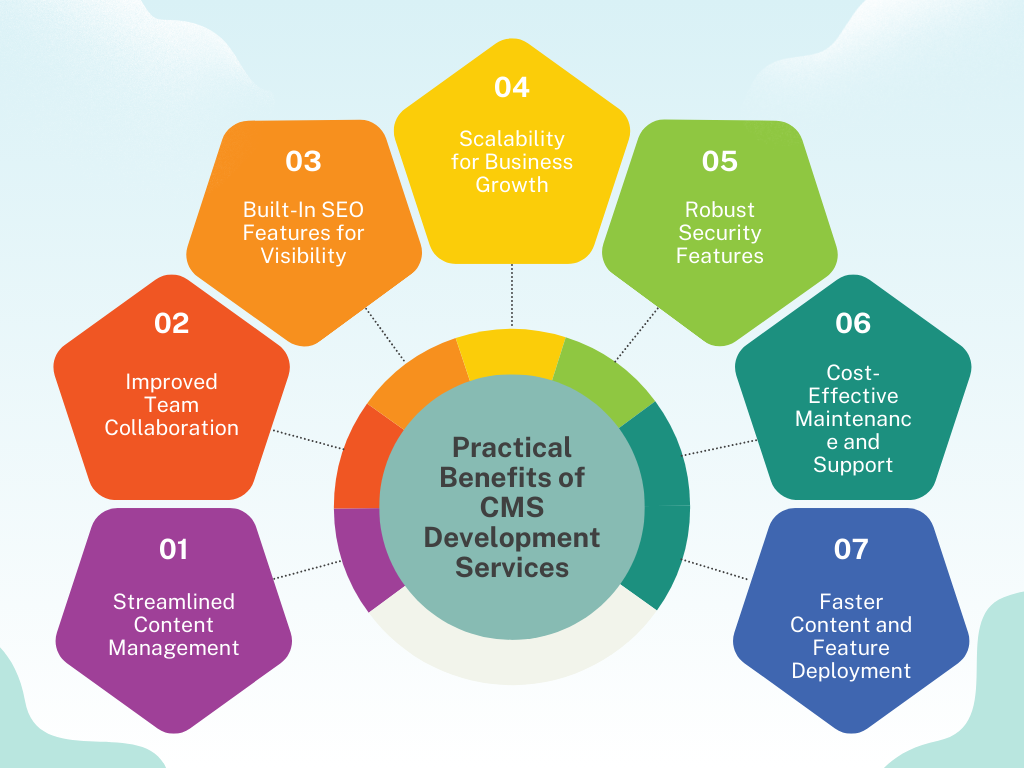
The Practical Benefits of CMS Development Services

Now that we’ve explored what CMS development services are, let’s dive into the specific benefits they offer your business. Each of these advantages helps save time, cut costs, and streamline your website management.

    1. Streamlined Content Management

    A CMS makes website updates simple, even for non-technical users. Whether adding a blog post, updating product descriptions, or changing images, you can do it all in just a few clicks.  

    Key Benefits:  

    • Instant Updates: Add or edit content whenever needed.  
    • Lower Costs: Reduce reliance on developers for routine changes.  
    • Ease of Use: Intuitive design makes it accessible for everyone.  

    With the right services, your platform will be tailored for efficiency, allowing you to focus on growing your business instead of worrying about website maintenance.  

      2. Improved Team Collaboration

      A CMS fosters teamwork by enabling multiple users to work on the website simultaneously. Departments can have distinct roles—marketing can post blogs while sales updates pricing—all without stepping on each other’s toes.  

      How It Helps:

      • Assign roles and permissions for better workflow.  
      • Reduce miscommunication between teams.  
      • Save time by centralizing content updates.  

      By using a professionally developed CMS, you ensure a smooth, collaborative process for all teams.

        3. Built-In SEO Features for Visibility

        Most CMS platforms come equipped with SEO tools to improve your website’s search rankings. From optimizing keywords to managing meta descriptions, these features are essential for driving organic traffic.  

        With CMS Development Services, You Can:

        • Automate key SEO tasks like creating XML sitemaps.  
        • Optimize for mobile responsiveness.  
        • Ensure page speed and performance are up to standards.  

        A web development company like AHN Group can fine-tune these features, helping you attract more visitors without spending heavily on paid ads.  

          4. Scalability for Business Growth

          Your business is evolving, and your website should keep up. A CMS lets you easily add new features, pages, or integrations as needed.  

          Why It Matters:

          • Avoid expensive website overhauls.  
          • Seamlessly add e-commerce or customer support portals.  
          • Stay competitive with the latest tools and trends.  

          With a scalable CMS, your website can grow alongside your business, saving you both time and future expenses.  

            5. Robust Security Features

            Cybersecurity is a top priority in the competitive digital market. CMS platforms offer built-in features to protect your website from potential threats.  

            Key Security Features Include:  

            • Automatic software updates.  
            • Two-factor authentication for added protection.  
            • Regular backups to safeguard your data.  

            When you partner with a web development company, they ensure these features are properly configured, giving you peace of mind without additional costs.  

              6. Cost-Effective Maintenance and Support

              Maintaining a website doesn’t have to drain your resources. A CMS automates many routine tasks, such as updates and security patches, reducing the need for constant technical support.  

              How CMS Saves on Maintenance:  

              • Handle basic updates yourself.  
              • Reduce dependency on external developers.  
              • Ensure smooth operation with automated processes.  

                7. Faster Content and Feature Deployment

                In a fast-moving digital world, agility is key. A CMS allows you to quickly adapt to market trends, deploy new content, and introduce features without delay.  

                Advantages: 

                • Speedy response to customer demands.  
                • Stay ahead of competitors by implementing updates faster.  
                • Save time by automating repetitive tasks.  

                This agility enables you to stay relevant and cost-effective in your industry.

                Why Choose AHN Group For Your CMS Needs?

                At AHN Group, we specialize in delivering tailored CMS development services that save you time and money. Our team works closely with you to:  

                • Understand your unique business needs.  
                • Develop a CMS that’s secure, scalable, and easy to use.  
                • Provide ongoing support to ensure optimal performance.  

                When you choose us, you’re not just getting a CMS—you’re gaining a partner dedicated to your success.  

                Conclusion

                If you want a website that feels like a trusted partner, AHN Group is here to help. We don’t just offer CMS development services—we provide tailored solutions designed to meet your business goals. As a leading web development company, we ensure your CMS is not only efficient and user-friendly but also a powerful tool for sustainable growth.

                It’s time to take the stress out of website management and focus on what matters most: scaling your business.

                Contact AHN Group today, and let’s create a website that works as hard as you do!

                graph-made-with-white-small-cards-jpg

                Ideas

                How much do web development services cost in 2025?

                Are you looking to build a new website or revamp an existing one in 2025? One of the first things to consider is the cost of web development services. The price can vary greatly depending on several factors, from the development team’s location and experience to the project’s complexity and scope. In this article, we’ll take a closer look at the average hourly rates for web development services in 2025, the factors that can affect the cost of a website project, and some tips for budgeting for ongoing maintenance and support. So, let’s dive in and find out exactly how much you can expect to pay for web development services in 2025.

                The Average Hourly Rates for Web Development Services in 2025

                In 2025, the average hourly rate for web development services can range anywhere from $20 to $150 per hour, depending on the development team’s location, their experience level, and the specific technologies and tools required for the project.

                Ukraine, Poland, and Belarus are some of the best countries to hire offshore developers. These countries offer some of the most affordable hourly rates for web development services, ranging from $20 to $50 per hour.

                In addition to the location of the development team, the specific technologies and tools required for the project can also affect the hourly rate for web development services. For example, developers with expertise in more specialized technologies such as React JS or Node JS may have a higher hourly rate than those with expertise in more standard and widely-used technologies such as PHP or HTML/CSS.

                The Cost of a Website Project: Basic vs Complex

                Basic websites, also known as informational websites, are typically smaller in scope and are designed to provide basic information about a company or organization, such as contact information and a list of services. These types of websites can often be built for as little as $1,000 to $5,000.

                On the other hand, complex websites are typically larger in scope and may include features such as e-commerce functionality, custom databases, and advanced user interfaces. These types of websites can often cost anywhere from $5,000 to $50,000 or even higher, depending on the specific requirements and features included.

                When determining the cost of a website project, it’s essential to consider the specific needs of your business and the types of features and functionality necessary for your website to succeed. While a basic website may be sufficient for some companies, others may require a more complex solution to meet their needs fully.

                Savvy Strategies for Cutting Costs on Web Development in 2025

                Web development can be a significant expense for any business, but there are ways to save money without compromising on quality. Here are 6 tips to help you cut costs when developing a website or application.

                1. Have a clear plan and scope of work: Define your project’s requirements, goals, and objectives before beginning development. This will help you identify the features and functionalities that are essential to your project and avoid unnecessary costs. I recommend you write a web design brief which is a document that outlines the specifics of a website design and development project.
                2. Use open-source software: Leverage open-source software, such as WordPress, Joomla, or Drupal, to reduce the development cost.
                3. Outsource to a cost-effective location: Outsourcing web development to countries such as Ukraine or Poland can be cost-effective and save you money on development costs.
                4. Use pre-designed templates and themes: Using pre-designed templates and themes can save you time and money on design costs.
                5. Avoid customizing unnecessary features: Only customize features that are essential to your project. Customizing unnecessary features will add to development costs.
                6. Use a project management tool: Using a project management tool to keep track of progress and timelines can save you money on development costs.

                Factors That Affect the Cost of Web Development Services

                Here are 8 factors that can affect the cost of web development services:

                1. Location of the development team: The cost of living and average wages in a given location can affect the hourly rate for web development services. Generally, web development services in countries with a higher cost of living, such as the US and Europe, tend to be more expensive than those in countries with a lower cost of living.
                2. The development team’s level of experience and expertise: Developers with more experience and expertise may charge a higher hourly rate for their services. On the other hand, full-stack web developers can spend less time on a project and provide more quality services that are essential for enterprise web projects.
                3. Specific technologies and tools required for the project: Projects that require specialized knowledge and experience in certain programming languages or frameworks may have a higher hourly rate compared to those that use more common and widely-used technologies.
                4. Project complexity and scope: The complexity and scope of the project can affect the amount of time and resources required to complete it, which can, in turn, affect the cost.
                5. Design and branding: The cost of web development services can be affected by the cost of design and branding elements, such as the cost of creating a custom logo, selecting color schemes and layouts, and other visual elements that are unique to the project.
                6. Third-party integrations: The cost of web development services can be affected by the cost of integrating third-party tools or services, such as payment gateways, analytics, and other features that are not included in the core development services.
                7. The level of customization required: Customized solutions will require more time and resources to develop, resulting in higher costs.
                8. The need for SEO and marketing: Implementing an SEO strategy and a marketing plan can add to the development costs. This may include optimizing website structure, content, and meta tags for search engines, building backlinks, developing an ongoing content marketing strategy to improve search engine rankings, and developing a marketing strategy to increase visibility and attract users to the website.

                Budgeting for Ongoing Maintenance and Support in Web Development Services

                Website maintenance is essential to keeping your online presence up to date and running smoothly. The cost of website maintenance can vary greatly depending on your website type and the level of maintenance required. In this case, we will explore the different types of websites and the corresponding maintenance costs you can expect to incur.

                1. Basic websites: These are simple websites that typically consist of a few pages, such as a home page, about us page, and contact page. The maintenance cost for these types of websites is usually low, averaging around $30 to $50 per month.
                2. E-commerce websites: These types of websites allow customers to purchase products or services online. The cost of maintenance for e-commerce websites is typically higher than basic brochure websites, averaging around $50 to $100 per month.
                3. Custom websites: Custom websites are tailored to a specific business or organization and often require more complex features and functionality. The cost of maintenance for custom websites can range from $100 to $200 per month.
                4. Content Management System (CMS) websites: CMS websites are built using platforms such as WordPress, Joomla, and Drupal. The maintenance cost for these types of websites can range from $50 to $100 per month.
                5. Social media websites: Websites that are focused on social media interactions, such as forums and message boards, require regular updates and maintenance to keep content fresh and users engaged. The maintenance cost for these types of websites can range from $50 to $150 per month.

                It is important to note that these costs are approximate and can vary depending on the specific needs of your website. Additionally, getting a quote from a website maintenance company is always recommended before committing to a contract. By understanding the different types of websites and the corresponding maintenance costs, you can make an informed decision when it comes to maintaining your online presence.

                Sum up

                In conclusion, the cost of web development services can vary greatly depending on several factors, including the development team’s location and experience, the project’s complexity and scope, and the specific technologies and tools required. In 2025, the average hourly rate for web development services can range anywhere from $20 to $150 per hour. Basic websites can often be built for as little as $1,000 to $5,000, while complex websites can cost anywhere from $5,000 to $50,000 or even higher. 

                To save money on web development costs, businesses can consider outsourcing to cost-effective locations, using open-source software and pre-designed templates and themes, and avoiding customizing unnecessary features. It is also essential to have a clear plan and scope of work before beginning development and use a project management tool to keep track of progress and timelines.

                Stopwatch on laptop keyboard. Deadline concept.

                Technologies

                How to improve the website loading speed

                Many people know that improving the website loading speed by 0.5 sec is invisible to the users. But it’s still one of the essential search engine factors they use in their ranking algorithms. Also, many web users may use a slow Internet connection, even in the USA and Europe. That is why improving website loading speed is a high-priority task for web development teams. How to improve the website speed?

                What is website speed?

                Technically the term website loading speed is incorrect because it is about page loading speed. 

                In short, website loading speed refers to how quickly the content and UI elements of the specific page load when a user visits it. 

                Several factors can influence specific page speed: 

                • The amount and size of the images and videos are contained on the page
                • UI animations
                • Themes and plugins are installed on the site
                • Front-end and server-side technologies are used
                • The code quality
                • Hosting or server

                But you must know that the user’s Internet connection also affects the web page speed.

                Start with website speed testing

                You may start the website speed test with your smartphone and mobile Internet connection. Does your site load quickly enough? Does your site look mobile-friendly? This test helps you to identify critical speed issues and how responsive the design of your website is.

                But using a smartphone test can’t tell about a website’s score in terms of the website loading speed. Also, it can’t help to identify the causes of slow website loading. That is why you should use tools to test and measure your website’s loading speed.

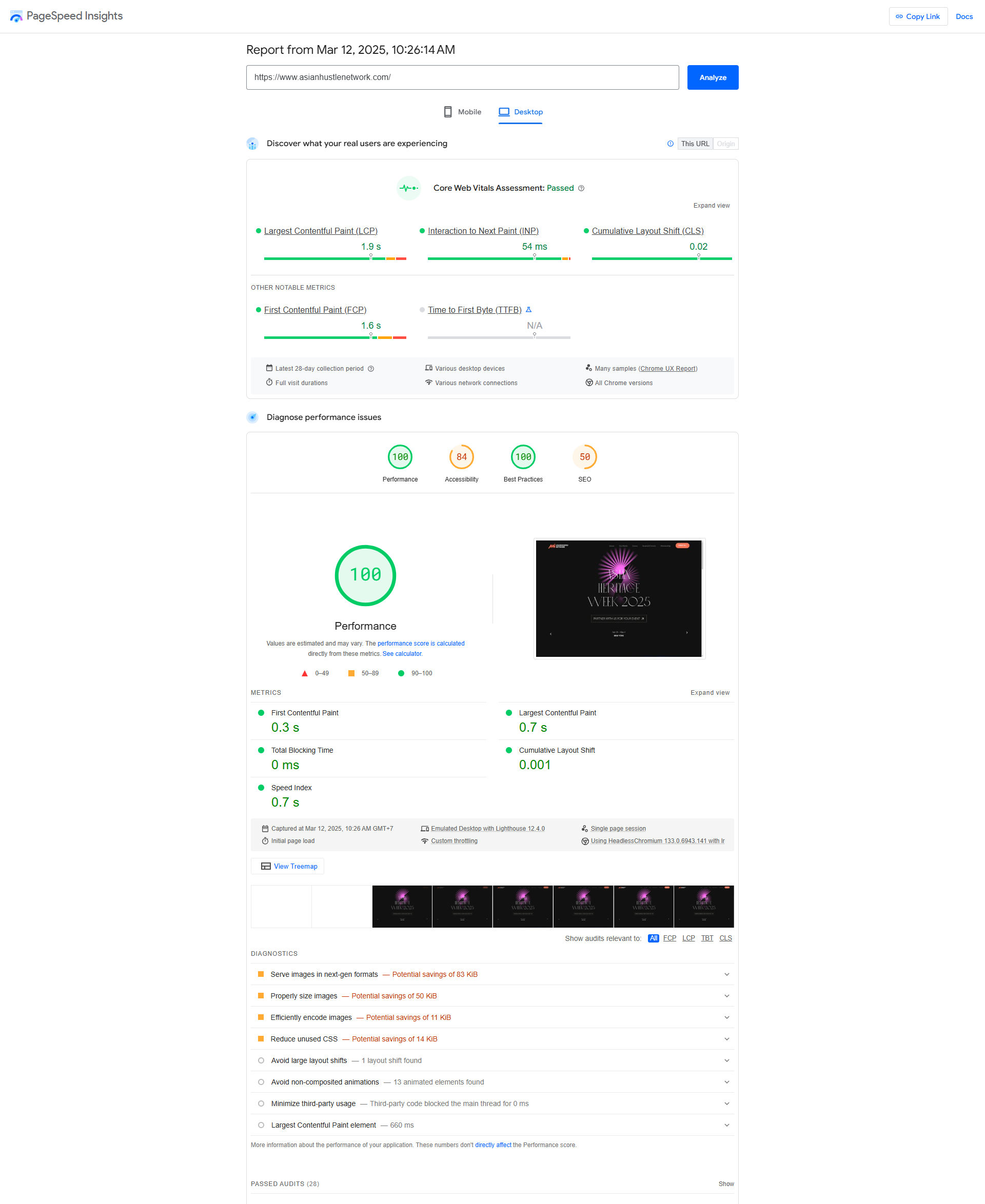
                The most used tool is Google Pagespeed Insights. It is easy to use and provides you with the most critical information. Look at the snapshot for our website.

                AHN’s team developed this site. You can see good scores and no critical issues that could affect the website loading speed.

                If Google Pagespeed Insights identifies issues, it will provide recommendations for increasing the website’s performance.

                This free tool allows testing the site’s mobile and desktop versions. You can use the Lighthouse tool that is built-in Chrome browser—Press F12 to run web developer tools and choose the Lighthouse tool to test the page.

                Also, web developers may use other tools like GTmetrix, Pingdom, or Performance Budget Calculator. 

                Some tools are free, but other tools can be payable. Many web professionals use Lighthouse and Core Web Vitals reports because it is usually enough.

                Guidelines to improve the website loading speed

                The Lighthouse tool (Google Pagespeed Insights) assessed your site as poor (score is less than 50) or as a website that needs improvements (score from 50 to 89). A web developer must look at the tool’s recommendations and fix issues. 

                This guide will help you to understand which factors influence website speed and how to increase it.

                Optimize the images

                Surprisingly, images are one of the most common issues affecting website loading speed. The main reason is that content managers do not pay attention to the size and format of the images when uploading them to the website.

                There is a typical image optimization process.

                Reduce the image size.

                Photos, images, or graphics on the web pages improve engagement. But if you use large files, the images slow down a website.

                Compressing images using tools is one way to reduce image size without affecting quality. Another way to reduce the image size is to adjust the image size based on user display properties.

                Choose the right image format.

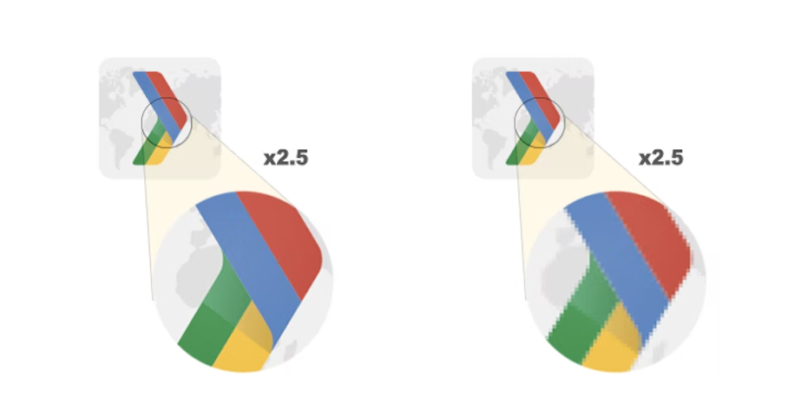
                Look at this image. It shows the difference between a zoomed-in vector image L and a raster image R.

                As you can see, vector images are preferable options as they are resolution-independent and always deliver excellent results.

                If you use raster images, a web developer should serve different image sizes to other devices. But bear in mind that serving desktop-sized images to mobile phones can use 2–4x more data than needed.

                Use WebP images

                When Facebook switched to WebP, they noticed a 25-35% filesize savings for JPEGs and an 80% for PNGs.

                How to convert images to WebP? Usually, web developers use the cwebp command-line tool (for simple projects) or the Imagemin WebP plugin(for complex projects).

                Replace animated GIFs with video.

                GIFs aren’t a good choice when you need a fast website because their size can be 10-15 MB.

                It takes a lot of time to upload a GIF file. That is why web professionals convert GIFs into video files (MPEG or WebM).

                Use image CDNs to optimize images.

                Image content delivery networks (CDNs) specialize in transforming, optimizing, and delivering images. They are excellent at optimizing images and can yield a 40–80% savings in image file size. Image CDNs work like API, making it easy to create variations of an image for different use cases by indicating parameters like size, format, and quality.

                Use lazy loading

                Lazy loading is a technique that defers the loading of non-critical resources while the web page loads. In practice, the image lazy loading loads lightweight placeholder images at page load and replaces them with lazily-loaded images when they’re scrolled into the viewport.

                Using lazy loading makes sense if you use many media files on your site.
                Web developers can use a variety of ways to implement lazy loadings, such as browser-level lazy loading, Intersection Observer (JavaScript), or CSS. If your website is built on WordPress, you can use plugins.

                Use a Content Delivery Network (CDN)

                Content delivery networks (CDNs) improve site performance using web servers distributed across various locations. These servers retrieve content from the website server and provide website content to users with regard to their location. CDNs reduce server load and handle traffic spikes. 

                Also, CDNs allow caching resources on their servers. As a result, the resources are delivered more quickly. Cashing also reduces the load on the website server.

                To choose a good CDN, you should focus on its performance, security, analytics features, support, and pricing. 

                You need to know that CDN performance can vary significantly depending on geography, time of day, and different events. That is why predicting the exact performance you’ll get from a CDN is difficult.

                Choosing a good CDN depends on the type of your site (e-commerce, corporate website, blog), user locations, and your budget.

                Prioritize loading resources

                Not every website resource has the same degree of importance, which is why browsers attempt to make a guess at the most important resources to load first. The problem is browsers could use the wrong priority for website resources. For example, loading scripts before CSS.

                Web developers can use different ways to influence browsers’ priority-making process.

                If a web developer adds the <script> tag in the page’s <head>, Chrome will load at a high priority. But using the async attribute changes it to low priority.

                Also, a web developer can use <link rel=”preload”> (informs the browser that a resource should start getting fetched as soon as possible), <link rel=”preconnect”> (informs the browser that you’d like the process to start as soon as possible), and <link rel=”prefetch”> (it tries to make something non-critical happen earlier if there’s a chance) for other resources.

                To make everything right, a web developer should know the browser’s priority for each resource. For example, to know Chrome’s priority, you need to press F12 to run DevTools and find the Network panel.

                These priorities help to understand how much relative importance the browser attributes to resources. A web developer can influence the browser to assign a different priority. For example, if an image is a part of the initial render, a web developer prioritizes it higher than an image that starts offscreen.

                Optimize CSS code

                CSS code must be loaded before the browser renders the website page because it is a render-blocking resource. If these web pages contain unnecessarily large CSS code, it takes longer to render them.

                There are two main techniques that web developers use.

                The first is deferring non-critical CSS. Many non-critical styles apply to content that’s not immediately visible, for example, paragraphs inside the accordions. A web developer can defer this non-critical code.

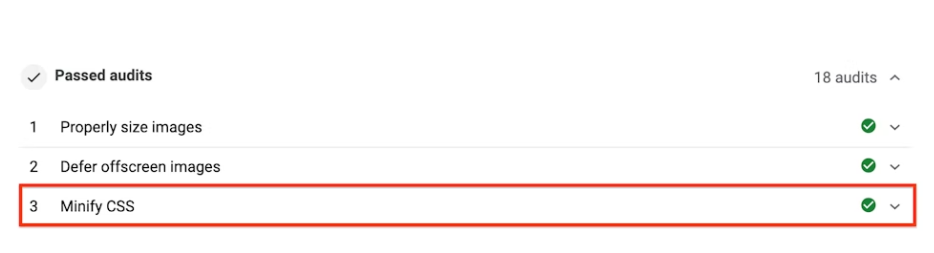
                The second is minifying CSS. Minification CSS files is a technique that reduces unnecessary code, comments, whitespaces, and indentation in CSS files. A professional web developer can safely remove unnecessary characters and reduce CSS file size without affecting website rendering. 

                If web developers minify CSS files, you will see that recommendation “Minify CSS” moved to the “Passed Audits” section of the Lighthouse report.

                Optimize JavaScript code

                JavaScript code is a critical part of modern website design. On the other hand, using JavaScript code may slow down a website’s loading speed.

                A web developer should analyze the Lighthouse report to fix JavaScript issues and speed up a website. There are most common issues and solutions.

                First, the JavaScript code used on the website is a significant source of tasks. What is a task? A task is any discrete piece of work that the browser does and impacts the website’s performance. It can be rendering, parsing HTML and CSS, and running JavaScript code.

                Some tasks can be too long (that take more than 50 milliseconds), and a web developer should break up such tasks. In other words, a web developer needs to divide a long task into smaller tasks that take less time using one of the task management strategies like the async attribute, manually defer code execution, yield only when necessary, and others. Choosing a strategy depends on the main website features you’d want to consider when managing tasks because it is about usability and how users interact with a website.

                Minification JS code is another way to improve a website’s speed. To minify JS code a web developer should remove whitespace and any code that is not necessary to create a perfectly valid code file.

                JS code compression is the process of modifying data using a specific algorithm. Most web developers use Gzip for server and client interactions, but Brotli is a newer compression algorithm that helps to achieve even better compression results than Gzip.

                Also, we recommend using modern JavaScript to avoid reducing the website’s loading speed.

                Modern JavaScript means syntax supported by all modern browsers such as Chrome, Edge, Firefox, and Safari. But using modern Java Script requires high-skilled web developers who have experience in advanced front-end and web app technologies.

                Move a website to better hosting.

                In some cases, the leading cause of slow website speed is hosting. A website owner must choose fast hosting to optimize the website’s performance.

                Several solutions can be used to host a website.

                Shared hosting is the most popular solution because it is cheap. But shared hosting means that you share the server’s CPU and RAM with many other sites that are also hosted on this server. If you need more RAM and CPU because your site attracts many visitors or use one of the modern frameworks, you need Virtual Private Servers (VPS) hosting or a dedicated server.

                Virtual Private Servers (VPS) and dedicated servers are faster than shared hosting. VPS  is fit needs of many business and e-commerce sites because it uses multiple servers for content distribution and provides your own part of the virtual server.

                Using a dedicated server is the most expensive solution because you need to rent or buy a server and pay for the system administrator’s services.

                Now alternative solutions are also available for website owners. You can use cloud solutions like Microsoft Azure, Google, or AWS. Cloud providers provide quality services that can scale on demand for your needs.

                Another alternative option is the serverless approach.

                Choosing a hosting provider is not easy but worth the effort.

                Conclusions

                Currently, a website’s loading speed is a vital factor that search engines assess, affecting website traffic and, as a result, business revenue.

                You can test your website speed using one of the tools to know if improvements are needed. 89 score and below means your site’s performance needs to be improved. Image optimization and minification of CSS and JS can speed up a website. But as you can see, it is not an easy task. 

                Also, hiring skilled web developers who can write quality, optimized code is important. Because it is an almost impossible job to optimize a website that was created by low-skilled web specialists. Re-developing the website from scratch becomes easier, faster, and cheaper in this case.