Stories

October 8, 2026

SHARE:

Vietnam is one of the world’s biggest coffee-producing countries, yet Thomas Vu rarely saw Vietnamese coffee given the same attention in North America’s specialty coffee scene.

That gap became the idea behind Hanoi Drip Coffee, a Vancouver-based Vietnamese specialty coffee brand that has grown into a multi-million-dollar cafe business in just over two years.

For Vu, the goal goes beyond opening more cafes. He wants people to see Vietnamese coffee differently and prove that a brand deeply rooted in culture can belong on a global stage.

Giving Vietnamese Coffee the Spotlight It Deserves

Vu grew up around the flavors and rituals that make Vietnamese coffee instantly recognizable, from strong Robusta to condensed milk and the slow drip of a phin. Yet despite Vietnam’s rich coffee history, he felt much of that story was still missing from mainstream specialty coffee culture.

That became the opportunity behind Hanoi Drip. Rather than recreate a traditional Vietnamese cafe, Vu and his team asked a bigger question: What could a global Vietnamese coffee brand look like today?

Their answer was to keep the parts of Vietnamese coffee they loved while presenting them for a new generation. Hanoi Drip serves coffee grown in Vietnam, including coffee from Đà Lạt, and puts Robusta, Vietnamese flavors, and phin brewing at the center of the experience.

Learning How to Grow Without Losing the Brand

Building the brand was one challenge. Learning how to grow it without losing what people connected with was another.

When Hanoi Drip was smaller, Vu and the other founders could be involved in nearly every part of the business. As more locations followed, they had to learn how to train teams, develop leaders, manage costs, maintain product consistency, and make sure customers still had a strong experience even when the founders were not there.

Mistakes have been part of that process, and Vu does not pretend otherwise. His approach is to treat them as useful information: fix the problem, build a better system, and move forward, a mindset that has helped Hanoi Drip expand into multiple locations alongside retail coffee, wholesale, and membership offerings.

Taking Vietnamese Coffee Beyond Vancouver

For Vu, some of Hanoi Drip’s most meaningful wins happen when someone tastes Vietnamese coffee for the first time and wants to know more. It also means hearing Vietnamese customers say the brand reminds them of home while still feeling like it belongs to their generation.

That connection has extended beyond coffee. During KOOLFEST 2025, customers purchased more than 1,600 Ube Coconut Coffee and Ube Milk drinks, helping Hanoi Drip raise over $5,500 for a local charity, while the company has also created jobs and collaborated with Asian-owned businesses and creators.

And Vu is still thinking much bigger. He hopes to bring Hanoi Drip beyond Vancouver to markets such as Toronto and Los Angeles, while showing other Asian founders that building something modern does not mean leaving their culture behind.

Learn more about Hanoi Drip and follow the brand as it works to take Vietnamese coffee from Vancouver to a wider global audience.

📍Website

Related Articles

Image Source: Shark Tank

Stories

Slime Company Started By High School Student In His Garage Made $1.2 Million Sales After Joining “Shark Tank”

Mark Lin was only 17 when he started selling food-scented slime out of his Burbank, California garage in 2020. 

He then won over venture capitalists on an episode of ABC’s “Shark Tank,” with his zeal for pitching and the amazing yield his company was generating, where $300,000 was a net profit out of the $540,000 in sales he obtained at the time.

With the assistance of a couple of his buddies, whom he employed for packaging and shipping, Lin, a high school freshman and novice in the industry, developed the slime successfully, enabling him to make $50,000 in sales in his first year of operation.

CNBC reports that Lin’s sales increased to $580,000 the following year.

Sliimeyhoney now sells edible and food-scented slimes with flavors like banana milk, hot cocoa, and birthday cake batter for between $10 and $16 per six-ounce jar utilizing Tiktok as his marketing platform.

The company consistently achieves sold-out sales for its weekly introduction of new products to its almost one million followers.

After a thorough negotiation with Kevin O’Leary and Daymond John, Lin secured $150,000 for 20% share from the two.

This, according to Lin, will be beneficial in moving his company from his garage into a warehouse and gaining mentorship while he still pursues his studies.

John was quoted saying “I believe in you, and we’re going to make sure you go to school, and I will help you with this business.”

Lin is now a first-year college student at UCLA with his company continuously rising.

Image Source: InvisaWear

Stories

Capitalizing On Her Advocacy For Women’s Protection, Young CEO Now Leading Safety Device Company Invisawear

Taking it from her unforgettable and scary experience involving safety and security, Rajia Abdelaziz realized the importance of women’s self-protection which made her put up Invisawear, now a leading safety device manufacturer.

Together with her best friend and now business partner Ray Hamilton, they designed a piece of wearable tech that allows the user to call for help and alert emergency contacts at a double-press.

InvisaWear is jewelry that can save lives. Although their components resemble ordinary accessories, they are actually safety devices supported by America’s top security supplier (ADT).

The devices have a secret panic button that can be set to dial 911, send a pre-programmed text message to five emergency contacts, and send a GPS location to the emergency services. They are worn on the body so they are nearly always available.

The co-owner was quoted saying “InvisaWear also partnered with ADT to provide access to video streaming, voice activation, and self-defense classes as a way of “equipping people to protect themselves,” 

Compared to a cellular phone, it is a more accessible safety device which comes in the form of a charm necklace.

Considering women’s safety as a very important issue, Abdelaziz rejected high-paying job offerings related to her electrical engineering training just to prioritize her advocacy even if she struggled with many challenges in starting it up.

Though laborious, Invisawear was able to raise millions of funds for the safety device.

Five years after its founding, the business has grown to produce more than just gold and rhodium-plated jewelry. It now makes fitness bands, hair accessories, and keychains, all of which have timeless appeal and fashionable, practical designs.

According to Abdelaziz in Forbes, several of their items are now also available in unisex versions since they discovered that safety wasn’t just important for women but also for some guys.

The business intends to grow in Europe and the Middle East and just announced a new cooperation with a Canadian security company.

Invisawear is a technical advancement that has significantly improved people’s lives.

Abdelaziz emphasized “One of the best moments of my life was the first time one of our devices saved someone’s life,” she says, “a young woman had been badly injured in a car accident and her keychain saved her life. Her dad was able to get to her and be with her while they waited for an ambulance, who knows how long it would have taken to find her otherwise.”

Image Source: Ben Marcum Photography

News

Christmas is Merrier at Mall of America With 6 Diverse St. Nicholas Including the First Asian Santa

After three long years of not celebrating Christmas the ‘usual’ way, children at the Mall of America (MOA) were finally sitting again in amusement and happiness on Santa’s lap. 

What makes the experience even happier and better is to have six different Santas whom children and parents can choose from in making The Santa Experience happen.

In 2016, Larry Jefferson became the first African American Santa Claus in MOA. 

Now, Jefferson will not be alone in completing the Christmas vibe as a diverse group of Santas will be working together to do the task. Among them are two African Americans and the first-ever Asian Santa Allan Siu, named “Santa Allan” in MOA’s record.

All of them are ready to listen to the Christmas wishes from young and young-at-heart people.

With two of the Santas able to speak both Spanish and Cantonese, it adds color in telling the children if they were naughty or nice.

“To run across someone who speaks your language, there’s kind of a bond there. Not only is the language a bond but there is also some sort of psychological bond,” Allan told Fox.

Image Source: ESQA

News

First Indonesian Vegan Cosmetic Startup Obtains $6 Million Funding From Unilever Ventures

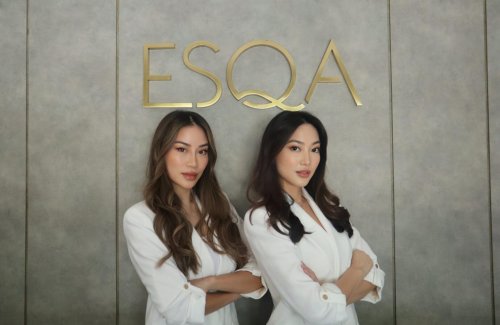
The first and top vegan cosmetics company in Indonesia, ESQA Cosmetics, raised $6 million in a series A round led by Unilever Ventures marking the latter’s first investment in the Southeast Asian beauty market.

In the said round, East Ventures also participated, the venture arm of the global consumer goods giant.

After spending over ten years living and working in Los Angeles, Cindy Angelina and Kezia Trihatmanto created ESQA in 2016, shortly after their return to Indonesia.

The two intended to redefine luxury cosmetic products and make them more widely available and reasonably priced.

With the acquired funds, the company plans to use the money to reach more cities and markets while also extending its omni-channel distribution.

Additionally, they want to expand their product offerings, foster talent development, and amplify their marketing initiatives.

Prior to this, the company reportedly increased its sales to Vietnam, Singapore, and Malaysia. 

TECHINASIA mentioned that one of the company’s expansion initiatives was to sell its goods through Sociolla’s physical storefronts, another East Ventures-backed startup.

Accordingly, the business stated that despite the pandemic, it had managed to turn a profit with its 120 vegan and Halal-certified products.

Avina Sugiarto, a partner at East Ventures, stated in Deal Street Asia that by having consistent profitability, they weren’t looking for high-quality, hyperlocal, and affordable beauty products.

She continued saying “We were certain that ESQA’s innovative, natural ingredients and wide-product offerings will propel ESQA to be a leader in the beauty market in Southeast Asia.”