Stories

March 17, 2023

SHARE:

Crystal was feeling emotionally and physically drained from her job before she finally decided to quit. She didn’t have any plans lined up when she did, which was very unlikely for her. So she decided to pursue something she’s passionate about – stickers and stationery.

Juice Box Club was molded out of creativity, perseverance, and determination. This small business has faced numerous hurdles along the way, from financial uncertainty to unexpected delays in product arrivals. But despite the challenges, Crystal has remained committed to her dream of sharing her unique designs with the world.

Crystal’s designs are inspired by real-life experiences, from personal passions like fitness and mental health to inside jokes with friends. And speaking of friends, Crystal recently launched a new collection of plushies called Boba Friends, inspired by her own friend group and their real-life pets.

Now, her small business is more than just a sticker shop. She is now designing and selling lifestyle items (glassware, tote bags, apparel) and even plushies! Let’s dive into the story of how The Juice Box Club was born.

HOW THE JUICE BOX CLUB CAME TO LIFE

The process of setting up my own stationery shop was very nerve-racking and exciting at the same time. When I first started off, I used Etsy and I had a lot of support from people back home in New York City, where I was born and raised. However, when I learned that it took a huge chunk of the profits, I took it off and started my own website. I registered my shop as an LLC because I felt like this was going to be a long-term commitment.

I decided to start my own stationery shop because it was always a hobby and passion of mine. I would always collect envelopes, paper, and stickers. 

The concept of The Juice Box Club came from some drawings I did and then while I was sharing it with my friend, we were messaging about a cute name. The Juice Box Club kinda reminded me a little bit of The Breakfast Club, an extremely memorable movie, and that’s what I wanted my brand to be.

OVERCOMING BUSINESS HURDLES

The challenges I have faced circled around finance, having too many ideas, running it by myself, products not arriving on time, machines not working, and rejection.

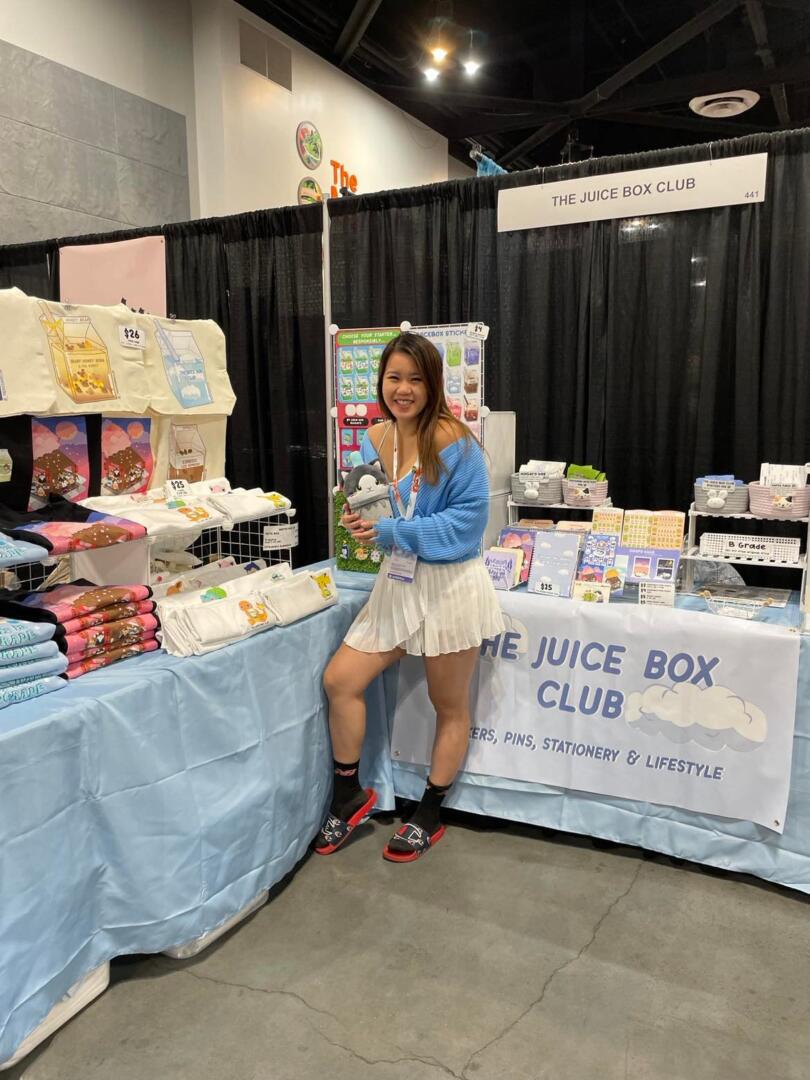
Finance — in terms of not knowing if I’ll make any sales this week or the next. I do sign up for a lot of in-person pop-up events! I rely on that more than my online sales since the internet nowadays is so funky with algorithms. I also like interacting with customers because they have an opportunity to get to know the brand firsthand.

Having too many ideas — definitely a challenge because I didn’t wanna grow too fast and then have a bunch of inventory. I used to work in fashion and I was used to always developing NEW items. I felt like I had to do the same with my brand, but I realized that I don’t and it’s okay to slow it down. 

Running the business by myself — also pretty hard! Sometimes I would ask my friends if they’d want to help me at bigger events. But most of the time, I’m a one-woman team. I had to do everything from designing, packaging, shipping, content creation, handling emails, etc.

Products not arriving on time — There are times when I outsource items since I don’t have the time or the tools or make them. When I first started, I outsourced my stickers and they were LATE by 1-2 weeks. There was also another time when all of my plushies came EARLY and I had to store 12 big boxes (1,200 plushies total) in my garage and some in my house. 

My Cricuit machine was not working in the beginning — I was making and hand-cutting all my stickers. I gave my Cricut a break and went back and tried it again until it finally started to work properly.. after 5 months.  

Rejection is something I dealt with a lot growing up, so I thought I’m okay with it by now. But getting rejected by big conventions or wholesale sites hits differently. However, I learned to see it as dodging a bullet. If it’s meant to be, it will be, maybe at the right time.

DESIGNS INSPIRED FROM LIFE

Everything designed in my shop all ties into my life somehow. When I first started, I had seven juice box designs. Six of them were themed — three were inspired by my personal passion for fitness/bodybuilding and the other three were inspired by the importance of mental health because I’m a very functional-anxious person and have a hard time relaxing. 

Some of my juice box designs were inspired by my texts with my friends so you might find cute and funny quotes on them. For example, “broke b*tch juice” was inspired by my convo with my bestie, Beth, we always talk about how things are so expensive and how we’re always broke. Or if you see the Pokémon x Soju collection, it was a merge of my childhood and adulthood — because I grew up playing Pokemon with my brother and spent my college years pounding shots of soju.

The Juice Box Club Pokémon x Soju Collection

THE BOBA FRIENDS

Growing up, I didn’t have a consistent group of friends. Most of them just either change or grow apart. But when I moved to California, I met my best friend who later on introduced me to my current friend group.

Some of us in the group have pets, so I then designed characters based on our pets, and their personalities reflect the owner! I called them Boba Friends because boba gatherings are one of the most common hangouts to do now! They have different flavors as well. I own the two cats, Platinum and Luna. My best friend Beth owns Sesame, a lionhead rabbit, and my friend Justin owns Kona, the Shiba Inu. Now none of us owns a bear or frog but I dedicated Ribberto the Frog and his personality to my late friend Josh because it was his favorite.

The Boba Friends Plushies

In the future, I plan to continue producing more drawings and products for The Juice Box Club. I hope to have my products in shops and stationery stores. I am also working on a YouTube channel to show my journey and reach more people.

Website: www.thejuiceboxclub.shop

Instagram: @thejuiceboxclub
Related Articles

tatler asia-jpeg

News

A Korean Immigrant’s Journey to Becoming a Beauty Industry Icon

Toni Ko is a first-generation Korean immigrant who has made an indelible mark in the business world as the founder of NYX Cosmetics and a champion of women-run brands.

Toni is the visionary behind NYX Cosmetics and a fierce advocate for women-run brands. With her relentless work ethic and unparalleled business acumen, she has carved a path to success that has earned her a well-deserved place among Forbes magazine’s Richest Self-Made Women.

Despite facing numerous challenges after moving to California in 1986, the language barriers and unfamiliar surroundings, she thrived on the difficulties and developed a resilient character. She drew from her family’s background in the cosmetics industry to launch NYX Cosmetics in 1999 with $250,000 in seed money from her parents. Her vision was to provide high-quality cosmetics at affordable prices, bridging the gap between luxury and affordability.

Toni used social media to propel NYX Cosmetics to remarkable success. The brand gained traction through partnerships with influential beauty creators on platforms like YouTube, capturing a younger audience and solidifying its place in the market. In 2014, L’Oréal acquired NYX Cosmetics for an estimated $500 million.

Driven by her passion for empowering women, Toni established the Toni Ko Foundation in 2014. Through this foundation, she supports organizations dedicated to uplifting underprivileged children and championing women’s empowerment. In addition, she actively invests in women-owned businesses through her venture capital firm, Butter Ventures, fostering the growth and success of fellow female entrepreneurs.

Toni has been lauded with prestigious accolades, including the WWD Beauty Inc. Brand of the Year award for NYX Cosmetics and her inclusion on Forbes’ esteemed list of Richest Self-Made Women. More than a businesswoman, Toni is a beacon of inspiration, paving the way for a future where women’s voices are amplified and their dreams are within reach.

Featured Image Source: Tatler Asia

The Fresno Bee-jpeg

News

Hmong Baker “The Brioche Lady” Opens Her Own Asian Grocery Store in Fresno

Renowned for her fluffy French bread, The Brioche Lady has returned, assuming a new role as the proprietor of an Asian grocery store.

While many people are familiar with Nubchi Thao for her delectable French brioche bread sold at farmers markets and her previous bakery, The Brioche Lady Bakery, she has now taken on the role of an Asian grocery store owner. Thao is of Hmong descent and was raised in France, where she acquired her expertise in baking French bread.

Located in Tarpey Village at the intersection of Ashlan and Clovis avenues, the newly opened store named TBL Asian Market is situated between the Arco station and the Sno-White Drive-In, replacing the former Golden Phoenix Asian Market, which was owned by Thao’s relatives.

According to Fresnobee, customers can now immerse themselves in a culinary journey spanning Filipino, Vietnamese, and various other cuisines. The store’s fresh vegetable section showcases an assortment of items, including fresh Thai peppers, okra, lychee, and rambutan—a peculiar fruit adorned with distinctive red whiskers.

The market boasts an extensive selection of noodles and rice, catering to diverse tastes. Moreover, the snack aisle entices shoppers with an array of treats sourced from several countries. From cookies originating from various regions to chocolate-dipped Pocky sticks, Japanese mochi desserts, and even wasabi peas, the store caters to a wide range of palates. Adding a touch of warmth and familiarity, one is likely to encounter the Thao family’s children among the store’s employees. 

In addition to on-site baking, Thao is exploring alternative avenues for customers to enjoy her beloved bread. She intends to introduce a brioche mix, empowering customers to bake their own loaf at home by simply adding eggs, water, and butter.

Furthermore, she is developing a larger version of the mix tailored for bakeries and restaurants. Additionally, Thao seeks to establish partnerships that would allow others to bake her recipe and serve the thriving Hmong community, which holds a strong affinity for her bread.

Featured Image Source: The Fresno Bee

NY Times-jpg

News

How Asian American Brewers are Celebrating Their Roots in Craft Beer

The craft beer industry in the United States has long been dominated by white owners, but a new wave of Asian American brewers is making their mark and infusing their heritage into their beers.

Although the number of Asian American-owned breweries remains low, their presence is steadily growing, challenging the prevailing demographics. These brewers are breaking cultural barriers and embracing their identities, creating unique brews that reflect their heritage.

One pioneering example is Highland Brewing in Asheville, North Carolina, which opened its doors under the leadership of Oscar Wong, a Chinese immigrant. Being one of the few Chinese Americans in the craft beer scene at the time, Wong faced the challenge of standing out in a predominantly white industry. Now, his daughter, Leah Wong Ashburn, serves as the CEO of Highland Brewing, continuing her father’s legacy.

Raymond Kwan and Barry Chan, owners of Lucky Envelope Brewing in Seattle, both children of Chinese immigrants, made a significant career change when they decided to pursue their passion for brewing. According to the New York Times, they took the leap and started their own brewery over a few beers one night.

Similarly, Youngwon Lee, the Korean American founder of Dokkaebier in Oakland, California, as featured also in Asian Hustle Network, drew from his heritage to create unique flavors. Collaborating with his white head brewer, they used elements from homemade kimchi to develop a kettle sour beer, infusing it with the sourness, chile, and ginger found in Korean cuisine.

These Asian American brewers are not only making their mark through their beers but also actively participating in efforts to diversify the craft brewing industry. While challenges persist, these brewers are toasting to a future where diversity and inclusivity thrive in the world of craft beer.

Featured Image Source: NY Times

dk4-jpg

Stories

The Fastest-Growing Asian-Influenced Craft Brewery Dokkaebier All Started with a Dream for More Representation In The Industry

Youngwon Lee is the founder and CEO of Dokkaebier, an Asian-influenced craft brewery in Oakland, California. Dokkaebier takes its name from the ‘dokkaebi,’ the mysterious, shape-shifting creatures found throughout Korean folklore. Myths describe them as mischievous spirits who love to eat, drink, and be in the company of others. 

Lee started Dokkaebier after he discovered only 2% of people in the craft beer industry identify as Asian American. He knew then that he had to take action. Over the last three years, he worked tirelessly to create craft beers that not only pair well with Asian food but can make craft beer more diverse and inclusive.

Founded only three years ago, Dokkaebier is already one of the fastest-growing craft breweries in the U.S. Lee and his team have earned more than $1 million in sales, which they expect to increase to $3 million at the end of this year.

Dokkaebier’s Asian-influenced craft beers are available in more than 400 locations, including Whole Foods Market, H Mart, and BevMo!, plus their new flagship brewery and taproom in Oakland, California. They plan to create more than 30 new craft beers, launch in another 10 states and expand their footprint to a whopping 5,700 locations by the end of 2024. 

Lee has more than a decade of experience in the alcohol industry and has finally created something uniquely his with Dokkaebier.

WHERE DOKKAEBIER CAME FROM

Although I have worked in the alcohol industry for most of my career, I spent much of it in South Korea. It was not until I started working in the beer industry in the United States that I realized I was the only Asian person. I quickly realized I needed to be the change. 

Not only was the craft beer industry missing out on some much-needed diversity, but it also lacked creativity from unique and differing perspectives and experiences.

I wanted to create the first Asian craft beer brand. Everything would be Asian-influenced, including the design, packaging, name, and branding. Most importantly, it would also have an Asian-driven taste. I wanted to be authentic to myself and bring my history and heritage to an industry I love.

I have my wife to thank for the name. One day,  she said, “Why not just name the brand after dokkaebi?” 

Dokkaebi loves to eat, drink, and play but hides during the day. It was perfect for a craft beer brand! The creatures also capture our heritage as Korean Americans, so we combined dokkaebi with beer and got Dokkaebier.

IT HAS ALWAYS BEEN A PART OF WHO WE ARE

Aaron Weshnak, our head brewer, and I know beer, but we knew we had to do a lot of experimentation to come up with something original and do it consistently. It has always been a part of who we are; we experiment, shape-shift, and try new things—just like the dokkaebi which inspired our name. We always look for that perfect combination of flavors to share with others. 

When we started our experiments, we knew we had to start with Asian cuisine. We used flavors and ingredients we grew up with, like bamboo tea, Szechuan peppercorn, and even kimchi, which remains one of our most popular craft beers today. Then, we started thinking about what makes a great dining experience. 

We think Dokkaebier should be the Asian-inspired complement to your meal, even if you are not eating Asian cuisine, and if you are, then certainly an Asian-inspired craft beer would be the cherry on top.  

IT WAS CHALLENGING TO GET SET UP ONLINE AS AN EARLY-STAGE ALCOHOL STARTUP

I founded Dokkaebier in early 2020, just before the COVID-19 pandemic. We decided to launch a pop-up taproom in San Francisco for our debut. We worked with a former chef de cuisine from the two Michelin-star-restaurant Saison to have the perfect food pairing. But the pandemic shut everything down. 

We quickly found a new way to get our craft beer to the fans we had made in such a short time. It was challenging to get set up online as an early-stage alcohol startup, but we overcame it because we are all “shape-shifters” as dokkaebis. 

We then started to sample our beer at local beer festivals and events in the San Francisco Bay Area. It was important for us to be a part of the community, especially in uncertain times. We donated food and beer to first responders at Kaiser Permanente in Santa Clara, California, and worked on exclusive collaborations with local Asian American community groups and nonprofits. We also proudly supply our beer to local small businesses, including many Asian restaurants all across California. 

We are proud that Dokkaebier is available everywhere from local grocers, such as Berkeley Bowl, Bi-Rite Market, and Gus’s Community Market, and national retailers, like BevMo!, H Mart, Whole Foods Market, and Total Wine & More.

MOST PEOPLE GET BACK INTO LINE THREE OR FOUR TIMES BECAUSE THEY LOVE OUR F LAVORS AND INGREDIENTS

We have been blown away by the support of craft beer fans and Asian Americans who credit Dokkaebier for giving them the confidence to try craft beer for the first time. Our reception has been overwhelmingly positive. 

At every beer festival that we go to, people line up to try our beer. Most people get back into line three or four times because they love our flavors and ingredients. We typically have the longest lines of any brewery at any event and have even been recognized as the top or must-see beer at the LA Beer Festival and SF Beer Week.

Dokkaebier is also an award-winning beer. Craft beer fans and alcohol industry experts have recognized us with medals and international awards. We earned best-in-class recognition at the World Beer Championships and have won 10 times at the 2021 and 2022 Annual Brewski Awards. In 2022, every one of our craft beers won an award, with our milk stout taking home Beer of the Year and our kimchi sour and yuza blonde winning platinum medals. It’s truly amazing to see what we’ve accomplished in a short time.

Finally, we have been hard at work making Dokkaebier more accessible to more people. Dokkaebier is now carried in more than 400 restaurants and retailers, and we expect to see sales skyrocket this year. 

MY INDUSTRY EXPERIENCE HAS ALLOWED ME TO FOCUS MORE ON INNOVATION

The alcohol industry is heavily regulated and very complex. Even in the craft beer industry, every aspect of the business can be a massive undertaking, from manufacturing, distribution, and sales to operating a taproom. Fortunately, I have a lot of experience in the industry and have been able to navigate it all easily.

My industry experience has allowed me to focus more on innovation, especially research, and development. I believe Dokkaebier focuses more on ingredients and flavors than other craft beer companies or breweries. In only three years, we have developed and released more than 40 original craft beers. 

We can experiment more freely with all sorts of ingredients and collect feedback from craft beer fans about the flavors they want in ways other beer companies could not. Our relationship with our customers and community makes it easier for our craft beer to stand out.

STAYING TRUE TO OUR ROOTS MEANS EXPLORING THE WORLD AND SHARING OUR SPIRIT WITH OTHERS

We want to establish Dokkaebier as a nationally renowned Asian craft beer brand. When someone mentions one of our core beers, such as kimchi sour, we want them to think, “Isn’t that from Dokkaebier”? 

We hope that one day, Dokkaebier will be a household name and synonymous with Asian craft beer. In the near future, we might also move beyond craft beer. Dokkaebier could also introduce adults to other alcohol, like spirits, with our Asian-influenced style.

As a company, Dokkaebier values adventurousness, shape-shifting, and indulgence. We want to be available in other regions and different types of alcohol, as it aligns with our adventurous and shape-shifting spirit. For us, staying true to our roots means exploring the world and sharing our spirit with others.

ADVICE FOR THOSE WHO WANT TO ENTER THE CRAFT BEER INDUSTRY

The alcohol industry can be challenging as an entrepreneur, especially as a startup founder. I recommend working at a craft brewery or alcohol company for at least a few months. It is a great way to get paid to learn and find a mentor.

As an underrepresented minority in the industry, do not be shy. Once you find an opportunity, look for ways to bring your unique perspective to the business. Combining your unique voice is an important step to differentiate your personal and future craft beer brand from everyone else.

CONNECT WITH YOUNGWON

Website: enjoydkb.com

Instagram: @dokkaebier