Stories

March 17, 2023

SHARE:

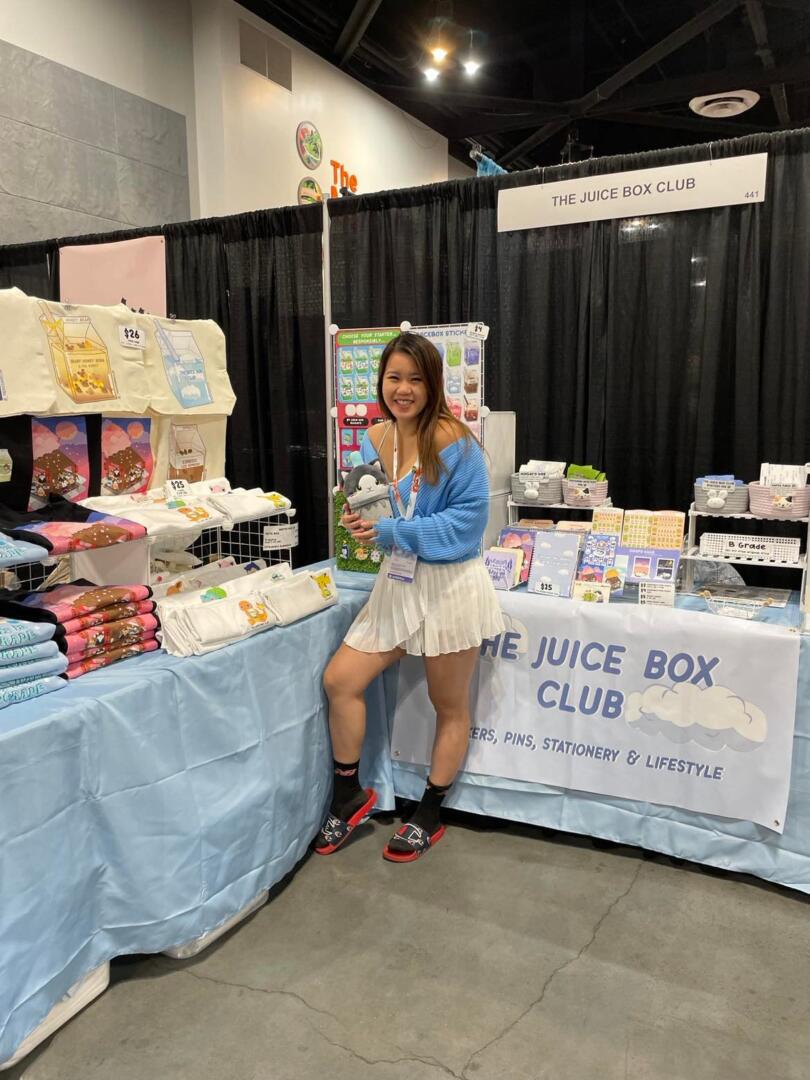
Crystal was feeling emotionally and physically drained from her job before she finally decided to quit. She didn’t have any plans lined up when she did, which was very unlikely for her. So she decided to pursue something she’s passionate about – stickers and stationery.

Juice Box Club was molded out of creativity, perseverance, and determination. This small business has faced numerous hurdles along the way, from financial uncertainty to unexpected delays in product arrivals. But despite the challenges, Crystal has remained committed to her dream of sharing her unique designs with the world.

Crystal’s designs are inspired by real-life experiences, from personal passions like fitness and mental health to inside jokes with friends. And speaking of friends, Crystal recently launched a new collection of plushies called Boba Friends, inspired by her own friend group and their real-life pets.

Now, her small business is more than just a sticker shop. She is now designing and selling lifestyle items (glassware, tote bags, apparel) and even plushies! Let’s dive into the story of how The Juice Box Club was born.

HOW THE JUICE BOX CLUB CAME TO LIFE

The process of setting up my own stationery shop was very nerve-racking and exciting at the same time. When I first started off, I used Etsy and I had a lot of support from people back home in New York City, where I was born and raised. However, when I learned that it took a huge chunk of the profits, I took it off and started my own website. I registered my shop as an LLC because I felt like this was going to be a long-term commitment.

I decided to start my own stationery shop because it was always a hobby and passion of mine. I would always collect envelopes, paper, and stickers. 

The concept of The Juice Box Club came from some drawings I did and then while I was sharing it with my friend, we were messaging about a cute name. The Juice Box Club kinda reminded me a little bit of The Breakfast Club, an extremely memorable movie, and that’s what I wanted my brand to be.

OVERCOMING BUSINESS HURDLES

The challenges I have faced circled around finance, having too many ideas, running it by myself, products not arriving on time, machines not working, and rejection.

Finance — in terms of not knowing if I’ll make any sales this week or the next. I do sign up for a lot of in-person pop-up events! I rely on that more than my online sales since the internet nowadays is so funky with algorithms. I also like interacting with customers because they have an opportunity to get to know the brand firsthand.

Having too many ideas — definitely a challenge because I didn’t wanna grow too fast and then have a bunch of inventory. I used to work in fashion and I was used to always developing NEW items. I felt like I had to do the same with my brand, but I realized that I don’t and it’s okay to slow it down. 

Running the business by myself — also pretty hard! Sometimes I would ask my friends if they’d want to help me at bigger events. But most of the time, I’m a one-woman team. I had to do everything from designing, packaging, shipping, content creation, handling emails, etc.

Products not arriving on time — There are times when I outsource items since I don’t have the time or the tools or make them. When I first started, I outsourced my stickers and they were LATE by 1-2 weeks. There was also another time when all of my plushies came EARLY and I had to store 12 big boxes (1,200 plushies total) in my garage and some in my house. 

My Cricuit machine was not working in the beginning — I was making and hand-cutting all my stickers. I gave my Cricut a break and went back and tried it again until it finally started to work properly.. after 5 months.  

Rejection is something I dealt with a lot growing up, so I thought I’m okay with it by now. But getting rejected by big conventions or wholesale sites hits differently. However, I learned to see it as dodging a bullet. If it’s meant to be, it will be, maybe at the right time.

DESIGNS INSPIRED FROM LIFE

Everything designed in my shop all ties into my life somehow. When I first started, I had seven juice box designs. Six of them were themed — three were inspired by my personal passion for fitness/bodybuilding and the other three were inspired by the importance of mental health because I’m a very functional-anxious person and have a hard time relaxing. 

Some of my juice box designs were inspired by my texts with my friends so you might find cute and funny quotes on them. For example, “broke b*tch juice” was inspired by my convo with my bestie, Beth, we always talk about how things are so expensive and how we’re always broke. Or if you see the Pokémon x Soju collection, it was a merge of my childhood and adulthood — because I grew up playing Pokemon with my brother and spent my college years pounding shots of soju.

The Juice Box Club Pokémon x Soju Collection

THE BOBA FRIENDS

Growing up, I didn’t have a consistent group of friends. Most of them just either change or grow apart. But when I moved to California, I met my best friend who later on introduced me to my current friend group.

Some of us in the group have pets, so I then designed characters based on our pets, and their personalities reflect the owner! I called them Boba Friends because boba gatherings are one of the most common hangouts to do now! They have different flavors as well. I own the two cats, Platinum and Luna. My best friend Beth owns Sesame, a lionhead rabbit, and my friend Justin owns Kona, the Shiba Inu. Now none of us owns a bear or frog but I dedicated Ribberto the Frog and his personality to my late friend Josh because it was his favorite.

The Boba Friends Plushies

In the future, I plan to continue producing more drawings and products for The Juice Box Club. I hope to have my products in shops and stationery stores. I am also working on a YouTube channel to show my journey and reach more people.

Website: www.thejuiceboxclub.shop

Instagram: @thejuiceboxclub
Related Articles

the guardian-jpg

News

Indian Immigrant Uncovers South Asian Stories Through Media Platform

Founded by Snigdha Sur in 2019, the Juggernaut is a subscription-based website that breathes life into forgotten histories and brings depth to current topics.

Sur was born in India and immigrated to the United States with her parents in 1990. Growing up in the Bronx and Queens, she experienced firsthand the lack of media outlets catering to South Asians of her generation. This led her to create a platform that would bridge the gap and provide authentic representation.

Sur’s journey towards launching the Juggernaut was marked by exceptional academic achievements and valuable professional experiences. After completing her undergraduate studies at Yale University, she embarked on a career in management consulting, working at prestigious firms like McKinsey & Company. She then pursued an MBA at Harvard Business School, where she honed her strategic acumen and entrepreneurial spirit.

Juggernaut’s mission is to uncover compelling stories that frequently go overlooked. The platform quickly gained traction, capturing the attention of a diverse audience eager for meaningful storytelling. 

Sur faced her fair share of challenges along the way. During the COVID-19 pandemic, Sur adeptly adapted the platform’s focus, demonstrating resilience and a commitment to delivering the content that resonates most with the Juggernaut’s audience.

Looking ahead, Sur envisions a future where the Juggernaut becomes a household name, synonymous with South Asian storytelling and expertise. Drawing inspiration from successful media ventures like the New York Times and the Athletic, Sur envisions a platform that collaborates with major productions, offers narrative consultation, and produces compelling content across various mediums. 

Featured Image Source: The Guardian

cnn-jpeg

News

TikTok Invests Billions to Drive E-Commerce Success in Southeast Asia

TikTok, the popular short video app owned by ByteDance, has announced plans to invest billions of dollars in Southeast Asia in a bid to boost its e-commerce business.

The move comes as TikTok aims to capitalize on its large user base in the region and address concerns over data security. With a collective population of 630 million, half of whom are under 30 years old, Southeast Asia represents a key market for TikTok, attracting over 325 million monthly visitors to the app.

Despite its impressive user numbers, TikTok has struggled to convert its popularity into significant e-commerce revenue in Southeast Asia, facing tough competition from established players such as Shopee, Lazada, and Tokopedia.

To address this challenge, TikTok CEO Shou Zi Chew revealed the company’s plans to invest billions of dollars in Indonesia and the broader Southeast Asian region over the next few years. While a detailed breakdown of the investment plan was not provided, TikTok intends to focus on training, advertising, and supporting small vendors interested in joining its e-commerce platform, TikTok Shop.

Chew emphasized that TikTok’s content is becoming more diverse as the platform expands beyond advertising into e-commerce. This evolution enables consumers to make purchases directly through the app during live streams. In Indonesia, TikTok’s largest market in Southeast Asia, the platform already hosts 2 million small vendors selling their products. The region’s e-commerce transactions reached nearly $100 billion in 2022, with Indonesia alone accounting for $52 billion of that figure, according to Reuters.

While Southeast Asian governments have not imposed major bans on government devices, TikTok has faced scrutiny regarding its content. In 2018, Indonesia briefly banned the app due to concerns over inappropriate content, while Vietnam has expressed concerns about the platform’s impact on local culture and tradition.

Despite the challenges posed by established competitors and data security concerns, TikTok remains committed to expanding its presence in Southeast Asia and tapping into the region’s vibrant e-commerce market.

Featured Image Source: CNN

the toronto star-jpg

News

Olivia Chow Makes History as First Chinese-Canadian Mayor in Toronto

Olivia Chow has emerged as Toronto’s first Chinese-Canadian mayor, ending over a decade of conservative rule and ushering in a new progressive era for the city.

Olivia was 13 years old when she first arrived in the country as an immigrant. Now, at 66, she has achieved a remarkable feat, surpassing 102 candidates to become Toronto’s first Chinese-Canadian mayor.  During her campaign, she focused on addressing the housing affordability crisis and pledged to raise the city’s low property taxes while providing support for tenants.

Upon taking office, Olivia faces opposition from Ontario’s premier, Doug Ford, who had warned that her victory would be an “unmitigated disaster.” Ford’s brother, Rob Ford, previously served as mayor of Toronto but faced controversy due to a video showing him smoking crack cocaine and a cancer diagnosis.

Throughout her career, Olivia has served as a member of parliament for the New Democratic Party, a Toronto city councilor, and a school board trustee. She also campaigned alongside her late husband, Jack Layton, who ran for mayor in 1991 and later became the leader of the opposition in Canada.

Olivia assumes the role of mayor at a challenging time for Toronto. The city, with a population of 2.7 million and a metropolitan area of nearly 7 million, is grappling with surging rents and a budget deficit of approximately $1.5 billion. Public safety concerns have also grown, particularly following a series of violent attacks on individuals using the public transit system.

According to The Guardian, Olivia is expected to be a champion for transit, as well as for walking and cycling – she does not have a driving license – and has promised to turn the tide on years of low-tax austerity politics enacted by her conservative predecessors.

Featured Image Source: The Toronto Star

vogue sg-jpg

News

Daniel Wu Shines Spotlight on Asian Cultural Icons in ‘American Born Chinese’

Daniel Wu, known for his roles in “Into the Badlands” and “Westworld,” is thrilled to bring Gene Luen Yang’s celebrated graphic novel, “American Born Chinese,” to a wider audience through its screen adaptation.

In a Zoom interview with UPI, Wu expressed his excitement about introducing the action-comedy story to a broader mainstream audience. The series, which is now streaming on Disney+, follows the journey of Jin Wang (played by Ben Wang), a teenager navigating the challenges of fitting in at his high school against the wishes of his traditional parents (portrayed by Yeo Yann Yann and Chin Han).

“The screen adaptation that was done by Kelvin Yu is amazing in integrating these three disparate story lines,” Wu said to UPI.

When Jin meets Wei-Chen (Jimmy Liu), a Chinese immigrant and the secret son of the legendary Monkey King (portrayed by Wu), their intertwined destinies set the stage for a captivating narrative.

Wu emphasized the significance of showcasing the iconic Monkey King character to a different audience, highlighting the character’s deep-rooted connection to Asian culture. By doing so, he hopes to reveal the Asian “superheroes” and idols from his own childhood to viewers who may not be familiar with these cultural icons. 

According to UPI, Wu found a personal connection to the Monkey King character as a father himself. Reflecting on his experiences during the COVID-19 pandemic and the challenges of distance learning, he humorously described himself as a “Tiger Dad.”

“I realized that I am part Tiger Dad and that I am strict on my kid and then I need to let go,” he said to UPI. “This character is dealing with that same situation.”

Wu is working alongside Michelle Yeoh who portrays Guanyin the Goddess of Mercy. Despite knowing each other for two decades, this project marked their first collaboration, making it even more special.

With its visually spectacular action sequences and heartfelt storytelling, the series offers a distinctive viewing experience that can be cherished by families across generations.

Featured Image Source: Vogue SG