Stories

September 2, 2023

SHARE:

Meet Jennifer Guo and Adam Szakacs, a couple with a creative vision. They wanted their child to cherish both her Chinese and Jewish roots, despite living far from family. So, they invented something extraordinary.

Inspired by their grandmothers’ unexpected friendship over mahjong, they reimagined the game as “Not Your Ma’s Jong.” This isn’t just any game; it’s a lively card version of mahjong that celebrates their backgrounds. It carries a powerful message – embracing your heritage and sharing it with others is something to be proud of.

Through Not Your Ma’s Jong, Jennifer and Adam hope to bring people closer. By sharing traditions, they aim to show that understanding each other’s cultures can create harmony.

In an exclusive interview with Asian Hustle Network, Jennifer and Adam share their journey in creating “Not Your Ma’s Jong.” Read through as we get a glimpse of how this game could help forge connections and celebrate diverse cultures.

Whether celebrating certain holidays, traveling together to meaningful places, or simply making a memorable recipe together, spending quality time together is the most important thing – and playing a game like Not Your Ma’s Jong is one way to spend time together.

Jennifer Guo

Can you tell us about the inspiration behind creating Not Your Ma’s Jong and how it connects to your Chinese and Jewish heritage?

Jenn: I learned how to play mahjong as a kid by watching my grandma play in China. Mahjong was a part of our daily lives and at the center of every family occasion. For me, mahjong is a way to connect with those memories.

My grandma used to split her time between her home in Xi’an, China, and Toronto where she stayed with my parents. In 2014, we brought my grandma to visit Adam’s granny who was healing from a hip injury. My grandma speaks only Mandarin, so we started by translating some simple hellos and small talk. It was so special to have them meet and communicate with each other.

Adam: At one point, we were talking about their respective cultures and the things they enjoy. My granny plays a lot of card games and also mentioned mahjong. Jenn’s grandma’s eyes lit up, and she told us about playing throughout her life. Jenn’s grandma is certainly the more avid player, but once my granny’s hip recovered and she was back home, they were able to play together.

Jenn: When I was pregnant with our first daughter in 2018, we started thinking about how we could connect our children with their cultures and heritage. I realized that living in Canada, they would not have the same exposure to Chinese traditions like mahjong as I did growing up. We started thinking about ways to honor the memories we had of growing up with our parents and grandparents and decided to create a simplified version of mahjong, which became Not Your Ma’s Jong.
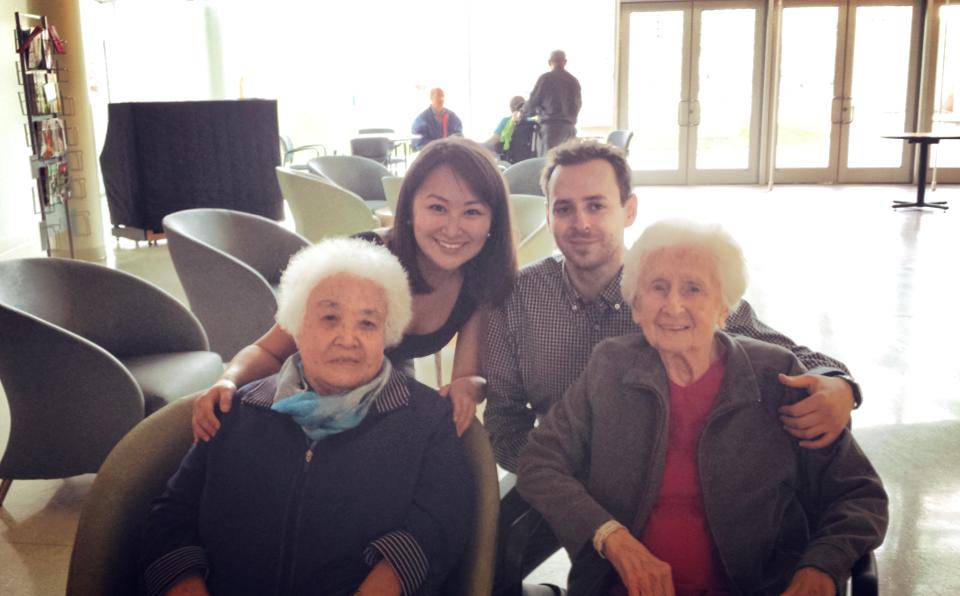
Jenn and Adam with their grandmas

As an international card game played around the world, what do you believe makes Not Your Ma’s Jong unique and appealing to a diverse audience?

Adam: We realized that even though our grandparents played mahjong and we played with them, we never played with our friends. We started asking around and kept hearing the same thing–most of our friends had heard of mahjong or seen their families play, but few knew how to play themselves.

Jenn: Not Your Ma’s Jong is a simplified version of mahjong, using 75 cards as opposed to 144 tiles in the traditional game. The rules are also simplified to create a fast-paced and fierce game that anyone can pick up quickly. When we started playing test versions with our friends, the excitement showed us we were on to something!

Could you share some examples of how you incorporated Chinese and Jewish emblems into Not Your Ma’s Jong? How do these cultural elements enhance the gameplay experience and foster cultural understanding?

Jenn: We wanted to dedicate the game to our grandmas. Many of the cards are symbols from growing up with them – some with Adam’s Jewish granny, and some with my Chinese grandma. Some center around memories of family feasts we’d eat together, gifts they’d give us, or how they made us feel – and while the symbols are specific to our cultures, those memories and feelings are universal.

Other cards are a bit whimsical – we imagined what their friendship could have been if they had lived near each other earlier in their lives. Things like doing tai chi together in a park, or building a muscular snowman together! We wanted to make them relatable for people who grew up in any culture, with special winks for people who grew up Chinese or Jewish.

What are some of the challenges you faced while developing and popularizing Not Your Ma’s Jong? How did you overcome those challenges, and what lessons did you learn along the way?

We had a lot of fun creating Not Your Ma’s Jong – but turning it into a product and making people aware of it was hard! After the initial Kickstarter campaign, the remaining games sat in our home for over a year until we started to get some media attention. We were fortunate that a blog article turned into a newspaper feature which then got our story and the game featured on TV twice! Hasbro took an interest at that point, licensed the game and it’s now being sold around the world. This showed us that people love it once they hear about it! That initial exposure was the hard part.

Can you share any heartwarming stories or feedback you have received from players of Not Your Ma’s Jong?

Adam: The initial Kickstarter campaign was a very personal experience for us. We received stories and repeat orders from some of the earliest recipients of the game, sharing how they played with their parents, children, or nieces and nephews, and how it caused them to reminisce about their own family stories when they saw the illustrations on the cards. We still love getting emails and seeing reviews from people who feel a connection to the game.

What advice would you give to individuals or families who are seeking to explore and celebrate their own cultural heritage? How can games like Not Your Ma’s Jong play a role in this process?

Jenn: It was important to us to not let our families’ cultures and memories fade away for our daughters, and creating this game was one of our ideas to do that. I know it’s hard – especially with young kids – but I think it’s important for parents to think back on their childhoods and choose some of the traditions that they want to continue with their children. Whether celebrating certain holidays, traveling together to meaningful places, or simply making a memorable recipe together, spending quality time together is the most important thing – and playing a game like Not Your Ma’s Jong is one way to spend time together.

In conclusion, what message or lasting impact do you hope Not Your Ma’s Jong will leave on players and society as a whole?

Jenn: The world can sometimes feel so divided – we hope people see this game, and the story behind it, as a small example of how people with different cultural backgrounds and languages can find common ground and develop a friendship. We hope they get a glimpse into Chinese and Jewish cultural experiences and relate with their own experiences too!

CONNECT WITH NOT YOUR MA’S JONG

Instagram: @notyourmasjong

Threads: @notyourmasjong

Website: notyourmasjong.com

Related Articles

Image Source: tribune.com.pk

News

Wu Makes Historic Singles Match Grand Slam Win For China In 63 Years

Wu Yibing became the first male tennis player from China in 63 years to win a Grand Slam tennis match with a victory in this year’s US Open beating Nikoloz Basilashvili 6-3 6-4 6-0 in the first round.

The 22-year-old didn’t compete from March 2019 to January 2022 owing to elbow, back, shoulder, and wrist injuries, with elbow surgery being the most significant. But Wu didn’t want to use his injuries as an excuse.

“I don’t really like to talk about those injuries in too (much) detail because every player has injuries,” Wu had told the ATP website, “The mental strength that you have to go through the pain is part of the game,” he added.

Wu’s compatriot Zhang Zhizhen nearly joined him in the second round, but Tim van Rijthoven saved seven match points in the third set to win 3-6 6-7(4) 7-6(9) 6-1 6-4.

But Wu hopes they can both raise China’s flag, “We are both pushing Chinese men’s tennis levels and we’re still young… I think we’re going to get to the Top 100,” 

As of this writing, Wu is ranked 173rd in the world for men’s singles. However, he hopes to move up the ranks when the 2022 U.S.

Image Source: Pesconex Facebook, Latest Chika

News, Stories

Young Siblings’ Pest Control Startup Skyrocketed In Two Months After Their Tiktok Video Went Viral

In just two months, these two siblings launched a pest control business that now serves a wide area around Quezon Province and nearby cities in the Philippines. They are like any other young adult with unfortunate life prospects, but they’ve persevered because they know there must be a better way. 

Pesconex Pest Control Services is owned jointly by its co-founders, Clark Dennies and Clarissa Joyce Demejes. They started their team with their cousin, who has grown to include four more members. 

What began as a training ground provided by their uncle is now a well-recognized business offering services with a quick phone call around Quezon Province and even reached the island of Palawan. 

Their uncle quickly loaned them money to help them start their own business. The effective pest control technique they use is a standardized process and is a convenient way to get rid of pests. They also made sure it is safe and environmentally friendly.

Within the first month, they serviced only a handful of clients, including a few homes, small sari-sari stores, and some bakeries — their parents even drove them to their clients. Nowadays, certain large companies and grocery stores are among the few that hire the team. 

Their success and customer acquisition began when Clarisse posted a TikTok video demonstrating the service they are providing. Many netizens have praised what the two have been doing, and some are so impressed that they would like to utilize their services. 

In just two short months, the siblings have established themselves financially and have also acquired their company car with their first significant earnings successfully.

Instead of focusing on the possibility that the endeavor will be unsuccessful, Clarissa encourages taking the risk. “Manifest that your business will be successful, do your best to succeed.” — she added. 

Image Source lawmagazine.bc.edu

Stories

Asian-American Woman in Law On Finding Her Voice That Lead To Her Success In The Courtroom

When looking at an Asian-American woman, certain implicit biases exist. They are often judged as being too meek, timid, or passive to achieve their goals. They may be held back by such an evaluation, preventing them from realizing their full potential.

It was difficult for Asian-American lawyer Debra Wong Yang to speak up throughout her early career. In the long run, she realized that her inability to stand up for herself did not only hurt her but also her clients.

“Eventually, we all find a voice — my advice is to just make sure the one you ultimately adopt is actually yours,” she advised in her essay published by Law360.

Yang graduated from law school in 1985 when women were still relatively powerless in the legal field. Since she was still working toward the goal of following the path she had chosen, she has faced many challenges along her journey. She has witnessed it all, from the very traditional Chinese upbringing she received to the various sacrifices, frustrations, and challenges she must face on a day-to-day basis in her chosen field.

After years of practicing law and facing challenges in the courtroom, she came to a number of important realizations that helped her become a successful attorney. She remembered when she thought up some strategies that she hoped would assist her in communicating effectively with others. 

Yang also tried to conquer her fear, and her motivation helped her cope with the situation and make further progress. With a lot of the many books she has read on leadership, she knows she has finally found her own approach to developing herself. 

She aspires on detailing how she was preparing for her court session with an outline of her questions and concerns, and other litigants will be able to better manage their time with counsel. She realized she was getting better at defending her clients in court because she was able to keep her attention solely on the issues and evidence in her case.

When she was currently going through a period of learning and challenges, she learned that holding a position of authority does not guarantee respect from subordinates. She came to understand that one of the responsibilities of a leader is to address concerns raised by those who doubt one’s abilities.

In her courtroom sessions, Yang strongly suggests analyzing the situation first and looking for authentic solutions carefully. She strongly believed that the solutions to some problems sometimes are not immediately obvious and have never been tried before, or that it’s extremely straightforward. However, she is challenged to keep turning the issue over and over in her mind until she begins to see it from a new perspective.

Yang also stressed the importance of having mentors to turn to for advice and insight. She was assertive in her belief that one should be guided by the process of sitting down, thinking it through, and acting in a way that is most beneficial to them. She went on to say that if the message comes from within, the receiver will perceive it as more genuine and at ease.

In 2002, She was appointed by President George W. Bush as United States Attorney and became a former judge serving the Los Angeles County Superior Court. The fact that her success can be attributed to her strong leadership and the bravery that she possesses as an individual is a reason why she wields her power. 

Not only does Yang share her own experiences, but she also provides valuable advice that other women can use to advance their careers. She stated, “My wish for each of you is that you will be brave when facing self-doubts, challenges, and obstacles. That you will dig deep, reach out if needed, do the research, make the tough decision and not be afraid of losing.”

The fact that Yang, an Asian American woman-in-law, was able to take control of her power demonstrates that one’s race should not determine the opportunities available to them or the path they choose to take in their professional advancement. However, by maintaining a positive attitude and giving oneself the power to make decisions, one will be able to live up to the standards and goals that have been established to assist in one’s own success.

Image Source: IGO online shop Ph Instagram

Blogs, Development, Ideas, Stories

Teen Student Entrepreneur Earns Millions Through Online Business Thanks To Mother’s Mentorship

16-year-old Irish Oloris from the Philippines has not only been successful in launching her beauty products business, but she also inspires others to follow their dreams and make them a reality. 

She wasn’t interested in starting her own business when she was young, but after being mentored by her entrepreneur mother, she learned the strategies and tried them. Today, she was able to make her first millions from the sale of skincare and other beauty products in her online shop Irish White Corp.

Irish has decided to invest in land in Zambales, Philippines, and is now a property owner at a very young age. With her motivation and inspiration, she desires to continue her online business to generate additional funds for her college education.

The young CEO encourages other young people like her to dream big and begin early. One of her favorite quotes is ‘Dream at a very young age,’ because for Irish there are no limits to dreams. She thinks it’s wise to lay the groundwork for future success by first focusing on the little things.  

Irish proved that any young person with an entrepreneurial spirit can establish a business at any age. Can you imagine what you could accomplish if you get going right this minute?