Stories

November 4, 2025

SHARE:

When Nisha Desai and Alice Zhang met at Harvard Business School, neither of them expected that a casual conversation about their frustrations with therapy would spark the idea for something much bigger.

As they juggled graduate school and their own mental health, they often felt therapy wasn’t built for people like them – they spent more time explaining their background to their therapists than actually healing. 

They realized it wasn’t just them – there’s a gap in mental healthcare that left many in the Asian and multicultural community feeling unseen and misunderstood.

That shared realization became the seed for Anise Health: a platform built to make therapy culturally attuned, accessible, and truly effective for the AAPI community.

A Problem They Both Knew Too Well

Before their paths crossed, both founders had already seen the same issue from different directions.

Nisha, who grew up in Florida in a family of healthcare entrepreneurs, had always been drawn to questions of access and equity in care. After studying finance and marketing at the University of Pennsylvania’s Wharton School and earning her MBA from Harvard, she worked in healthcare investing and later in digital product management at Humana. It was there, while helping build a mental health app, that she started hearing a troubling pattern from thousands of users – the same barriers she had personally faced.

Nisha recalls that people weren’t saying therapy didn’t work. They were saying it didn’t fit, that they didn’t feel understood.

Alice, meanwhile, came to the same conclusion through her own deeply personal experiences. Born in China, raised across Japan and Canada, and now based in New York, she calls herself a “third culture kid.” Her multicultural background gave her adaptability, but also a sense of never fully belonging anywhere.

That feeling resurfaced when she sought therapy during business school. Despite being fluent in English, she found herself translating her own emotions for her therapist – explaining why criticism from parents felt like love, or why pursuing excellence felt non-negotiable.

Alice remembers feeling exhausted after each session, explaining her background again and again, and leaving each time feeling unseen.

Alice Zhang (left) and Nisha Desai (right)

Building a Culturally Grounded Model of Care

After that pivotal conversation at Harvard, the two women began mapping out what culturally attuned mental health care could look like. They spoke to clinicians, patients, payors and community leaders, testing how cultural nuance could be integrated into evidence-based therapy and coaching.

They envisioned a new kind of care model: one that didn’t require clients to educate their therapists or set aside their cultural identity at the door. Instead, therapy would start from a place of understanding.

“Alice and I really built Anise to be what we believe our community has needed during our upbringing. What we kind of wished for ourselves through our own personal journeys with therapy.”

But building what didn’t yet exist came with challenges. They had to prove — to investors, clinicians, and even the broader healthcare system — that cultural context wasn’t just a “nice to have,” but essential to effective care. Many mental health professionals hadn’t been trained to deliver culturally adaptive therapy, so Anise Health had to design that framework from the ground up: provider training programs, accurate diagnostic tools, tailored care plans, curated resources and a scalable model for personalized, culturally attuned care.

Their persistence paid off. What started as late-night brainstorming sessions between classes evolved into a fully fledged mental health platform that blends clinical rigor with cultural empathy.

Growing the Movement

Since its founding, Anise Health has facilitated over 10,000 paid appointments and built a network of 60+ licensed providers across multiple states. The company is now expanding through insurance partnerships that make culturally attuned care more affordable and accessible.

Behind the scenes, Nisha leads operations and product design, while Alice drives partnerships and provider training.

Their complementary strengths, coupled with a shared sense of purpose, have helped Anise Health raise $6.4 million in funding and gain recognition as one of the top 10 most innovative Asian Pacific-led companies to watch by NYSE, Y Combinator, and Gold House.

Redefining the Future of Mental Health for Asian Communities

For both founders, Anise Health’s success goes beyond numbers. It’s about shifting how mental health is understood and delivered, starting with a community that has long been underserved and stigmatized.

“Our goal isn’t just to make care available,” Nisha says. “It’s to make it effective, culturally relevant, and sustainable within the healthcare system.”

By creating a new gold standard of culturally attuned care, Nisha and Alice aren’t just helping Asian Americans access therapy that finally feels like it speaks their language – they’re reimagining what inclusive mental health care can look like for everyone.

Learn more about Anise Health at anisehealth.co

Related Articles

Image Source: Chinese Parade / Mark Andrew Boyer / KQED

News

Rich Ting Leads First San Francisco’s Chinese New Year Parade After Pandemic

Chinese American actor Rich Ting will serve as the grand marshal of San Francisco’s Chinese New Year parade in 2023.

The 42-year-old was reared by an athletic family, was born in Torrance, California, and spent time growing up in both Southern and Northern California.

Not only did he focus on being an athlete growing up, but also trained to be a Hollywood actor just what he always dreamed of. He made this goal come true by appearing in several films and TV shows, including Chicago P.D., NCIS: Los Angeles,  and Salt.

Succeeding Daniel Wu in leading the city’s Chinese New Year’s Year of The Rabbit parade, Rich stated “I am beyond words to express my gratitude for including me in such an iconic cultural celebration” in The San Francisco Standard.

The Chinatown exhibition will be celebrated for the first time since the pandemic with Harlan Wong serving as the parade’s director. Harlan Wong revealed that several rabbit sculptures will be placed throughout the city as part of the festivities and then sold at auction to benefit charities.

Michelle Yeoh, Jon Chu, and Mayor London Breed were hailed as grand marshals in prior years.

The Lunar New Year will be celebrated on January 22 at events hosted by the Chinese Chamber of Commerce, although festivities will get underway at Chinatown’s Flower Market on January 14.

On February 3, the Miss Chinatown Pageant will take place the day before the parade.

Image Source: Strait Times

Stories

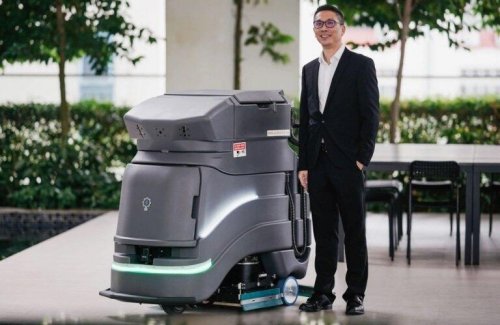
What Motivated A Cleaner To Become Singapore’s Primech Services & Engineering CEO

Starting out poor and being dumped by a girl because she saw no better life with a cleaner is truly a successful and inspirational story for a man who now makes fortune.

Instead of getting frustrated, Vernon Kwek used his heartbreak and the discrimination he went through from his girlfriend who chose a university guy over him as a motivation of working hard and striving further in life.

The 48-year-old is now Singapore’s Primech Services & Engineering CEO who owns a 10% share in the company.

Simultaneously, Vernon also runs A&P Maintenance Services and Maint-Kleen, two other cleaning companies handling some of the biggest companies in Singapore, including Changi Airport Group, with over 3,000 employees under his power.

Vernon was born to a humble family. When he was barely 13 years old, he helped his father find a new job after losing the latter’s job as a salesman.

After his father was accepted as a cleaning supervisor, Vernon manifested his hard work and family-orientedness by helping his father in cleaning toilets and offices during the weekends.

A year after, he gave up school just to work as a full-time cleaner to help his family. Being a responsible teenager, he was shortly promoted to cleaning supervisor at the age of 14.

“I asked the manager if he was sure. My dad became a supervisor only when he was 40. I was only 14. But he said: ‘Don’t worry. You have your dad’s genes. He has leadership qualities, you should have the same too,’” Vernon shared in Strait Times

Later on, he was again promoted to a higher position as a senior supervisor until he finally became the company’s CEO.

Nevertheless, Vernon experienced many downfalls in his journey but never lost hope as he was determined to have a better life. Now, he is a successful family man with four kids.

Image Source: Weilyn Chong Linkedin

Stories

A College Freshman’s “Failure Class” Podcast Project Paved Her Way To Times Square

When Weilyn Chong’s name and photo appeared on a Times Square billboard from the Nasdaq Tower, it instantly went viral, inspiring many young Singaporeans to pursue entrepreneurial endeavors.

Weilyn acknowledges the value of entrepreneurship in Southeast Asia despite the fact that the majority of her work with founders is focused in the US.

Growing up, 20-year-old Weilyn Chong has lived from one place to another between Singapore, Hong Kong, and the Netherlands which made her immersed in varied cultures.

Weilyn’s global exposure enabled her to be more flexible in dealing with many kinds of people especially since their family annually joins in Singapore Global Network events.

Despite their frequent moves, Weilyn’s mother made sure to give them a strong sense of connection to their roots by taking them to see their grandparents, spending time with family, and eating Singaporean food. 

The Singaporean third-year economics student at Princeton University expressed how being among passionate individuals inspires her.

Weilyn started a podcast about women entrepreneurs with her failure project for “The Other ‘F’ Word” class when she was still a freshman, and she has since enjoyed it.

Together with her high school friend Ali Debow, she even converted it into a regular extracurricular activity by co-founding The Entrepre女ers Network, a podcasting startup that connects and promotes female entrepreneurs with topics including design, young changemakers, and Gen Z female founders.

Weilyn wants to increase the visibility of female business owners and give them connections opportunities. Her team has spoken with over 130 creators in a year and increased their listenership and social media reach to 30,000.

She said that they hope to get young females to dream of being an entrepreneur and understand that entrepreneurship doesn’t have to look a specific way.

Learning that bias happens between genders in the global arena as only 2% of total venture capital funding goes to women because they are women, she attended a conference put on by the Nasdaq Entrepreneurial Center (NEC) to address the complex issue of inequity in venture for entrepreneurs of color and women entrepreneurs.

There, she met people from the Center and expressed her interest to get involved in the work they do in any capacity. 

She was asked to join the NEC board in order to represent Generation Z and put a spotlight on young entrepreneurship.

“I grew up thinking those two things are mutually exclusive – either you do charity work or you make money. But what we’re seeing is that you can raise a lot of money and make a positive impact on the world,” she said on CNBC.

Image Source: Taho Klasiko

Stories

Former Teachers Went Outside of Their Comfort Zones, Found Success in MilkTea-Inspired Taho Shop

Both Filipino educators, Camille Ona and Marvin Paclibare found a different world and passion out of their classrooms during the pandemic as teachers-turned-entrepreneurs and founders of Taho Klasiko, a special milk tea-inspired taho shop.

Breaking free from their first-loved profession, the two sculpt their name as entrepreneurs who choose to walk into another path.

Marvin said that if not for the pandemic, he might still be teaching now just as he thought that he would forever be a teacher. He also added how he realized that there is a bigger world waiting outside teaching.

With people becoming more mindful of their health, especially during the onslaught of the pandemic, Marvin said that they eyed tendering a healthier version of milk tea.

The shop attained a grand slam as the two now earn 6-digit figures per month, an amount far way better than their incomes as teachers in the Philippines.

Camille mentioned in an interview that although they are still passionate about teaching, they just chose to be practical.

Despite entering the world of business, the owners are still having the vibe of teaching as entrepreneurs who are open to learning and improving their craft just like when they were still teaching.

They also shared that they hired working students to extend help to them. 

As a piece of advice, the former teachers said that would-be entrepreneurs should go outside of their comfort zones and open their ways to many opportunities.

“It’s not enough that you have a dream; you need to work hard to make it a reality,” Camille added.