Stories

July 5, 2023

SHARE:

Christine Holmes grew up feeling different from her peers due to being a bi-racial Taiwanese-American.

Christine was often referred to as either the “Asian girl” by her non-Asian friends and the “White girl” by her Asian peers until eventually, they referred to her as “Whasian girl,” which she liked because it represented both of her ethnicities.

She struggled to embrace her cultural background and wished to be fully White. It took her long before she learned to love her identity and cultural heritage, but she did.

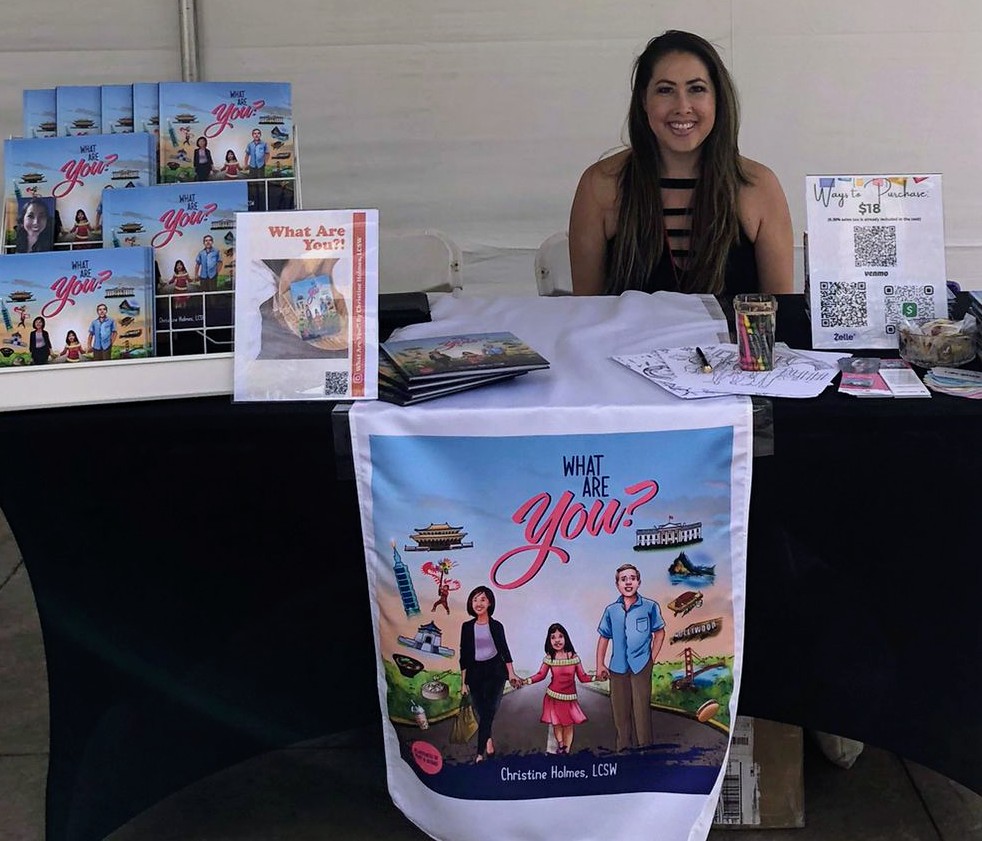
Inspired by her personal experiences, she wrote the book “What Are You?” to provide representation in children’s literature for mixed Asian children.

The book touches on her personal struggles with food and language, among other things, and highlights the importance of representation in literature for children who come from mixed cultural backgrounds.

GROWING UP WITH A TAIWANESE MOTHER AND AN AMERICAN FATHER

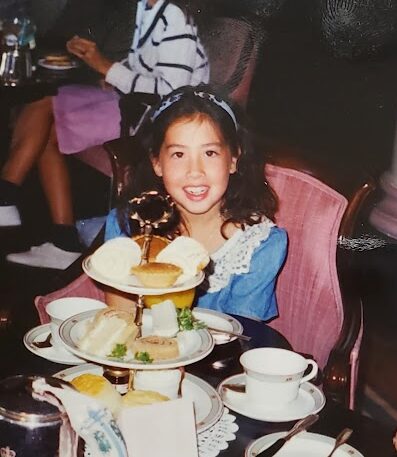
Christine grew up in Irvine, CA, where the population was predominantly white and Asian. However, there were very few mixed children, which made Christine feel very different from her peers, who were either fully White or fully Asian.

As a child, Christine was immersed in Chinese School, Chinese Choir, piano, and tennis, which made her feel even more different from her peers because most of them were fully Asian.

Christine’s dad, who is White but very much into Asian culture and a world-renowned Master of martial arts, made it very important for them that Christine knew her Taiwanese/Chinese culture. Christine’s mother cooked Chinese food for most dinners, and her first language was Mandarin.

Their home is filled with beautiful Chinese/Taiwanese antiques, and they used to visit Taiwan every year until Christine was in junior high/high school.

CHALLENGES OF BEING THE “WHASIAN” GIRL

“To my White friends, I was the Asian girl but to my Asian friends, I was the White girl until I got into high school and my friends decided to call me the “Whasian” girl which I preferred since it represented both of my ethnicities.”

Christine felt different from everybody growing up, which bothered her internally. In fact, she had a teacher in her Chinese school that wasn’t very nice to her because even though she can speak Chinese, she couldn’t write Chinese like the other children. This treatment left Christine feeling isolated and alone, until she eventually quit Chinese school altogether.

Her non-Asian friends also often made comments about the food her mom would bring to potlucks or the bags she would use to pack her lunch, making her feel ashamed of her culture. When her mom spoke Mandarin, her non-Asian friends would be offended and ask why she had to speak Mandarin in front of them. She would have to explain that it was sometimes easier for her mom to speak in her native language than speak English. This made her feel uncomfortable, and she would get angry at her mom for it.

At this point, she wished that she was fully White, perhaps because being White and blonde was considered the most beautiful when she was growing up. Her mom used to pinch her nose to make it look “taller” and less stubby like a typical Asian nose. Some of her Asian peers even told her that she was lucky to be at least half White compared to them being fully Asian.

THE TURNING POINT

It wasn’t until college that she fully embraced being mixed and started to love her identity. Christine found herself surrounded by a diverse group of friends who not only accepted her but celebrated her mixed heritage.

“In college, most of my friends were either mixed or of different ethnicities other than White or full Asian. And, they embraced me,” she said.

They appreciated the unique perspective she brought to the table and encouraged her to embrace her identity. For the first time in her life, Christine felt truly proud of her background and of who she is.

WRITING THE BOOK

Christine’s personal experiences served as the inspiration behind her book, “What Are You?” which is a story about her life growing up as a mixed-race individual in a predominantly white and Asian community.

Christine wrote the book when she realized there were no books that represented mixed Asian children. Despite being able to find books for her own children who are half Black, she couldn’t find any for children who were mixed Asian. So, she decided to create something that represented kids like herself.

“I think the part of the book that was most emotionally challenging was writing about the food and how embarrassed I was about my mom packing me Asian food even though I secretly loved it.” Christine admits to feeling a lot of guilt now as an adult for all the times she blamed and got mad at her mom as a child.

REPRESENTATION IN CHILDREN’S LITERATURE

Christine strongly believes in the power of representation and the need for diverse books that accurately reflect the experiences of mixed-race individuals. Having grown up without any books that reflected her own identity, she recognizes the importance of seeing oneself represented in literature.

She saw firsthand how much her own children appreciated books with characters that looked like them and had similar cultural backgrounds. Writing her book, “What Are You?”, she received overwhelming positive feedback from other mixed Asian individuals who wished they had a book like this when they were children.

Despite increased awareness and acceptance of mixed-race identities in modern times, Christine recognizes that children may still struggle with their identity and the pressure to choose one ethnicity over the other. Her book seeks to empower mixed-race children to embrace and celebrate all aspects of their identity.

OVERJOYED BY THE POSITIVE FEEDBACK

Christine initially had doubts about the book’s reception due to her own insecurities about putting herself out there. However, the encouraging and uplifting words from her readers have exceeded her expectations.

“I was featured on a TikTok page, twice, by someone with 1 million followers, who’s sister bought the book for her. She shared that my book had emotionally resonated with her in many ways. It was then that I realized the impact that my book has had on some people.”

HOPE FOR THE FUTURE

Christine hopes that her book will inspire readers to embrace their identity, no matter where they come from. She wants readers to know that they don’t have to choose between different cultural backgrounds and can be proud of their unique mix.

“I hope they embrace their cultural background, and they are proud of their roots.”

By highlighting her personal experiences, Christine hopes her book will contribute to a larger conversation about identity and belonging in our society today, and ultimately help break down barriers and build more inclusive communities.
CONNECT WITH CHRISTINE

Website: publishyourgift.lpages.co/christine/

Instagram: @whatareyoubook  

Facebook:  What Are You? Book

TikTok: @whatareyoubook 

Related Articles

Image Source: Shark Tank

Stories

Slime Company Started By High School Student In His Garage Made $1.2 Million Sales After Joining “Shark Tank”

Mark Lin was only 17 when he started selling food-scented slime out of his Burbank, California garage in 2020. 

He then won over venture capitalists on an episode of ABC’s “Shark Tank,” with his zeal for pitching and the amazing yield his company was generating, where $300,000 was a net profit out of the $540,000 in sales he obtained at the time.

With the assistance of a couple of his buddies, whom he employed for packaging and shipping, Lin, a high school freshman and novice in the industry, developed the slime successfully, enabling him to make $50,000 in sales in his first year of operation.

CNBC reports that Lin’s sales increased to $580,000 the following year.

Sliimeyhoney now sells edible and food-scented slimes with flavors like banana milk, hot cocoa, and birthday cake batter for between $10 and $16 per six-ounce jar utilizing Tiktok as his marketing platform.

The company consistently achieves sold-out sales for its weekly introduction of new products to its almost one million followers.

After a thorough negotiation with Kevin O’Leary and Daymond John, Lin secured $150,000 for 20% share from the two.

This, according to Lin, will be beneficial in moving his company from his garage into a warehouse and gaining mentorship while he still pursues his studies.

John was quoted saying “I believe in you, and we’re going to make sure you go to school, and I will help you with this business.”

Lin is now a first-year college student at UCLA with his company continuously rising.

Image Source: InvisaWear

Stories

Capitalizing On Her Advocacy For Women’s Protection, Young CEO Now Leading Safety Device Company Invisawear

Taking it from her unforgettable and scary experience involving safety and security, Rajia Abdelaziz realized the importance of women’s self-protection which made her put up Invisawear, now a leading safety device manufacturer.

Together with her best friend and now business partner Ray Hamilton, they designed a piece of wearable tech that allows the user to call for help and alert emergency contacts at a double-press.

InvisaWear is jewelry that can save lives. Although their components resemble ordinary accessories, they are actually safety devices supported by America’s top security supplier (ADT).

The devices have a secret panic button that can be set to dial 911, send a pre-programmed text message to five emergency contacts, and send a GPS location to the emergency services. They are worn on the body so they are nearly always available.

The co-owner was quoted saying “InvisaWear also partnered with ADT to provide access to video streaming, voice activation, and self-defense classes as a way of “equipping people to protect themselves,” 

Compared to a cellular phone, it is a more accessible safety device which comes in the form of a charm necklace.

Considering women’s safety as a very important issue, Abdelaziz rejected high-paying job offerings related to her electrical engineering training just to prioritize her advocacy even if she struggled with many challenges in starting it up.

Though laborious, Invisawear was able to raise millions of funds for the safety device.

Five years after its founding, the business has grown to produce more than just gold and rhodium-plated jewelry. It now makes fitness bands, hair accessories, and keychains, all of which have timeless appeal and fashionable, practical designs.

According to Abdelaziz in Forbes, several of their items are now also available in unisex versions since they discovered that safety wasn’t just important for women but also for some guys.

The business intends to grow in Europe and the Middle East and just announced a new cooperation with a Canadian security company.

Invisawear is a technical advancement that has significantly improved people’s lives.

Abdelaziz emphasized “One of the best moments of my life was the first time one of our devices saved someone’s life,” she says, “a young woman had been badly injured in a car accident and her keychain saved her life. Her dad was able to get to her and be with her while they waited for an ambulance, who knows how long it would have taken to find her otherwise.”

Image Source: Ben Marcum Photography

News

Christmas is Merrier at Mall of America With 6 Diverse St. Nicholas Including the First Asian Santa

After three long years of not celebrating Christmas the ‘usual’ way, children at the Mall of America (MOA) were finally sitting again in amusement and happiness on Santa’s lap. 

What makes the experience even happier and better is to have six different Santas whom children and parents can choose from in making The Santa Experience happen.

In 2016, Larry Jefferson became the first African American Santa Claus in MOA. 

Now, Jefferson will not be alone in completing the Christmas vibe as a diverse group of Santas will be working together to do the task. Among them are two African Americans and the first-ever Asian Santa Allan Siu, named “Santa Allan” in MOA’s record.

All of them are ready to listen to the Christmas wishes from young and young-at-heart people.

With two of the Santas able to speak both Spanish and Cantonese, it adds color in telling the children if they were naughty or nice.

“To run across someone who speaks your language, there’s kind of a bond there. Not only is the language a bond but there is also some sort of psychological bond,” Allan told Fox.

Image Source: ESQA

News

First Indonesian Vegan Cosmetic Startup Obtains $6 Million Funding From Unilever Ventures

The first and top vegan cosmetics company in Indonesia, ESQA Cosmetics, raised $6 million in a series A round led by Unilever Ventures marking the latter’s first investment in the Southeast Asian beauty market.

In the said round, East Ventures also participated, the venture arm of the global consumer goods giant.

After spending over ten years living and working in Los Angeles, Cindy Angelina and Kezia Trihatmanto created ESQA in 2016, shortly after their return to Indonesia.

The two intended to redefine luxury cosmetic products and make them more widely available and reasonably priced.

With the acquired funds, the company plans to use the money to reach more cities and markets while also extending its omni-channel distribution.

Additionally, they want to expand their product offerings, foster talent development, and amplify their marketing initiatives.

Prior to this, the company reportedly increased its sales to Vietnam, Singapore, and Malaysia. 

TECHINASIA mentioned that one of the company’s expansion initiatives was to sell its goods through Sociolla’s physical storefronts, another East Ventures-backed startup.

Accordingly, the business stated that despite the pandemic, it had managed to turn a profit with its 120 vegan and Halal-certified products.

Avina Sugiarto, a partner at East Ventures, stated in Deal Street Asia that by having consistent profitability, they weren’t looking for high-quality, hyperlocal, and affordable beauty products.

She continued saying “We were certain that ESQA’s innovative, natural ingredients and wide-product offerings will propel ESQA to be a leader in the beauty market in Southeast Asia.”