Stories

August 29, 2024

SHARE:

Navigating the world of law and order as an Asian American can be convoluted. However, as John D. Tran Talks about working with start-ups like AHN, overcoming industry barriers, and the power of mentorship.

A fun fact that encapsulates John’s impact is that he was the trademark attorney who helped protect and register the ASIAN HUSTLE NETWORK name back in 2019—a contribution that underscores his dedication to empowering the Asian American community.

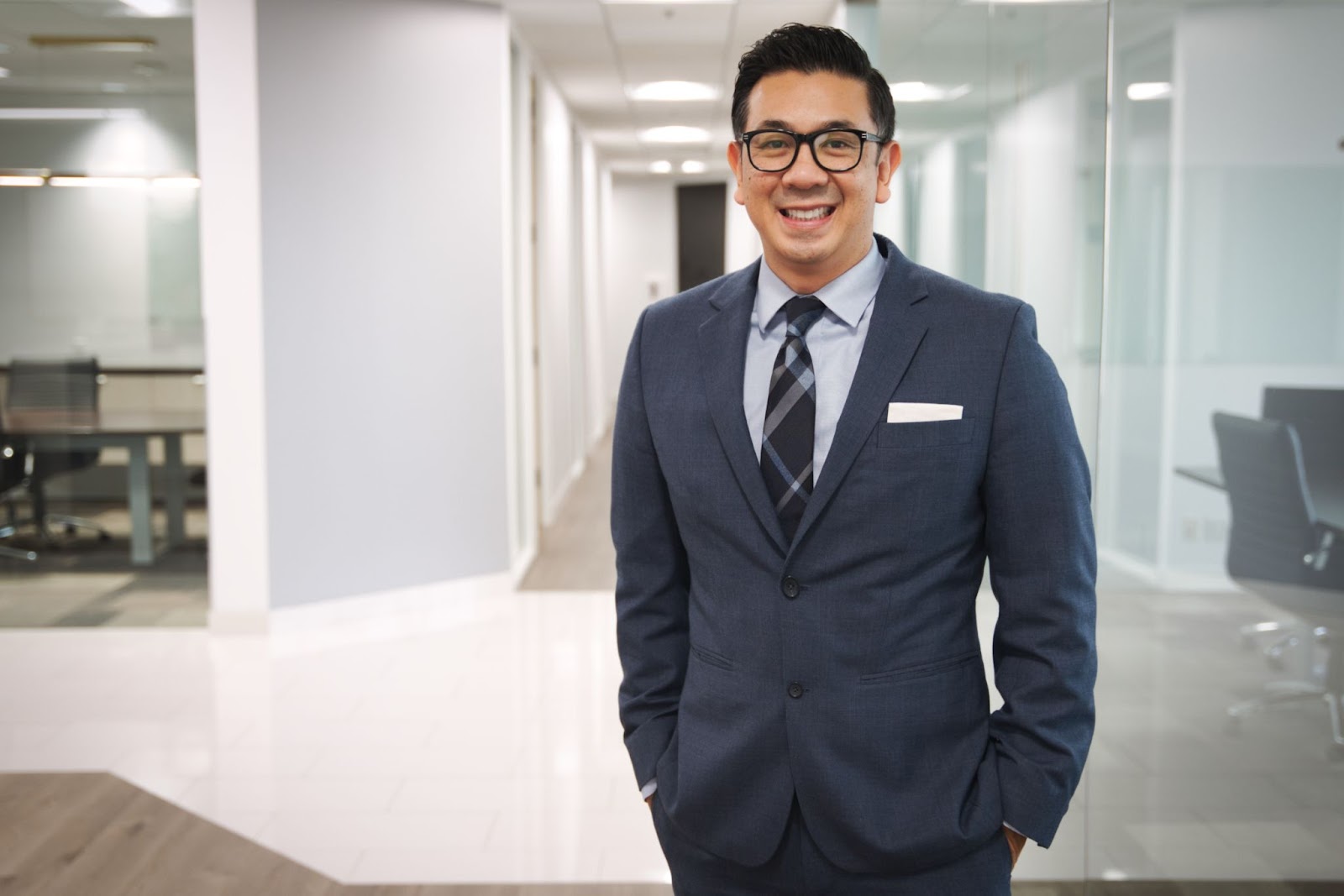
As a Partner at the Rhema Law Group®, John has spent over 20 years working as a Registered Patent Attorney, Intellectual Property Counsel & IP litigator, driven by a mission to aid startups & emerging companies navigating the complex business world. 
Finding Balance & Purpose in the Madness

In 2012, with the arrival of their boy-girl twins, John and his wife Rosalind Ong switched gears. Both seasoned lawyers at larger firms, the duo seized this joyful moment and joined forces to partner at a private law firm, Rhema Law Group, which specializes in intellectual property, business, and corporate law. While people may think being a lawyer trades much of one’s freedom for endless tedious readings into acts and regulations, John finds a nice work/life balance being a “cool” dad to twins (double the coolness), playing basketball, and being an avid sports fan, but finds ultimate enjoyment in spending time with friends and family.  

Protecting the Interests of Start-Ups & Emerging Businesses

Working as a lawyer for startups can be tough, considering how new and fragile they are in the market. While his work requires a focus on quality, integrity, and community, John treats startups with extreme care and attention, prioritizing personalization and case-by-case flexibility for each of his clients. He understands that these new businesses often operate on tight budgets, but also wants his clients to recognize the importance of investing in intellectual property protection right from the start. 

This is not just about legal protection—it’s an act of partnership, building relationships with the clients, getting to know who they are, and helping them grow. John said in an interview with AHN:

“With start-ups, even those backed by investors or venture capitalists, you’re usually dealing with a limited budget that needs to be responsibly allocated across various areas, such as R&D, marketing, sales, employment, and more. A good IP attorney will understand these constraints and focus on identifying the core IP of the start-up that needs to be protected from the outset while determining which IP can be addressed later.

Also, we find it important to conduct IP ‘think tank’ sessions, where we work closely with our clients to identify what protectable IP the company has and then develop an overall IP portfolio strategy. From trademarks, patents, copyrights and even trade secrets, approaching a business’s IP ensures that the start-up’s IP is properly protected at every stage of its growth. It’s incredibly rewarding to work with start-ups and emerging companies, watching them grow and mature over the years, and being a small part of their journey to success.”

John finds pride in working with primarily Vietnamese, Asian and minority-run companies.  His client list ranges from the small entrepreneur with an idea to multi-million dollar manufacturers with hundreds of employees working overseas. 

Building Leaders and Communities

His legal acumen has been shaped by mentorship, as he profoundly affirms his gratitude and advocacy for what mentorship has given him, “I think mentorship is so important, and I wouldn’t be where I am today without being fortunate enough to be mentored by some great people in my life, both professionally and personally.”

Above all, mentorship is not just a veteran-novice work of professional guidance, but, to John, it is a way of personal growth for everyone involved. This mindset coheres with his work ethic, where he hones his expertise (as startups can be quite a hard case to crack, your honor) while supporting their growth. 

“Mentoring builds up individuals, individuals build up communities, and communities raise families, support businesses, and can become the social networks that bring people together. For me, personally, mentorship has been a valued and rewarding part of my life. My wife and I have been fortunate to mentor several individuals for over 15 years, many of whom we met while volunteering at a leadership camp for foster care and at-risk teens.”

For John, mentorship is about time, consistency, and authenticity—qualities he embodies both professionally and personally.

“One particular mentee has become a little brother to me. We have mentored Salesi since he was 12, and then he served in the Army after high school and later worked at our law firm as a paralegal. Now, we’re proud to say that he has just been accepted to law school on scholarship! He was the first in his family to graduate from college and is now on his way to becoming a lawyer. Watching him grow and being there with him through the years has been such a rewarding experience, and it truly highlights the power of mentorship.”

A photo of John D. Tran (L) with his mentee who served in the Army and has just been accepted to law school on scholarship.

Navigating the Legal Landscape as an Asian American

Now, let’s get to the part where most Asian parents will be intrigued to see—being an Asian American attorney. There’s nothing that excites them more than when their kids come home and say “I want to be an attorney.” Respect, stability, and profitability—needless to say more. However, as an Asian American attorney in a predominantly white male-dominated industry, John has faced a sense of isolation and underrepresentation within the industry, forging the urge to always have to outperform himself. 

“I remember the first time I appeared in court on a case—the judge looked at me, smiled, and asked if I was still in law school because I looked so young (haha). It’s that Asian curse! But thinking back now, although there have been great strides made in recent times, the legal industry is still greatly underrepresented when it comes to Asian American attorneys. In my field of intellectual property law, I primarily practice before the federal courts, which are still largely dominated by older white males. That’s just the way it is, and as an Asian American attorney, you can sometimes feel like you’re the only one and feel pressure to prove that you belong in such a competitive space.”

John has overcome them by focusing on his craft and building a reputation for doing great work. John’s advice to aspiring legal professionals all comes down to self-awareness and passion, emphasizing the importance of choosing a practice area that aligns with one’s strengths and personality, as well as the value of giving back through mentorship and community service.

“Matching your personality and skill set to a particular area of law is often overlooked. For example, if you’re an extrovert who likes to be ‘in the action’ of things, becoming a transactional attorney who drafts contracts and agreements at your desk all day may not be the best fit for you. Conversely, if you’re more of an introvert, choosing to become a litigator where you’re in court frequently and presenting oral arguments to a judge or jury may not be a good fit either… Additionally, I think serving on some non-profit organizations and local organizations are things that help provide joy & fulfillment, including what we talked about earlier regarding the power of mentorship.”

Connect With John D. Tran / Rhema Law Group®

“One thing I love about the law is that, for the most part, it is impartial.  So, if you’re a good attorney doing great work, it doesn’t matter if you’re white, black, brown, or blue,, there’s no limits to what you can achieve and accomplish.”

X: @patentjt

Website: www.rhemalaw.com 

Contact:  jdt@rhemalaw.com | 949-852-4430 

Related Articles

Image Source: Las Vegas Review Journal

Uncategorized

Patricia Lee Sculpts History as First Black Asian American To Succeed Seat F In Nevada Supreme Court

Following her victory over the other two candidates, Patricia Lee made history by becoming the first Black and Asian American attorney to hold the vacant Department F seat on the Nevada Supreme Court.

Lee was chosen by Gov. Sisolak from among the candidates put out by the state Judicial Selection Committee to take the place of Justice Abbi Silver, who resigned from her position due to “unexpected circumstances” and a desire to spend enough time with her family.

Being an attorney in Las Vegas, Lee contended with Washoe County District Judge Scott Freeman and Clark County District Judge Tierra Jones.

The Reno Gazette-Journal cited Sisolak saying, “I am thrilled and honored to appoint Patricia to serve on the Nevada Supreme Court. The breadth and depth of her skill set, as well as her personal and professional experience, make her an excellent addition to the State’s highest court.”

Lee will begin serving her term in January 2025 and must run for reelection in two years in order to preserve her position.

Lee’s mother, a native South Korean, and father, an African-American soldier, brought her up in South Korea. She majored in psychology and communications at the University of Southern California, where she also participated in the Black Students’ Union and had her first political experience.

She started working at Hutchison & Steffan in 2003, concentrating on family law, trademark law, medical claims billing, and business and commercial disputes. She later joined the firm as a partner.

Lee is a skilled attorney with a history of being chosen as the chair of the Nevada Crime Commission by the then-Gov. Jim Gibbons, a volunteer with the Children’s Attorney Project in Las Vegas who advocates for abused and abandoned children, has handled pro bono cases at the Legal Aid Center of Southern Nevada.

Nonetheless, Lee is not just a dedicated lawyer but also a devoted family woman being a mother to Brianna and Devin, and a wife to Ronnie.

Image Source: South China Morning Post

Uncategorized

Bankrupt Chinese Restaurant Owner Bounces Back To Pay $6.4 Million Debt Through Sausage-Selling

“We are born with nothing. Why be scared of starting all over again?” says Chinese Tang Jian after starting up a street food stall in Hangzhou, China following his business bankruptcy which left him with $6.4 million.

At 52, the former millionaire Chinese restaurant proprietor is positive of earning funds to pay his multi-million debt by selling barbecued sausages.

Thus, his optimism put netizens in awe as a person, who despite losing his 16-year-old business venture and everything he had because of the unsuccessful investment in the landscape engineering industry, is still hopeful of being able to recover from the downfall.

Tang was once a successful businessman starting at the age of 36. However, because of the fruitless outlay, he was compelled to sell everything he founded through his business including his restaurants, homes, and cars.

Still unable to pay his debts in full, Tang decided to put up the small-time sausage-selling business.

Tang proudly exclaimed that “Every sausage is genuinely filled with meat, and there is no starch in it. When compared with those sold in amusement parks or markets, ours will make you feel safer,” as quoted in South China Morning Post.

Upon knowing that his story trended in social media, Tang explained that it was because all of us face our own challenges in life, however, we must always have that strong spirit of winning each battle. 

He also said that he is really determined to settle his debts although still uncertain when it would be.

Tang shared that bravery is a key to overcoming hardships and going on in life and that we should always seek strength, especially during hard times.

Uncategorized

Virginia Embraces Diversity and Korean Culture, Celebrates First Kimchi Day

Being home to one of the biggest Korean communities in the nation, Virginia had its first-ever Kimchi Day on November 22, through the Korean American Women’s Association.

Held at the Good Shepherd Evangelical Church in  Springfield, the festivity was materialized especially for this motive: acknowledge kimchi as a nonnative dish in Virginia which is specially imported for the increasing number of Korean American citizens in the country. It also reflects how the state has embraced diversity.

During the celebration, roughly 150 people of different colors converged to make their own kimchi, following the traditional and neat process of kimchi preparation. 

Originally, families and acquaintances converge to happily prepare the ingredients, store them in jars, and place them underground for fermentation producing a savory, piquant, and sugary kimchi. This is done every November, a month after harvesting cabbage.

On the other hand, it was officially moved to be celebrated in January through Irene Shin (D), the foremost Korean American servant in the House of Delegates, who acquired two-way support for her proposition.

For Koreans, kimchi is beyond being a cuisine. It narrates Korea’s past, its folks’ tenacity, and its landscape which Koreans are more than proud of. Kimchi is a celebration of family and blessings.

Northern Virginia and Annandale seem to be “Korea Towns” as Korean establishments like diners, worship places, food markets, bakeries, and beauty shops in Hangul inscriptions are all over. The state and Korea have found strong connections with each other that Fairfax County Economic Development Authority can even be found in the latter’s capital.

A Korean American mentioned how Kimchi Day appreciates the essence of exporting not only the product but of Korean culture; a manifestation of how the US whole-heartedly accepted acculturation.

Image Source: Tufts Daily

Uncategorized

Sunil Kumar To Sit As The First Person Color President of Tufts University in 2023

The Board of Trustees commissioned Indian politician Sunil Kumar as the 14th president of Tufts University, Massachusetts in 2023 succeeding President Anthony P. Monaco, after the latter’s 12-year term.

Kumar is currently a provost and Vice President for Academic Affairs at Johns Hopkins University and was once the dean of the University of Chicago Booth School of Business with a Ph.D. in electrical engineering and is a competent operations manager.

The head of the commission on presidential search and BOT, Peter Dolan, proudly exclaimed that Kumar’s never-ending dedication to providing first-rate tertiary education and extraordinary track in leadership, teaching, and interpersonal skills are essential as a presidential successor. 

Furthermore, Kumar’s colleagues at Johns Hopkins mentioned him as a wholesome partner and co-worker who has the distinct qualifications of an outstanding leader.

Looking back at how Kumar started, he is a son of a police officer who attained his master’s in Computer Science Automation at the Indian Institute of Science, Bangalore two years after he completed his bachelor’s degree at Mangalore University in 1990. While having his master’s, he met a professor from the University of Illinois who enlisted him in the prestigious university for a doctorate program which he finished in 1996.

Kumar had his first teaching experience at Stanford Graduate School of Business where he exclaimed how was amazed to be paid for the work he is passionate about and after more than a decade there, he became the Dean of the University of Chicago Booth School of Business, leading him to the provost and senior vice president posts in Johns Hopkins in 2016.

Nonetheless, he said that being a mathematician served him well in his profession.

Prior to being named as the new president, Kumar already has his eyes on Tufts because of its pursuit of serving not just those who are inside the school but the wider community outside its premises.

As the newly-elected leader to sit on July 1, 2023, Kumar’s mission is to reach out to people to a greater degree by giving them an opportunity to know the school by experience and make that experience extraordinary.