Stories

July 18, 2025

SHARE:

For Nan Lin, entrepreneurship isn’t just business; it’s freedom. A freedom earned through sacrifice, relentless execution, and a refusal to accept the limits of a broken system. As the founder of Kaizen Capital and 4DIFY, Lin is reimagining the housing industry, tackling its inefficiencies with cutting-edge technology and a bold vision. His mission? To build stronger homes faster, at lower costs, empowering communities and challenging the status quo.

From Immigrant Roots to Visionary Leadership 

Lin’s journey began at age 10, when he immigrated to America with his mother. While adapting to a new country, he was inspired by his loving parents’ sacrifices, which shaped his relentless drive. “I saw the lengths they went to give me a better life,” Lin says. “Their love and dedication became my compass.” Years later, that resolve led to the creation of Kaizen Capital, where he transforms underutilized properties into vibrant housing solutions: ADUs, subdivisions, condo conversions, and luxury short-term rentals. By unlocking hidden value in land, he delivers market-rate and affordable housing that strengthens neighborhoods.

But Lin saw a deeper problem: traditional construction is slow, costly, and vulnerable to fire, pests, and natural disasters. Frustrated by an industry stuck in the past, he founded 4DIFY to lead a new era of construction through 3D-printed concrete homes.
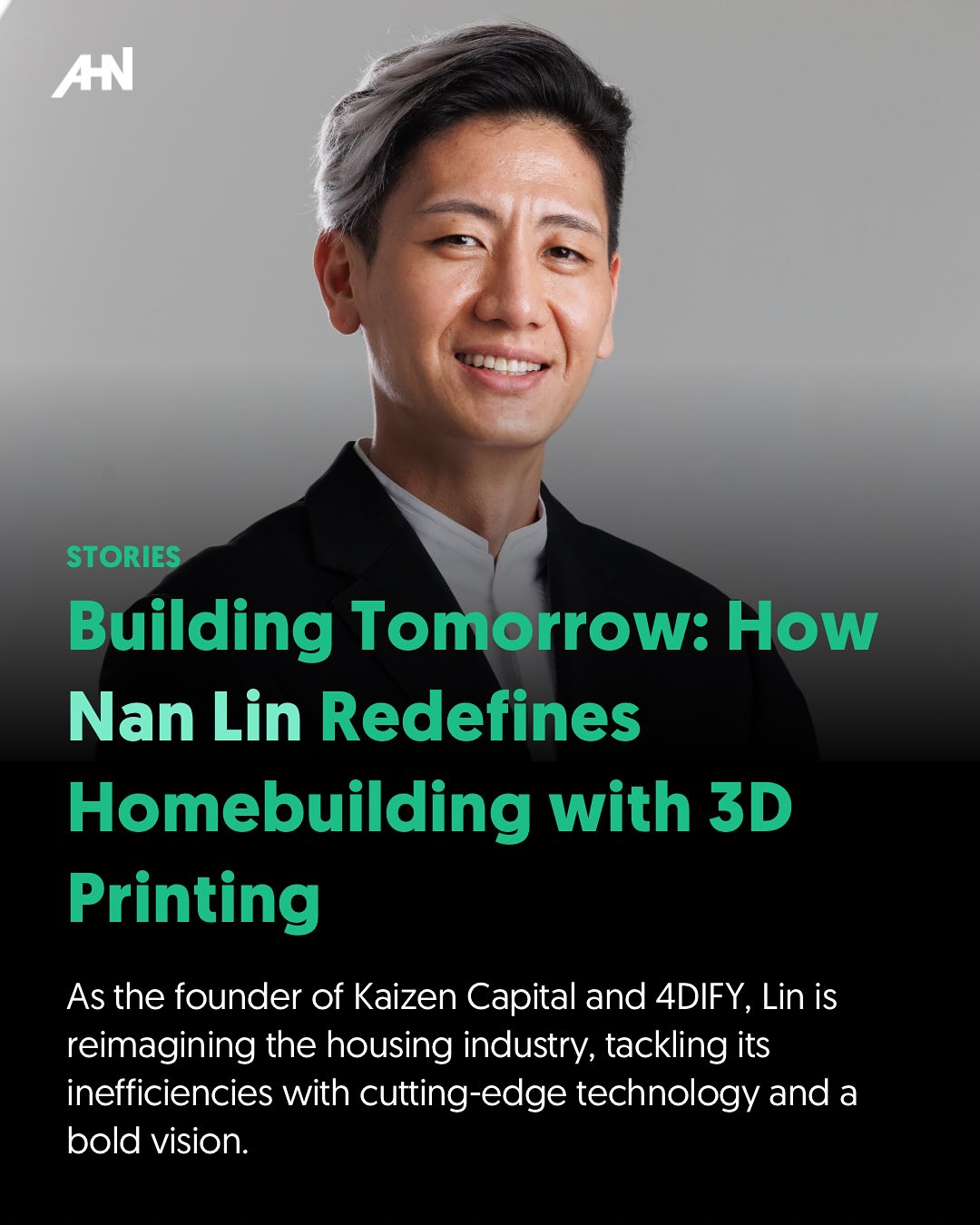
Nan Lin | Founder and Principal of Kaizen Capital and 4DIFY

3D Printing: The Future of Housing, Today

Lin’s vision for 4DIFY was sparked by a frustrating reality: “Wildfires destroy neighborhoods every year, yet we keep building stick-frame homes that burn like kindling,” he says.

After visiting several 3D printer manufacturers, Lin partnered with New York–based SQ4D. It took nearly a year to secure exclusive licensing rights, navigate regulatory hurdles, and obtain building permits, but he got it done.

Now, 4DIFY is building California’s first community of 3D-printed concrete homes. As this article goes live, their first printed home is nearing completion, despite heavy regulations and a steep learning curve. The team is already outperforming traditional timelines and cost benchmarks. The second and third homes will soon print simultaneously, targeting completion in two months, effectively one home per month at under $200 per square foot.

Despite challenges as an Asian immigrant, Lin managed to transform them into motivation and success. 

“We’re aiming to build at half the cost and in a quarter of the time,” Lin says. “That’s not a dream. It’s the direction we’re heading.”

Built with concrete, reinforced with rebar, and topped with metal roofs, these homes are resilient against fire, wind, earthquakes, mold, and pests. They’re also designed for long-term savings, with lower maintenance, less waste, and reduced energy and insurance costs.

“Critics doubted it would work,” Lin reflects. “But seeing is believing. This is the future.”

A Philosophy of Purpose and Resilience

Lin’s journey has been marked by relentless challenges, some seemingly insurmountable. “Obstacles never stop,” he admits. Yet he transforms adversity into opportunity, fueled by a positive mindset, solution-driven focus, and disciplined execution. His trusted team is his backbone. “No one succeeds alone,” he says. “My team turns the impossible into reality.” This resilience shapes his leadership, blending bold vision with purposeful action to create opportunities, particularly for communities long excluded from wealth-building. “Housing isn’t just a product,” Lin says. “It’s a platform for empowerment.”

Recognition and Inspiration

Lin’s impact is gaining notice. The Sacramento Bee named him one of the Top 20 AAPI Change Makers, and he was honored in the Business Elite Awards’ 40 Under 40. But for Lin, the real reward is inspiring others. “I want to show the next generation of Asian entrepreneurs what’s possible when we claim our seat at the table,” he says.

Lin wants to create opportunities for those marginalized by elevating the future of construction, making it more accessible for his community.

Join the Housing Revolution

Nan Lin isn’t just building homes, he’s redefining what’s possible. Through Kaizen Capital and 4DIFY, he’s creating a future where housing is affordable, resilient, and sustainable. Follow his journey and see the revolution unfold.

Connect with Nan Lin:

Related Articles

Image Source: Fiona Chan

Stories

TikTok Viral Beauty Brand Youthforia Inspired From Asian Roots And Self-Awareness

We spend most of our waking hours trying to care for ourselves, but there’s only so much time in the day. That’s what the makeup brand Youthforia is for — a line of high-quality beauty products that fit seamlessly into your routine. 

Founder Fiona Co Chan accomplished this goal for Youthforia, making it the first East Asian makeup brand to be sold at Ulta Beauty. 

While quarantined in Hong Kong, Fiona realized she should launch a cosmetics line. She also recalled a lesson her Vietnamese refugee mother had taught her early on about the importance of paying attention to what goes into one’s body. Although she didn’t have the best track record with makeup, she was able to consider her interest. 

Before 2020, she worked in technology and visited several highly polluted Asian cities. She realized that her Western cosmetics reacted poorly to heavy pollution, resulting in skin damage. 

This led Chan to work on a gentle formulation and test it out for two months before releasing it to the public on TikTok in 2021. She used the video hosting giant to see if people would be interested in trying out her new makeup creations, such as a liquid blush that adjusts to the skin’s pH. The BYO Blush was a huge success, and Chan’s Youthforia’s TikTok accumulated 40 or 50 million views in its first year.

While the launch of Youthforia on TikTok is undoubtedly cutting-edge, the brand’s core values are founded in the past. This comes directly from Chan’s identity and her upbringing in an Asian San Francisco household where her mother stressed the importance of viewing the body as a whole.

Image Source: Zen Sekizawa

Stories

Linda Lindas: What Life Is Like For Teenage Students Who Are Also In A Punk Rock Band

How does one balance their passions for creativity and artistic expression with maintaining an everyday life? This seems to be one of the hardest things to do when not everyone appreciates your creativity. Perhaps it may be possible, but very few people have been able to pull it off.

Meet the punk rock band Linda Lindas who are all still teenagers and are concentrating on their studies while on stage. They never go out to clubs after their concerts, instead, they do homework.

The Linda Lindas are comprised of the four members Lucia and Mila de la Garza, ages 15 and 12, respectively, their cousin Eloise Wong, age 14, and their friend Bela Salazar, age 17. They hail from Los Angeles and identify as both Asian American and Latinx. 

Linda Lindas didn’t grow up thinking they would be a musician. The fact that Mila and Lucia de la Garza’s father is a Grammy-winning producer had no impact on their future goals. Wong always wanted to study paleontology, while Salazar dreamed of becoming a doctor. Youngest and most gregarious of the bunch, Mila de la Garza always looked up to the character of Olaf from “Frozen.”

In 2018, Kristin Kontrol invited local girls to perform with her at a concert titled Girlschool L.A., marking the debut of Linda Lindas with the Dum Dum Girls. The band’s reputation grew as they continued to perform in Chinatown. They have supported Bikini Kill, Alice Bag, Money Mark, the Dils, and the Alley Cats, among others. Amy Poehler reached out to them to have them perform a medley of “Rebel Girl” by Bikini Kill and “Big Mouth” by The Muffs for her film “Moxie.”

They say they do their homework in the backstage area, on the plane, or during another downtime. They are convinced they are not yet adults, but they would still like to give their full attention to schoolwork. The band’s debut album, titled “Growing Up,” is centered around progress and ongoing education.

Image Source: Mark Ezzer Ligan Facebook

Stories

Filipino Entrepreneur Cultivates Family’s Land With A Goal Of Providing Food For Every Family’s Table

The Philippines, like many countries around the world, is dealing with skyrocketing food inflation due to supply issues and high fuel costs. 

26-year-old Mark Ezzer Ligan, from Bacolod, Philippines, has learned how to start and sustain his farm by producing vegetables such as okra, eggplant, soursop, and coconut in his family’s 3-hectare plot of land called MBL Integrated Farm. He also raises imported goats from Australia, cows, carabaos, and chickens.

Mark continues to cultivate the land and raise livestock to increase community production. He ensures sufficient supplies from eggs to vegetables and corn to fresh milk for the general public. As a farmer, he believes it is his responsibility to ensure that everyone has enough to eat.

More than 80% of Filipinos eat goat meat, but there are only two major commercial goat farms in the Philippines. The opportunity for growth for goat farmers is also substantial in light of this booming market.

Even more importantly, he benefits financially from their crop yields. Mark worked so hard that the provincial government of Negros Occidental recognized him as the 2019 Oustanding Young Animal Raiser. His success hasn’t hindered him from his commitment to his main goal of providing food, especially during the pandemic.

Image Source: ©Studio Ghibli

News

World’s First Studio Ghibli Park In Japan Features Iconic Settings And Characters Animation

It’s the perfect time to visit Kyoto, Japan, as Ghibli Park opened less than an hour away from the city last November 1st. The new Park features some of your favorite animated scenes and characters from Studio Ghibli films.

During an event a few days before the park’s official opening, Studio Ghibli Co. chairman and president Koji Hoshino said that the start of the park has a significant meaning for them that surpasses almost three years of the pandemic.

Overall, the final design for Ghibli Park encompassed some 17.5 acres and was split into five distinct areas. Ghibli’s Grand Warehouse, the park’s centerpiece, is a huge indoor “town” with streets, displays, and reproductions of Studio Ghibli’s “Totoro” and “The Catbus from Outer Space” sets. The Ghibli Museum’s theater shows special short films to visitors of the new park and Tokyo’s Ghibli Museum.

There are also two restaurants, a souvenir shop, a vintage shopping district with lanes, and a play area for children. The “Hill of Youth” antique shop from “Whisper of the Heart” and “The Cat Returns” is the second tourist attraction. The park can be seen in its entirety from this vantage point.

The third and newest section of the park is the Dondoko Forest, which is themed after the anime film “My Neighbor Totoro.” Both the bouncy house and a Totoro-themed playground can be found there.

Valley of Witches will feature elements from “Howl’s Moving Castle,” about a young milliner who accidentally gets caught up in a war, and “Kiki’s Delivery Service,” about an earnest and hardworking young witch. 

According to the director and son of Studio Ghibli co-founder Hayao Goro Miyazaki, the park was conceived with the local community in mind. Miyazaki’s original intention for the site was to be a park, not a typical theme park with rides and attractions. He desires that the people of Aichi share his passion for their gardens, as he believes parks are primarily for the local community.

Check out their official website for ticket and booking information.