Stories

June 23, 2023

SHARE:

Meet Joyce Ai, a woman with a passion for two seemingly different things – healing and raving. By day, she’s a physical therapist, helping patients recover from injuries and regain strength. But by night (and on weekends), she transforms into something of a superhero: ThePhysioRaver.

That’s right! Joyce is a hardcore raver, and she’s on a mission to help others in the raving community party safely, including DJs, shufflers, and ravers. With her extensive background in strength and conditioning, Joyce is uniquely qualified to help fellow ravers stay healthy, fit, and injury-free.

Her ultimate goal? To keep herself and other ravers stay in top shape so they can keep dancing until they’re 80, or beyond!

Read through as Joyce dives into her journey, explores her passion for both healing and dancing, and let’s learn how she’s using her skills to make a difference in the world as ThePhysioRaver. So turn up the volume, lace up your dancing shoes, and get ready to rave – Joyce-style!

THE STORY OF ‘THEPHYSIORAVER’

I was born and raised in Guangzhou, China, where I spent most of my childhood before my parents and I immigrated to Canada.

I got into physical therapy because I thought the human body was super interesting. I took a human anatomy dissection course in my first year of college. I was amazed by how all the tissues, fascias, tendons, and ligaments were connected.

I have also always enjoyed being active and staying fit, so physical therapy seemed like the natural pathway for me. As I continue to work in this field, I’ve also discovered that the more fulfilling part of this job is being able to help people and truly make a difference in their lives, which is super meaningful and rewarding. 

WORKING WITH THE RAVING COMMUNITY

What I love the most about working with the raving community is that we share a common culture and love for music. Music and live concerts are a big part of my life. Whenever I go to an event, I know everyone there comes to vibe out, enjoy the music, and take a break from their busy lives. Whenever I encounter a patient in the clinic who is also a raver, we always instantly hit it off and become best friends. Wouldn’t you want to be able to work with all of your best friends?

The most common injuries for ravers are back pain, knee pain, and foot pain. The most common injuries for shufflers are knee pain and ankle pain. The most common injuries for DJs are usually neck, shoulder, jaw, and back pain.

My treatment philosophy is that everything we do is goal oriented. There is a clear end goal in mind, and knowing these individuals’ goals helps me reverse engineer a solution to help them get there. In that way, my job is really cool because what it looks like for every patient is going to be different depending on their personality, their hobbies, their injury history, their demographics, and most importantly their goals and aspirations.

THE ROAD AHEAD FOR ‘THEPHYSIORAVER’

For now, this is a side hustle that I am doing that I eventually want to turn into a full-blown full-time business. I’m currently trying to produce consistent and high-quality educational content to bring more awareness to the importance of health and wellness in the raving community.

I have been connecting to some other accounts with a similar niche to potentially collaborate, and spread more awareness that way. I also plan on being more present in the local community, setting up booths at community events, and shuffle dance competitions to help broadcast my services.

FINDING HER CALLING

The most rewarding aspect of my work is making people feel heard. A lot of the time, the raving community tends to be an underserved community. 

People who get hurt in a mosh pit tend to cover up the real reason they got hurt and tell the doctor something else to save themselves from embarrassment. When asked about goals, people also tend to not list “being able to last through a whole festival” as one of their goals, because most of the time, they will be told off by their doctors or physical therapists to “just don’t go to these festivals”.

Moreover, since I am an avid shuffler myself and have gone through my fair share of shuffling-related aches and pains, I am uniquely equipped to help this community rehab and reach its goals, something that a traditional physical therapist with no shuffling experience is not quite prepared to do. This is why they are always very appreciative when talking to me because I actually listen to their stories, relate to their pain points, and genuinely want to help them get better so they can go raving and dancing all night long. 

The biggest lesson that I gleaned from this experience is to never stop trying and to always take consistent, uncertain action. I had a lot of doubts before launching this business. My inner critic kept telling me “but Joyce, you’re an academic, you’re not a businesswoman, and there is no way you’d be an entrepreneur.” Then, when I finally overcame that obstacle, my inner voice kept saying “you are creating a problem that does not exist. There is a reason why no one has done this yet because ravers, shufflers, and DJs do not need your services”.

It wasn’t until I got my first client that finally these voices were getting smaller. They still pop up from time to time, but I know that I am staying true to myself and my mission. This is corny, but you miss 100% of the shots you don’t take. If I never made the leap to put myself out there, I would have never had the opportunity to work with this population that I have been truly called to serve.

If I never made the leap to put myself out there, I would have never had the opportunity to work with this population that I have been truly called to serve.

-Joyce ai

Related Articles

Image Source: Open Table

Blogs, Development, Ideas

If You Are Doubting On Your Career Move, Take It From This CEO Who Made Corporate Twists and Turns

If you’re worried about making the wrong career move because you’ve started to second-guess yourself, keep in mind that there is no bad decision regarding your professional development. Debby Soo, CEO of restaurant reservation service OpenTable, can understand.

Consider Soo’s words carefully if you’re struggling to make a major career choice or feel paralyzed by uncertainty.

She eventually settled on a mantra that brought her peace. She struggled with worry and stress over her future career path and doubted her choices at each turning point. Eventually, things worked out for her. 

She realized that her work experience was valuable despite her dissatisfaction with her job. She knew that her decision which appeared disastrous at the time might ultimately result in professional success in ways she could never have imagined. Soo firmly believed there are no wrong turns in any career, “I didn’t have to spend so much time stressing about it,” she told CNBC Make It.

To maximize one’s employment as a learning opportunity, Soo suggested working diligently in any position. Soo advised, “Do the work, do the homework, and be prepared, even if it’s a boring and tedious task or position,” Soo explains to CNBC Make It, “If you put in the effort, something will come to fruition eventually.”

As a result of keeping an open mind and learning from her mistakes, she has come to appreciate the tasks she once found tedious. She has acquired knowledge in areas such as the types of work one never wants to do again and the best ways to handle problematic coworkers.

Soo was well aware that one choice regarding a job opportunity would not determine the course of the rest of her life. She may find that her definition of an ideal dream job shifts for the better due to the twists and turns she encounters along the way toward her goal of advancing her career. 

At the moment, Soo has continued to manage OpenTable since 2020. After more than a decade at the travel search company Kayak and work experience at Google that left her with a great deal of doubt about her professional future, Soo is now actively working to better herself and is successfully advancing her career as a CEO woman.

Image Source: Brendan Duong

Stories

A Secret Business Purchase Grew Into A Multi-million Dollar Enterprise

Tess Nguyen who is a trained physiotherapist was searching Gumtree, Australia’s marketplace, for a physiotherapy clinic to buy. Instead, a sleepwear ad called Midnight Mischief captured her eye, “I’d never heard of personalised pyjamas, and I was pretty up-to-date with trends, so I sent an inquiry,” she told 7life.

She consulted her friends who have accounting and business experience and told Tess it was worth nothing and advised her not to buy it. However, she liked the pyjamas’ style and name, plus she was able to bargain the business down to $15,000. So, a month later she bought the business.

Tess kept the purchase secret from her family. The business was going slow during the first two years, and running the business while working as a full time physiotherapist, took its toll.

When 2020 hit, the business was ready for the huge demand prompted by COVID and people staying at home. The big moment was when TV presenter Jules Sebastian posted a photo of herself wearing Midnight Mischief pyjamas.

The brand grew 165% in the year to July 2021. And Tess has gone from pyjama girl to Pyjama Queen – selling a set every 10 minutes. The designs retail for about $99.95 – and her sleepwear empire is now turning over $2.3 million.

“I’m so glad I did it and I’d tell anyone else to do the same,” Tess told 7Life, “Just go for it. You can figure it out as you go along. It’s worked for me.”

Image Source: Chris Pizzello/ Invision /AP file

Stories

Awkwafina Knows Best About How She Is Still More Financially Great Living On $500 A Month

Even though the Crazy Rich Asians actress’ wealth is likely in the millions, she believes that a mere $500 per month is sufficient to cover her expenses.

The 32-year-old actress recently told Harper’s Bazaar that her money philosophy goes back to when she was building her Awkwafina musical and comedy persona, which she used as an outlet for her creativity while she worked a day job in book publicity.

Her grandmother brought her up in a one-bedroom apartment in Queens, New York. Because her family’s restaurant went out of business and they were forced to sell their home, she has developed a greater appreciation for monetary gain than any other aspect of her life.  

Awkwafina remembers that funds were tight at home and that she would stay up late with her grandma, who worried about paying the bills.

She also claims that despite being in a better financial position to support her family and herself, she still maintains a just-the-basics mentality. The actress has been known to buy clothes at Target and not spend much money on anything. She set out with the simple objective of covering her living expenses. 

She explains to Harper’s Bazaar, “I went into this mode off, if I can make $500 a month, that’s all I need.” 

Awkwafina’s motivation and success are attributed mainly to her refreshingly optimistic view of financial considerations. She has kept herself busy acting in the years since, including launching her comedy series on Comedy Central and becoming the first Asian-American actress to win the Golden Globe for best actress for her lead role in the 2019 drama “The Farewell.”

Image Source: Photograph by Ken Richardson Boston Magazine

Stories

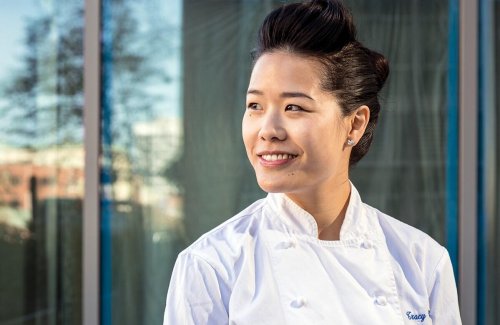
Chef Tracy Chang Gives Back To The Community Through The Language Of Food

Restaurateur Tracy Chang started the nonprofit Off Their Plate and Project Restore Us through the COVID-19 pandemic in 2020. 

The owner of the Japanese tapas restaurant,  PAGU, started Off Their Plate as a way to feed healthcare workers, and Project Restore Us sends nutritious and culturally appropriate grocery boxes to families living in food deserts. Both groups work to support local kitchens run by women and BIPOC and volunteers.

As a chef, Tracy also finds herself more in tune with customers than ever before. As someone who grew up lactose intolerant, she sources ingredients responsibly and remains mindful of the way guests feel after they leave her restaurant. This is also part of her restaurant’s ethos.

Her grandmother has also influenced Tracy’s cooking. Although her grandmother didn’t speak English, she spoke the language of food really well, said Tracy, and that was something that always resonated with her.

For Tracy, her personal experience has definitely come into play — trained in Spain but worked at a Japanese restaurant, and she grew up with a lot of Japanese and Taiwanese food, “The menu at PAGU is autobiographical and about my experience learning very specific dishes and techniques from people like my grandmother, my mentor and some of the chefs I’ve worked with.” she told TimeOut.