News

January 24, 2025

SHARE:

Japan has an old proverb: “The nail that sticks up gets hammered down.” 

While in China, there is a saying, “The higher the tree, the stronger the wind.”

In a critical lens, both idioms illustrate harmony and unity – a vital essence of Asian culture and heritage. Nevertheless, the proverbs also shed light on a contrasting school of thought: conformity and crab mentality. 

Crab mentality refers to the situation one can explore by placing a crab or a collective of crabs in a bucket. A lone crab can inevitably crawl out of the bucket, however, a peculiar scenario would arise if one situates a group of crabs in a bucket. As a crab tries to crawl out, the other crabs will pull it back down. If it tries again, the others will rip its claws off to ensure it can never do so again. Ultimately, no crabs can go anywhere besides the stew pot you are brewing. 

Crab in a bucket scenario (Image source: Microsoft Designer)

Crab in a bucket scenario (Image source: Microsoft Designer)

It is naivety to assume human beings are a unified collective group. History, wars, and jealous conflicts are testaments to human being’s selfishness. Hence, it is arguable that we are inclined to place ourselves above others, even if it means at the expense of our peers. Despite being a precarious thought, this insight opens new dimensions to understanding crab mentality in the human context. 

“Remember your cousin Timmy in China? He has 15 years of experience. He’s nine!” 

Steven He’s dad (played by Steven He) exclaimed.

Terms like “Asian-level difficulty,” “Tiger Moms,” and “Asian parents” have become widely recognized through memes, movies, and other mainstream media, serving as a lens for global audiences to understand and appreciate aspects of Asian culture. Yet, one community still paints a negative view of the Asian community, even discriminating against its individuals – and the answer is ironically the Asian community itself.

The purpose of this work is not to discriminate or criticize any peculiar group but to foster intellectual discourse and encourage reflection on societal dynamics and individual perspectives. The chosen quote embodies this intention, capturing four intertwined facets.

Understanding the concept of face is crucial when discussing Asian culture and heritage. Face serves as a societal construct that governs social interactions and determines one’s standing within a social hierarchy. It is a dynamic measure that can be given, earned, taken away, or lost, often extending beyond the individual to include family and friends. For those unfamiliar with this concept, here’s a simplified explanation:

  • A wife who earns a promotion gains face for herself in front of her boss, while also bringing face to her husband and parents through her achievement. 
  • Conversely, a student who performs poorly on an exam loses face among peers, and their parents, in turn, lose face within their social and familial circles.

Despite being debatable, visualizing face as a form of currency provides an interesting lens through which to examine crab mentality in Asian communities. Much like any valuable asset, currency must be earned, safeguarded, and strategically utilized. Losses, even those meant for long-term gains, are approached with caution and calculation. Consequently, individuals strive to enhance their reputation while using criticism to diminish the face of others.

The concept of face is deeply tied to education and parenting, playing a role in fostering crab mentality. Asian children are often raised to prioritize self-achievement above personal aspirations, adhering to predetermined paths for the “greater good” of the family. This emphasis on collective reputation often comes at the cost of individual dreams, reinforcing a mindset where personal success is weighed against familial expectations.

Parenting can affect mindsets, a reflection on Tiger Moms (Image source: Mims On The Move)

Parenting can affect mindsets, a reflection on Tiger Moms (Image source: Mims On The Move)

Indeed this is a generalized claim that leaves certain minorities for speculation, but the interplay between face and sacrifice is crucial in understanding the environment Asian children grow up. Literary works like Truyện Kiều (Tales of Kieu), a renowned Vietnamese poem, highlight traditional ideals through terms like cầm-kỳ-thi-họa—the four virtues defining a successful woman. Similarly, the stereotype of Asian children being expected to become doctors or lawyers has become a familiar cultural reference in contemporary discourse.

No parents want their children to grow up as bad people. Hence, it would be injudicious to blame parents and the system for a negative societal mentality. Yet, there are certain repercussions to sacrificing a child’s dream in return for a destined path to greatness. This leads to the third facet of crab mentality in Asian communities: A ramification for every child following the same success path means comparison and competition. 

Let’s revisit Steven He’s joke: Timmy is used as a benchmark for comparison. The only way for Steven to save face is by climbing the same ladder and offering Timmy a similar spiteful insult. This vicious cycle of comparison fuels crab mentality within families, peers, and the broader community. True to reality, Asian students often spend countless hours in extra classes and clubs to meet rigorous expectations. Tiger moms push their children to excel in every class as if their lives depend on it. There is no middle ground—you’re either a winner or a failure.

This brings us to the final facet: the absence of praise and apologies. Ironically, according to BBC and Vocal Media, Asia is home to some of the politest people in the world, with countries like Japan and Thailand leading the way. Despite this, hierarchy plays a pivotal role in relationship dynamics. To save face, many Asian parents rarely offer praise to their children. Astonishingly, when it comes to apologies, parents often go to great lengths to defend their actions rather than acknowledge their mistakes. 

A similar response can be seen in Asian workplaces, where higher-ups are more inclined to criticize and are far out of reach from their team members. Individuals will praise their peers and colleagues in hopes of receiving similar treatment instead of actual commemoration. Workers often segregate themselves into teams of interest to promote one another instead of collaborating as a group. These groups create outcasts who, despite their talents, are looked down upon and have their accomplishments taken or snuffed out by negative criticisms. This reluctance to give praise and apologize reinforces a mindset of self-achievement above all else. At first glance, mentality such as these are not wrong, but they leave cracks for detrimental thoughts of arrogance and selfishness – ultimately sustaining the crab mentality.

While this article explores the crab mentality within the Asian community, it is important to recognize that this negative mindset is not exclusive to any one group—it exists everywhere. The concepts of face, self-achievement, competitiveness, community, and sacrifice are what make Asian heritage unique and beautiful. This work argues that these cultural elements are not the root cause of the crab mentality, but rather, insights into why such a mindset may emerge. 
Related Articles

Image Source: Pesconex Facebook, Latest Chika

News, Stories

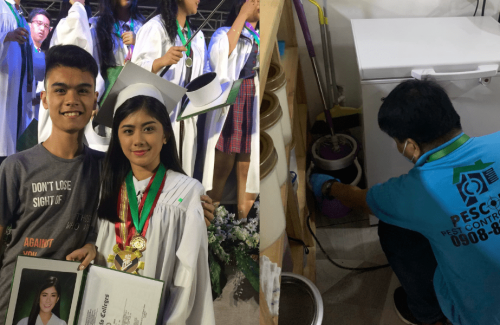
Young Siblings’ Pest Control Startup Skyrocketed In Two Months After Their Tiktok Video Went Viral

In just two months, these two siblings launched a pest control business that now serves a wide area around Quezon Province and nearby cities in the Philippines. They are like any other young adult with unfortunate life prospects, but they’ve persevered because they know there must be a better way. 

Pesconex Pest Control Services is owned jointly by its co-founders, Clark Dennies and Clarissa Joyce Demejes. They started their team with their cousin, who has grown to include four more members. 

What began as a training ground provided by their uncle is now a well-recognized business offering services with a quick phone call around Quezon Province and even reached the island of Palawan. 

Their uncle quickly loaned them money to help them start their own business. The effective pest control technique they use is a standardized process and is a convenient way to get rid of pests. They also made sure it is safe and environmentally friendly.

Within the first month, they serviced only a handful of clients, including a few homes, small sari-sari stores, and some bakeries — their parents even drove them to their clients. Nowadays, certain large companies and grocery stores are among the few that hire the team. 

Their success and customer acquisition began when Clarisse posted a TikTok video demonstrating the service they are providing. Many netizens have praised what the two have been doing, and some are so impressed that they would like to utilize their services. 

In just two short months, the siblings have established themselves financially and have also acquired their company car with their first significant earnings successfully.

Instead of focusing on the possibility that the endeavor will be unsuccessful, Clarissa encourages taking the risk. “Manifest that your business will be successful, do your best to succeed.” — she added. 

Image Source lawmagazine.bc.edu

Stories

Asian-American Woman in Law On Finding Her Voice That Lead To Her Success In The Courtroom

When looking at an Asian-American woman, certain implicit biases exist. They are often judged as being too meek, timid, or passive to achieve their goals. They may be held back by such an evaluation, preventing them from realizing their full potential.

It was difficult for Asian-American lawyer Debra Wong Yang to speak up throughout her early career. In the long run, she realized that her inability to stand up for herself did not only hurt her but also her clients.

“Eventually, we all find a voice — my advice is to just make sure the one you ultimately adopt is actually yours,” she advised in her essay published by Law360.

Yang graduated from law school in 1985 when women were still relatively powerless in the legal field. Since she was still working toward the goal of following the path she had chosen, she has faced many challenges along her journey. She has witnessed it all, from the very traditional Chinese upbringing she received to the various sacrifices, frustrations, and challenges she must face on a day-to-day basis in her chosen field.

After years of practicing law and facing challenges in the courtroom, she came to a number of important realizations that helped her become a successful attorney. She remembered when she thought up some strategies that she hoped would assist her in communicating effectively with others. 

Yang also tried to conquer her fear, and her motivation helped her cope with the situation and make further progress. With a lot of the many books she has read on leadership, she knows she has finally found her own approach to developing herself. 

She aspires on detailing how she was preparing for her court session with an outline of her questions and concerns, and other litigants will be able to better manage their time with counsel. She realized she was getting better at defending her clients in court because she was able to keep her attention solely on the issues and evidence in her case.

When she was currently going through a period of learning and challenges, she learned that holding a position of authority does not guarantee respect from subordinates. She came to understand that one of the responsibilities of a leader is to address concerns raised by those who doubt one’s abilities.

In her courtroom sessions, Yang strongly suggests analyzing the situation first and looking for authentic solutions carefully. She strongly believed that the solutions to some problems sometimes are not immediately obvious and have never been tried before, or that it’s extremely straightforward. However, she is challenged to keep turning the issue over and over in her mind until she begins to see it from a new perspective.

Yang also stressed the importance of having mentors to turn to for advice and insight. She was assertive in her belief that one should be guided by the process of sitting down, thinking it through, and acting in a way that is most beneficial to them. She went on to say that if the message comes from within, the receiver will perceive it as more genuine and at ease.

In 2002, She was appointed by President George W. Bush as United States Attorney and became a former judge serving the Los Angeles County Superior Court. The fact that her success can be attributed to her strong leadership and the bravery that she possesses as an individual is a reason why she wields her power. 

Not only does Yang share her own experiences, but she also provides valuable advice that other women can use to advance their careers. She stated, “My wish for each of you is that you will be brave when facing self-doubts, challenges, and obstacles. That you will dig deep, reach out if needed, do the research, make the tough decision and not be afraid of losing.”

The fact that Yang, an Asian American woman-in-law, was able to take control of her power demonstrates that one’s race should not determine the opportunities available to them or the path they choose to take in their professional advancement. However, by maintaining a positive attitude and giving oneself the power to make decisions, one will be able to live up to the standards and goals that have been established to assist in one’s own success.

Image Source: IGO online shop Ph Instagram

Blogs, Development, Ideas, Stories

Teen Student Entrepreneur Earns Millions Through Online Business Thanks To Mother’s Mentorship

16-year-old Irish Oloris from the Philippines has not only been successful in launching her beauty products business, but she also inspires others to follow their dreams and make them a reality. 

She wasn’t interested in starting her own business when she was young, but after being mentored by her entrepreneur mother, she learned the strategies and tried them. Today, she was able to make her first millions from the sale of skincare and other beauty products in her online shop Irish White Corp.

Irish has decided to invest in land in Zambales, Philippines, and is now a property owner at a very young age. With her motivation and inspiration, she desires to continue her online business to generate additional funds for her college education.

The young CEO encourages other young people like her to dream big and begin early. One of her favorite quotes is ‘Dream at a very young age,’ because for Irish there are no limits to dreams. She thinks it’s wise to lay the groundwork for future success by first focusing on the little things.  

Irish proved that any young person with an entrepreneurial spirit can establish a business at any age. Can you imagine what you could accomplish if you get going right this minute?

Image Source: The Guardian / Unison Creative

Stories

TukTuk Box Founders Highlight Southeast Asian Flavors With Snack Kits

Laotian American Christy Innouvong-Thornton and Beatriz Aurelio-Saguin of Filipino and Indonesian descent use food to explore and share their heritage.

“Food is our love language. In the Asian community, sometimes our parents don’t like to express their emotion,” Beatriz told the Guardian, “But they’d give you a big bowl of rice and your favorite dish when you’re sad, and you know you’re loved. For us, food is also an ever-changing storytelling vehicle.”

They wanted to find a way to debunk racist stereotypes about the foods they grew up eating while giving back to Southeast Asian communities.

In 2020, Christy and Beatriz founded TukTuk Box to raise money and awareness for Thai refugees.TukTuk Box is a specialty food retailer and subscription box company focusing exclusively on Southeast Asian products and purveyors, working with people from the diaspora or identifying as BIPOC.

For Christy, starting TukTuk was also a way for her to heal and create a relationship with my biological mom. 

Most of Beatriz’s dad’s siblings were born in Jakarta, while her dad was born in the Philippines, which made him only know a few staple Indonesian dishes. But because of Tuk Tuk Box, he’s been able to learn more about his own background.

They told The Guardian that they’ve curated their products from Asian stores all around California, Thai Town in LA, and Cambodian communities in Orange county. Before the pandemic, they also had a lot of snacks directly imported from Thailand and the Philippines.

Christy and Beatriz are publishing a cookbook soon featuring different stories and recipes from folks in our community that they have collected over the last two years.