How to use Midjourney AI in UI design - AHN Media Group

Design

March 13, 2025

SHARE:

As AI increasingly makes its way into the UI designer’s toolkit, Midjourney is fast becoming one of the most popular image generators. 

With a simple text prompt, you can use Midjourney AI to create custom digital artworks, whip up an app screen, design individual UI elements, and generate colour palettes—all in a matter of seconds.

For UI designers, this can really accelerate the ideation process and help you expand your own creativity. 

So how does Midjourney AI work? And how can you leverage it in the UI design process? Let’s take a look. 

What is Midjourney AI and how does it work?

Midjourney is a generative AI tool created by Midjourney, Inc.—an independent research lab based in San Francisco.

Midjourney AI generates images and digital artworks based on text prompts. If you enter a prompt asking for an image of a mermaid swimming underwater surrounded by marine life, Midjourney will generate four versions for you to choose from. The more specific your prompts, the better—but we’ll get to the art of prompt-writing for Midjourney in a later section. 

Midjourney works within the Discord platform. Discord is an instant messaging app, commonly used to create communities where users can chat via text, voice, and video. Discord essentially facilitates communication between the user and the Midjourney bot.

Midjourney uses two key machine learning technologies:

  • Large Language Models (LLM): this is how Midjourney understands and interprets the text prompts provided by the user.
  • Diffusion Models (DM): in very simple terms, this technology converts random visual noise into a meaningful image. You enter a text prompt, which sparks a field of visual noise. The AI then progressively removes that noise in incremental steps, eventually resulting in an image that resembles what you’ve asked for. 

Now we know what Midjourney is and how it works, let’s drill down to some key functions and features. 

What can Midjourney AI do? Key features

Midjourney’s core function is to convert text prompts into images. This allows you to generate unique digital artworks and graphics in a range of styles. 

You can guide the image generation process by applying custom parameters to your prompts. You might specify a certain aspect ratio, for example, or a particular style such as ‘watercolour’ or ‘flat design’. 

You can also customise the quality of your images by specifying, within your prompt, a value for the rendering quality. You might specify ‘q 1’ (that’s the default quality level) or request that images be rendered to a higher quality by specifying ‘q 2’ in your prompt. 

Once you’ve entered your prompt, Midjourney will give you four different image versions. You can choose to upscale a particular version, which will increase the size/dimensions of the image and also improve the quality. 

Beyond image generation, Midjourney serves as a great source of community and inspiration. You can share your creations and browse images created by others, allowing you to see what’s possible with Midjourney and sparking ideas for your own work. 

How to get set up on Midjourney AI

To use Midjourney AI, you’ll need to create both a Discord account and a Midjourney account. 

If you’re not already a member, first head over to the Discord platform and follow the instructions to create your account. Once you’re signed up, join the official Midjourney Discord server by clicking the ‘Accept invite’ button. 

You’ll then find yourself in the “Getting started” channel, where you can create your Midjourney account (if you haven’t already done so) by clicking “Get your Midjourney membership” (visible in the chat):
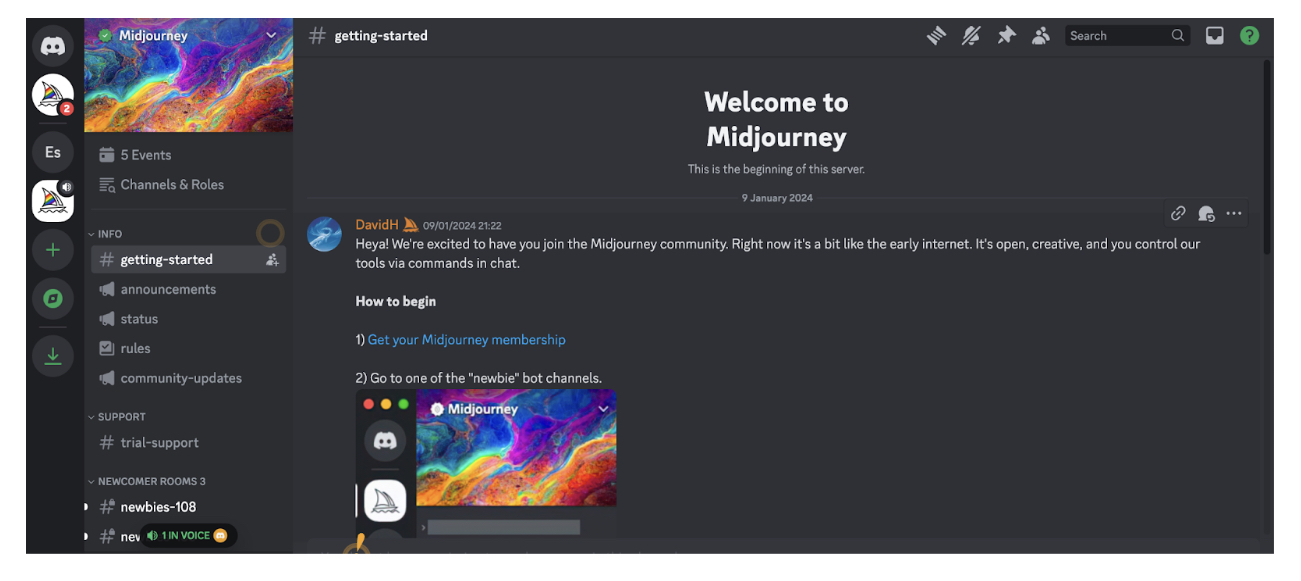
This will take you to a separate page, the Midjourney showcase, where you can click “Sign up” in the bottom left corner to create your Midjourney account. 

Once you’re signed up and logged in to Midjourney, you can navigate back to the Midjourney Discord server and enter one of the so-called “newbie” bot channels. You’ll find available newbie channels on the left-hand side.
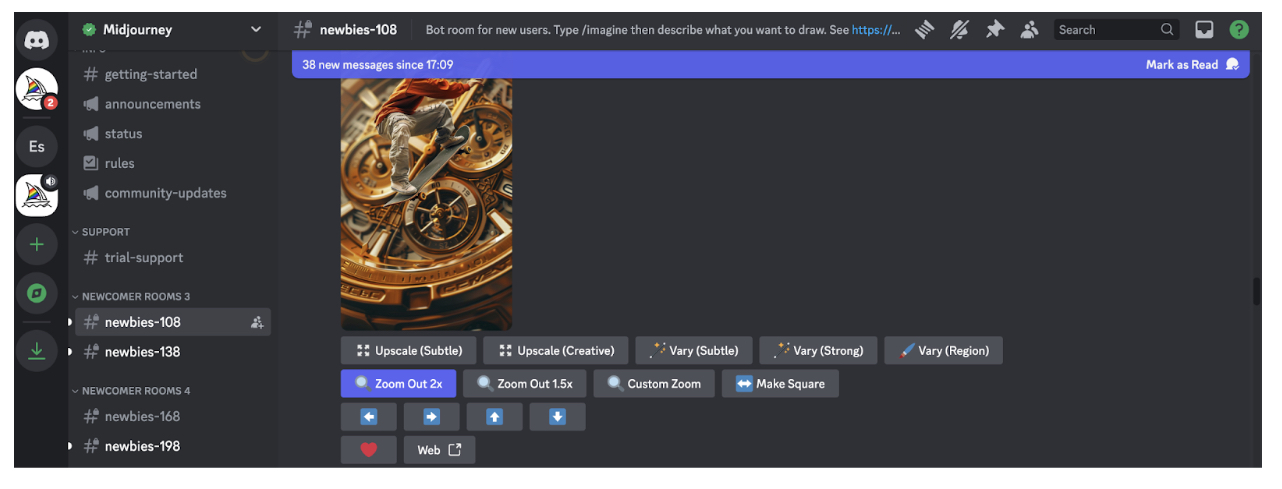
You can then enter your own prompts into the chat box to start generating images. 

At the time of writing, Midjourney is no longer offering a free trial for new users. If you want to start prompting, you’ll need to sign up for a paid subscription. 

How much does Midjourney AI cost?

Midjourney offers four price tiers:

  • Basic Plan for $10 per month or $96 per year with an annual subscription (that’s around €9 per month / €89 per year)
  • Standard Plan for $30 per month or $288 per year with an annual subscription (that’s around €28 per month / €267 per year)
  • Pro Plan for $60 per month or $576 per year with an annual subscription (that’s around €55 per month / €533 per year)
  • Mega Plan for $120 per month or $1,152 per year with an annual subscription (that’s around €111 per month / €1,066 per year). 

For more information about each price tier and what’s included, visit the official Midjourney pricing page.

How to use Midjourney AI in UI design (with example prompts)

Midjourney can generate custom visuals in a matter of seconds—making it an incredibly interesting tool for UI designers. You can use Midjourney to quickly create screens and individual UI components, come up with themes, styles, and colour palettes, and generate unique digital artwork. 

Note, however, that the graphics you create with Midjourney won’t necessarily be directly usable—and working with Midjourney doesn’t eliminate the need to create your own screens and elements using the usual UI tools like Sketch and Figma. If you generate an app screen with Midjourney, for example, you’ll still need to actually create that screen from scratch yourself. 

Where Midjourney really comes in useful is helping you to explore different ideas and concepts and gather inspiration. You might use your AI-generated artwork to inspire mood boards, kick-start an ideation session, or serve as a guide for certain layouts or colour schemes. 

With that, let’s consider some examples of how to use Midjourney for UI design. 

Use Midjourney AI to generate app screens 

If you’re designing for mobile, Midjourney can help you ideate layouts and designs for various app screens. If you’re designing a dating app, for example, you might try the following Midjourney prompts:

  • /imagine a vibrant and fun login screen for a dating app, with an eye-catching background, username and password fields, and buttons for login and social media sign-ins
  • /imagine a user profile screen for a dating app, featuring a large profile picture at the top, user bio, interests, and match percentage displayed in a clean layout
  • /imagine a match screen for a dating app, showing potential matches with profile pictures, a brief bio, and buttons to like, dislike, or super like
  • /imagine a chat screen for a dating app with a clean interface, message bubbles, timestamps, and an input field at the bottom

Create UI components such as icons, buttons, and logos 

Perhaps you want inspiration for the finer details of your app or website. In that case, try using Midjourney AI to create individual UI components such as icons, buttons, and logos. Here are some prompt examples to guide you:

  • /imagine a set of modern buttons for a mobile app, including primary, secondary, and disabled states, using a black and white colour scheme
  • /imagine a collection of minimalist icons for a mobile app, including icons for home, search, messages, settings, and notifications
  • /imagine a sleek and modern logo for a dating app, incorporating elements of connection and love, with a vibrant colour scheme

Generate theme and style concepts 

In the early stages of the design process, you might focus on coming up with an overall visual style for your website or app—and Midjourney can help with this, too. Specify your vision or initial ideas and let Midjourney bring them to life. 

Consider the following prompt examples:

  • /imagine a light mode theme for a productivity app, featuring white backgrounds, soft grey UI elements, and navy blue highlights
  • /imagine a dark mode theme for a music app, with black backgrounds, dark grey UI elements, and neon pink highlights
  • /imagine a vibrant and colourful theme for a creative design app, with bold colours like orange, pink, and teal, playful typography, and dynamic UI elements

Create custom website imagery 

Imagery plays an important role in UI design, helping to reinforce brand identity and enhance the visual appeal of your website or app. 

Whether you want to create cartoon-style illustrations, abstract artwork, or realistic images of products, places, or people, Midjourney can generate custom imagery that reflects your brand and vision. 

Here are some examples of how you might prompt Midjourney to generate images for different use cases:

  • /imagine a stunning hero image for a tech startup website, featuring abstract technology elements and a modern cityscape in the background
  • /imagine a set of custom illustrations for a health and wellness website, featuring people doing yoga, eating healthy, and meditating
  • /imagine a unique background image for a creative agency website, with abstract shapes and vibrant colours

Generate colour palettes 

Perhaps you want help coming up with the perfect colour palette, or you’ve already got a colour scheme in mind and want to see how it looks in practice. Again, Midjourney is an excellent source of inspiration here. Simply specify the kind of look and feel you’re aiming for and Midjourney can generate multiple colour palettes accordingly.

Consider the following prompt examples to guide you:

  • /imagine a pastel colour palette for a wellness app, featuring soft shades of mint green, blush pink, lavender, and light grey
  • /imagine a bold, split-complementary colour palette for a fitness app, comprising three colours
  • /imagine a monochromatic colour palette for a finance app

How to write effective prompts for Midjourney AI

As with all generative AI tools, the quality of the output depends on the quality of the input. In other words, it’s up to you to tell the AI what you want—and to master the art of prompt-writing for the specific tool you’re using. 

Here are some tips to help you write effective prompts for Midjourney AI:

  • Start each prompt with the /imagine command, followed by a description of what you want the AI to create.
  • Keep it simple and specific. To quote the official Midjourney guidelines for prompt-writing: “The Midjourney Bot works best with simple short phrases that describe what you want to see. Avoid long lists of requests and instructions.”
  • Specify what you want the image to include, rather than what you don’t want it to include. Even if you specify “no flowers” in your prompt, the AI will likely only focus on the word “flowers” and therefore create an image that does indeed contain flowers. If you absolutely want to exclude something from the image, use the “no” parameter. For example: – – no flowers.
  • If necessary, specify your desired aspect ratio using the following parameter: – – ar [value]. If you wanted to generate an app screen, you could specify – – ar 16:9.
  • Use the stylize parameter to control the level of artistic flair that Midjourney injects into each image. If you imagine that the default level, 2500, gives you a medium level of stylization, you can dial it up or down by specifying values higher or lower than 2500. If you wanted to generate an image of a garden that’s more realistic than artistic, you might specify – – stylize 500. If you wanted to create an image of a garden that looks magical and fantastical, you might specify – – stylize 3500.
  • Use the quality parameter to adjust the level of quality and detail in the image. – – q 1 is the default, so work from that value to dial the quality up or down. 

Most importantly, be prepared to experiment. The more you use Midjourney, the more intuitive the art of prompt-writing will become. You’ll start to get a feel for what works and see how different words, phrases, and parameters influence the output. 

Ethical considerations when using Midjourney AI

If you’re using Midjourney AI (or indeed any AI tools) throughout the design process, you must take care to use it responsibly. Here are some of the most important ethical considerations to bear in mind.

Intellectual property and copyright

When generating images with AI, be careful about replicating existing images or artworks created by other artists or designers. You might use a famous logo for inspiration, for example, but you wouldn’t want to emulate the style too closely to the point of copying. 

Deceptive and misleading content

This is like the visual equivalent of fake news—creating image-based content that deliberately deceives, misleads, manipulates, or spreads misinformation. Don’t do it!

Stereotypes and bias

It’s well-documented that AI can and does perpetuate harmful stereotypes and biases. As a human user, you must be diligent about actively looking out for such biases and taking steps to mitigate them.

Strive to generate images that are inclusive and representative of diverse groups. If you generate an image that doesn’t feel inclusive or could potentially exclude or harm certain people, don’t use it. You can learn more about the importance of designing inclusive content in this guide. 

As a general rule: always review AI-generated content with a critical eye, and use your better judgement. As a human user, it’s your responsibility to consider the impact of any content you create—and to ultimately decide what makes it into the public domain. 

The takeaway

Midjourney AI can generate custom images in seconds, making it an excellent tool for gathering inspiration, sparking your own creativity, and ideating and exploring different design concepts, layouts, and styles. 

Whether you use it to generate fully-fledged app screens, individual UI elements, impressive artworks, or colour palettes: Midjourney AI is a powerful addition to your UI design toolkit. 

Ready to get started with Midjourney AI? Experiment with different prompts and use cases, explore other Midjourney users’ creations, and be mindful of the ethical considerations we’ve laid out in this guide. You’ll soon be generating images like a pro! 
Related Articles

2647f4a1-07b8-4f94-8f7f-415ae5d0eeae-jpeg

Stories

The Story Behind Inspire To Create Media: How Trysen Kaneshige Uses Art to Heal and Connect Community

Born and raised in Kauaʻi, Hawaii, Trysen Kaneshige never imagined that a series of brain injuries would redirect the course of his life. Art, which had once been a hobby, became his lifeline—a way to heal, process, and reconnect with the world around him.

What began as a personal form of therapy soon turned into a mission: to use creativity not only for his own recovery but to uplift his community and share stories that mattered.

As he experimented with murals, branding, and design, Trysen discovered that each project could bridge culture, healing, and connection in ways he had never anticipated. Through perseverance and collaboration, he began working with brands like Volcom, Olukai, and Soulection Radio, while also leading projects for schools, nonprofits, and community organizations across Hawaii.

From these experiences, Trysen founded Inspire To Create Media, a healing-centered creative agency that blends streetwear aesthetics, cultural storytelling, and design to create work that resonates far beyond the islands.

Finding Inspiration in Adversity

Trysen’s path to entrepreneurship was shaped by necessity and resilience. “I wasn’t able to work a regular job since I would have a lot of migraines or dealt with depression etc. It’s been challenging but I’ve learned to be resilient and not give up. What also inspired me was to create something for my community and for the next generation that is after me,” he recalls. The setbacks could have ended his creative ambitions, but Trysen chose to focus on what he could control: his art and his recovery.

Instead of succumbing to frustration, he saw opportunity in every challenge. He began creating small pieces, testing ideas, and using art as a method to regain focus, confidence, and purpose. These early efforts helped him realize that healing and creativity could coexist and even amplify one another.

What started as a personal journey of recovery soon became a mission to uplift others. Trysen wanted to leave something meaningful for his community and for the next generation, showing that creativity could transform not only individual lives but also the cultural landscape of Kauaʻi.

Overcoming Challenges Without a Safety Net

The road to building a creative business was far from smooth. Trysen faced difficult challenges that he considered walking away from everything, grappling with both the physical and emotional toll of head injuries. Each day was a battle between self-doubt, pain, and the desire to keep moving forward.

Beyond personal health struggles, he had no investors, no team, and no corporate backing. Every decision, every financial risk, and every project came solely from his determination and willingness to learn through trial and error. “If I had someone that saw what I was creating in the beginning, it would’ve been easier,” he admits.

Gratitude and persistence became his anchors. By embracing the lessons from failures and small victories alike, Trysen built a foundation that was resilient, flexible, and authentic. This mindset allowed him to continue pursuing his vision even when support was scarce and the path ahead was uncertain.

Turning Achievements Into Community Impact

Despite obstacles, Trysen’s journey is marked by achievements that combine personal growth with community recognition. He takes pride in consistently showing up, even on days when recovery felt impossible, and in taking creative risks that shaped the identity of his agency.

Inspire To Create Media has earned acknowledgment on multiple levels—from Proclamations by Mayor Derek Kawakami highlighting community murals and workshops to features in local newspapers chronicling his evolving projects. These recognitions validate his belief that creativity paired with purpose resonates far beyond personal satisfaction.

For Trysen, the real measure of success is impact. Each mural, logo, or art initiative tells a story and strengthens the connection between people and place, leaving a lasting mark on Kauaʻi’s cultural and creative landscape.

Building a Healing-Centered Creative Vision

At the heart of Inspire To Create Media is a philosophy that creativity can heal, connect, and inspire simultaneously. From large-scale murals to branding and apparel, every project is designed with intention, reflecting local culture while appealing to a global audience.

Trysen explains, “Art became my way to rebuild, reconnect, and serve. What began as personal recovery grew into a mission: to use art as a tool for transformation for myself, for my community, and for the next generation of island creatives.”

Today, Inspire To Create Media continues to expand its reach, bridging art, healing, and business. Trysen’s story proves that even the toughest setbacks can spark the most powerful creativity—turning personal recovery into a force that inspires communities, cultivates connection, and demonstrates that a small island studio can have a big global impact.

Follow Trysen’s journey:

📍 @trys.creates | @inspiretocreate.media

{"ARInfo":{"IsUseAR":false},"Version":"1.0.0","MakeupInfo":{"IsUseMakeup":false},"FaceliftInfo":{"IsChangeEyeLift":false,"IsChangeFacelift":false,"IsChangePostureLift":false,"IsChangeNose":false,"IsChangeFaceChin":false,"IsChangeMouth":false,"IsChangeThinFace":true},"BeautyInfo":{"SwitchMedicatedAcne":false,"IsAIBeauty":false,"IsBrightEyes":false,"IsSharpen":false,"IsOldBeauty":false,"IsReduceBlackEyes":false},"HandlerInfo":{"AppName":2},"FilterInfo":{"IsUseFilter":false}}

Stories

Building Meraki: How Vivian Kwan Turned Passion into Purpose

The first time Vivian Kwan realized she could build something on her own terms was during her college years in the U.S. — a time that completely shifted her perspective on what a career could be.

She found herself surrounded by students who were running side hustles, freelancing, and starting companies before graduation. It was a stark contrast to her upbringing in Hong Kong.

“Back home in Hong Kong, the path was pretty clear: study hard, land a stable job, and climb the corporate ladder,” she recalls. “But in the U.S., I met people who were building something entirely their own. That inspired me to think differently.”

Curious and driven, Vivian began experimenting — running a small photography business and creating content for fun. That experiment grew into Meraki Group, a boutique talent management agency representing a diverse roster of lifestyle creators — and now a 7-figure business built entirely from the ground up.

Redefining Success as a First-Generation Founder

When Vivian launched Meraki Group in 2021, she had no network, no outside funding, and no PR machine behind her, just the belief that creators deserved better representation.

As a first-generation Asian immigrant, Vivian was raised to stay quiet and keep her head down. “But entrepreneurship requires something different,” she says. “I had to learn to advocate for myself and my talents loudly and unapologetically.”

Without big teams or resources, she leaned into what she could control: being hands-on, transparent, and relationship-driven. That boutique approach became Meraki’s unique selling point: brands and creators know they can reach Vivian directly, and that trust has allowed Meraki to thrive against the odds. Today, Meraki has closed 300+ brand campaigns with brand partners like HOKA, REI, Shark, Columbia Sportswear, Libman, Google, and UGG.

The Challenge of Balance

Motherhood has always run parallel to Vivian’s entrepreneurial journey — two worlds that demand her heart in equal measure. In the early years of Meraki, she often found herself caught between deadlines and bedtime stories, client calls and school drop-offs. The guilt was relentless: every hour spent growing the business felt like time borrowed from her children.

But over time, her perspective shifted. She began to see that showing her kids what fulfillment looked like was one of the greatest gifts she could give them. Building Meraki wasn’t just about proving something to the industry — it was about showing her children what resilience, purpose, and self-belief looked like in real life.

“My kids deserve a mother who’s confident and happy,” she says simply. “That thought keeps me grounded when things get hard.”

A Year of Growth and Gratitude

In October, the Meraki community came to life in a way that no Zoom call ever could. Vivian and her team hosted their annual NYC dinner — an intimate gathering of creators, brand partners, and friends who had helped shape the agency’s journey. The room buzzed with laughter, warm reunions, and stories that stretched back to Meraki’s earliest days.

For Vivian, it was a full-circle moment. Many of the guests were creators she had signed during the uncertainty of the pandemic — people she had championed from afar before ever shaking their hands in person. Watching them share a table, swapping stories and ideas, felt like witnessing the agency’s spirit materialise in real life.

It wasn’t a night of flashy sponsors or curated photo ops, but of genuine connection — the kind that has quietly fueled Meraki’s success from day one. “What I’m most proud of isn’t the growth,” Vivian reflects. “It’s loyalty. Many of my creators have been with me for three or four years. In an industry where talent often comes and goes, that kind of long-term commitment means everything.”

What Comes Next

As Meraki continues to grow, Vivian is laying the groundwork for a new chapter — one that strengthens the agency’s foundation while amplifying its impact. She’s focused on expanding her team and refining systems to preserve Meraki’s signature boutique quality, even as it scales.

“I’m being intentional with this next chapter,” she says. “Before stepping deeper into consulting and mentorship, I want to make sure the agency continues to run with the same care and creative integrity it was built on.”

With that foundation in place, Vivian plans to open limited consulting slots and launch educational programs for creators and emerging talent managers. Her goal is to nurture the next generation of creative leaders — empowering them to build with heart, purpose, and the courage to redefine what success can look like.

Follow Vivian’s journey:
📍 LinkedIn | Instagram

Color - Anise Health 27710_2 (1)-jpg

Stories

The Founders Behind Anise Health: How Two Women Are Reimagining Mental Health for the Asian Community

When Nisha Desai and Alice Zhang met at Harvard Business School, neither of them expected that a casual conversation about their frustrations with therapy would spark the idea for something much bigger.

As they juggled graduate school and their own mental health, they often felt therapy wasn’t built for people like them – they spent more time explaining their background to their therapists than actually healing. 

They realized it wasn’t just them – there’s a gap in mental healthcare that left many in the Asian and multicultural community feeling unseen and misunderstood.

That shared realization became the seed for Anise Health: a platform built to make therapy culturally attuned, accessible, and truly effective for the AAPI community.

A Problem They Both Knew Too Well

Before their paths crossed, both founders had already seen the same issue from different directions.

Nisha, who grew up in Florida in a family of healthcare entrepreneurs, had always been drawn to questions of access and equity in care. After studying finance and marketing at the University of Pennsylvania’s Wharton School and earning her MBA from Harvard, she worked in healthcare investing and later in digital product management at Humana. It was there, while helping build a mental health app, that she started hearing a troubling pattern from thousands of users – the same barriers she had personally faced.

Nisha recalls that people weren’t saying therapy didn’t work. They were saying it didn’t fit, that they didn’t feel understood.

Alice, meanwhile, came to the same conclusion through her own deeply personal experiences. Born in China, raised across Japan and Canada, and now based in New York, she calls herself a “third culture kid.” Her multicultural background gave her adaptability, but also a sense of never fully belonging anywhere.

That feeling resurfaced when she sought therapy during business school. Despite being fluent in English, she found herself translating her own emotions for her therapist – explaining why criticism from parents felt like love, or why pursuing excellence felt non-negotiable.

Alice remembers feeling exhausted after each session, explaining her background again and again, and leaving each time feeling unseen.

Alice Zhang (left) and Nisha Desai (right)

Building a Culturally Grounded Model of Care

After that pivotal conversation at Harvard, the two women began mapping out what culturally attuned mental health care could look like. They spoke to clinicians, patients, payors and community leaders, testing how cultural nuance could be integrated into evidence-based therapy and coaching.

They envisioned a new kind of care model: one that didn’t require clients to educate their therapists or set aside their cultural identity at the door. Instead, therapy would start from a place of understanding.

“Alice and I really built Anise to be what we believe our community has needed during our upbringing. What we kind of wished for ourselves through our own personal journeys with therapy.”

But building what didn’t yet exist came with challenges. They had to prove — to investors, clinicians, and even the broader healthcare system — that cultural context wasn’t just a “nice to have,” but essential to effective care. Many mental health professionals hadn’t been trained to deliver culturally adaptive therapy, so Anise Health had to design that framework from the ground up: provider training programs, accurate diagnostic tools, tailored care plans, curated resources and a scalable model for personalized, culturally attuned care.

Their persistence paid off. What started as late-night brainstorming sessions between classes evolved into a fully fledged mental health platform that blends clinical rigor with cultural empathy.

Growing the Movement

Since its founding, Anise Health has facilitated over 10,000 paid appointments and built a network of 60+ licensed providers across multiple states. The company is now expanding through insurance partnerships that make culturally attuned care more affordable and accessible.

Behind the scenes, Nisha leads operations and product design, while Alice drives partnerships and provider training.

Their complementary strengths, coupled with a shared sense of purpose, have helped Anise Health raise $6.4 million in funding and gain recognition as one of the top 10 most innovative Asian Pacific-led companies to watch by NYSE, Y Combinator, and Gold House.

Redefining the Future of Mental Health for Asian Communities

For both founders, Anise Health’s success goes beyond numbers. It’s about shifting how mental health is understood and delivered, starting with a community that has long been underserved and stigmatized.

“Our goal isn’t just to make care available,” Nisha says. “It’s to make it effective, culturally relevant, and sustainable within the healthcare system.”

By creating a new gold standard of culturally attuned care, Nisha and Alice aren’t just helping Asian Americans access therapy that finally feels like it speaks their language – they’re reimagining what inclusive mental health care can look like for everyone.

Learn more about Anise Health at anisehealth.co

Angel Zhen Built a $500K Solo CPA Firm and Redefined Success

Stories

Angel Zhen Built a $500K Solo CPA Firm and Redefined Success

From Public Accounting to Personal Freedom

For most people in the accounting world, success looks like a corner office, a big team, and an endless stream of clients. For Angel Zhen, CPA, MST, success meant something entirely different — independence.

“I wanted to build something that valued freedom, quality, and impact,” he says. “After years in public accounting, I saw how the system rewarded long hours over real results. I knew there had to be a better way — to build a high-performing firm without sacrificing your life.”

That clarity led Angel to found Pasadena Tax CPA, a one-person practice that now generates over $500,000 in annual revenue and serves more than 300 clients nationwide. Angel’s work has earned national recognition from both CPA.com and the AICPA, including being named a 2025 Innovative Practitioner Award Finalist and 2025 Leadership Academy Selectee.

From Public Accounting to Personal Freedom

Turning Loss into Leadership

Angel’s story didn’t begin with business success. It began with loss.

“In April 2020, my dad passed away unexpectedly,” he recalls. “Because COVID hit and I was deep in tax season, I didn’t get to see him one last time. That moment changed everything — life, time, and purpose.”

Like many in Asian families, Angel describes his father as the pillar — the provider and decision-maker everyone looked up to. When he passed, Angel knew it was his turn to step up.

He moved back home to Rosemead, California, to take care of his mom and rebuild his life. What began as a moment of grief became a defining transformation. “Starting over during a pandemic forced me to innovate to survive,” he says. “I turned loss into fuel and fear into focus.”

Five years later, that focus became a thriving solo CPA firm built on innovation, strategy, and heart.

“There’s a Chinese saying, 苦尽甘来 — after bitterness comes sweetness,” Angel says softly. “Every struggle built the clarity, strength, and mindset that led me here today.”

Challenging the Traditional CPA Model

Angel’s biggest challenge wasn’t the market — it was his own mindset. As an Asian CPA, he grew up with messages about safety and stability: work hard, follow the rules, don’t take risks. But entrepreneurship demanded something different.

“I had to unlearn the belief that success required a big team, long hours, or a corporate ladder,” he explains. “I built systems, automations, and pricing models that gave me confidence and time back.”

Those systems didn’t just make him efficient — they made him exceptional. Today, Pasadena Tax CPA is recognized as one of the most efficient solo CPA firms in the nation, a model of what’s possible when technology meets intention.
His book, The Profitable Solopreneur Playbook, expands on that mission — teaching other CPAs and solo business owners how to build practices that generate both profit and freedom.

Challenging the Traditional CPA Model

Redefining Success in the Modern Asian American Dream

Angel’s success challenges a long-held cultural narrative — that stability and ambition are mutually exclusive. His mission is to show Asian professionals that they can have both.

“For the Asian community, I want to normalize the idea that you don’t have to choose between stability and ambition,” he says. “You can honor your roots while building your own path.”

Through mentorship, education, and storytelling, he’s helping others reclaim the idea of financial independence — not as a luxury, but as a form of empowerment. His philosophy is simple but powerful: “Build with intention, clarity, and courage.”

A Beacon of Innovation and Leadership

Angel’s recognitions from CPA.com and the AICPA are more than professional honors — they’re milestones in a larger movement to modernize the accounting industry.

“Being recognized by CPA.com as one of the most innovative practitioners isn’t just about accounting,” he says. “It’s about leadership, legacy, and resilience.”

His nomination for the 2025 Innovative Practitioner Award celebrates his ability to merge technology and empathy — running a fully remote, tech-driven practice that still feels deeply personal.
🗳️Vote for Angel Zhen, CPA → cpa.com/innovative-practitioner

Rooted in Legacy, Driven by Purpose

What drives Angel today isn’t just revenue or recognition — it’s the promise he made to himself after his father’s passing: to live with intention.

“I’m proud of building a $500K+ one-person CPA firm from scratch — without a team, referrals, or outside funding,” he reflects. “It’s proof that with clarity, systems, and consistency, one person can do extraordinary things.”

Beyond his business, he continues to inspire thousands of professionals across CalCPA, Asian Hustle Network, and beyond — showing that even in an industry built on rules, creativity and freedom can lead the way.

Rooted in Legacy, Driven by Purpose

About Angel Zhen, CPA, MST

Angel Zhen is the founder of Pasadena Tax CPA, a one-person firm serving clients nationwide with a focus on tax strategy, clarity, and efficiency. He has been recognized by CPA.com as a 2025 Innovative Practitioner Award Finalist and by the AICPA as a 2025 Leadership Academy Selectee. Angel is also the author of The Profitable Solopreneur Playbook, helping others design businesses that create both wealth and freedom.

🗳️Vote for Angel Zhen, CPA as the 2025 Innovative Practitioner

https://www.cpa.com/innovative-practitioner

Connect with Angel Zhen

LinkedIn: linkedin.com/in/angelzhencpa 

Website: www.pasadenatax.cpa