Awaken* newsletter

August 29, 2024

SHARE:

This article was co-written by Edwin Ong from the AHN Ventures team and Lennie Zhu, who is the Founder of 01 Labs, a product studio that builds products with early-stage software companies serving creators (media, entertainment, social), small businesses and independents. She has worked with startups such as HIFI (acquired by Block), F*** You Pay Me, and more. One of AHN Ventures’ portfolio founders, Amartya Jha, was the lead interviewer. Amartya is the Co-founder & CEO of CodeAnt AI, a DevTool that helps companies find and auto-fix code issues and security vulnerabilities used by small teams all the way to large unicorns.

In this edition, we had the honor of hosting an exclusive advisory session between Kun Gao, co-founder and former CEO of Crunchyroll, and Amartya Jha of Codeant AI. For those who don’t know, Crunchyroll is the leading anime streaming service with over 13 million subscribers as of 2024, and was last valued at $1.5 billion when it was sold to Sony in 2020. Nowadays, Kun works on two new companies that he co-founded: GGWP, an AI-powered game moderation platform; and Forge, which rewards gamers within and out-of-game prizes for the data they generate through gaming.

We are excited to share 7 hidden lessons for founders from our conversation with Kun.

1. The consumer products that succeed are the ones that go viral – and that can be hard to predict

One of Kun’s early insights was that consumer apps with baked-in virality tend to be the ones that work out. Examples of built-in viral features are share buttons, “invite a friend/collaborator features,” or content that can be easily reposted. 

However, consumer behavior can be notoriously difficult to predict. Unless you have superior product sense like Steve Jobs, your best bet is to take your best guess, then ship quickly and avoid getting caught up in minute details. If your product truly has value, people will use it even if it isn’t polished. Need proof? Check out the screenshot below of what Crunchyroll looked like in 2006. 

Kun: “One of the lessons I learned from that experience is that you really don’t know what the consumer mindset is. You can have a guess, but with pure consumer experiences, it’s better to just try something, throw it against the wall, and see if it sticks. Then, you can collect the data, iterate, and see what works and what doesn’t.

We developed the first version of Crunchyroll in about a month. We put it out there and shared it with our friends. They started using it, and pretty soon we had hundreds, then thousands of users. At the end of the day, it’s about making something really engaging that can capture an audience and get them to virally spread it. Those kinds of consumer products just inherently grow. So my advice would be to think about how to build products that inherently have virality built in.”

2. Build something that solves your own problems

The advantage of building something for yourself is that you will have at least one user out of the gate, and likely a few others since you likely have some friends with similar issues. Furthermore, you’ll be able to understand the customers’ needs because *you* are the customer. For Crunchyroll, this allowed them to cut out hiring product people and only hire engineers at the start

Kun: “With Crunchyroll, we were trying to solve a problem that we personally had. Every Thursday, Naruto would come out on TV in Japan, and it would be only accessible in the US on unreliable torrent websites. We just wanted a place where we could watch Naruto at 6 p.m. every Thursday after work. 

We knew we could get at least a starting set of users because we had that problem, and we were our own consumers…. We also knew we could get all of our friends to use it because we knew they were experiencing the same problem. And so we built Crunchyroll.”

3. Experiment relentlessly until you perfect your conversion funnel

What is often talked about when monetization is on the agenda is “What monetization model makes sense for my company?” Subscriptions, one-time purchases, ad revenue, freemium…the list goes on. But what gets less airtime yet is arguably even more important is how to optimize your conversion funnel. While there is no glory in experimenting with things like button placement, CTA copy, and 1 vs. 3-step payment flows, those kinds of nitty-gritty decisions are exactly what separate “businesses with potential” from the real moneymakers. 

Kun: “Before [we started offering paid subscriptions], we already had a decent amount of users, around a few million. When we flipped the switch to premium content, around 10,000 people converted to paid, which is really low. We thought we would get 50,000, but we only got 10,000 people to convert to paid. The rest stayed on as free users. So then we had to figure out why more people weren’t converting.

We ran some tests on alternative business models. We tested charging per episode, and even some rental models. Those tests didn’t perform that well, so we decided to double down and optimize our subscription model. 

To tackle [conversion], we basically annotated everything on the site and figured out what users were clicking, what they were looking at, and which buttons converted better. Should we start with a free trial? If it’s a free trial, should it be seven days or four? The size of the icons—we basically tested everything, especially in the first year… Over time, we were able to convert the majority of the audience to become paid subscribers.”

4. Ride societal waves in culture and technology

It’s important for every company to have an answer to the question “Why now?” What was not true before, that is now true and enables the product to succeed? This could be something technological or societal. In the case of Crunchyroll, Twitch, and YouTube, the explosion of video streaming was a major driver for those platforms to reach the dizzying levels of success they have today. 

Kun: “Part of what separated us was that we were in the right place at the right time. If you look at all the successful video platforms today—YouTube, Twitch, Crunchyroll—they all started at basically the same time, around the 2004 to 2006 period. You kind of needed to start during that time to be successful. 

Within that time frame, there were also a lot of competitors we were competing with. Platforms like Stage Six, Veoh, and Joost were trying to go after the same space and opportunity. Speed was really important because there was a land grab for distribution at that time. When I say distribution, I mean the proliferation of consumer devices besides the PC from 2006 to 2007, all the way until the early 2010s. Because of our speed, we were able to build these platforms before everyone else and ride that wave of device growth. We were one of the first launch partners on PlayStation alongside Netflix. Being able to build on new platforms with a product engineering focus first allowed us to outgrow and out-distribute others in the space.”

5. The best companies expand their markets or create new ones

Today, Crunchyroll has over 13 million subscribers. There were a lot of external factors that drove the massive growth in the popularity of anime, including the pandemic, but Crunchyroll itself played a major part in making anime more mainstream because it made it accessible to Western audiences. 

Kun: “The thing that surprised me most was that our TAM (Total Addressable Market) ended up being much bigger than we expected. I would project that we would maybe hit 200,000 subscribers. That’s it. Then when we actually reached 200,000 subscribers, we thought maybe we’d get to a million. And then when we got to a million, we thought maybe we’d get to 3 million. The growth itself has really surprised even us. Today, it’s the largest pure vertical play among all the content verticals out there. Initially, because we didn’t expect our TAM to be so big, our approach was to super-serve our audience and do way more than just streaming, which we eventually did, but it just continued to grow even beyond our expectations.”

6. Get creative about how to finance your startup

Many founders’ minds jump immediately to venture funding when they consider how to support their companies. But raising venture money can be a long and difficult path, and it’s not always the right choice for every startup. Timing is everything, and bringing in outside capital before establishing product-market fit can be a mistake, driving founders to pivot into oblivion. Kun gave us a look behind the curtain at how Crunchyroll funded itself before venture money, which included user donations, partner investments, and- yes, credit cards. While taking on significant credit card debt may not be recommended, staying open-minded about where your financing could come from is.

Kun: [Before we were profitable, we financed Crunchyroll with] venture money, and maxed out our credit cards before that. For a period of time, we also accepted donations. Before we raised VC funding, we had pretty hefty bandwidth bills because video streaming was very expensive. At some point, we realized that we couldn’t sustain the site. At the same time, we couldn’t directly charge users because we didn’t own the content. That was the motivation behind accepting donations. To give the users some incentive to donate, we built a very sticky social product where users could create an account, participate in forums, and chat with other anime fans. Anyone who donated would get a star next to their name so people would know that the person donated. It was an appeal to social status and social proof. That was enough to offset some of the bandwidth bills in the early days before we had venture funding.

I [also went to one of] our biggest content partners, the folks who license the content to us, and asked if they wanted to own a piece of the business. It made a lot of sense because if they invested, they would also have a vested interest in the platform and could capture more of the value that their shows were generating. It was a win-win. We took in about a million dollars, which was enough to bridge us to the break-even point.

7. As an Asian founder, take advantage of your inherent cultural strengths

Asian founders starting businesses in Western countries should not underestimate their ability to globalize their businesses by capitalizing on Asian markets, which they may be much better positioned to do than their non-Asian counterparts. Fundamental cultural context that you may not even acknowledge your grasp can help you succeed overseas.

Kun: “With Crunchyroll, we obviously worked a lot with Japan. I think that because I’m Asian, they trusted me more. At the end of the day, it was also about understanding and appreciating their value system, which is very different from the US. In the US, it’s really about the value proposition. In Asia, it’s much more about relationships and trust, so we really leaned into that. Maybe part of that was influenced by our upbringing. You can’t just show up and expect deals immediately. You need to be around, be persistent, and show them that you’re committed. But that might be a bit of a unique situation for us.”

Conclusion

Thank you to Kun Gao for the interview! If you are a gaming company looking for moderation tools, please consider checking out GGWP, and if you are a gamer wondering why you aren’t being rewarded for the mountains of data you are generating, please check out Forge!

Written by Edwin Ong and Lennie Zhu
Related Articles

Image Source Colin Boyle/Block Club Chicago

Uncategorized

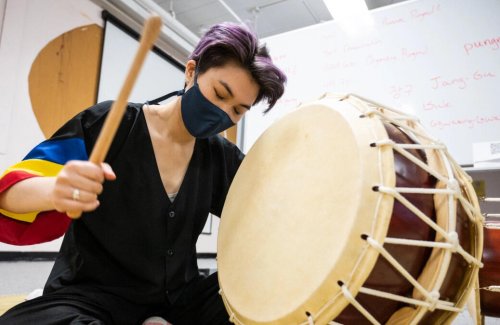
North Side Immigrant Rights Group Foster Community By Folk Drumming

Hana Center, a nonprofit organization for Asian American and immigrant rights, provides neighbors new opportunities to teach them traditional Korean folk drumming, which activists frequently use in their advocacy. 

Community engagement coordinator Won Joon Lee tells Block Club Chicago that the group teaches Pungmul, a Korean folk tradition with deep historical roots. It originated in Korea’s pre-industrial farming culture and used the hourglass-shaped janggu (a double-sided drum) to protest immigration and racism. 

Lee explained that during the Japanese occupation of Korea from 1910 to 1945, public gatherings were prohibited except for musical performances, making Pungmul a form of resistance. 

In 2017, two long-standing organizations,  the Korean American Community Services, and the Korean American Resource and Cultural Center were combined to become Hana Center, named from the Korean word for “one.”

The organization has a long history of youth Pungmul programming, but this summer marked the first time the non-profit offered classes for adults interested in advocacy work. 

The first-ever class will proceed after the initial session of eight weeks has passed. As the new program expands, the instructors intend to continue enrolling new students in it on an ongoing basis.

Hana Drum School instructor Inah Jeong said Pungmul drumming is loud as planned, and they are culturally and politically distinct. Korean immigrants may connect with Chicago immigrants and join the immigrant rights and citizenship march, she tells Block Club Chicago.

The ensemble delivered its first drumming class this summer, but new students are always welcome to join in. Residents and community organizations can benefit from such events, according to the center’s administrators.

Choi tells Block Club Chicago that the current situation is both exhausting and frightening, but she believes the strong and loving communities they form may provide joy even in difficult times.

Their communities enable them to change the world now and in the future. The goal according to Choi is to turn community building into advocacy that targets racial, gender, and economic concerns along with immigrant rights.

Hana Center is located at 4300 North California Avenue in Irving Park. It also offers services to address needs related to citizenship and immigration, housing, and other areas.

Image Source TomoCredit

Uncategorized

TomoCredit Raised Its Value To $222M To Help Gen-Z Build Credit Fast

TomoCredit announced that it had raised $22 million in a Series B funding round, giving it a post-money valuation of $222 million. 

It has also secured $100 million in debt financing and has raised $39 million in equity since its launch.

The newly acquired funds will be put to use by the corporation in the form of product line expansion, which may include the provision of mortgages and automobile loans. 

Kristy Kim founded TomoCredit in 2019 to help international students get credit. Three and a half years later, the fintech no longer focuses just on immigrants but is now also eyeing domestic students and SMBs that want to “build credit fast”. They received 2.5 million applications over time.

TomoCredit provides users credit limits of up to $30,000. It earns revenue from merchant interchange fees, not consumers. It doesn’t require a credit check, a deposit, or an APR.

According to TechCrunch, the firm doesn’t use FICO scores to underwrite, unlike many other credit offerings. Tomo Score, a “proprietary” underwriting algorithm, identifies “high potential borrowers” without credit scores. 

“Our customers are not in financial trouble…Once you identify them and give them a card, they spend a lot and don’t default. Our performance has been great and that gave us and our investors the confidence to scale.” Kim told TechCrunch.

Morgan Stanley’s Next Level Fund and Mastercard participated in the equity portion of the deal including GoldHouse, Asian Hustle Network, and Hyphen Capital, while Silicon Valley Bank provided the debt.

Alice Vilma co-manages Morgan Stanley’s Next Level Fund, which invests in early-stage innovation and tech-enabled enterprises with women or diverse founding teams, said that she was amazed by Kim’s ability to recognize a need as a young female immigrant and create a financial product.

“As a first-generation South Korean immigrant, I wanted to help immigrant communities to reach their American Dream faster with TomoCredit,” Kim told TechCrunch. “It has been wonderful to partner with minority-focused funds who truly understand Tomo’s mission.”

Ai Nguyen

Uncategorized

“My dad left our family for another woman when I was around 6 years old”

You might have heard a tale similar to this one here and there, but for every family who is now going through this — it feels like the beginning of the end. 

What more if your father left your family when you were young and just beginning a new life in a foreign place?

Nevertheless, it is utterly devastating that some even end up questioning themselves, “what have I done wrong or what should I have done right?” But eventually, you’ll come to the conclusion that you should just accept it, keep a positive attitude and figure out how to go on living your life without a father figure.

But what if one day your father knocks on your door and asks if he could come back to your family’s life?

Here’s Ai Nguyen, A Life and Business Breakthrough Coach, who shares a powerful story through her voice and experience of her 80-year-old dad.

The Crucial Memory

Last week, I celebrated my dad’s 80th birthday.  It was a deeply healing experience for me. Many of you don’t know this, but my dad left our family for another woman when I was around 6 years old, about a year after we had immigrated from Vietnam over to America. Here we are in a strange new country, and then he left us.

One of the last memories I had at that time was that he took me to the bus stop in the morning for school and told me that he was leaving the family and wasn’t coming back. That was it. I came home from school and he was gone.

For decades, I had blocked out this CRUCIAL memory of the bus stop day. It was brought out again during a healing hypnosis session I had last year. While growing up, he would come and visit our family from Guam every few years to attend any huge celebrations such as family weddings. 

Here we are in a strange new country, and then he left us.

-Ai nguyen

The Comeback

But then, about 18 years ago, he asked us if he could come back because he was struggling with his business. He was basically going to be homeless if we didn’t take him in.

This was such a stressful time in my life because we had to learn to build a life without him fully being there and then we had to also learn to accept him as he came back. Long story short, when he came back, even though he stayed, he had lost his power in the family.

We weren’t interested in what he had to say. I wasn’t interested in his opinions. Because, honestly, he lost our respect when he left the family. So, we had never celebrated his birthday.   

My dad had to learn how to make peace with himself. He practiced Buddhism, spirituality, and yoga to calm his internal state.

Long story short, when he came back, even though he stayed, he had lost his power in the family.

-Ai nguyen

The Celebration of Birthday and Healing

Fast forward to last week, his birthday party, my husband Dave and I flew back to St. Louis, Missouri to celebrate this with my family. My dad has been asking the family for the past year to do a party for him. He had an inkling that he would die soon and it was important for him to experience this. And so we made tons of food and brought the whole family together.

And there was a moment where I caught him feeling super happy, in front of the colorful walls, getting photos taken by me. Like a child’s smile when they are being acknowledged and celebrated. I caught it in the moment and in the photos.  

Ai’s father all smiles for his 80th birthday

And all of a sudden..

A deep level of compassion and forgiveness fell into my body.

(As I am writing this, I am CRYING. Nose dripping, wiping my shirt all over my face type of crying)

I suddenly realized that this man is 80 years old. And now he’s finally being celebrated. My heart felt the pain of living in a body for 80 years and not experiencing the greatest, most loving moments in life.  

I felt compassion for the pain of him having to forgive himself for his mistakes. I felt compassion for him, probably realizing he could have done more in his lifetime, but he didn’t get to do so. I felt compassion for him for having to release guilt, shame, and resentment over the years. Because death is near, and he simply wants to be acknowledged.

At that moment, I saw the inner child in him; the child who just wants more praise, love, and attention on this special day. And I wish if I had been quicker in my realization, that I had taken more pictures, to make him laugh, and make it even more of a special day for him. 

(A moment of regret showed up for me)

I suddenly realized that this man is 80 years old. And now he’s finally being celebrated. My heart felt the pain of living in a body for 80 years and not experiencing the greatest, most loving moments in life.  

-ai nguyen

This was the level of compassion that I had prayed for, and I wasn’t ready to fully receive it for many years until I participated in this birthday party.

I got balloons with his favorite celebration colors: red and gold. (Coincidentally, his outfit matched my balloon colors).  Intuitively, I knew what he wanted. If my sister had not asked me to be in charge of the balloons and decorations at the last minute, I would have missed out on seeing the joy and happiness in my dad.  

It was as though SPIRIT planned all of this to happen FOR ME.

I share this story with you because I want you to know that we all have the opportunity to experience forgiveness and healing. Be present, be open, and compassionate and spirit will give you powerful insights. Life flies by fast. Always celebrate yourself. Find gratitude and greatness in your reality and everything will shift for you!

Lastly, you have the power to turn your pain into your purpose.

Ai Nguyen

Your Life and Business Breakthrough Coach

Image Source Esquire Philippines

Uncategorized

Filipino Founder of Mega Sardines William Lim Shares Business Wisdom

Mega Global Corporation began as a fishing vessel in 1975 and is now one of the Philippines’ most successful canned sardine manufacturers. It has 88 ships, two functioning factories, one under development, and two headquarters.

The company’s founder William Lim said that her wife was from a fishing family and his enthusiasm for fishing sparked his successful business – but his entrepreneurial journey wasn’t easy.

Be a risk-taker

He advised taking calculated risks and anticipating outcomes. “When we came up with advertisements, in three to six months, our sales started to improve slowly. You need to spend to build your brand name so people will have confidence in your product,” he told Esquire.

Good Brand Communication

By learning how to communicate effectively to store owners and consumers about your brand, you will be able to differentiate it from its competitors. “Because nobody knew our brand, supermarket owners did not want to accept our products to be on their shelves,” he told Esquire Magazine, he had to personally visit the stores to convince them for a chance to sell their product. 

Adapt to the times

Simply abandoning ineffective old methods, and always taking opportunities to improve.

Remain focused on your vision

Never forget what the goal was when starting and always remember what the company stands for. He added that when it comes to making decisions about the company, these guiding principles will serve as the primary motivation and compass. “If you keep changing your focus, you have less time to succeed. You have to put your heart and mind to your vision and never give up, no matter the odds,” he tells Philstar.