In San Fernando, the Philippines, thousands of locals and foreigners flock to the streets to celebrate Christmas. The town, adorned with giant and intricate star lanterns, symbolizes hope and the victory of light over darkness.

Star Lanterns in San Fernando, the Philippines (Image Source: Dico Calingal)
But how did a holiday rooted in Western tradition become celebrated in an Asian country, and what about the reverse? This raises an intriguing question about hybrid holidays and their influence on a nation’s cultural identity, particularly in Asian countries. Truth be told, nothing is perplexing about an Asian country celebrating a Western holiday and vice versa—who doesn’t want more holidays to celebrate? However, hybrid holidays allow for the exploration of whether these celebrations diversify the identity of Asian countries or act as a catalyst for eroding their traditions and heritage.
As one of the largest diaspora populations on Earth, the Filipino diasporic communities provide a valuable lens through which to examine the rise of hybrid holidays and their impact on national cultural identity. According to Dr. Anthony C. Ocampo’s interview with NBC, the Philippines underwent a dramatic transformation during its three-and-a-half-century Spanish colonial period. Similar to the Philippines, many Asian nations also endured decades of colonization, imperialism, and the imposition of Orientalist ideologies. For example, countries like Vietnam have adopted numerous terms from Latin, such as Noel, festival, flan, and vin (the Vietnamese term for wine, rượu vang, is pronounced vin). Scholars widely acknowledge that colonizers employed various tools—religion, education, and language—to assert control. Thus, it’s debatable whether exposure to foreign holidays and customs serves as another subtle form of maintaining dominance.
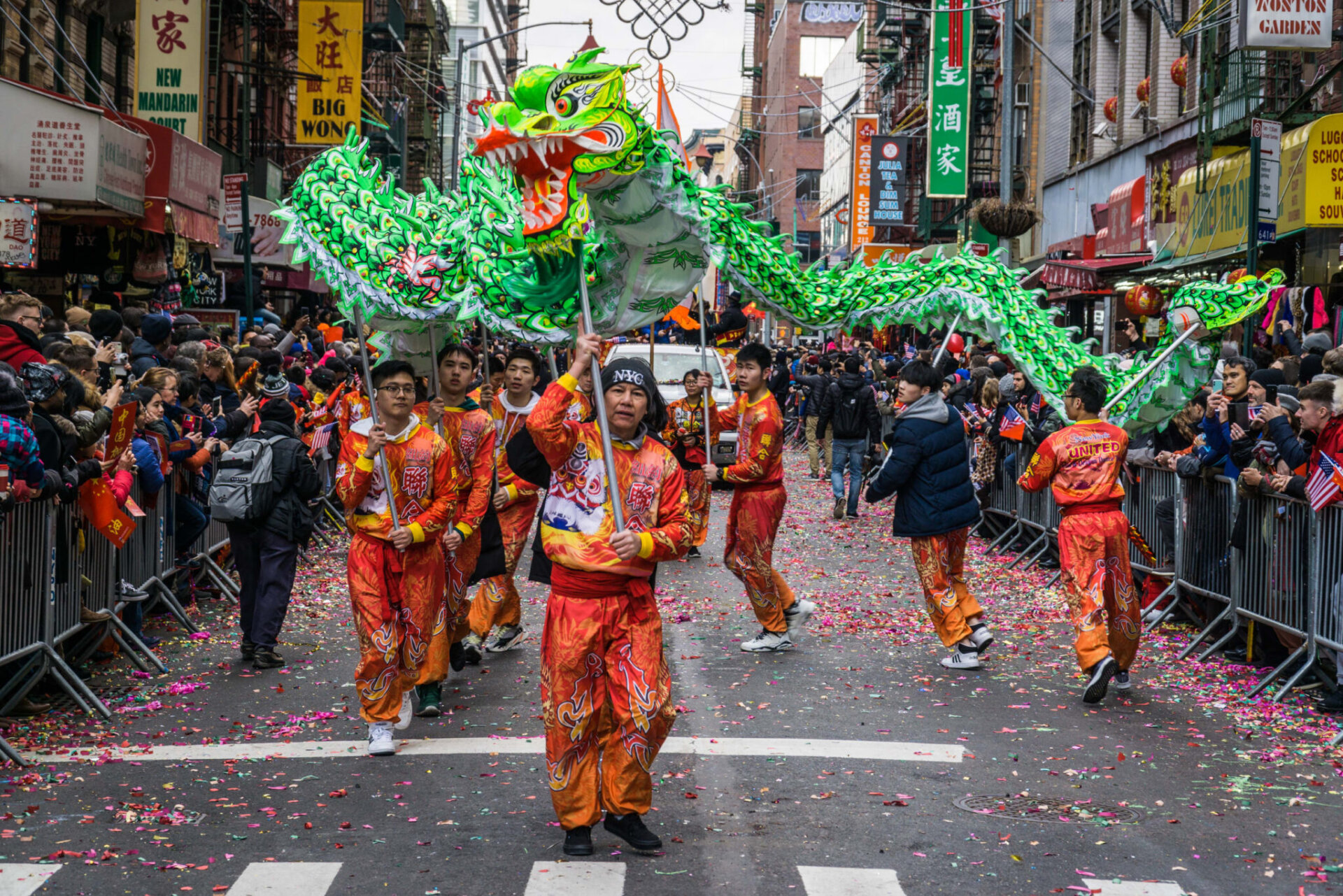
Yet, both nations, like many other Asian countries, have become uniquely distinct. More interestingly, many countries under foreign rule experienced a period of hesitation in adapting to these foreign changes. Only in the modern era did we see these holidays being adopted. Globalization and social media have accelerated cultural exposure and sparked a desire to assimilate among individuals. As a result, we see holidays becoming more homogeneous and embraced regardless of ethnicity. For instance, Vietnam celebrates both New Year and Lunar New Year with fireworks and live events aimed at captivating both international and local audiences. In contrast, states like California in the U.S. not only celebrate the Lunar New Year but declare it a state holiday to promote diversity and honor the traditions of its Asian community.

People celebrating Lunar New Year at Santa Monica, California (Image Source: Santa Monica)
For many, globalization represents homogeneity and modernization, but the challenge of rapid development lies in balancing it with cultural identity. On this precipice, an argument emerges that cultural hybridity is unattainable without conflict. While the topic of immigration might seem like a digression from the discussion of hybrid holidays, it provides insight into why such holidays may disadvantage Asian communities. The upcoming article on The Broken Dream delves deeper into the harsh realities faced by Asian immigrants, addressing the barriers to cultural assimilation. Upon arriving in a new country, many immigrants face language barriers that hinder their ability to engage in daily life. Additionally, being in a foreign land creates a disconnect from cultural practices once shared back home. This amalgamation has contributed to the erosion of cultural identity within the Asian diasporic community and, ultimately, a lack of representation and recognition of Asian holidays in Western nations. Thus, despite both Western and Asian countries experiencing globalization, the lack of representation and centuries of influence have made Asian communities more likely to accept Western holidays rather than maintain their own.
Understanding the significance of hybrid holidays on a nation’s cultural identity requires accepting that not all nations are the same. Globalization offers vast development, but it also poses the risk of diluting cultural identity, particularly for Asian communities across the globe. However, the growth opportunities outweigh the risks, as seen in the increasing recognition of holidays like Diwali and the growing acknowledgment of the Lunar New Year by international brands seeking to connect with consumers. Hybrid holidays provide an intriguing perspective on how Asian cultural identities have evolved, influenced, and grown. Through globalization, the world has come to recognize and appreciate the profound impact of the Asian community. This opportunity to celebrate and embrace holidays from diverse backgrounds has enriched Asian cultures, making them more accessible to people from different parts of the world.
The implications of this insight are vast. As members of the Asian community, we must understand that representation matters. The holidays we celebrate reflect our individual and collective identity, showing that we are adaptable to change while remaining true to our roots. This adaptability is one of the reasons why the cultural identity of Asian countries is so idiosyncratic. Now, the only question for us as readers is how we can represent our identity in a way that makes us proud while staying true to our heritage.