How CMS Development Services Can Save You Time and Money?
Development
March 12, 2025
SHARE:
Are you finding it hard to balance growing your business while managing your website? When you’re focused on scaling, the task of maintaining an up-to-date website can quickly become overwhelming. From marketing campaigns to team management and customer satisfaction, your plate is full. On top of that, your website—a core part of your digital presence—requires constant updates and attention. This is where CMS development services come in. They simplify website management, saving you time and cutting costs. Think of a Content Management System (CMS) as your virtual assistant, helping you organize, edit, and scale your website effortlessly without needing a developer at every turn.
By partnering with experts like AHN Group, you can ensure your CMS is tailored to your unique business needs. In this blog, we’ll explore how CMS development services streamline your processes, reduce expenses, and set your business up for long-term success.
What Are CMS Development Services?
CMS development services are focused on creating and customizing a Content Management System to meet the specific needs of your business. These services typically include:
Platform Selection: Choosing the right CMS (e.g., WordPress, Joomla, or Drupal) based on your goals.
Designing a User-Friendly Interface: Ensuring that the CMS is intuitive and easy to navigate.
Integrating Plugins & Tools: Adding necessary functionalities, such as SEO, social media sharing, or e-commerce.
Security & Scalability: Making sure your CMS is secure and can grow with your business.
By partnering with a professional web developmentcompany like AHN Group, you can create a CMS solution that is efficient and user-friendly for your team.
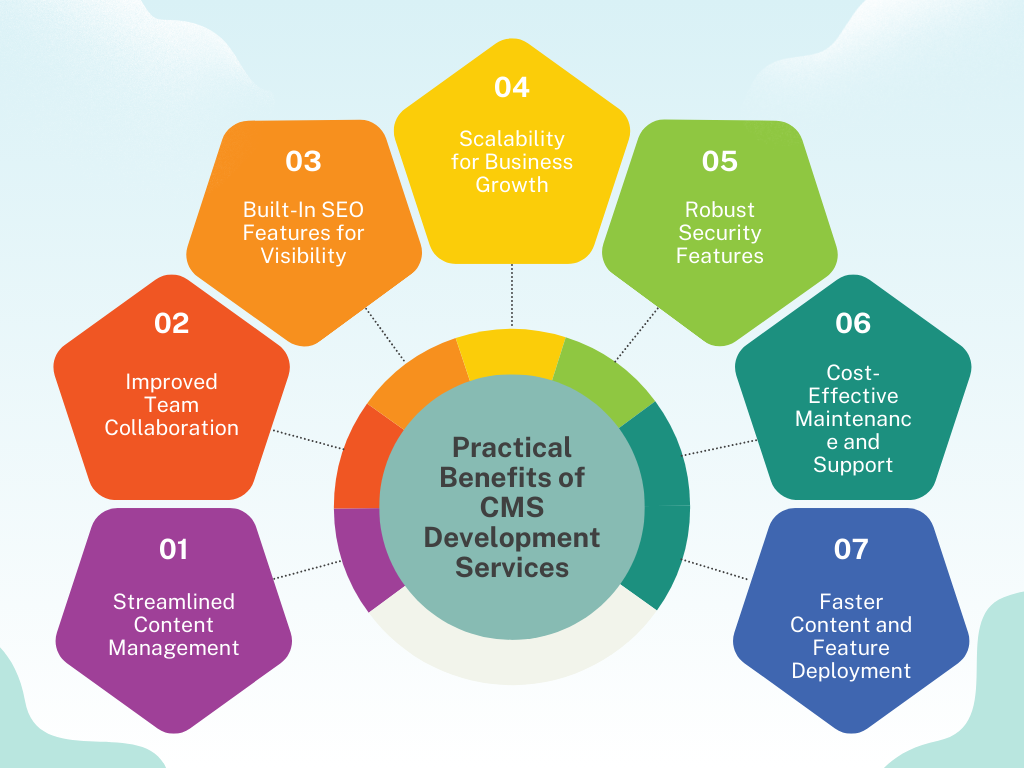
The Practical Benefits of CMS Development Services
Now that we’ve explored what CMS development services are, let’s dive into the specific benefits they offer your business. Each of these advantages helps save time, cut costs, and streamline your website management.
1. Streamlined Content Management
A CMS makes website updates simple, even for non-technical users. Whether adding a blog post, updating product descriptions, or changing images, you can do it all in just a few clicks.
Key Benefits:
Instant Updates: Add or edit content whenever needed.
Lower Costs: Reduce reliance on developers for routine changes.
Ease of Use: Intuitive design makes it accessible for everyone.
With the right services, your platform will be tailored for efficiency, allowing you to focus on growing your business instead of worrying about website maintenance.
2. Improved Team Collaboration
A CMS fosters teamwork by enabling multiple users to work on the website simultaneously. Departments can have distinct roles—marketing can post blogs while sales updates pricing—all without stepping on each other’s toes.
How It Helps:
Assign roles and permissions for better workflow.
Reduce miscommunication between teams.
Save time by centralizing content updates.
By using a professionally developed CMS, you ensure a smooth, collaborative process for all teams.
3. Built-In SEO Features for Visibility
Most CMS platforms come equipped with SEO tools to improve your website’s search rankings. From optimizing keywords to managing meta descriptions, these features are essential for driving organic traffic.
With CMS Development Services, You Can:
Automate key SEO tasks like creating XML sitemaps.
Optimize for mobile responsiveness.
Ensure page speed and performance are up to standards.
A web development company like AHN Group can fine-tune these features, helping you attract more visitors without spending heavily on paid ads.
4. Scalability for Business Growth
Your business is evolving, and your website should keep up. A CMS lets you easily add new features, pages, or integrations as needed.
Why It Matters:
Avoid expensive website overhauls.
Seamlessly add e-commerce or customer support portals.
Stay competitive with the latest tools and trends.
With a scalable CMS, your website can grow alongside your business, saving you both time and future expenses.
5. Robust Security Features
Cybersecurity is a top priority in the competitive digital market. CMS platforms offer built-in features to protect your website from potential threats.
Key Security Features Include:
Automatic software updates.
Two-factor authentication for added protection.
Regular backups to safeguard your data.
When you partner with a web development company, they ensure these features are properly configured, giving you peace of mind without additional costs.
6. Cost-Effective Maintenance and Support
Maintaining a website doesn’t have to drain your resources. A CMS automates many routine tasks, such as updates and security patches, reducing the need for constant technical support.
How CMS Saves on Maintenance:
Handle basic updates yourself.
Reduce dependency on external developers.
Ensure smooth operation with automated processes.
7. Faster Content and Feature Deployment
In a fast-moving digital world, agility is key. A CMS allows you to quickly adapt to market trends, deploy new content, and introduce features without delay.
Advantages:
Speedy response to customer demands.
Stay ahead of competitors by implementing updates faster.
Save time by automating repetitive tasks.
This agility enables you to stay relevant and cost-effective in your industry.
Why Choose AHN Group For Your CMS Needs?
At AHN Group, we specialize in delivering tailored CMS development services that save you time and money. Our team works closely with you to:
Understand your unique business needs.
Develop a CMS that’s secure, scalable, and easy to use.
Provide ongoing support to ensure optimal performance.
When you choose us, you’re not just getting a CMS—you’re gaining a partner dedicated to your success.
Conclusion
If you want a website that feels like a trusted partner, AHN Group is here to help. We don’t just offer CMS development services—we provide tailored solutions designed to meet your business goals. As a leading web development company, we ensure your CMS is not only efficient and user-friendly but also a powerful tool for sustainable growth.
It’s time to take the stress out of website management and focus on what matters most: scaling your business.
Contact AHN Group today, and let’s create a website that works as hard as you do!
For years, Cantonese Americans/Canadians like Sheldon Ho have struggled to learn Mandarin, feeling like existing language learning apps weren’t designed with them in mind.
Through the Canto to Mando Blueprint, there’s a solution that takes advantage of their existing Cantonese knowledge to help them master Mandarin in a fraction of the time.
The Canto to Mando Blueprint is the brainchild of Sheldon, who personally struggled for years with Mandarin learning. Not only has it helped countless Cantonese Americans reconnect with their Chinese culture, but it has also enabled them to learn more of their native tongue.
The success of this program speaks for itself – it has over 400 students and counting! It’s time for the world to take notice of this groundbreaking innovation in language learning.
Read through as Sheldon shares more about his story and how the Canto to Mando Blueprint is changing the game for Cantonese Americans learning Mandarin.
FAILING TO LEARN CHINESE AS A KID
Growing up, I was really resentful of my culture.
I think having failed at learning Chinese as a kid made me detached from my Chinese culture and resent it. As a result, I grew up hating being Chinese and always felt it was uncool. It made me want to be “extra” Western.
I would speak to my parents in English intentionally instead of Cantonese and as a result, my Cantonese became mediocre. I never realized this all came as a result of having failed Chinese as a kid but now that I’m older, I can see how things would have been different had I learned the language better when I was young. I would have learned more about my culture, and ancestors, and since the culture is naturally pretty cool, I would have definitely embraced it more.
AN ASIAN AMERICAN CHINESE LANGUAGE LEARNER’S PERSPECTIVE
The big thing plaguing the language learning industry is learning resources that are made for the mass market. I think that language learning businesses definitely cater to the mass market with good reason. ALL Americans Can benefit from one single Chinese learning resource made for English speakers. There’s a lot more money in that space because the market is a lot larger and they have the opportunity to help more people. Given that logic, there’s absolutely no incentive to make something for the Cantonese American market.
Another thing plaguing the language learning industry is having solely native speakers teaching the language. This is due to the curse of knowledge. It’s when you know too much in your brain and you can’t relate to your students as much anymore. They actually find it HARDER to learn from you.
That’s why from an Asian American Chinese language learner’s perspective, I think representation is really important. I think having more Asian American teachers as opposed to pure Chinese teachers is really beneficial.
When I was learning, all teachers were from China and while their Mandarin level was top-notch, there was a gap in their ability to relate to my struggles as a Chinese learner. This is because they have never been in my position as they grew up in a 100% Chinese environment. Employing techniques made for kids in China doesn’t work the same with us.
This is why most Asian Americans flunked out of Chinese school when they were kids. It’s made by native Chinese people who don’t understand the differences between the struggles of learning Chinese here in the West vs in China. In the same way, I also can’t relate to the struggles they may have faced learning English. I can confidently say that I’m probably not gonna be a good English teacher because I don’t understand the struggles ESL learners face.
On the other hand, I understand very well what struggles Cantonese Americans may face when trying to learn Mandarin and improve their Cantonese. I literally went through all those struggles myself. I was the kid unable to write his own Chinese name.
THAT “YOU LOOK CHINESE BUT YOU CAN’T SPEAK CHINESE” MOMENT
I’ve tried countless times to learn Mandarin. I think I’ve had “I’m gonna learn Mandarin this year” as my new year’s resolution for like 10 years straight.
Each time I failed, I wasted MORE time but more importantly, it made me feel like more of a failure. I felt like maybe I was just too dumb to learn my language, maybe I was just too dumb overall. How many more tutors, apps, and university classes am I gonna waste time and money on?
I went through my lowest point when I was unable to talk to the family of the girl I was dating at the time. It was a really big “you look Chinese but you can’t speak Chinese” moment for me where I felt quite embarrassed.
It was a big mental hurdle that really messed with me. Things changed when I finally took time to think about how I could learn by leveraging my existing Cantonese. What if I just took my Cantonese and brought it over to Mandarin? Through an arduous process of figuring out how to do that, I finally learned Mandarin.
Once I learned this, I realized how easy it is to learn this language for Cantonese speakers. I realized that we’ve been being taught wrong all our lives and that is the reason why we haven’t been able to learn. This motivated me to create this platform. I wanted to help Cantonese Americans finally get this Mandarin learning thing handled and hopefully through that, help them with embracing their culture.
I always felt that Mandarin was so hard to learn. It always baffled me that I was thrown into the same class as Craig, someone who had no Chinese background at all.
I tried so many different learning apps and went to so many different Mandarin classes and tutors in college and it was ALWAYS the same. We always wasted WEEKS on basic stuff like “ni hao.” This felt stupid to me as a Cantonese person. I knew “ni hao.”
Cantonese Americans are in a weird middle ground. For the most part, we speak just enough Cantonese to have an advantage over people with no Chinese background – yet we can’t read Chinese, and aren’t good enough to take advantage of Mandarin resources meant for true native Canto people in Hong Kong which leverage your Cantonese. As a result, we have to stick with English resources made for white people.
So fundamentally, when setting up our program the only goal in mind was to create something for Cantonese Americans who can speak a little bit of Cantonese. We wanted to make something for the Cantonese American who spoke a little but couldn’t read or write Chinese. We’d teach them all the fundamentals while leveraging their existing Cantonese.
PLATFORMS MADE FOR PURE ENGLISH SPEAKERS CAN’T DO THIS
With our method, students improve their Cantonese while learning Mandarin. Most Cantonese speakers want to learn Mandarin but it’s also important to them that they improve in their heritage language.
Because Mandarin and Cantonese have such similar structures – if you know how to leverage them, you can improve on both languages at the same time. This way, as your Cantonese gets better, so does your Mandarin, and vice versa.
Platforms made for pure English speakers can’t do this since they’re not made for Cantonese speakers. The next thing is the speed at which you learn. Our students start speaking literally from day 1 because we’re essentially just teaching you how to bring your Cantonese over to Mandarin in the beginning.
There are a lot of tips and tricks that make things a lot faster. For example, the Cantonese ‘G’ becomes a Mandarin J about 80% of the time. This takes away a lot of the memorization work when it comes to learning Mandarin.
So the main difference is just the speed of learning. It’s a lot faster. I don’t want to say the other apps or university courses don’t work because of course they do. But when you have to wait months for marginal results it’s really easy to get discouraged. That’s why we made it a PRIORITY to get people speaking from Day 1 so they see results right away.
SUCCESS STORIES
A large portion of our students happens to be in healthcare. There was this nurse who often felt ashamed at work. Chinese patients would reach out to her because she looked Chinese but when she couldn’t reply in Mandarin – she would feel sad for being unable to help her own people. This is what made her reach out to me and within the first couple weeks of doing the program, she shared with us how good it felt to be able to communicate with Chinese patients, and that was a big win.
Another success story is about this girl who wanted to surprise her parents with her Mandarin. She started texting them on day one of the program, and it made them really happy.
But my favorite story is about one of our students who had been dating her Taiwanese boyfriend for 10 years. Each time she hung out with his family, it’d be in English. She would have very basic and shallow conversations with her boyfriend’s mom. Note that it’s been 10 years!
Recently, she told me that she had a full Mando conversation with her boyfriend’s mom and that she was so excited that she could finally speak Mandarin. If I could put it in her words, it was like the mom went from being almost mute to being the most talkative person in the world! Excitement grew on her face and she said “OMG I can take you to Taiwan now and show you everywhere!”
IT’S WHAT I WISH I HAD
What we have is a program and curriculum specifically designed for Cantonese Speakers to leverage their Cantonese (no matter what level) to learn Mandarin and improve their Cantonese.
Along the way, we have tutors for support who are fluent in BOTH Cantonese, Mandarin, and English. From my experience, oftentimes, Mandarin tutors only speak one language. They speak Mandarin amazingly – but the lessons aren’t conveyed in the best way in English. They can’t convey certain concepts to English speakers. We make sure our tutors are able to do that, as well as in the Cantonese perspective. Lessons are all given with the Cantonese English Perspective in mind.
The truth is, in most cases, Mandarin tutors are overqualified in the wrong thing. Cantonese diaspora don’t need someone who studied classical chinese literature and classical chinese to teach them Mandarin. They just need someone who can speak good Mandarin, and understands how to convey that effectively in English to them.
We make sure our tutors have that. I took big a part in training our tutors on how to view things from a Cantonese-American perspective.
I’ve been through the journey myself as a Cantonese Canadian who learned Mandarin. I pretty much know what each student will struggle with, where the pain points will be, and what type of questions everyone will have. I’ve poured that knowledge into the program and poured that knowledge into our tutors.
An example is the simple understanding that Cantonese Americans can speak a little bit of Cantonese, but can’t read or write Chinese. How do you tailor-make something for that person? That’s what we sat down for months to figure out. It’s what I wish I had.
HOW THE COMMUNITY HAS RECEIVED THEM
The Cantonese American community has been really thankful to have something made for them.
A lot of people dealt with the same struggles I dealt with so I’ve received a lot of comments from people thanking our team for what we’re building as well.
From the broader language learning community, there’s been a lot of intrigue about seeing a course that dives this deep into linguistics. We really dug into textbooks to find information like how Cantonese tones map to Mandarin and at what percentage. For instance, it’s really fascinating to know that you can map your Cantonese tones to Mandarin with about 80% accuracy. This means that Cantonese speakers can essentially skip memorizing Mandarin tones and still be right about 80% of the time. This is knowledge that takes YEARS off the Mandarin learning curve.
PROGRAM TAKEAWAYS
Three things that I hope users will take away from using our platform and learning Mandarin through our program:
How beautiful Chinese culture is and how great it feels to reconnect with it. If they can get a deeper sense of belonging and more interest in their roots, that’d be incredible.
A deeper love for Cantonese. Through our program, students will also improve their Cantonese. As they learn about the differences between Cantonese and Mandarin, they’ll see that Cantonese has its own writing system that makes it really unique. Through this, I hope they feel more pride as Cantonese speakers. I grew up resenting my Cantonese side because Mandarin is more popular – but ironically, as I learned more Mandarin, I grew to love Cantonese more and more.
A renewed sense of confidence in their ability to learn. A lot of people feel traumatized as kids because Chinese school was so ineffective. We feel that we’re failures because we couldn’t learn our native tongue and then make memes on subtle Asian traits to feel better about ourselves. I can confidently say that the way they teach Chinese in the West is not the best. I want to help people recover and feel better from that Chinese school trauma.
MANDO TO CANTO
I was surprised by how many Mandarin speakers are interested in learning Cantonese so I’m excited to share that the next big project we’re working on is Mando to Canto! We’re currently in the R&D phase.
Love – a universal language that transcends boundaries, cultures, and time.
It’s a force that can inspire, challenge, and ultimately transform our lives. And I’m not just talking about the heart-fluttering, romantic kind of love, but also the tough love, the kind of love that helps us grow, teaches us the hardest lessons, and makes us strong in the face of challenges. Linda Marigliano’s “Tough Love” podcast embarks on a mission to uncover these lessons hidden within the folds of love stories.
Linda is a creator, co-founder, author, and podcaster. She created Tough Love during the most difficult times of her life. It was in the middle of a rigid lockdown in Australia in 2021. After being in a long distance relationship for three years, Linda quit her high profile radio job planning to move overseas and begin a new life with her boyfriend who lived in LA, but the pandemic happened and the world stopped. She found herself stuck in Australia due to border closures and was forced to move back in with her strict parents in her mid-30s.
Her podcasting journey began with the ambition to share her own story, inspire diversity, and share Australia’s proud immigration stories. Building the podcast from scratch was a challenge she embraced with passion.
Facing Challenges Head-On
Linda’s most significant challenge in this journey was launching, producing, and marketing the podcast as an independent creator. She had to master every facet of the podcasting industry, acquiring equipment to set up her home studio and venturing into the field as a roving reporter, capturing real-life scenes like a documentary. The hustle was relentless as she faced rolling deadlines and created a media campaign to promote the series.
As the podcast’s host, Linda also faced the personal challenge of sharing her vulnerable story. Linda had to let the listeners into her own uncertainty in modern life as she opened up her Italian Chinese family home. She addressed topics about how she froze her eggs during Season 1 and how she navigated her heartbreaking long distance relationship.
These stories, though challenging to share, created a devoted community of listeners who resonated with her journey through uncertain times.
Achievements and Milestones
The “Tough Love” podcast has been a remarkable success. In 2021, it earned the title of Best Lockdown Podcast at the Australian Podcast Awards and was a finalist in the Best New Podcast category. What makes this achievement even more impressive is that “Tough Love” is a completely independent project, with no financial backing from a production company.
In 2023, Linda achieved another milestone in her journey. Not only did she release her own book, “Love Language,” a deeply personal and true story that inspired the podcast, but she also performed a SOLD OUT live podcast show at the iconic Sydney Opera House.
This performance brought her Chinese mother, Janet, into the spotlight, sharing her experiences of growing up in a tiny village in Malaysia and how her unwavering loyalty to her family back home has shaped the way she lives her life. This narrative moved the audience, making them eager to learn more about Janet, her upbringing and her immigrant journey as a teenager who had a difficult time fitting in when she first moved to Australia.
Mission and Vision
Linda’s mission for the podcast is to share her compelling story using innovative documentary storytelling and music, offering practical lessons for modern life, while her vision involves expanding her audience to live shows, events, and exploring television and film opportunities.
With Linda’s focus on her Chinese Malaysian culture, especially through her friends and her mother’s portrayal in it as a strong business woman even in her late 60s (and fan-favorite), amplifies diverse Asian perspectives, resonating with a dedicated community of listeners.
Message from Linda
If there is one episode of the Linda Marigliano’s Tough Love podcast you should listen to, make it the Season 2 ‘Help, My Parents Are Getting Older’ episode. This one showcases how we feel when we realize our parents are aging and what it means to remain loyal to family. We attend a salsa party with my Chinese mother, Janet, and she tells us about her Malaysian upbringing. It’s a moving, heartbreaking, but ultimately joyous scene.
I am incredibly proud to have inherited my mom’s deep Asian hustle spirit! There’s delight in hard work, and I love hearing the Asian hustle stories you share.
Now, I’m finally living in LA, reunited with my boyfriend, and the hustle continues. I’m open to exploring the city and connecting with the Asian community, so please reach out. And stay tuned for Linda Marigliano’s Tough Love Season 3!
Jeanny Chai is an entrepreneur, coach, and cancer survivor. She’s inspired hundreds of women to break free from unfulfilling jobs and relationships. But she wasn’t always this way. In this exclusive interview she talks about how she went from a scared loner kid to a powerful leadership coach.
Childhood Pressures and Shaping of Mindset
Growing up, Jeanny was always under pressure to achieve. Sound familiar? In episode 3 of her podcast, Asians Breaking Ceilings, she shares the expectations her parents placed on her. “Oh, you’re going to be a doctor.”
She lived under constant pressure to be perfect. “I was called careless when I missed math problems and my parents were displeased. I got disapproval and felt like a burden whenever I made mistakes, like spilling milk or getting sick. I felt like I had to be perfect to avoid anyone getting mad at me.”
You don’t need anyone’s permission, apology, validation, or approval for you to make the transition from unfulfilled to living your leadership potential.
Jeanny Chai
Her Battle with Cancer and Path to Transformation
As an adult she was free from her parents but then cancer got her. Her doctor told her that she had 3 tumors, stress-induced. Her reaction? “ashamed, scared, angry and then finally hopeful.” Despite cancer being a shitty experience, she had HOPE. How?
Hope came when she realized that she was allowed to ask for help. It wasn’t her job to suffer alone in silence. She had managed to handle all the other stressors in her life alone, but this one was too much for her – and that was okay. For the first time ever, Jeanny learned asking for help was not a sign of failure or weakness. This theme would return later on.
A Glimmer of Hope in Solitude
Cancer threw Jeanny’s life and routine out the window. Yet the hardest part wasn’t the physical pain – it was the overwhelming sense of loneliness she experienced. Unable to have visitors, she was profoundly isolated, physically and emotionally. She shares, “When you are under so much medication, your days and nights mesh together and you get lost in your own thoughts,”
But in that time of sadness, Jeanny felt a glimmer of hope. One day, she heard a loud voice that declared, “You are already good enough.” The unexpected declaration left her in a state of awe.
Jeanny had never entertained such a notion about herself before; this was a pivotal moment. She kept repeating this idea to herself for the next few years, and that’s when she started to feel stronger, more confident, and more in control of her life. This also marked the starting point of her business, Bamboo Myth.
A Journey of Self-Discovery
After casually beating cancer, Jeanny embarked on a five-year journey of self-discovery.
“When I got sick, I was no longer focused on becoming the next Elon Musk or landing a job at the next unicorn start-up in Silicon Valley. Instead, I bought myself an electric piano and an acoustic guitar. Later I bought a saxophone and ukulele and I gave myself voice lessons. I bought myself a baby rabbit, who was my bedside companion during my chemotherapy treatment. I remembered that I loved music, singing, and animals and learned to create my own happiness,” she shared.
With cancer showing her that life was short, Jeanny decided to leave the corporate world and start her own business, pursuing purpose instead of promotions.
“Asians Breaking Ceilings” Podcast
Fast forward a few years and her business is thriving. She speaks about the Bamboo Ceiling at Fortune 500 companies and major conferences.
She also runs a 12-week coaching program called “Live Your Leadership Potential,” and has coached over 300 Asian women, bringing “life-changing” results. Her program centers on 2 core principles that help women regain confidence, energy, and agency.
She teaches that what’s needed isn’t communication strategies, but permission to speak without guilt or shame. Once women overcome this barrier, their natural leadership abilities and newfound confidence are allowed to shine.
The best part? Jeanny emphasizes that this mindshift set doesn’t require years of therapy or yoga; all it takes is a focused approach to transform from burnout to happiness.
Now she is making these cultural-specific leadership strategies available to everyone, through her podcast. In it, she shares a powerful new definition of success.
“Confidence, assertiveness, and happiness are an inside job. So my new definition of success is this: Being able to decide, create, and ask for what you want in your career and life. And my podcast is designed exactly to do just that,” Jeanny shared.
Advice for Those with Similar Struggles
Did you resonate with any of this? Jeanny has the the following advice for individuals who struggle with people-pleasing, fear, or lack of self-compassion:
First, you must stop stuffing your feelings and coping by working harder and harder. Realize that you don’t need anyone’s permission, apology, validation, or approval for you to make the transition from unfulfilled to living your leadership potential.
Stop getting more certifications and degrees to fill that feeling of “not being enough.”
Listen to my podcast! Start with Episode 1 and let yourself feel again. Many of us have numbed out our emotions so we can handle and cope with all the stress but this is the opposite of what we need to do to begin the transformation.
Find a safe person (therapist, coach) and tell them your story. As Brene Brown says, shame thrives in silence. That’s why I’m paving the way by speaking up so others can speak up and be transformed for good.
And take this FREE assessment that I’ve created just for Asian Americans. It helps you identify in just under 5 minutes what is your biggest roadblock to success:
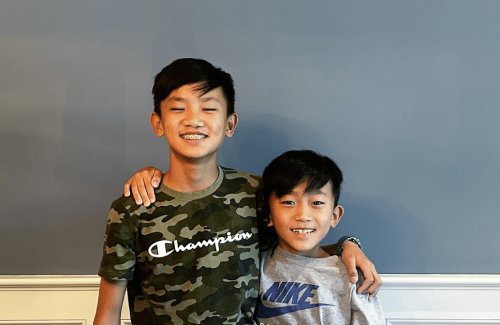
Today, we turn our attention to the promising endeavors of Oliver and Archer as they share their inspiring journey in bringing the Maine Catch card game to life.
Finding Inspiration in Lobsters and Art
When asked about the source of their inspiration, the brothers responded with youthful exuberance, “We’re just two young, lobster-obsessed kids hoping to make our game a reality.”
Their spark of creativity was ignited during a visit to Maine, where they stumbled upon a lobster shack that introduced them to the captivating world of rare lobsters and lobster collecting. Merging these newfound passions with their love for art, the concept of Maine Catch was born.
Navigating Challenges and Staying on Course
Like many creative minds, Oliver and Archer faced challenges on their journey. They openly admitted, “We often get sidetracked.”
Distractions can be a hurdle for entrepreneurs of any age, and learning to stay focused is a valuable skill they are honing.
“Our mission is to create a card game that people can enjoy. This achievement wouldn’t just be ours; it would inspire Asian children worldwide who dream of becoming entrepreneurs.”
Oliver and Archer Noe
Celebrating Artistic Achievements
Despite their age and the challenge of getting sidetracked, these young entrepreneurs have achieved remarkable milestones.
They take immense pride in the fact that all the art featured in Maine Catch is hand-drawn, meticulously refined on the computer, and masterfully shaded in. They have designed and created over 20 unique cards for the game.
Balancing School and Chores with Entrepreneurship
Beyond their entrepreneurial pursuits, Oliver and Archer are just like any other kids their age. While they are blazing a trail in the world of entrepreneurship, these young entrepreneurs still embrace their roles as students and household chore-doers.
Introducing Maine Catch
Oliver and Archer’s passion for game creation has been a lifelong journey, encompassing both imaginary adventures and tangible projects. Lately, their focus has shifted towards card games, with Maine Catch being their most ambitious and promising endeavor yet. It’s evident that their dedication to refining their skills is paying off with this exciting project.
Empowering Aspiring Entrepreneurs
When asked about their mission and vision for Maine Catch, the young entrepreneurs shared, “Our mission is to create a card game that people can enjoy. This achievement wouldn’t just be ours; it would inspire Asian children worldwide who dream of becoming entrepreneurs.”
Their aspirations extend beyond their own success as they aim to empower the Asian community and inspire young minds to chase their entrepreneurial dreams.
Oliver and Archer Noe are setting a remarkable example of youthful determination and creativity in the world of entrepreneurship. Their journey from lobster shacks to designing a unique card game, Maine Catch, is an inspiring testament to the power of imagination and passion.
As they continue to grow and develop their entrepreneurial skills, they are not only achieving their dreams but also paving the way for aspiring young Asian entrepreneurs worldwide. We look forward to seeing Maine Catch make waves in the gaming world and the positive impact these young talents will have on their community.