Stories

December 8, 2022

SHARE:

The blood of entrepreneurship runs through the veins of Chinatown’s Chinese food business owners, as three of the longest-running businesses have their children enter the management fields of their family business.

Tony and Selina Chun, together with Alan and Helen Chun, who have been in the business for decades, fully trusted their children to run the meat market company they bought in the 1980s.

The older generation passed it down to their children believing that they would treat it the same way they had after 40 years of building and creating the Chinatown cornerstone with crispy roast pigs, burnished roast ducks, and glazed char siu along with butcher store and seafood vendor.

Frankie, 35, and his cousins are now in charge of running the company that they established through diligence and thrift. Given that they have a family business to manage, Frankie has known since then that he won’t take long in any career.

He was reported in Honolulu magazine as saying, “I knew that anything I was going to pursue wasn’t going to be lengthy, because the family would always ask us back for support.”

He and his cousins learned the operations as a result of early exposure to the business and used them as a means of support, which pleased their parents, especially when they took their first vacation in four decades.

Meanwhile, Liana Fang, whose parents Wesley and Jie Mei Fang founded Sing Cheong Yuan Bakery, assists in running the business.

The pair bought the bakery from its original owners and then expanded it by bringing in more goods. The homemade goods were prepared using original family recipes that they later improved.

The 27-year-old claims she adores Chinatown but acknowledges that she is more passionate about cooking than baking. “It’s so authentic. I love Asian food, the fresh markets, the mom-and-pop shops,” she said.

Completing the list, the 33-year-old daughter of Sun Chong supermarket co-owner Ann Sung also contributes to management of the business.

Sun helps them sell their products and other items by marketing it online and by helping accomplish other stuff needed in the business.

Sun, who grew up at the shop with her cousins, said that their business is like a thread that can connect generations. She also claimed that coming home after studying abroad was like paying back her mother, who had done everything for her. Sun plans to update and improve her mother and aunt’s traditional business structure.
Related Articles

AHS EMAIL ANGLE (4)

Blogs, Development

Know Your Value Proposition

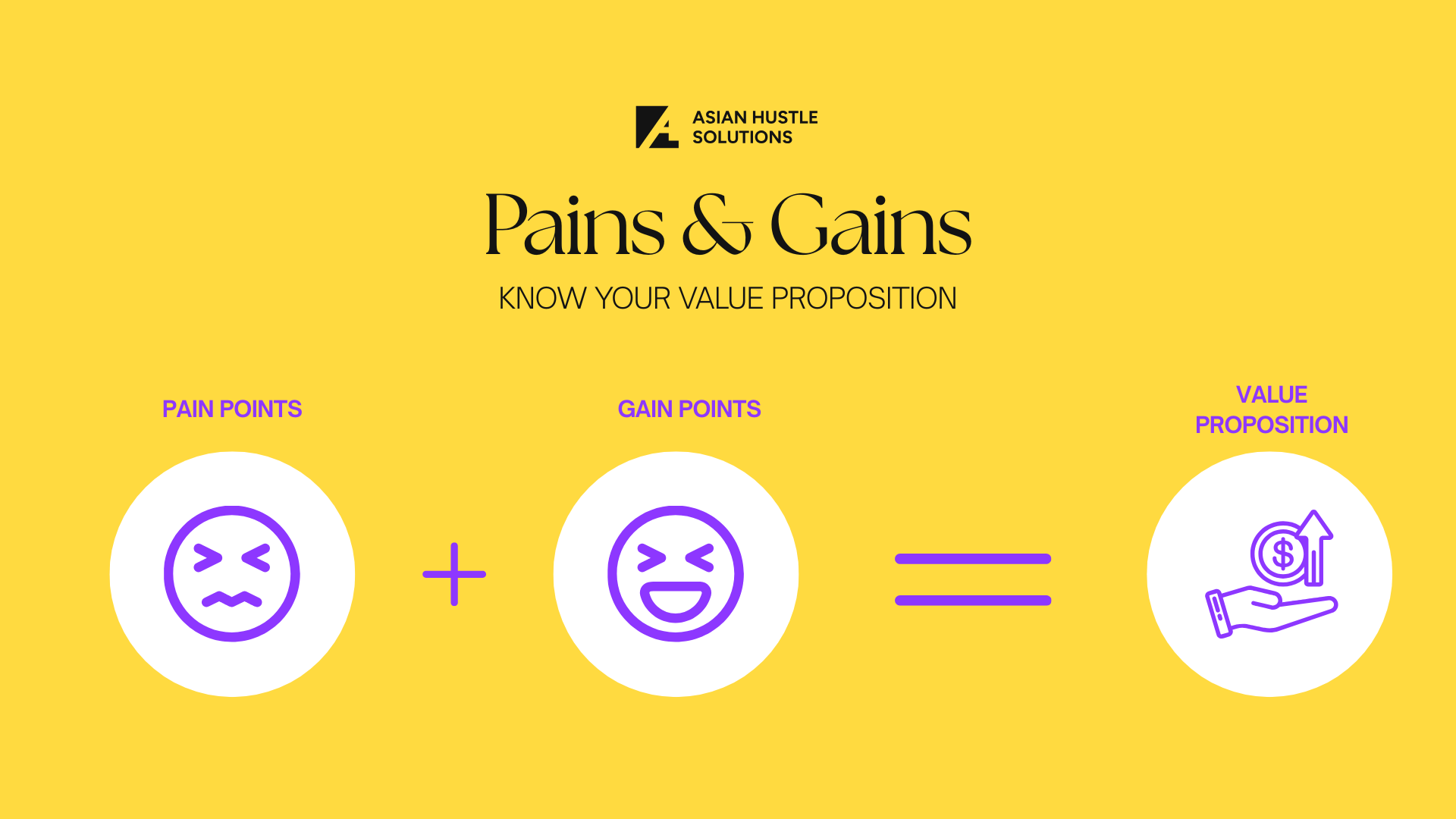
Pain points and gain points are not necessarily new concepts, but some might think they are opposing concepts, when in contrast, the two complement each other. Through customer pain and gain points, you can get a better understanding of your customers’ needs, and offer a unique value proposition.

  • Pain point: As the name suggests, it’s something that “pains” your customers; an issue that they have that needs to be addressed; a challenge that they need to overcome.
  • Gain point: Gain point, on the other hand, is more about you. What can your product or service do for the customers; what can they gain from using your service; what can you help them with?

The two are extremely simple and are a good place to start when you’re trying to advertise your product or service since they consider both your and your customer’s sides to offer a value proposition that is valuable. 

[Book a FREE call with us]
If you want to explore our services more, visit the Asian Hustle Solutions website at AHS.

Development

Winning The Race by Understanding Customer Journey

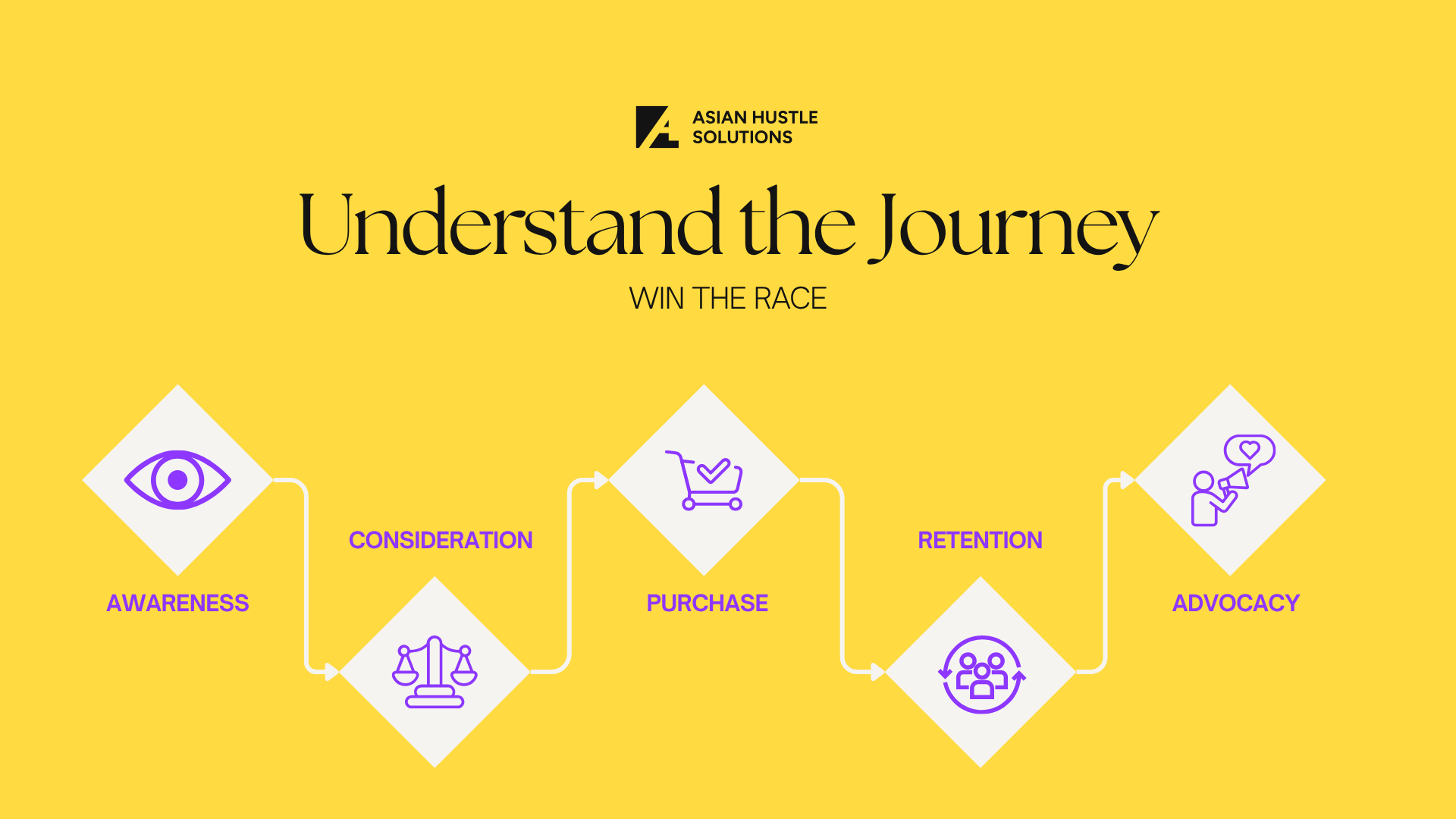
Before becoming a loyal customer, a lead has to interact with your product/service at various stages. This entire process is summarized in the customer journey, divided into 5 main stages:

  • Awareness: The customer becomes aware of your brand and your product, usually through search engines when searching for a solution to their problem.
  • Consideration: The customer is aware of your brands but also your competitors’;, they start wondering which of the options they should choose from.
  • Purchase: The customer makes a buying decision, either from your brand or your competitors’.
  • Retention: After the purchase, you need to consider how to get them to repurchase many more times, since retaining is cheaper than recruiting.
  • Advocacy: At this stage, the customer is basically your brand ambassador., Tthey love your product;, they tell their acquaintances about your product.

Understanding the journey and what stage the audience is at can help you understand their needs and adjust accordingly. Each stage has a different touchpoint as well, so adjusting to said touchpoint makes it more effective and less costly. Understanding the journey can help you win the race.

Why Asian Hustle Solutions?

At AHS, we specialize in helping brands capture attention and inspire action — whether you’re launching a new product or scaling your business, we’ll guide you to marketing that resonates and delivers results.

If you want to learn more about our services, visit the Asian Hustle Solutions website at asianhustlenetwork.com/services/

AHS EMAIL ANGLE (1)-png

Blogs, Development

Getting Back To Basics: 4Ps Marketing Mix

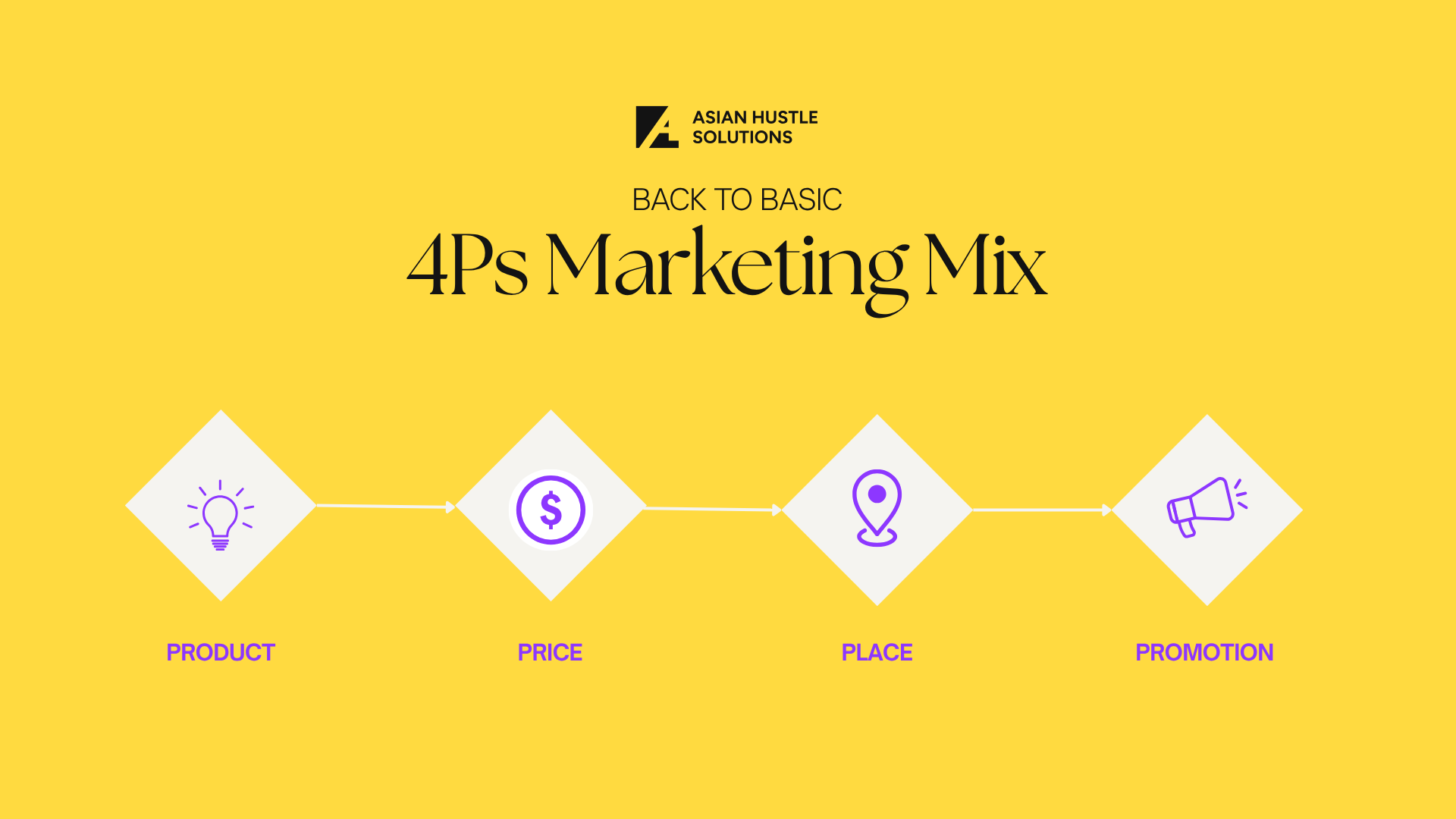
Sometimes, to create an effective marketing strategy for your business means going back to the basics. Popularized by Neil Borden, the 4P’s model is still widely used today, with each P representing a core aspect of the marketing mix:

  • Product: The core of your business, whether it is a physical product or a service. Understanding your product, what differentiates it from the competition, what is unique about it, etc.
  • Price: How much your product should be sold for. This should be based on the supply cost, how you position your product, and whether you should increase or decrease the price based on your target audience.
  • Place: The “where” of your product. Where can the customers purchase your products (online or physical stores, drug stores or supermarkets, etc). More so, it is also where you choose to advertise.
  • Promotion: How you reach your customer, either through advertising, public relations, or promotion, increases your brand awareness.

Why Asian Hustle Solutions?

At AHS, we specialize in helping brands capture attention and inspire action — whether you’re launching a new product or scaling your business, we’ll guide you to marketing that resonates and delivers results.

If you want to learn more about our services, visit the Asian Hustle Solutions website at asianhustlenetwork.com/services/

Stories

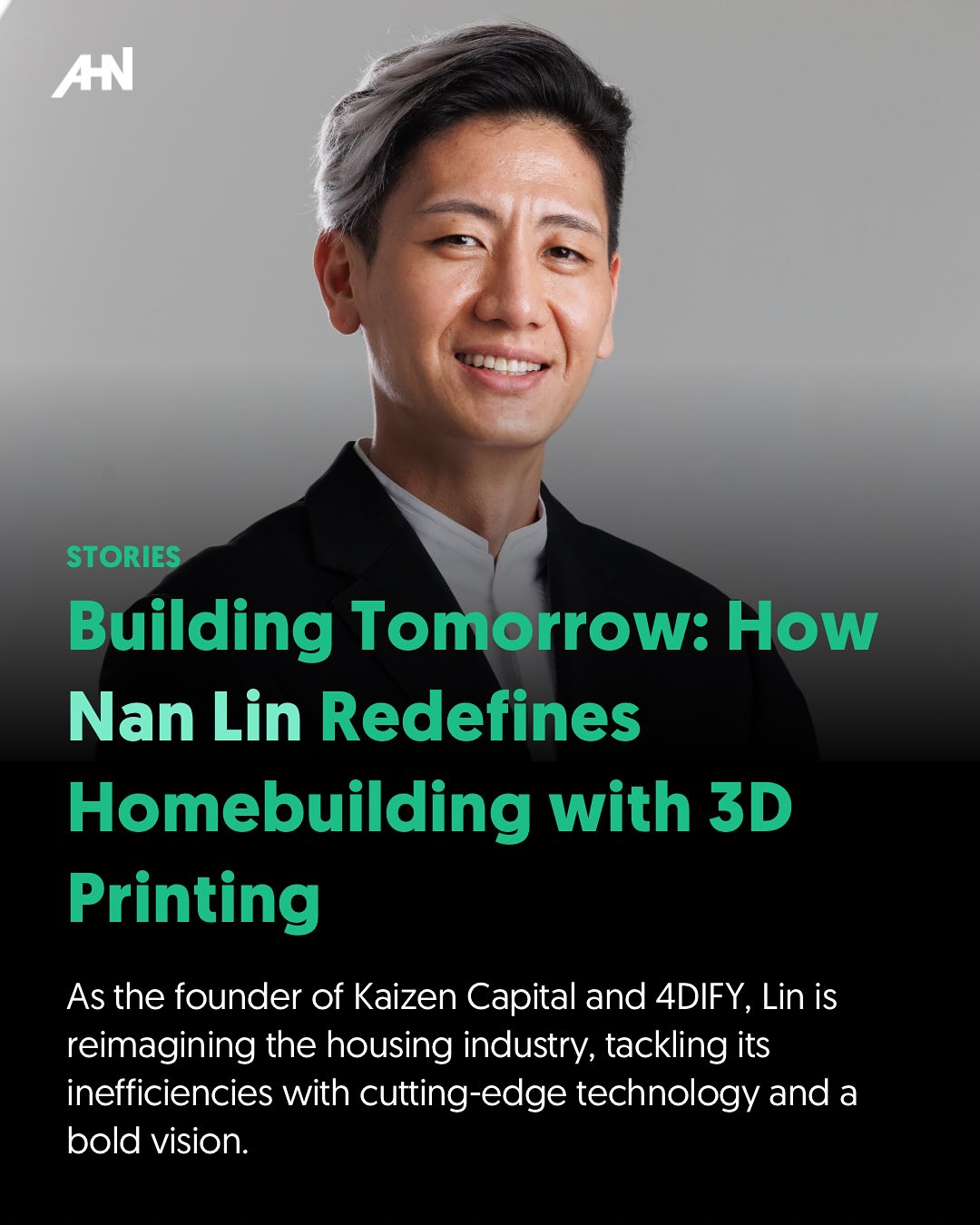
Building Tomorrow: How Nan Lin Redefines Homebuilding with 3D Printing 

For Nan Lin, entrepreneurship isn’t just business; it’s freedom. A freedom earned through sacrifice, relentless execution, and a refusal to accept the limits of a broken system. As the founder of Kaizen Capital and 4DIFY, Lin is reimagining the housing industry, tackling its inefficiencies with cutting-edge technology and a bold vision. His mission? To build stronger homes faster, at lower costs, empowering communities and challenging the status quo.

From Immigrant Roots to Visionary Leadership 

Lin’s journey began at age 10, when he immigrated to America with his mother. While adapting to a new country, he was inspired by his loving parents’ sacrifices, which shaped his relentless drive. “I saw the lengths they went to give me a better life,” Lin says. “Their love and dedication became my compass.” Years later, that resolve led to the creation of Kaizen Capital, where he transforms underutilized properties into vibrant housing solutions: ADUs, subdivisions, condo conversions, and luxury short-term rentals. By unlocking hidden value in land, he delivers market-rate and affordable housing that strengthens neighborhoods.

But Lin saw a deeper problem: traditional construction is slow, costly, and vulnerable to fire, pests, and natural disasters. Frustrated by an industry stuck in the past, he founded 4DIFY to lead a new era of construction through 3D-printed concrete homes.

Nan Lin | Founder and Principal of Kaizen Capital and 4DIFY

3D Printing: The Future of Housing, Today

Lin’s vision for 4DIFY was sparked by a frustrating reality: “Wildfires destroy neighborhoods every year, yet we keep building stick-frame homes that burn like kindling,” he says.

After visiting several 3D printer manufacturers, Lin partnered with New York–based SQ4D. It took nearly a year to secure exclusive licensing rights, navigate regulatory hurdles, and obtain building permits, but he got it done.

Now, 4DIFY is building California’s first community of 3D-printed concrete homes. As this article goes live, their first printed home is nearing completion, despite heavy regulations and a steep learning curve. The team is already outperforming traditional timelines and cost benchmarks. The second and third homes will soon print simultaneously, targeting completion in two months, effectively one home per month at under $200 per square foot.

Despite challenges as an Asian immigrant, Lin managed to transform them into motivation and success. 

“We’re aiming to build at half the cost and in a quarter of the time,” Lin says. “That’s not a dream. It’s the direction we’re heading.”

Built with concrete, reinforced with rebar, and topped with metal roofs, these homes are resilient against fire, wind, earthquakes, mold, and pests. They’re also designed for long-term savings, with lower maintenance, less waste, and reduced energy and insurance costs.

“Critics doubted it would work,” Lin reflects. “But seeing is believing. This is the future.”

A Philosophy of Purpose and Resilience

Lin’s journey has been marked by relentless challenges, some seemingly insurmountable. “Obstacles never stop,” he admits. Yet he transforms adversity into opportunity, fueled by a positive mindset, solution-driven focus, and disciplined execution. His trusted team is his backbone. “No one succeeds alone,” he says. “My team turns the impossible into reality.” This resilience shapes his leadership, blending bold vision with purposeful action to create opportunities, particularly for communities long excluded from wealth-building. “Housing isn’t just a product,” Lin says. “It’s a platform for empowerment.”

Recognition and Inspiration

Lin’s impact is gaining notice. The Sacramento Bee named him one of the Top 20 AAPI Change Makers, and he was honored in the Business Elite Awards’ 40 Under 40. But for Lin, the real reward is inspiring others. “I want to show the next generation of Asian entrepreneurs what’s possible when we claim our seat at the table,” he says.

Lin wants to create opportunities for those marginalized by elevating the future of construction, making it more accessible for his community.

Join the Housing Revolution

Nan Lin isn’t just building homes, he’s redefining what’s possible. Through Kaizen Capital and 4DIFY, he’s creating a future where housing is affordable, resilient, and sustainable. Follow his journey and see the revolution unfold.

Connect with Nan Lin: