Awaken* newsletter

June 20, 2024

SHARE:

This edition was a collaboration with The Early Newsletter by Michaela Gordon. You can read her thoughts on our conversation with Patrick here. Thank you Michaela for collaborating and please go check out her article!

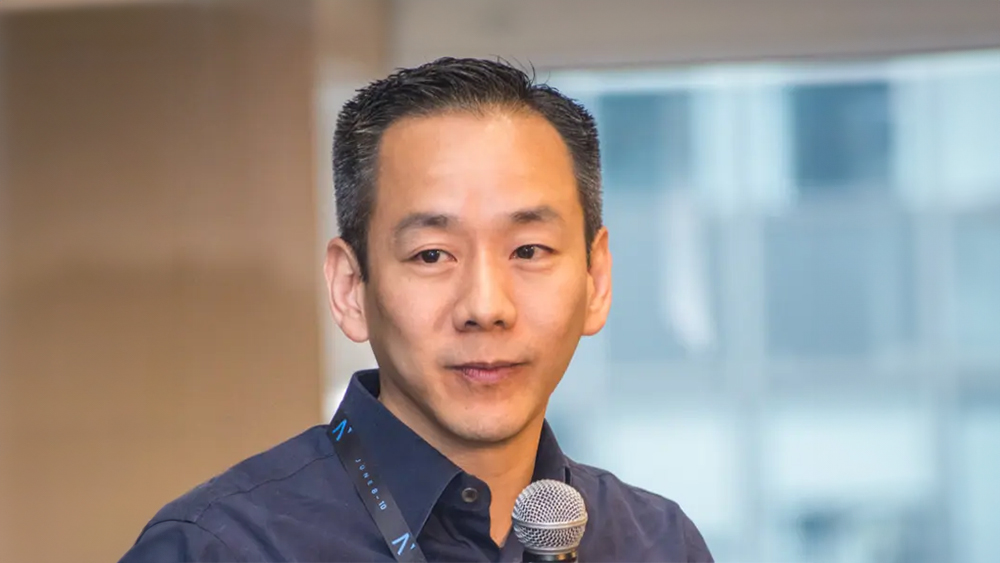
The startup ecosystem has gone through a lot of changes over the years. From the dot com era to the modern era of AI, Patrick Lee has seen it all. A stalwart of the startup ecosystem, Patrick has started seven different companies over the last 30 years, including everybody’s favorite movie review website: Rotten Tomatoes. Michaela and I had the chance to sit down with Patrick to talk about Rotten Tomatoes, advice for founders, and Patrick’s reflections on being Asian.

How did Rotten Tomatoes get started?

Rotten Tomatoes had three co-founders. I was the CEO. There’s Senh Duong, who was the creator of Rotten Tomatoes, and he was basically our chief product officer, and Stephen Wang, who was our CTO. I knew them all from my freshman year of college. Senh was down the hall from me in the dorms. 

Prior to Rotten Tomatoes, Stephen and I had founded a web design firm. We were doing a lot of work for the entertainment industry, a lot of work for Disney Channel, stuff for Warner Bros., Artisan Entertainment, MTV, VH1, and ABC. We even made the online flash game for Who Wants to Be a Millionaire. 

During that time, Senh was our creative director, and he came up with the idea on the side. He was a huge movie buff. He came up with it and launched it on his own. It was written in static HTML because he wasn’t able to code at the time. And we hosted it for him. After about a year of hosting, we were like, “maybe this should be the business?” So we actually merged our company with his company and became co-founders of both companies and had equity in both. I went out and raised a million in funding, then transitioned our design firm off to another group to take over. We kept an equity stake in that design firm, but then we basically passed our clients to another group to take over. They took over the name and everything so that we could focus on Rotten Tomatoes fully. 

What was your experience raising money like?

Rotten Tomatoes was my third company. In my first company, we put in our own savings. For the second company – the design firm – we took loans from our families. $10,000 from my mom and $20,000 from Stephen’s uncle. Once we started getting clients, we paid back the loan with interest. 

For Rotten Tomatoes, one of our clients raised some venture money, so they put us in touch with their VC who said they would lead the round. They put in half a million. The rest we actually raised from our old design firm clients. A number of them were tech companies and had successful exits. So they were totally open to investing, and they knew what we could do because they were our clients.

Why did you decide to raise venture capital for Rotten Tomatoes?

This was in late 1999, right before the dot-com crash, so there was a lot of money going around and a lot of investment into the internet. It’s kind of like what Web3 was like a few years ago or what AI is like now. Multiple companies we worked with had raised a lot of money and had successful exits. We were basically building for all these companies and realized that we were on the wrong side of the business. We decided to try to build something that was our own instead of being a services company. That’s why we went and approached the VC that we had contact with. It was a small VC out of Taiwan. I remember we had a couple of different ideas. The first one was Rotten Tomatoes, which already had traction. The other one we thought was interesting was making a portal for Asians and Asian Americans. We were doing the official Jet Li site. We were working with Yolk magazine at the time. I remember having a meeting with Jet Li and he was getting excited about that idea. He was saying he could bring on Jackie Chan. At that time, there were a couple of other Asian magazines that were within our reach. It was a very small community back then. Our thought was, what if we got the different magazines, the different Asian sites, some of the big Asian and Asian American celebrities, and brought them all together? I remember when we pitched these two ideas to our VC, they told us to do Rotten Tomatoes because movies were mainstream. At the time, only 3% of the population in the US was Asian. Even among Asians, there are many different types and they might identify separately as Chinese, Japanese, Korean, Filipino, etc. The investor felt it would be very difficult to have content that appeals to all of them. They recommended we do Rotten Tomatoes, which, looking back, was definitely the correct decision. The other idea would have probably been about 20 years too early. 
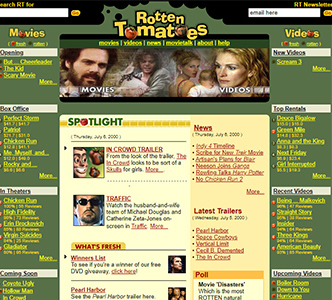
The first Rotten Tomatoes front page, published in 1998.

Rotten Tomatoes was launched in just two weeks. How did you navigate the tension between creating the perfect product versus getting it out as soon as possible?

Rotten Tomatoes was our creative director Senh Duong’s idea. He was a huge Jackie Chan fan. He wanted to know what everyone was saying about Rush Hour when the movie was coming out, so Senh went to the library and gathered reviews from magazines and newspapers–back then, very little was online. He decided that if he was putting all this work together, he might as well share it with other people. So he went home, built a page for Rush Hour and the other mainstream movies coming out that week, and put all the information up there. Because the scope was limited, he was able to go from idea to launch in about two weeks. He was gathering twenty to fifty reviews per movie for three or four movies. It was a lot of work, but doable by one person. 

It turns out that just having the new releases was still very useful because people were most interested in the movies coming out that week. He didn’t need to have tens of thousands of scores for the long tail of movies. He just focused on the head, the tippy top of the head. It was immediately useful, and instantly started getting traffic and attention. Then he just kept it up. He would work on the next week and the next week and the next week. It wasn’t until a year in that we said; “hey, maybe we should turn this into a business.” 

My advice for anyone is to launch quickly and test quickly. A lot of people, and I’ve made this mistake multiple times, spend six months to a year or two trying to make this perfect thing. They end up spending a lot of their own money or burning half or more of the funding that they raised trying to build this thing. The issue is you don’t know what perfect is until you actually get it out there.

You’ll see over and over, especially in consumers, folks put something out as a test and then it blows up. Twitter was a weekend project and then they just blew up. Twitch was Justin.tv in the beginning. They just messed around and put something out there. You just have to get the basic thing out there to see if people want it. Sometimes you don’t even have to build anything, you can literally just interview people or just do a mockup, and make a walkthrough of what the product would look like. It could literally be a napkin scribble and you can immediately start getting feedback. That feedback can actually give you a lot more information than putting something “perfect” out there. Go back to almost any consumer site or app and try to look up what version one looks like. Go look at the first versions of Facebook, eBay, Amazon, or whatever. They were ugly. But they solved something. That’s why they kept growing and taking off. I’m always recommending that. 

The other thing I say to people a lot of times is to really focus. It’s generally a single thing that people care about. For Rotten Tomatoes, it’s the TomatoMeter. We could get rid of the cast, crew, filmography, photos, movie showtimes, and almost everything else on the site. But really, as long as you have a score, that’s the critical thing that you need. 

If you think about fast food chains, every fast food chain specializes in a single type of food. The restaurants that offer multiple types of food are generally all mom-and-pop shops. The really big chains do one type of food. Every single one of them. When you look at social media, every social media platform started off with one unique singular feature. Like TikTok, Snapchat, Clubhouse, Twitter, YouTube, Instagram, and Substack, they all started as one thing. And again, as they got big, they started looking more like each other because they added more features. But they all started out as one thing. You find one thing that people actually care about. And you try to put that one thing out as fast as possible to see if they really care. 

How do you know when to give up on an idea?

Testing doesn’t have to be serial. You can actually do some stuff in parallel. As an analogy: if you have a kitchen, you can test a few different types of food concurrently. You could even do a survey before you start cooking to narrow down your options. Then, you can try each of them out and go forward with the best-performing one. It doesn’t have to be: Let’s try chicken, now let’s try hamburgers, now let’s try pizza. You can try all of them at once. 

In terms of knowing if an idea will work–you’ll know it when you see it. Rotten Tomatoes got the press instantly. It was getting noticed. USA Today was writing about it and Netscape was highlighting it at Yahoo. The day Pixar released A Bug’s Life, right around the time we released Rotten Tomatoes, we saw spiking traffic coming from Pixar. 

When you look at Asian Hustle Network, they just put something out there and it went crazy. Facebook and Twitter had the same thing. Especially with consumer products, when it works, it works. You’ll know when it doesn’t work because it’s crickets. You’ll be trying to tell everyone to go on, you’ll be telling your friends and family, and some of them will go on once and never come back. That’s normal. That’s actually what happens almost every time. 

Take an average YouTube video. You’d have a hard time getting even 100 views on it. Then every once in a while, for whatever reason, someone puts up a video and it gets millions of views and everyone’s sharing it like crazy. You kind of know it when you see it. If you’re begging everyone you can get, you’re trying to market in every way, you’re even buying ads and you’re having trouble getting a hundred views or a thousand views, you’re probably done. If it’s an app or a website, it’s probably not the right one. The way you know if you have product-market fit is if people tell other people about it without being asked to or incentivized to. Think about TV shows like The Queen’s Gambit a couple of years ago or Squid Game. People were sharing it with each other unprompted. They would just tell other people about it and it’s essentially free marketing.

Is it necessary to have startup experience or experience working for another company to execute and test ideas well? Or do you think the best experience to start a company is just to go and start it?

I would say that there is an optimal founder. That founder would be very bootstrappy. They would be able to launch things very quickly, iterate quickly, and without many resources. Also, they would have what I call irrational confidence. They just believe in themselves and what they’re trying to do with this insanely crazy confidence, and often based on nothing. 

“When we did Rotten Tomatoes, we didn’t know anything about movies. The Airbnb people weren’t hotel people. The Uber people were not taxi people. Industry disruption often comes from outsiders because disruption requires something out of the box and those people were never in the box to begin with. It’s rare that the disruption happens from within.”

I often speak to students and recent graduates. Some of them will come up and say, “Hey, I was thinking about doing a startup, but I wanted to go work in corporate or management consulting for a couple of years, get experience, and then start it.” There’s a 99% chance you’ll never leave once you’re in and you’re used to a salary, getting raises, promotions, and all that stuff. It’s going to get harder and harder to quit, especially if you get to a point where you’re in your early 30s, married, with kids and a mortgage. The chance of you risking all of that is pretty much zero.

These people, when they come up to me, they’re saying, “Look, I’m too scared. I’m too conservative to actually go out and do it.” The best ones just do it. Yahoo, and Google, they were grad students at Stanford and just left. Zuckerberg was an undergrad at Harvard. Steve Wozniak and Steve Jobs just left and did it. Most of them don’t even finish school because they’re not scared of leaving early. They have so much belief that they just have to do it. This has happened so many times.

In some ways, dropping out was a good sign. It’s not that they dropped out to bum at home playing video games, they believed in themselves so much they didn’t have that fear of failure. I absolutely think that founding a startup is not for everyone. I don’t recommend it if you’re someone who’s very conservative, and very scared. Go get a normal job, and do the safe thing. But there are people who just have to do it. Even if you have the confidence, you still have to have the ability to iterate, to bootstrap, to do those things properly. 

When you see that mix, it almost doesn’t matter what the idea is, assuming that they want to do something big. When you see that mix, that’s the right person. It doesn’t matter what their idea is, they’ll figure out something that’s going to work. 

They are sharp and bold – it doesn’t surprise me at all when they make it later on. Look at any of these great athletes or entertainers, and when they were young, they probably had that spark. There is an element of luck, but a lot of it is who they are as a person. The biggest thing when looking at young founders is their irrational confidence. This is true for athletes, entertainers, or anyone who takes that risk. Go back to the beginning and look at them, they have that spark. 

You’ve been founding startups for many years now. How have you seen the landscape for Asian American founders change since you started, particularly within tech and venture?

In tech and venture, we generally punch above our weight. At the highest levels, if you look at Nvidia, Yahoo back in the day, YouTube, Twitch, and Zoom, there are Asian founders. If you’re also counting South Asians, look at corporations such as Microsoft and Google, the heads are all Indian. 

A lot of Asians tend to lean towards engineering, so we tend to be weaker on the executive side. When people talk about diversity, they often don’t count Asians as diversity for tech and venture. 

Similar to college, it’s actually harder for Asians than anyone else. From when I started until now, it’s gotten better, but overall, we could use help on the executive side. In other industries like entertainment, it’s getting better but it’s still not great.

A lot of your business partners have been Asian. Is this intentional or coincidental?

Part of it is because I went to Berkeley. I wanted to go there because it was 40% Asian. I was born in LA but grew up in Maryland. There were only three Asians in my grade in elementary school, so I felt a little invisible sometimes. I later attended a magnet program for intermediate school and high school, where there were obviously more Asians. When college came around, I wanted to find a place that had more Asians so that I would find more people like me. After we sold Rotten Tomatoes, I went to China and then later on, I went to Hong Kong. What I realized was that when I went to China, they could tell I wasn’t like them just by looking at me. I realized that I’m actually a minority everywhere. The closest thing to people like me are Asian Americans, or even more specifically, Chinese Americans. 

My circle tends to be at the intersection of tech and entertainment, and it leans more heavily Asian. The folks I was working with, like Holly, Kun, and Kevin, they’re Asian but they also were all doing companies at the intersection of tech and entertainment. I did Rotten Tomatoes, Holly did Kabam, Kun did Crunchyroll, and Kevin did Twitch. With Kun and Holly, we also had a connection through Berkeley. I was also really into Chinese martial arts when I was at Berkeley. Because of Berkeley and martial arts, I naturally had a pretty Asian group. But for me, I’ve tried really hard to get good diversity across industry, race, and gender.

What have you been working on recently?

When I came back from Asia, I did another startup, a mobile gaming company. We raised a lot of money – five million – but it didn’t work. We made every mistake you could make, including not being focused. I took a break and then ended up doing PKO Investments with Holly, Kun, and Kevin. We made an investment syndicate, investing at the intersection of tech and entertainment. We had about 800 people in our syndicate, half of which invested in at least one company. From 2021 to 2022, we invested in 45 companies and raised $35 million for those companies. Around November 2022, there was a big market crash and a lot of our angels needed to take a break. At that point, no one in our syndicate was looking to invest. We talked about potentially doing a fund or doing something else and eventually, we decided to do another startup. 

That’s [Fanverse] what I’m currently working on full-time, and we’re basically doing a membership-driven community. We’re bringing together all the best builders, creators, and talent in the geek fandom space. Geek fandom being things like comic books, video games, anime, sci-fi, and fantasy. Geek fandom is something I’ve loved my whole life. We have founders of companies like Patreon and YouTube. We have gaming people: the CEO of Tetris, an ex-chairman of Midway Games, a board director from Roblox, and a board director from Atari. We have entertainment people, such as Adele Lim (a Malaysian director/writer), Shannon Lee, (Bruce Lee’s daughter who produced the TV series, Warrior), and Karen Gillen (Nebula in Guardians of the Galaxy). We have sci-fi authors like Neil Stevenson. This is a super cool group of people. There are about 80 people so far and it’s all community. We’re doing dinners, larger events featuring different speakers, a WhatsApp group, online Zoom stuff, all these things to try and get this community together. 

At a very high level, we want to be broad enough that you’re going to meet people outside of your lane that you don’t know, but narrow enough that they are people you should know and could potentially collaborate with in the future, especially since pop culture and geek fandom IPs often span multiple mediums. For example, you have The Last of Us, Halo, and Fallout which are games that became TV shows. You have One Piece, which was a manga that became an animated TV show that has become a live-action TV show. You have the Marvel and DC comics which have become TV shows, movies, and games. 

With all this crossover, our idea is to bring in people from each of those different mediums together, let them all meet socially, and then see what happens. We’re already seeing folks working together and investing in each other. Essentially, it’s a networking group of these nerdy folks.

Is there anything else you’d like to share?

For anyone who’s reading this, Asian or not, I would say that when you look historically, the biggest companies tend to form every time there’s a new wave of technology. Desktop computing gave us Apple, Microsoft, IBM, and Hewlett-Packard. The internet gave us Google, eBay, Amazon, and others. Mobile and cloud computing brought more. Today, I think AI is bigger than all of those combined times a thousand. It’s crazy what AI can do to change literally everything we know.

Rotten Tomatoes, for example, rode the wave of the internet. Most of these companies that are still around rode some wave. AI is the biggest wave ever and if you are interested in entrepreneurship and you are reading this article, get on that wave. When there’s such a massive wave, why wouldn’t you get on it? Why would you just go and get a normal job and do something boring and have this wave pass you by? Assuming you’re not too scared and you’re not too conservative, you should get on the wave, do something, and just survive and stick with it for a while. Everyone I know who got into entrepreneurship and stuck with it for ten years ended up doing something pretty interesting.

We at AHN Ventures are of the same mind as Patrick, and encourage our readers to go out there and start building! If you like what you read, you can follow Patrick @rottendoubt on all socials. Thank you for the interview, Patrick!
Related Articles

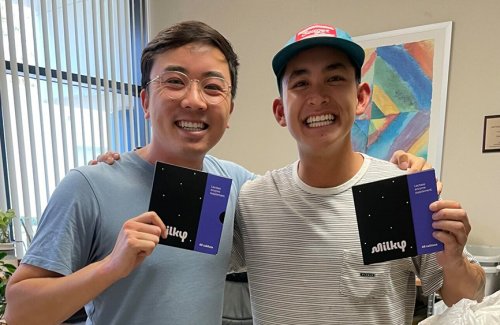
From Personal Struggle to Business Triumph- Khai Pham’s Journey with Milky-jpg

Stories

From Personal Struggle to Business Triumph: Khai Pham’s Journey with Milky

Meet Khai Pham, a visionary entrepreneur reshaping how we manage lactose intolerance.

Armed with a business degree from USC, Khai’s journey took an unexpected turn after an eye-opening internship experience. After leading strategy and operations at a tele-orthodontics startup, he took the big step to start his own venture: Milky.

Milky stems from Khai’s personal struggle as a lactose intolerant person. Collaborating with Dr. Michael Seidman, he created Milky, a revolutionary lactase supplement designed for convenience and portability.

The path to Milky’s creation was marked by challenges. Khai and his team encountered manufacturing hurdles and setbacks, but their unwavering dedication and problem-solving spirit prevailed. Join us as we delve deeper into Khai’s journey with Milky.

KHAI PHAM’S JOURNEY WITH VENTURE FOR AMERICA

Venture for America profoundly shaped Khai’s career. Khai revealed the exceptional prospects that startups offer compared to larger corporations. In bigger companies, promotion chances often hinge on the person above you advancing or departing. However, in startups experiencing rapid growth, the entire business expands, creating numerous opportunities.

As a result, Khai’s hard work earned him two well-deserved promotions in just one year, leading him to become an Associate Director, with his initial compensation increasing four times by the time he turned 23. More importantly, Khai was able to engage with more substantial challenges much earlier in his career.

LEADERSHIP LESSONS AS YOUNGEST DIRECTOR

Climbing the ranks at Candid and achieving the distinction of being the youngest Director brought both challenges and growth to Khai Pham. In his perspective, the most demanding aspect of this journey was the increasing gap between decision-making and its outcomes. During the earlier stages of one’s career, tasks are straightforward; you receive assignments like crafting financial models, and when you perform well, immediate feedback follows. That immediate validation is comforting for junior professionals.

However, as one advances into more senior roles, the time gap between decision and result widens significantly. Senior leaders must make weighty choices, such as shaping the market strategy for a new product. Yet, the effects of these decisions might remain concealed for months, even years. This adjustment, bridging the gap between choices and their eventual outcomes, is a formidable mental challenge that confronts most individuals, Khai included. This evolution in leadership style and responsibility marked Khai’s journey as he navigated the complexities of decision-making at Candid.

KHAI’S PERSONAL STRUGGLES THAT LED TO THE BUSINESS OPPORTUNITY

Khai Pham’s personal battle with lactose intolerance ignited the creation of Milky, a transformative lactase supplement.

Khai shared that aside from being lactose intolerant, he also coped with ADHD, which often led him to forget bringing a Lactaid, making casual outings for ice cream, boba, or pizza very hard. Though the idea of a more portable version of Lactaid had crossed his mind, Khai initially didn’t see it as a true business opportunity.

When Khai moved to New York and found his favorite boba shop, Machi Machi, in Koreatown, he kept running the same problem of forgetting his Lactaid. He also noted that the pharmacy in Koreatown always seemed to run out of Lactaids. “Lactaids fly off the shelves at their location,” one of the pharmacy’s employees said. Intrigued by this, Khai went to visit various drug stores across lower Manhattan, asking their employees about Lactaid sales.

Khai shared that the farther he ventured from Koreatown and Chinatown, the less frequently stores experienced Lactaid stock shortages. This was the moment that Khai recognized his idea of a super-thin lactase supplement as a viable business opportunity, setting in motion the Milky journey.

“What I slowly began to realize is that people can’t help you if they don’t know you need help.”

Khai Pham

THE EXPONENTIAL POWER OF NETWORKS

Khai Pham’s collaboration with Dr. Michael Seidman marked a turning point for Milky, their second joint venture. Many wonder how a board-certified surgeon like Dr. Seidman came to co-found a company with Khai. The answer is simple: asking for help.

“I used to play it close to the chest when I was starting a company because I didn’t want to be embarrassed if it didn’t work out. What I slowly began to realize is that people can’t help you if they don’t know you need help,” Khai shared.

With this profound realization, Khai began sharing his desire to start a dietary supplement business with his coworkers and his search for a scientific co-founder. One day, a coworker mentioned a friend whose father, Dr. Seidman, had both a medical background and a penchant for formulating ideas. And the rest was history.

How Khai and Dr. Seidman met illustrates the exponential power of networks, but only if you open up and tell people that you need their help.

KHAI’S INSIGHTS IN NAVIGATING ENTREPRENEURSHIP

When asked what advice he would offer to his younger entrepreneurial self, Khai Pham emphasizes that failure doesn’t equate to poor decision-making. He notes that while they are connected, making the right choice with the information at hand doesn’t guarantee success.

Khai’s experience has taught him that if a decision carries even a 10% chance of yielding a 1000x return, it’s worth taking that calculated risk. Even if it doesn’t pan out, it doesn’t make the decision wrong. He candidly shares that in his earlier career, he often focused on the immediate results of his actions, sticking to high-probability decisions, and missing out on better, higher-expected-value opportunities. For Khai, the key metric for decision-making is expected value, not just the probability of success, a lesson he holds close as he navigates the entrepreneurial landscape.

MILKY’S VISION TO REVOLUTIONIZE DIETARY ACCESSIBILITY

When contemplating the future of Milky, Khai envisions creating an entire ecosystem of dietary accessibility.

While Milky’s initial focus centers on lactose intolerance, Khai recognizes that many individuals face a variety of dietary restrictions, including issues like acid reflux. The prevailing frustration lies in the disconnect between scientific solutions and user experience. Drawing a parallel to Lactaid, Khai points out the impracticality of carrying around large plastic bottles of products like TUMS.

The Milky team aspires to create a world where your entire medicine cabinet can be conveniently carried in your pocket, offering a seamless solution to dietary challenges, thus transforming the lives of those managing lactose intolerance and other dietary issues.

CONNECT WITH KHAI / MILKY

Instagram: @shop__milky

TikTok: @milky

Linkedin: Khai Pham

Stories

How Sheldon Ho Created a Tool to Help Cantonese Speakers Learn Mandarin

For years, Cantonese Americans/Canadians like Sheldon Ho have struggled to learn Mandarin, feeling like existing language learning apps weren’t designed with them in mind.

Through the Canto to Mando Blueprint, there’s a solution that takes advantage of their existing Cantonese knowledge to help them master Mandarin in a fraction of the time.

The Canto to Mando Blueprint is the brainchild of Sheldon, who personally struggled for years with Mandarin learning. Not only has it helped countless Cantonese Americans reconnect with their Chinese culture, but it has also enabled them to learn more of their native tongue.

The success of this program speaks for itself – it has over 400 students and counting! It’s time for the world to take notice of this groundbreaking innovation in language learning. 

Read through as Sheldon shares more about his story and how the Canto to Mando Blueprint is changing the game for Cantonese Americans learning Mandarin.

FAILING TO LEARN CHINESE AS A KID

Growing up, I was really resentful of my culture.

I think having failed at learning Chinese as a kid made me detached from my Chinese culture and resent it. As a result, I grew up hating being Chinese and always felt it was uncool. It made me want to be “extra” Western. 

I would speak to my parents in English intentionally instead of Cantonese and as a result, my Cantonese became mediocre. I never realized this all came as a result of having failed Chinese as a kid but now that I’m older, I can see how things would have been different had I learned the language better when I was young. I would have learned more about my culture, and ancestors, and since the culture is naturally pretty cool, I would have definitely embraced it more.

AN ASIAN AMERICAN CHINESE LANGUAGE LEARNER’S PERSPECTIVE

The big thing plaguing the language learning industry is learning resources that are made for the mass market. I think that language learning businesses definitely cater to the mass market with good reason. ALL Americans Can benefit from one single Chinese learning resource made for English speakers. There’s a lot more money in that space because the market is a lot larger and they have the opportunity to help more people. Given that logic, there’s absolutely no incentive to make something for the Cantonese American market.

Another thing plaguing the language learning industry is having solely native speakers teaching the language. This is due to the curse of knowledge. It’s when you know too much in your brain and you can’t relate to your students as much anymore. They actually find it HARDER to learn from you. 

That’s why from an Asian American Chinese language learner’s perspective, I think representation is really important. I think having more Asian American teachers as opposed to pure Chinese teachers is really beneficial. 

When I was learning, all teachers were from China and while their Mandarin level was top-notch, there was a gap in their ability to relate to my struggles as a Chinese learner. This is because they have never been in my position as they grew up in a 100% Chinese environment. Employing techniques made for kids in China doesn’t work the same with us.

This is why most Asian Americans flunked out of Chinese school when they were kids. It’s made by native Chinese people who don’t understand the differences between the struggles of learning Chinese here in the West vs in China. In the same way, I also can’t relate to the struggles they may have faced learning English. I can confidently say that I’m probably not gonna be a good English teacher because I don’t understand the struggles ESL learners face. 

On the other hand, I understand very well what struggles Cantonese Americans may face when trying to learn Mandarin and improve their Cantonese. I literally went through all those struggles myself. I was the kid unable to write his own Chinese name.

THAT “YOU LOOK CHINESE BUT YOU CAN’T SPEAK CHINESE” MOMENT

I’ve tried countless times to learn Mandarin. I think I’ve had “I’m gonna learn Mandarin this year” as my new year’s resolution for like 10 years straight.

Each time I failed, I wasted MORE time but more importantly, it made me feel like more of a failure. I felt like maybe I was just too dumb to learn my language, maybe I was just too dumb overall. How many more tutors, apps, and university classes am I gonna waste time and money on?

I went through my lowest point when I was unable to talk to the family of the girl I was dating at the time. It was a really big “you look Chinese but you can’t speak Chinese” moment for me where I felt quite embarrassed.

It was a big mental hurdle that really messed with me. Things changed when I finally took time to think about how I could learn by leveraging my existing Cantonese. What if I just took my Cantonese and brought it over to Mandarin? Through an arduous process of figuring out how to do that, I finally learned Mandarin. 

Once I learned this, I realized how easy it is to learn this language for Cantonese speakers. I realized that we’ve been being taught wrong all our lives and that is the reason why we haven’t been able to learn. This motivated me to create this platform. I wanted to help Cantonese Americans finally get this Mandarin learning thing handled and hopefully through that, help them with embracing their culture.

CANTONESE AMERICANS ARE IN A WEIRD MIDDLE GROUND

I always felt that Mandarin was so hard to learn. It always baffled me that I was thrown into the same class as Craig, someone who had no Chinese background at all. 

I tried so many different learning apps and went to so many different Mandarin classes and tutors in college and it was ALWAYS the same. We always wasted WEEKS on basic stuff like “ni hao.” This felt stupid to me as a Cantonese person. I knew “ni hao.”

Cantonese Americans are in a weird middle ground. For the most part, we speak just enough Cantonese to have an advantage over people with no Chinese background – yet we can’t read Chinese, and aren’t good enough to take advantage of Mandarin resources meant for true native Canto people in Hong Kong which leverage your Cantonese. As a result, we have to stick with English resources made for white people.

So fundamentally, when setting up our program the only goal in mind was to create something for Cantonese Americans who can speak a little bit of Cantonese. We wanted to make something for the Cantonese American who spoke a little but couldn’t read or write Chinese. We’d teach them all the fundamentals while leveraging their existing Cantonese.

PLATFORMS MADE FOR PURE ENGLISH SPEAKERS CAN’T DO THIS

With our method, students improve their Cantonese while learning Mandarin. Most Cantonese speakers want to learn Mandarin but it’s also important to them that they improve in their heritage language. 

Because Mandarin and Cantonese have such similar structures – if you know how to leverage them, you can improve on both languages at the same time. This way, as your Cantonese gets better, so does your Mandarin, and vice versa.

Platforms made for pure English speakers can’t do this since they’re not made for Cantonese speakers. The next thing is the speed at which you learn. Our students start speaking literally from day 1 because we’re essentially just teaching you how to bring your Cantonese over to Mandarin in the beginning. 

There are a lot of tips and tricks that make things a lot faster. For example, the Cantonese ‘G’ becomes a Mandarin J about 80% of the time. This takes away a lot of the memorization work when it comes to learning Mandarin. 

So the main difference is just the speed of learning. It’s a lot faster. I don’t want to say the other apps or university courses don’t work because of course they do. But when you have to wait months for marginal results it’s really easy to get discouraged. That’s why we made it a PRIORITY to get people speaking from Day 1 so they see results right away.

SUCCESS STORIES

A large portion of our students happens to be in healthcare. There was this nurse who often felt ashamed at work. Chinese patients would reach out to her because she looked Chinese but when she couldn’t reply in Mandarin – she would feel sad for being unable to help her own people. This is what made her reach out to me and within the first couple weeks of doing the program, she shared with us how good it felt to be able to communicate with Chinese patients, and that was a big win. 

Another success story is about this girl who wanted to surprise her parents with her Mandarin. She started texting them on day one of the program, and it made them really happy.

But my favorite story is about one of our students who had been dating her Taiwanese boyfriend for 10 years. Each time she hung out with his family, it’d be in English. She would have very basic and shallow conversations with her boyfriend’s mom. Note that it’s been 10 years!

Recently, she told me that she had a full Mando conversation with her boyfriend’s mom and that she was so excited that she could finally speak Mandarin. If I could put it in her words, it was like the mom went from being almost mute to being the most talkative person in the world! Excitement grew on her face and she said “OMG I can take you to Taiwan now and show you everywhere!”

IT’S WHAT I WISH I HAD

What we have is a program and curriculum specifically designed for Cantonese Speakers to leverage their Cantonese (no matter what level) to learn Mandarin and improve their Cantonese. 

Along the way, we have tutors for support who are fluent in BOTH Cantonese, Mandarin, and English. From my experience, oftentimes, Mandarin tutors only speak one language. They speak Mandarin amazingly – but the lessons aren’t conveyed in the best way in English. They can’t convey certain concepts to English speakers. We make sure our tutors are able to do that, as well as in the Cantonese perspective. Lessons are all given with the Cantonese English Perspective in mind.

The truth is, in most cases, Mandarin tutors are overqualified in the wrong thing. Cantonese diaspora don’t need someone who studied classical chinese literature and classical chinese to teach them Mandarin. They just need someone who can speak good Mandarin, and understands how to convey that effectively in English to them.

We make sure our tutors have that. I took big a part in training our tutors on how to view things from a Cantonese-American perspective. 

I’ve been through the journey myself as a Cantonese Canadian who learned Mandarin. I pretty much know what each student will struggle with, where the pain points will be, and what type of questions everyone will have. I’ve poured that knowledge into the program and poured that knowledge into our tutors. 

An example is the simple understanding that Cantonese Americans can speak a little bit of Cantonese, but can’t read or write Chinese. How do you tailor-make something for that person? That’s what we sat down for months to figure out. It’s what I wish I had.

HOW THE COMMUNITY HAS RECEIVED THEM

The Cantonese American community has been really thankful to have something made for them.

A lot of people dealt with the same struggles I dealt with so I’ve received a lot of comments from people thanking our team for what we’re building as well. 

From the broader language learning community, there’s been a lot of intrigue about seeing a course that dives this deep into linguistics. We really dug into textbooks to find information like how Cantonese tones map to Mandarin and at what percentage. For instance, it’s really fascinating to know that you can map your Cantonese tones to Mandarin with about 80% accuracy. This means that Cantonese speakers can essentially skip memorizing Mandarin tones and still be right about 80% of the time. This is knowledge that takes YEARS off the Mandarin learning curve.

PROGRAM TAKEAWAYS

Three things that I hope users will take away from using our platform and learning Mandarin through our program:

  • How beautiful Chinese culture is and how great it feels to reconnect with it. If they can get a deeper sense of belonging and more interest in their roots, that’d be incredible.
  • A deeper love for Cantonese. Through our program, students will also improve their Cantonese. As they learn about the differences between Cantonese and Mandarin, they’ll see that Cantonese has its own writing system that makes it really unique. Through this, I hope they feel more pride as Cantonese speakers. I grew up resenting my Cantonese side because Mandarin is more popular – but ironically, as I learned more Mandarin, I grew to love Cantonese more and more.
  • A renewed sense of confidence in their ability to learn. A lot of people feel traumatized as kids because Chinese school was so ineffective. We feel that we’re failures because we couldn’t learn our native tongue and then make memes on subtle Asian traits to feel better about ourselves. I can confidently say that the way they teach Chinese in the West is not the best. I want to help people recover and feel better from that Chinese school trauma.

MANDO TO CANTO

I was surprised by how many Mandarin speakers are interested in learning Cantonese so I’m excited to share that the next big project we’re working on is Mando to Canto! We’re currently in the R&D phase.

CONNECT WITH SHELDON 

Instagram: @sheldonhoho

Stories

Linda Marigliano on Sharing Lessons of Love and Immigration Stories

Love – a universal language that transcends boundaries, cultures, and time.

It’s a force that can inspire, challenge, and ultimately transform our lives. And I’m not just talking about the heart-fluttering, romantic kind of love, but also the tough love, the kind of love that helps us grow, teaches us the hardest lessons, and makes us strong in the face of challenges. Linda Marigliano’s “Tough Love” podcast embarks on a mission to uncover these lessons hidden within the folds of love stories.

Linda is a creator, co-founder, author, and podcaster. She created Tough Love during the most difficult times of her life. It was in the middle of a rigid lockdown in Australia in 2021. After being in a long distance relationship for three years, Linda quit her high profile radio job planning to move overseas and begin a new life with her boyfriend who lived in LA, but the pandemic happened and the world stopped. She found herself stuck in Australia due to border closures and was forced to move back in with her strict parents in her mid-30s. 

Her podcasting journey began with the ambition to share her own story, inspire diversity, and share Australia’s proud immigration stories. Building the podcast from scratch was a challenge she embraced with passion.

Facing Challenges Head-On

Linda’s most significant challenge in this journey was launching, producing, and marketing the podcast as an independent creator. She had to master every facet of the podcasting industry, acquiring equipment to set up her home studio and venturing into the field as a roving reporter, capturing real-life scenes like a documentary. The hustle was relentless as she faced rolling deadlines and created a media campaign to promote the series.

As the podcast’s host, Linda also faced the personal challenge of sharing her vulnerable story. Linda had to let the listeners into her own uncertainty in modern life as she opened up her Italian Chinese family home. She addressed topics about how she froze her eggs during Season 1 and how she navigated her heartbreaking long distance relationship.

These stories, though challenging to share, created a devoted community of listeners who resonated with her journey through uncertain times.

Achievements and Milestones

The “Tough Love” podcast has been a remarkable success. In 2021, it earned the title of Best Lockdown Podcast at the Australian Podcast Awards and was a finalist in the Best New Podcast category. What makes this achievement even more impressive is that “Tough Love” is a completely independent project, with no financial backing from a production company.

In 2023, Linda achieved another milestone in her journey. Not only did she release her own book, “Love Language,” a deeply personal and true story that inspired the podcast, but she also performed a SOLD OUT live podcast show at the iconic Sydney Opera House.

This performance brought her Chinese mother, Janet, into the spotlight, sharing her experiences of growing up in a tiny village in Malaysia and how her unwavering loyalty to her family back home has shaped the way she lives her life. This narrative moved the audience, making them eager to learn more about Janet, her upbringing and her immigrant journey as a teenager who had a difficult time fitting in when she first moved to Australia.

Mission and Vision

Linda’s mission for the podcast is to share her compelling story using innovative documentary storytelling and music, offering practical lessons for modern life, while her vision involves expanding her audience to live shows, events, and exploring television and film opportunities. 

With Linda’s focus on her Chinese Malaysian culture, especially through her friends and her mother’s portrayal in it as a strong business woman even in her late 60s (and fan-favorite), amplifies diverse Asian perspectives, resonating with a dedicated community of listeners.

Message from Linda

If there is one episode of the Linda Marigliano’s Tough Love podcast you should listen to, make it the Season 2 ‘Help, My Parents Are Getting Older’ episode. This one showcases how we feel when we realize our parents are aging and what it means to remain loyal to family. We attend a salsa party with my Chinese mother, Janet, and she tells us about her Malaysian upbringing. It’s a moving, heartbreaking, but ultimately joyous scene.

I am incredibly proud to have inherited my mom’s deep Asian hustle spirit! There’s delight in hard work, and I love hearing the Asian hustle stories you share.

Now, I’m finally living in LA, reunited with my boyfriend, and the hustle continues. I’m open to exploring the city and connecting with the Asian community, so please reach out. And stay tuned for Linda Marigliano’s Tough Love Season 3!

CONNECT WITH LINDA

Instagram: @lindamarigliano

Linkedin: Linda Marigliano

Tiktok: @lindamarigliano

Facebook: Linda Marigliano

Stories

A Cancer Survivor’s Life-Changing Journey to Self-Discovery and Empowerment

Jeanny Chai is an entrepreneur, coach, and cancer survivor. She’s inspired hundreds of women to break free from unfulfilling jobs and relationships. But she wasn’t always this way. In this exclusive interview she talks about how she went from a scared loner kid to a powerful leadership coach. 

Childhood Pressures and Shaping of Mindset

Growing up, Jeanny was always under pressure to achieve. Sound familiar? In episode 3 of her podcast, Asians Breaking Ceilings, she shares the expectations her parents placed on her.  “Oh, you’re going to be a doctor.” 

She lived under constant pressure to be perfect. “I was called careless when I missed math problems and my parents were displeased. I got disapproval and felt like a burden whenever I made mistakes, like spilling milk or getting sick. I felt like I had to be perfect to avoid anyone getting mad at me.”

You don’t need anyone’s permission, apology, validation, or approval for you to make the transition from unfulfilled to living your leadership potential.

Jeanny Chai

Her Battle with Cancer and Path to Transformation

As an adult she was free from her parents but then cancer got her. Her doctor told her that she had 3 tumors, stress-induced. Her reaction? “ashamed, scared, angry and then finally hopeful.” Despite cancer being a shitty experience, she had HOPE. How? 

Hope came when she realized that she was allowed to ask for help. It wasn’t her job to suffer alone in silence. She had managed to handle all the other stressors in her life alone, but this one was too much for her – and that was okay. For the first time ever, Jeanny learned asking for help was not a sign of failure or weakness. This theme would return later on.

A Glimmer of Hope in Solitude

Cancer threw Jeanny’s life and routine out the window. Yet the hardest part wasn’t the physical pain – it was the overwhelming sense of loneliness she experienced. Unable to have visitors, she was profoundly isolated, physically and emotionally. She shares, “When you are under so much medication, your days and nights mesh together and you get lost in your own thoughts,”

But in that time of sadness, Jeanny felt a glimmer of hope. One day, she heard a loud voice that declared, “You are already good enough.” The unexpected declaration left her in a state of awe. 

Jeanny had never entertained such a notion about herself before; this was a pivotal moment.  She kept repeating this idea to herself for the next few years, and that’s when she started to feel stronger, more confident, and more in control of her life. This also marked the starting point of her business, Bamboo Myth.

A Journey of Self-Discovery

After casually beating cancer, Jeanny embarked on a five-year journey of self-discovery.

“When I got sick, I was no longer focused on becoming the next Elon Musk or landing a job at the next unicorn start-up in Silicon Valley. Instead, I bought myself an electric piano and an acoustic guitar.  Later I bought a saxophone and ukulele and I gave myself voice lessons. I bought myself a baby rabbit, who was my bedside companion during my chemotherapy treatment. I remembered that I loved music, singing, and animals and learned to create my own happiness,” she shared.

With cancer showing her that life was short, Jeanny decided to leave the corporate world and start her own business, pursuing purpose instead of promotions. 

“Asians Breaking Ceilings” Podcast

Fast forward a few years and her business is thriving. She speaks about the Bamboo Ceiling at Fortune 500 companies and major conferences. 

She also runs a 12-week coaching program called “Live Your Leadership Potential,” and has coached over 300 Asian women, bringing “life-changing” results. Her program centers on 2 core principles that help women regain confidence, energy, and agency.

She teaches that what’s needed isn’t communication strategies, but permission to speak without guilt or shame. Once women overcome this barrier, their natural leadership abilities and newfound confidence are allowed to shine.

The best part? Jeanny emphasizes that this mindshift set doesn’t require years of therapy or yoga; all it takes is a focused approach to transform from burnout to happiness.

Now she is making these cultural-specific leadership strategies available to everyone,  through her podcast. In it, she shares a powerful new definition of success. 

“Confidence, assertiveness, and happiness are an inside job. So my new definition of success is this: Being able to decide, create, and ask for what you want in your career and life. And my podcast is designed exactly to do just that,” Jeanny shared.

Advice for Those with Similar Struggles

Did you resonate with any of this? Jeanny has the the following advice for individuals who struggle with people-pleasing, fear, or lack of self-compassion:

First, you must stop stuffing your feelings and coping by working harder and harder. Realize that you don’t need anyone’s permission, apology, validation, or approval for you to make the transition from unfulfilled to living your leadership potential.  

Stop getting more certifications and degrees to fill that feeling of “not being enough.”

Listen to my podcast! Start with Episode 1 and let yourself feel again. Many of us have numbed out our emotions so we can handle and cope with all the stress but this is the opposite of what we need to do to begin the transformation. 

Find a safe person (therapist, coach) and tell them your story. As Brene Brown says, shame thrives in silence. That’s why I’m paving the way by speaking up so others can speak up and be transformed for good.

And take this FREE assessment that I’ve created just for Asian Americans. It helps you identify in just under 5 minutes what is your biggest roadblock to success:

https://quiz.tryinteract.com/#/5daf9bbeb77a6e0014e41210

There is personal advice emailed to you based on your quiz results. 

CONNECT WITH JEANNY CHAI

Instagram: @jeannychai

Linkedin: Jeanny Chai

Twitter: @bamboomyth

Facebook: Bamboo Myth

Website (Bamboo Myth): bamboomyth.com

Website (Podcast): asiansbreakingceilings.com