Awaken* newsletter

May 30, 2024

SHARE:

Welcome to another edition of AHN awaken*! Apart from our guest, I’m excited to introduce a new member of our team, Han Yue Yin! Han Yue is a current Stanford GSB student and was my fellow jazz bandmate in college. Although this article was written by me (Edwin), Han Yue co-interviewed with me and will be taking the lead on writing some great articles in the future. Everyone, please welcome Han Yue!

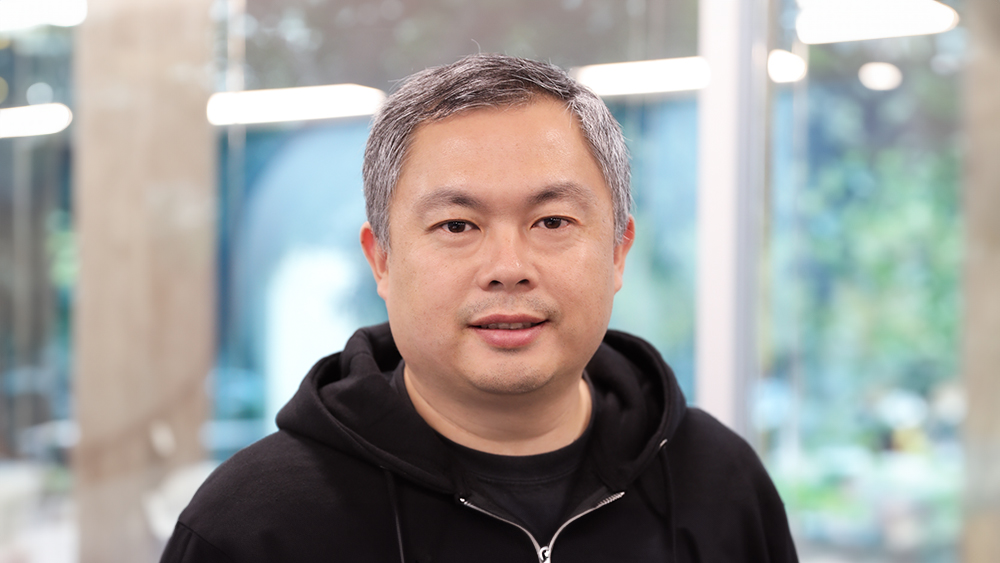
Our guest for this edition is Larry Liu, co-founder and CEO of Weee! (exclamation mark included). Weee! is the leading online Asian supermarket in America, think Amazon but for Asian groceries. Larry is an exceptional founder, and his journey of immigrating to America without any connections into founding a company worth $4.1 billion truly exemplifies the American dream. As an aside, Han Yue and I were especially excited about this interview as avid users of Weee! ourselves. Without further ado:

The Origins of Weee!

Our first question for Larry was how the idea for Weee! first came about:

Originally, we started as a WeChat (Chinese messaging app popular with the American diaspora) group-buying company. I believe it was really an opportunity we observed around the 2014-2015 time frame. This was when WeChat became extremely popular among Chinese immigrants and many people formed WeChat groups to buy food together, among other things. We found this to be a very interesting business model. As you may know, I was an eBay seller for more than 10 years and was familiar with the traditional e-commerce model, which is search-based. So, when I saw the group buys, I thought it was a completely new model, not search-based, but recommendation-based. I believed it was very promising. That’s when we decided to quit our jobs and start the business. However, it turned out not to be the right model. We pivoted in 2017 because social buying was not what we thought it was. It was not the ultimate solution to solve the lack of service experienced by Asian Americans for their food needs. The delivery-to-home model is a much better model. So, we pivoted in 2017. I believe it’s one of the greatest pivots in history.

The reason we pivoted was because we couldn’t grow the original group buy model. We couldn’t raise money because we didn’t grow. This forced us to think very hard about the fundamentals. That’s when we realized that the reason most people used group buys was actually because they didn’t have easy, affordable access to the food they love. It wasn’t apparent in the beginning because people were group buying all kinds of things. But those were only distractions. When we thought deeper, it was about the food. That’s why we had to pivot. 

Following up, we asked Larry what lessons they were able to port over from their group-buying stage into their current business model:

We learned a lot during the group buying stage. We had already built some warehousing and delivery capability during the group buy era. Many vendors didn’t want to sell to the group leaders directly, so we had to build a warehouse to buy a lot of products from the vendors. We acted as the supplier to many of the group leaders. This already made us into the warehousing and delivery side of things. We also learned that people were willing to wait for great products that were hard to find. This gave us the confidence to not do same-day delivery or on-demand.

Obviously, we had to ask what were these products that people were willing to wait for:

It’s usually the products that are hard to find even at Asian supermarkets. For example, super fresh fish, very fresh produce, and fruits. In the early days of group buying, the Pacific Black Cod was very popular. People were buying pork bellies together because they were not easy to find in mainstream supermarkets. During winter time, a lot of Chinese immigrants make sausages themselves, so they buy a lot of pork bellies. 

One of our most popular items was Kyoho grapes. Kyoho grapes are not always available in Asian supermarkets. Additionally, Asian supermarkets have issues with consistent quality, the range of products, and the fact that a lot of people live far away from those supermarkets. That’s why those kinds of products were very attractive. During the group buy days, we would never do tofu, soy sauce, or green onions. Those kinds of products were not considered exciting for group buys. So we only would do, like I said, super fresh seafood or produce or restaurant food or things not so readily available.

The Business of Weee!

One of the big ongoing initiatives at Weee! is adding storefronts for more ethnicities, complete with their own goods. We asked Larry what opportunities and challenges they’ve experienced expanding into more ethnicities:

All of them are very underserved, which makes our business very attractive to all these ethnicities. If you look at U.S. history, there was a very important piece of legislation passed by Congress called the Immigration Act of 1965. It really started this whole demographic shift in this country. It’s a once-in-a-century shift. That’s when the Asian and Latino populations started to grow in the U.S. Right now, if you look at the Chinese population, five to six million people in the U.S., this group is still quite small, less than two percent of the U.S. population, so it’s very hard for mainstream supermarkets to try to serve the specific needs of Chinese Americans. It doesn’t make sense for them to focus on this two percent of the population and try to bring in thousands of products to serve them. That gave opportunities for offline Chinese supermarkets, but the offline model is not the ideal model to serve low-density populations. That’s why there aren’t that many such stores. 

Ranch 99 is the biggest Chinese supermarket chain. The biggest Korean chain is H Mart. It took them more than 40 years to build less than 100 stores. The reason is that the population density is not high enough for them to build thousands of stores. All the mainstream supermarkets have thousands of stores. But these ethnic ones can never achieve that, which means they will always be more inconvenient to access. And that’s physics. You just can’t have that many stores when the population is so low. The good thing for our business is that our model is a better model. You don’t have to drive to us, we deliver to you. We have very large warehouses and we can cover a very wide range. Another big advantage for us is that we can be authentic to multiple ethnicities. An offline Chinese supermarket can never be an Indian supermarket at the same time. An offline Korean supermarket can never be a Filipino supermarket at the same time. No matter how you design this, it’s impossible. But online, you go to us, the first thing we ask you to do is choose the store. You choose the Filipino store, it’s all Filipino. You choose the Vietnamese store, it’s all Vietnamese. We can really be authentic to multiple ethnicities, and that can only be done online.

One thing that caught our attention was Larry’s point about how sparse populations inhibit additional stores which inhibit accessible stores, which would make more people turn to online stores such as Weee! We were curious if the converse was true, whether or not customers use Weee! less in Asian-dense areas where there are accessible in-person stores, like in cities such as Cupertino, CA:

That’s actually not the case. We actually have a lot of customers in Cupertino. Here’s the reason: our assortment is not the same as offline Asian supermarkets. A lot of things we carry, they don’t carry, and a lot of things we carry consistently, they don’t carry consistently. The assortment of items is differentiated. We also have a third-party marketplace. Right now, we have more than 50,000 third-party marketplace products on Weee!, these are all products that brick-and-mortar stores don’t carry. We have sellers in Japan, Korea, and China. Some other sellers are local restaurants and local bakeries. For example, on Weee! you can buy a local bakery product at the same price you would pay in the local bakery, and that is just not available in other apps. You can go to DoorDash, you buy the same product, you pay 40 percent more, 50 percent more depending on what’s your total order value. We have a lot of products that actually aren’t available from Asian supermarkets. In fact, we have slightly better prices than Asian supermarkets because our supply chain is more efficient. Even if you live in Cupertino, we have a better selection and prices. Plus, you don’t have to go out. You don’t have to spend your entire Saturday afternoon grocery shopping. You have better things to do. I’m not saying offline supermarkets shouldn’t exist. That’s not what I mean. We actually don’t see them as competitors. I think that they will exist for a long time and a lot of people like shopping offline. That’s totally fine. We just try to serve underserved communities and we believe we have better products and services than anyone in the marketplace.

A common customer behavior in Asia that hasn’t quite made it to the US is browsing online stores. For instance, most people who go on Amazon already know what they want to buy and only search for that, you generally don’t wander a disparate tab and scroll through those listings. Given that Weee! targets people from Asia, we asked if Larry has noticed such behavior on Weee!

Our customers tend to browse more. With our design, we actually want people to browse more. There’s a common belief that grocery shopping is boring and repetitive. Almost every single website prominently features a ‘buy again’ option. Amazon does that because it makes sense. If you think of shopping as a chore, then it’s logical. However, we see grocery shopping, especially for immigrants, as an opportunity to discover exciting new things that they may not even know exist in the U.S. We always try to create that excitement. That’s why we want people to browse. These exciting products are also important for our user acquisition strategy. People tend to tell their friends about the exciting things they find on our site. If you buy things from Amazon or Safeway, you probably won’t tell your friends about it because it’s the same old thing. But our customers actually tell their friends a lot after they buy something from us because we offer a lot of exciting products.

For our readers (and ourselves!), we asked Larry for examples of some of these exciting products on Weee!:

Nowadays, we’re really strong at seasonal fruits. We really care about flavor because our customers do too. We carry things like the Ori Mandarin from Israel, which is very tasty. Our dragon fruits and coconuts are super popular. In fact, we’re America’s largest retailer of fresh coconuts.

It’s fascinating because this ties in with our multi-ethnicity strategy. We have a lot of customers from different ethnicities. People from Vietnam, China, the Philippines, Southeast Asia, and India all consume coconuts. We are the only place that aggregates so much demand for coconuts and our price is unbeatable. For instance, if you go to Whole Foods, a coconut costs $4.99 each. If you buy on Weee!, it’s $14 for nine. It’s the best price on the market and our volume is really big. We’re also strong in fruits, vegetables, and hot pot-related products. We have all kinds of sliced meat, lamb, beef, pork, and different sauces and vegetables.

Larry’s Personal Growth

Although Weee! is not Larry’s first venture (he did some dropshipping previously), it is the first business he has scaled. As such, we asked him about his process of learning how to be a leader:

It was not very natural. It was a very steep learning curve for me. I managed like two people before I started Weee! at my previous company where I worked in finance. So I had very limited management experience, but as a founder CEO, you just have to learn everything on the fly. Not just managing people, but also how to raise money, how to come up with business strategies, and how to communicate the strategies to your team. 

I read a lot of books. I like to read. So I guess I had some knowledge on paper. This was my opportunity to apply that knowledge to the real world. I also reflect a lot. I’m a huge believer in deliberate practice. So I think I approached the job as something I need to really break down into different areas. For each area, I try to have some mechanism to get feedback and to check whether I did well or not so well. One of the reasons I was really attracted to retail is because retail gives you a very fast feedback loop. If you do a B2B business or pharmaceutical, it can take years for you to get the feedback. But in retail, if you do something right, you can literally see the results in minutes.

Also, I later realized that my finance background gave me an unusual habit. I try to forecast everything. For a lot of people, if you ask them about their strategy, they can’t tell you the impact of that strategy. I think forecasting is important because it requires understanding the mechanism between the input and the output. It also gives you the chance to constantly compare your expectations to the actuals, allowing you to fine-tune your understanding of the business. That feedback is very beneficial for improvement. 

I also hired really good people and learned from them. Our COO is very experienced. When she joined us, she managed teams with hundreds of people. I learned a lot from her. A lot of our management practice is what she brought to us. It’s really a combination of learning from experienced leaders and your own curiosity to constantly get better, to seek feedback, and just a lot of hard work.

We followed up by asking Larry if wished that he had done anything differently in his journey:

I think everything that happened was necessary. If I went back and told myself 10 years ago the things I know today, I still wouldn’t learn from my own advice. There are so many management books, and so many wise people out there. They give talks. Can you really learn from that? Even this conversation, can you really learn from this? I don’t think so. I think it’s just one piece of information. When I read a book now, I see it as one data point, one piece of information. I have to actually do it or be in the process of doing it, then revisit the concept I learned on paper and try to connect that concept to my real experience to make it part of my own. But without the doing part, the information is just a piece of information, nothing more. I could go back and tell myself a lot of things, but it wouldn’t help me 10 years before.

I have the habit of reading certain books over and over again at different stages of my life. For example, one of my favorite books is Sam Walton’s autobiography, “Made in America”. It’s very interesting. Throughout my journey, every time I read it, I pick up different things. The book didn’t change, I changed. A lot of things I didn’t understand before, but now I can understand because my experience grew. Sam Walton, I think when he wrote the book, he was diagnosed with cancer already. He probably gave everything he knew and put it in the book, but unfortunately, most people don’t understand all those things. They have to experience it and then they can relate to that. That’s why I think reading a really good book over and over again is a good idea.

I had heard Larry talk about Sam Walton in other interviews before so I figured that Walton must be one of Larry’s favorite entrepreneurs. We asked Larry what draws him to Sam Walton:

There are a few things I really admire about him. Firstly, in his whole life, he only did this one thing. He started Walmart and then he just stuck to it. He spent his whole life working on that. I’m attracted to that kind of entrepreneur. I’m not attracted to so-called serial entrepreneurs. I admire people who just try to do one thing super well, the best in the world. Also, he’s kind of an underdog. He was in Arkansas, a Midwest town. For a long time, Walmart only served towns with less than 5,000 people. It’s like how we at Weee! focus on serving minorities.  But he, as an underdog, built a business against all the odds. He started in the late 40s, and early 50s. His company went public around 1980. It took him 30 years to bring the company public. But even going public was just the beginning. In the next 20 years, I think Walmart’s stock price grew like a thousand times. Now, I think it has the most revenue out of any U.S. company. He was the richest man in America, but he lived a very simple life. His values very much match my values. So, I do see the parallels with us. If you read his book, you will love him. He’s very simple. I like a simple life. I don’t want things to be so complicated. Just figure out one thing you want to do, and then go for it and spend the rest of your life pursuing it. 

Asian Representation and Identity

Given that Weee! is the largest platform selling ethnic foods, we asked Larry how he sees Weee!’s role in enhancing the representation of ethnic food in the broader American landscape: 

We actually have a lot of mainstream users, and they’re growing very rapidly. We are the top seller on TikTok Shop in the U.S. in the food and beverage category. Almost all our customers on TikTok are mainstream Americans. I think it’s a less intimidating way to shop for products from another ethnicity if you do it online. Let’s say it’s a Middle Eastern store. You just want this one thing, you really like the lamb, what do you have to do? You have to drive to the store, go in, and it’s very unfamiliar. The barrier for mainstream Americans to try Asian supermarkets is a lot higher if they try to do it offline. It’s a lot lower if they do it online.

Personally, I found this extremely insightful as I had never thought of that. When you go to ethnic grocers such as Ranch 99, the store employees sometimes don’t speak very much English. I never thought much of it since I can speak the language, but I can see how the experience could be a lot more intimidating than buying online. For our next question, we asked Larry how being an Asian immigrant has impacted your founder journey:

I’m a first-generation immigrant. I came to the U.S. 20 years ago. My experience really put me in the position to do this business. That’s why I want to be like Sam Walton. I think this is almost a perfect business for me, and I want to keep doing it for as long as I can. There are so many smart people in the world, but what you can accomplish has a lot to do with what position you are in to see and recognize a great opportunity. I just felt like I was at the right place at the right time and I had the right experience and I met the right people. I owe everything to my background as an Asian immigrant to do this business. There were a lot of challenges in the early days. It was very difficult to raise money because people in the VC industry, the mainstream investors, didn’t really understand this opportunity. They couldn’t relate to it. But we were lucky enough to find Asian partners from those investment firms in every round of financing. I think I counted eight or nine rounds. In every single round, there was at least one Asian partner in the deal. They understood what we were trying to do.

Shoutouts

If you ever find yourself looking for Asian groceries, please consider joining millions of other users and trying out Weee! You can order on the web at https://www.sayweee.com/en or through the app, which you can download from all major app stores.

Weee! is also looking to grow their exceptional team across all functions. If you would like to work at the fastest-growing ethnic e-grocer, please check out their available job openings at https://www.sayweee.com/company/careers.

Thank you Larry for joining us!
Related Articles

Screenshot 2023-07-10 160958-png

Stories

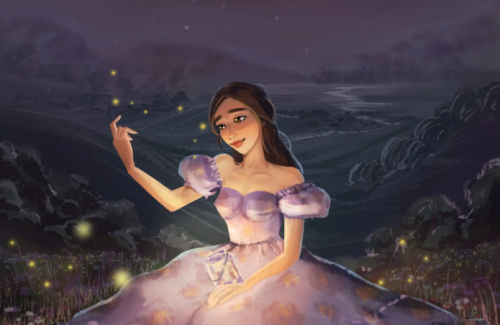
Accountant Escapes from the Mundane Reality into a World of Fantasy for Mental Wellness and Culture Through Digital Art

In a world where it can be easy to feel disconnected and jaded, Serene Chan’s art is a refreshing reminder of the beauty and magic that surrounds us.

With her ability to use digital art and visual storytelling to provoke child-like wonder and capture nostalgia, Serene creates images that are not just visually stunning – but also carry a deeper message about the importance of mental health and the value of diverse cultures and communities.

Serene is a Chinese-Canadian creative and expert daydreamer who worked as a freelance traditional painter and digital illustrator for 8 years, supporting other independent musicians, writers, and artists. Alongside her art, she works full time as an accountant. Her versatile background includes her academic education in business and years of entrepreneurial experience exemplified in three of her start-up businesses.

When she’s not painting, Serene channels her artistic energy into other creative endeavors such as crafting resin crafts, thrifting, sewing, and thrift flipping.

JOURNEY TO DISCOVERING ART AS AN OUTLET

Growing up, I was extremely socially awkward and spent a lot of time in my head. I like to call myself an expert daydreamer because I spent most of my life imagining different worlds that I fit in a little bit better than this one.

When I found art as an outlet, it just made sense because it allowed me to be able to create places that defied all odds; places where stars could be captured in your hands, where dragons roam free, a place that I can call home. I was inspired by the power that all artists have- the ability to create something from nothing, especially when it doesn’t exist in the real world. 

The traditional painting came naturally to me, but my immigrant parents pressured me to conform to their ideals of what a successful individual looks like and put little emphasis on my creative passions. I followed their well-intentioned guidance and wishes for their daughter to be self-sufficient one day. I did not receive the arts education I sometimes wish I received in my 20s. I followed the motions of getting a bachelor’s in business and my accounting designation, and ended up in a corporate budgets job.

Over time, I realized that going to art school does not determine the success of an artist. If I really wanted to have an art career, I was going to make it happen regardless of whether or not I had the connections or credentials to do so.

I began my art journey in 2015, starting an art website with no idea what I was doing. I transitioned into digital illustration only 2 years ago when I finally invested in an iPad to accelerate my painting process. For the last 8 years, I spent an uncountable amount of time experimenting with different tactics to maintain a part-time art career selling prints, doing custom artwork, and applying to every open call I qualified for.

I’ve spent much of my art journey finding resources to personally develop, and reached out to countless individuals in the art industry to learn about their experiences. Ambition is what fuels my love for learning and my efforts of sharing high-quality art content with the world. Though my art career is not full-time yet, I’m still excited to continue grinding it out and seeing where it takes me.

COPING UP WITH LIFE’S CHALLENGES

My immigrant parents pressured me to assimilate with society and put little emphasis on carrying out Chinese traditions from home. So, while I became comfortable with Westernized routines, I began to feel embarrassed about my culture in my youth.

I grew up developing mental health issues from suppressing my reactions to the microaggressions around me and being unable to cope with them. As time passed, I realized that resiliency comes from releasing some of the trauma and anxiety that’s been clouding my thoughts. However, it’s also understanding that although it might never disappear, it’s a part of what makes you-you. It’s transforming into someone who is at peace with the chaos and accepts it as something that has to happen in order to grow. This is why I’m now extremely driven to teach the importance of celebrating my Asian culture and incorporating the aspect of mental health to start conversations.

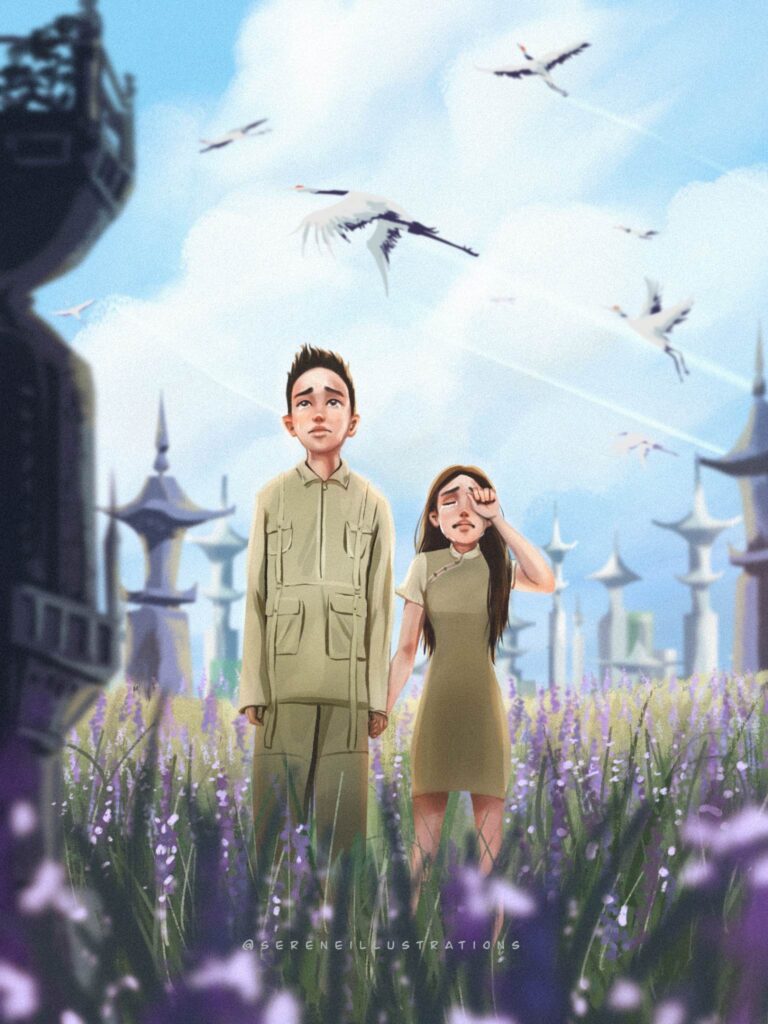
One of my favorite paintings with both of these concepts is “Remembered Always.” I painted this during a time when my family was trying to navigate grief from mental health-related death. Watching my family try to recover from that trauma made me realize how death, how to grieve, and mental health rarely gets talked about in an immigrant family, especially at an early age.

Remembered Always by Serene Chan

In Chinese symbolism, cranes are often believed to carry spirits to heaven after they die. This painting depicts loss remembered by the living and hopes that their spirits are brought to a happier place. My inspiration is to educate the values and symbolism the Chinese believe in to help them ease the pain of death.

PROMOTING MENTAL WELLNESS THROUGH ART

One of the worst parts of mental health is having thoughts or feelings that you can’t control. Any form of art (drawing, writing, music, etc) can be a way to express those thoughts you have. You don’t have to be good at it, or even have any experience. Using art to convey what’s on your mind lets you manifest those feelings into something physical that you CAN control. 

I know sometimes it sounds easier than putting it into practice. Maybe your mind is drawing a blank. Maybe it’s too difficult to put into words what you’re feeling because there are no words in the dictionary that describe what you’re going through. I would recommend finding paintings, poetry, stories, or music that speaks to you. I guarantee you that there’s someone out there who has felt what you feel and was able to put it into art. Perhaps then, you’ll feel a little less alone knowing there’s someone else in this universe who understands how you feel.

Just know that your mental struggles are never too small or insignificant. You matter in this world, so please take care of yourself.

THE PAINTING PROCESS

My process requires more planning than most might think. Before I begin a painting, I focus on a feeling I want to capture. I then refer to the resources I regularly collect from the internet or everyday life. I take inspiration from different components found in my references to construct an image in my head.

After I get an idea of the scene, I create a very rough sketch and a color mock-up. About 80% of the time, I have to do in-depth research about every item I’m painting so I have a better understanding of how each component looks in the environment it’s in. This could mean understanding how the light impacts each object, understanding how the body looks in a specific pose, or even how clothes fall on the body when positioned a certain way. After all that work, then I can finally begin the fun part: painting!

I usually start with the background and paint the figures on top after. Because I did so much planning and prep work beforehand, the painting process is pretty effortless afterward. The entire process can range between 1-2 weeks. 

Usually, the painting process is done digitally on my iPad. Lately, I’ve been doing sketches in pencil on paper before taking a picture of it and continuing the sketch digitally. I find that my hand-eye coordination is better when I can feel the pencil touch paper.

SUPPORTING AND SHARING OTHER ARTISTS’ STORIES

Art is meant to be shared and to inspire each other with our individual perceptions of the world. If I have the ability to help other artists/writers/musicians further their voices by providing thought-provoking artwork that attracts people’s attention, then why not? My art business is not only meant to share my own stories and experiences but to also help others share theirs.

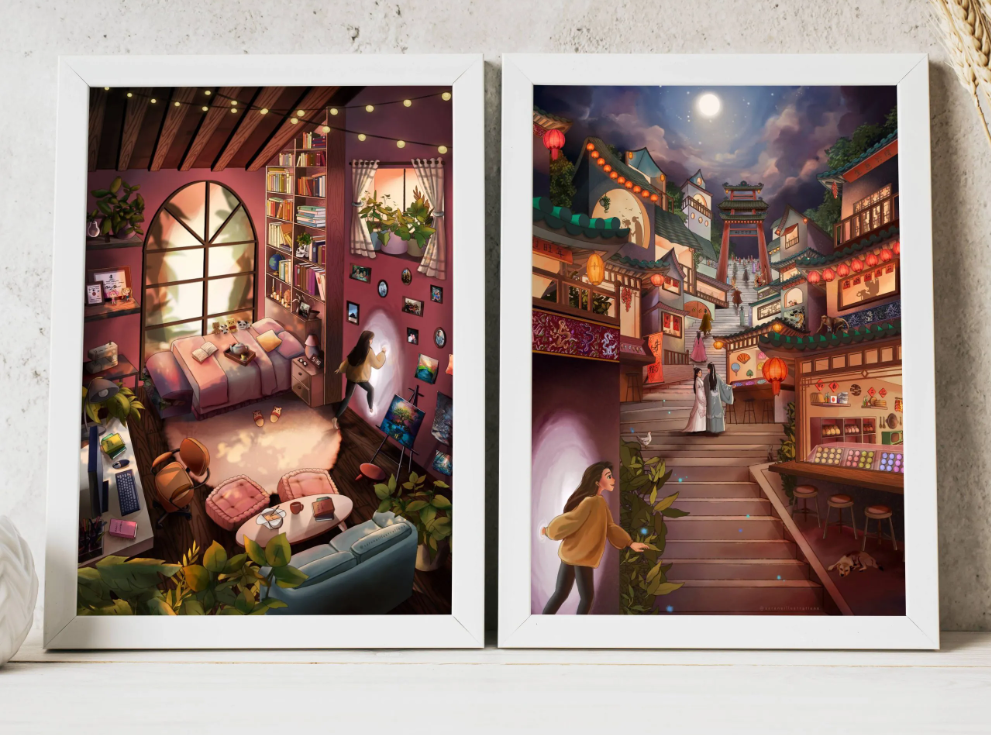
One of my favorite collaborations includes one with RBC and VIBE Arts, where I created two huge poster ads to be displayed in a Toronto Transit Commission Subway station in Toronto. This project was meant to promote women in art and what speaks to them as an artist. This two-panel illustration represents my present self in one painting and my discovering my past ancestry in another painting. The present self-painting depicts my safe haven- my ideal room filled with all my favorite art forms and passions. The ancestry painting depicts 6 different Chinese hidden mythologies in an alternate ancient East Asian universe. This project highlights the importance of my ancestry and how it’s deeply rooted in my identity today.

Stories That Made Me I & II by Serene Chan

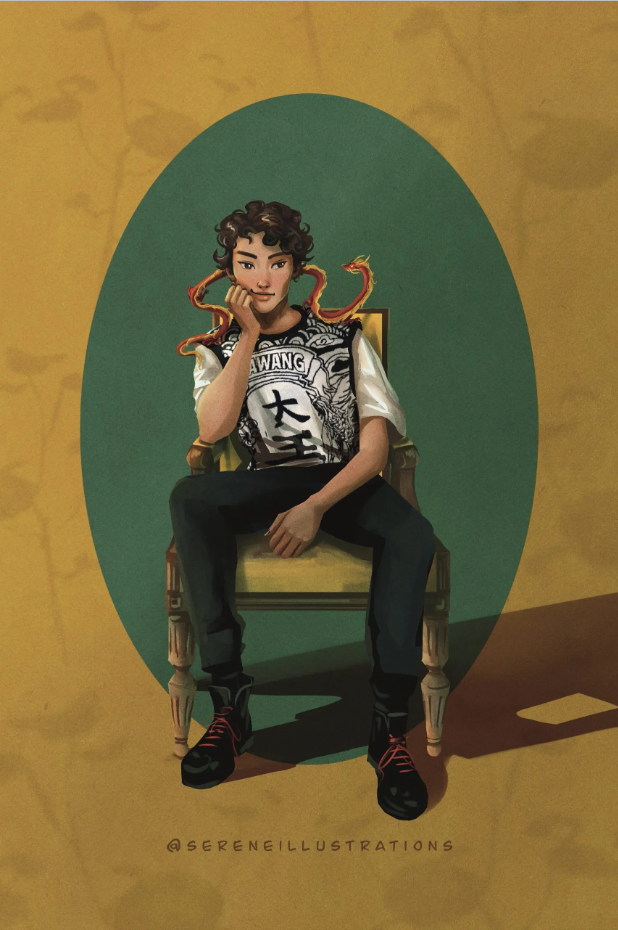
Other honorable mentions include the collaborations I did with East Asian fashion and jewelry designers, such as DAWANG and Sublima Jewelry. They both focus on promoting their East Asian heritage with a modern twist, encouraging their audiences to feel beautiful and proud of being Asian while wearing their pieces. What made it extra special for me was being able to connect with other small businesses and learn about how they bring their visions to life. Being inspired by other talented artists is truly such an honor.

Chinese New Year by Serene Chan
Male Mulan & Mushu by Serene Chan

COLLABORATE WITH SERENE

I have a current collaboration with DrawaDot, where I created a piece celebrating the Lunar New Year and the concept of celebration. All proceeds of this project go toward supporting emerging artists who are striving to kick-start their art careers.

I also have a super fun collaboration with Toronto Pearson Airport coming up. So if anyone is flying to Toronto… they might just see my artwork in Arrivals in a couple of months!

My hope is that my art will inspire others to appreciate the many traditions and celebrations of Asia, and help people develop a child-like wonder everyone is capable of experiencing when viewing the world. Between just you and me, I’m in the process of illustrating a self-published book that promotes both mental health and an Asian festival.

For anyone who wants to stay updated on my work and give feedback on what they’d like to see, I encourage you to sign up for my newsletter! I send monthly updates of new art, art processes, shop updates, and painting tips/tricks. If you come along on my journey, I promise you’ll find art that helps people become daydreamers and find a sense of belonging in this world.

Website: sereneillustrations.com

Instagram: @sereneillustrations 

Founder photo 2-jpeg

Stories

These Sisters Infuse Chinese Cultural Aesthetics in Designer Womenswear

SHUMINGYU is an esteemed designer womenswear brand that finds its roots in the poetic essence of Chinese art.

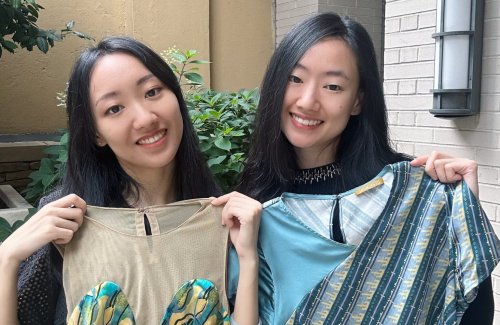
Alvina Ding and Laura Ding, the talented sister team behind the brand, have embarked on a remarkable venture to preserve and interpret the artistic lineages of China through the medium of fashion.

With their deep personal connection to their heritage as second-generation Chinese Americans, their brand serves as a heartfelt expression of their cultural journey and a platform to share the cultural memories passed down through generations. The name SHUMINGYU holds great significance, as it pays tribute to the profound Chinese saying “落叶归根”, which invokes the powerful imagery of autumn leaves falling towards their roots, returning to the soil that once nurtured it.

Throughout history, Chinese artists have expressed their poetic selves through various art forms such as painting and poetry. SHUMINGYU draws inspiration from this legacy. Alvina, as the designer, and Laura, in charge of marketing, collaborate to create a collection that captures the elegant beauty inherent in Chinese aesthetics.

In an exclusive interview with Asian Hustle Network, Alvina and Laura walked us through their journey of preserving Chinese artistic lineages through fashion.

WHAT INSPIRED THEM TO CREATE SHUMINGYU

Alvina and Laura: We always had a passion for Chinese culture. As Chinese Americans, we were fortunate to grow up in a household that gave us exposure to the beauty of the culture such as its poetry and the arts, despite not being able to visit that often.

The fact that we were physically removed from the country of our cultural heritage, in many ways enabled us to appreciate the culture even more. We spent the next decade in between the U.S. and China, completing our undergraduate degrees in Beijing, kickstarting our early professional careers, and finishing graduate school in the U.S. It was during this time that the idea for SHUMINGYU was conceptualized. 

Alvina: The idea for SHUMINGYU was first planted in my mind in college, where I was formally introduced to the canon of Chinese artistic lineages as a Chinese art history major. I thought it was odd that despite the breadth and nuances of Chinese aesthetics that were crystalized over thousands of years, it was rarely reflected in modern fashion products. To me, culture should not be relegated to a museum. It has meaning only when it is a part of one’s daily life. While I was studying fashion design at Parsons and Laura was in business school, we began to turn this idea into reality. I want this type of beauty to be seen, not only in rarified spaces such as classrooms and museums but by more people through a medium such as fashion that can be a part of our everyday lives. This fuels me as a fashion designer. 

HOW SELF-DISCOVERY INFLUENCED THEIR AESTHETIC AND VISION

During our young adult years living between China and the U.S., we came to understand that identity is multifaceted.

There isn’t one way to be American, Chinese, or Chinese American. Cultural identity and heritage are not limited by where you were born or what period you are living in. It is something that is constantly evolving, passed down through generations, and shaped by the people who are currently living and breathing it.

This motivated us to combine the cultural fluency we gained over the years with design as a universal language to create SHUMINGYU. This is our way of sharing our perspectives on the beauty of Chinese aesthetics and the artistic lineages that have come before us with a global audience.

THE CREATIVE PROCESS

Alvina: I first decide on a particular theme, which is either a genre of Chinese art or a type of craft. Then I dive into research on the theme for a month or two. I read academic papers and art history books to understand the significance of this kind of genre, the elements that influenced its formation, what type of art it had an impact on later, its philosophical underpinnings, where the colors come from, and literary references. I look at the most representative pieces of art from the genre and identify the most distinctive characteristics that will define the overall feel of the collection.

During this process, I am looking at art objects that have graced the courts of emperors, the gaze of connoisseurs, and the hands of skilled artisans. From the free-spirited brushwork of ink paintings, the rhythmic flow of poetry, and the delicate luster of ceramics, all of this informs my final design decisions.

As I do the research, I see designs in my head. I visualize the images and colors and capture what I see into sketches, which I then translate into prints. Once I finish my prints, I think about what silhouettes they would work best on. From then on, it’s about deciding what fabrics work best for each design and seeing how different designs fit together into an overall collection.

SHOWCASING CULTURAL HERITAGE INTO THEIR DESIGNS

Each of our collections has a specific theme, and then we incorporate that theme into the custom prints that we develop, as well as the silhouettes of our designs. For example, our first collection ‘Of Blue Mountain and Verdant Forests’ was designed around the theme of Chinese landscape paintings. Therefore, each custom print that we developed is rooted in a piece of artwork, literature, or philosophy that is connected to landscape paintings. Our hope is that with each piece a customer wears, they can discover a new piece of culture.

Example 1:

The print of our Brushwork Dress is inspired by a brush stroke technique from the Southern Song Dynasty landscape painting The Joy of Harvest. Developed by the painter Li Tang from the Northern Song dynasty, the technique is called the “axe-cut stroke” and uses angular, staccato brushstrokes to depict the rocky surfaces of mountain peaks. The brush stroke derives its name from its visual resemblance to chopped wood and is one of two major brush strokes used to depict the texture of rocks in landscape paintings. The color of the dress is inspired by the golden brown hue of the painting scroll and the style lines are outlined in the shape of mountain ranges. The skirt hem shape is symbolic of the reflection of mountains in the water.

The Joy of Harvest is a masterpiece by Song Dynasty artist Ma Yuan (1160 – 1225), one of the most influential landscape painters of his time.

Example 2:

The print of our Spring Mountains Set is inspired by the mountain ranges from the Sui Dynasty painting Spring Excursion, widely cited as the earliest surviving work of Chinese landscape painting. The print traces the delicate, twisting brush strokes that outline the rise and fall of spring mountains in the distance. The colors are inspired by the luxurious powdered gold, malachite green, and azurite blue pigments used in the painting.

Painted by artist Zhan Ziqian, Spring Excursion was one of the first paintings to give prominence to mountains and rivers over human figures. It is considered a seminal work that marks the genesis of the most influential category of Chinese art for thousands of years to come.

FOSTERING A DEEPER APPRECIATION OF CHINESE AESTHETICS AMONG A GLOBAL AUDIENCE

We want to share the breadth, depth, and nuances of Chinese aesthetics with a global audience through our clothing. By offering an alternative aesthetic view to the exotified and caricatured version of Chinese fashion that has been perpetuated throughout the past century, we want to move beyond the set of narrow motifs that have defined what Chinese fashion can look like and open the door into a world where design is created by those who live and breathe the culture and comes from an informed and nuanced perspective.

Perhaps one of our prints will spark someone’s interest in understanding a particular artistic movement in history or thinking about how Chinese aesthetics is perceived today. If our pieces can inspire people to value culture more and spark conversations, then we’d consider that a success. 

WHAT LIES AHEAD FOR SHUMINGYU

We already have a lineup of themes for our future collections, and some designs are already in the works for our second and third collections. We also want to integrate more types of fabrics, silhouettes, and crafts into our designs.

In addition to clothing, we have future plans to expand into accessories, including handbags and fragrances. We are excited to bring our vision to life, step by step, and hope that others are excited to come along on this journey as well!

CONNECT WITH SHUMINGYU

Instagram: @shumingyuofficial

Website: shumingyu.co

unnamed (1)-jpg

News

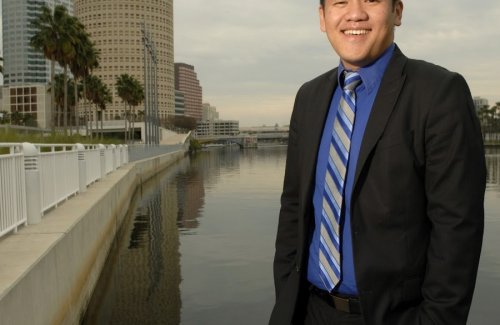
How This Entrepreneur Shares the Richness of Asian Cuisine and Culture in Tampa

Born in Indonesia, Ferdian Jap’s upbringing in a Chinese restaurant fostered his passion for culinary arts and his desire to share the richness of Asian cuisine.

As the owner of Zukku Sushi and Astro Craft Ice Cream, Ferdian is not only continuing his family’s legacy of running restaurants but is also on a mission to showcase the diverse cultures and flavors of Asia to the local community.

With his entrepreneurial spirit, Ferdian is set to revolutionize the dining experience in Tampa. In addition to his current ventures, he is working on a Korean BBQ concept that promises to be a unique and upscale establishment. He envisions a dining environment that goes beyond Tampa’s expectations, immersing guests in an extraordinary atmosphere while savoring delectable Korean dishes.

Beyond his influence in the culinary world, Ferdian has actively participated in initiatives to revitalize downtown Tampa, demonstrating his dedication to the community. As the former project manager for Friends of the Riverwalk, he played a crucial role in fundraising efforts that contributed to the development of downtown Tampa. Inspired by his involvement, Ferdian launched “Big City Events,” an organization that focuses on organizing festivals and concerts in Tampa.

Ferdian has also established a subsidiary called “Pier Events,” which aims to bring the same dynamic energy to St. Petersburg. Notably, he is the event manager for the iconic St. Pete Pier, overseeing a diverse range of engaging activities.

Ferdian Jap is eager to introduce new concepts and plans to expand his restaurant empire both locally and nationally. Through his endeavors, he continues to celebrate the diverse cultures of Asia while leaving a lasting impact on the dynamic landscape of Tampa’s restaurant and entertainment industries.

Featured Image Source: Linkedin

Daily Expert News-jpg

News

Indian Designer’s Iconic Lehengas Make Mark in Sustainable Fashion

Renowned fashion designer Rahul Mishra has emerged as a leading advocate of ‘slow fashion’ in the industry, redefining bridal wear with his unique ethos.

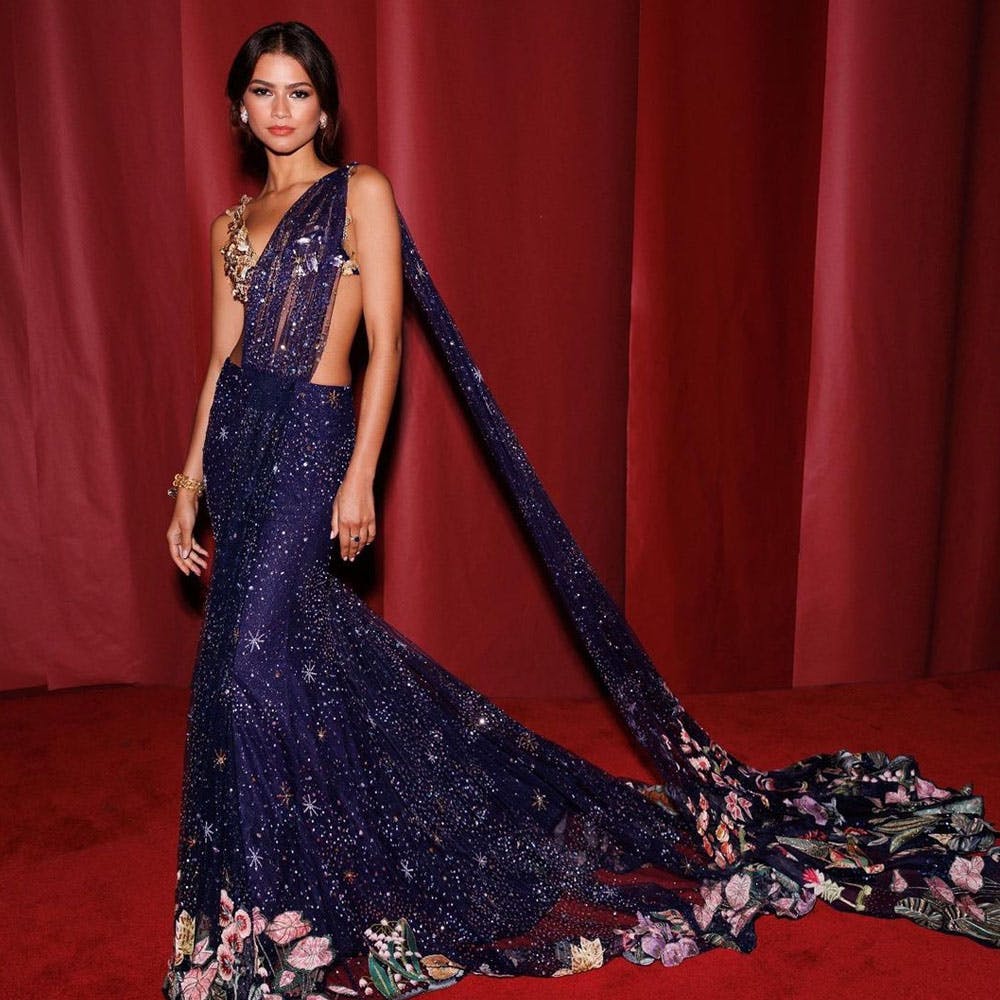
Since his debut in 2017, Mishra has seen a remarkable rise in demand for his bridal lehengas. Today, eager customers face an almost five-month wait to own one of his coveted designs. Mishra’s talent has also caught the attention of international celebrities. He recently made headlines for dressing Zendaya in a stunning blue sari at the opening of the Nita Mukesh Ambani Cultural Center in Mumbai.

Image Source: LBB

Mishra’s accomplishments include being the first Indian designer to showcase his collection at Paris Haute Couture Week in 2020, a feat he continues to achieve year after year.

Drawing inspiration from ancient Indian designs that utilized calico textile, an unbleached fabric made from cotton fibers, Mishra creates lehengas that embody an off-white, ecru aesthetic. The brides who choose Rahul Mishra lehengas appreciate the uniqueness of his designs, characterized by intricate embroidery and unparalleled craftsmanship.

The surge in wedding attire sales, especially during the COVID-19 pandemic, has helped Mishra support and provide employment to over 1,200 embroiderers from rural communities in India. The impact of his creations extends beyond fashion, creating meaningful opportunities for artisans and their families.

Rahul Mishra’s journey started from a small village in Uttar Pradesh. Although his initial aspirations to become a cinematographer were met with rejection, his decision to enroll in an apparel design program opened doors to a fulfilling career in fashion.

Featured Image Source: Daily Expert News