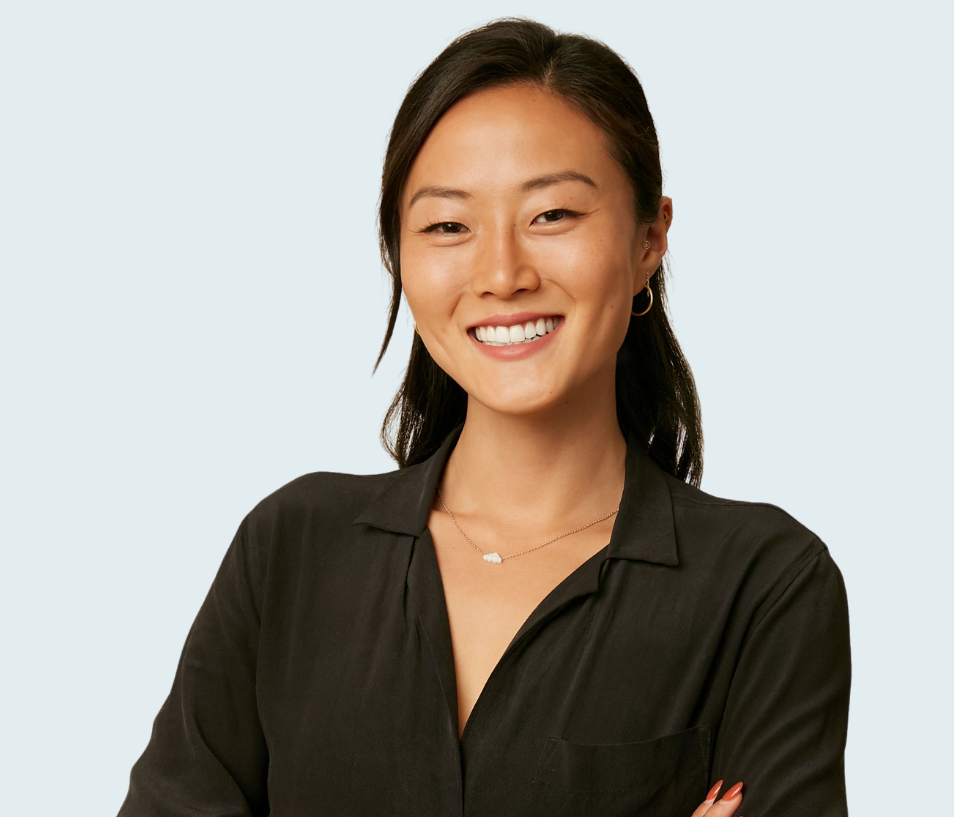
Melody Hahm has held many roles as an acclaimed business journalist for CNBC and Yahoo Finance and a platform and community manager for venture capital firm Harlem Capital. But her Twitter bio begins with “unapologetically Korean.” That’s a good indicator of the kind of person Melody is.
In her interview with AHN, Melody is unapologetically honest about her experiences as, often, the only Asian in the room. She shares her journey of finding value in her work and, as a result, recognizing her self-worth to advocate for herself in traditionally male-dominated newsrooms.
Since joining Harlem Capital in July 2021, she has helped female entrepreneurs and people of color make their mark in history. She leads off-site and operator networking events and content strategy for the firm’s portfolio companies. But she’s doing so much more for the BIPOC community of entrepreneurs by giving them the resources and platform to succeed.
A CHILD OF KOREAN IMMIGRANTS FINDING HER PASSION FOR JOURNALISM
I was born in New York City and raised in the tri-state area in Connecticut and Jersey. I was a lifelong east coaster. My parents are Korean immigrants who met in the States, and I’m their only child. It became my passion early on to become a journalist.
I had a dream of telling international stories, given my background as a child of Korean immigrants. Starting in elementary school, I took a liking to my Spanish class, and I performed the best in English reading and comprehension. So, pairing those things together, I was like, I’ll think I’ll figure out what this journalism thing is. It was after a journalism and writing summer program that I did after eighth grade that I realized this is the area I want to focus on.
I started to write for my school newspaper and contributed to my local newspaper, the New Haven Register. There weren’t necessarily Asian bylines I could look to. There was Connie Chung and a few token Asian women on TV. But I could not envision what my career would look like.
I’ll never forget what my mom said. She said, if you watch TV or go to a Broadway show and see someone that looks like you, it’s probably the stereotypically nerdy character who has a line or two, but you’ll never see someone who looks like you as the main character. She didn’t mean to discourage my dreams, but I think it was a reality check that perhaps it wasn’t the most practical route.
“There weren’t necessarily Asian bylines I could look to…I could not envision what my career would look like.”
-Melody hahm
FROM PRE-LAW TO BUSINESS JOURNALISM AND VENTURE CAPITAL
I went into college pursuing pre-law, but all my internship interests were in journalism. Then, I got a grant through school to go to New Delhi, India, for two months on a broadcast journalism internship. That was a turning point for me. Until that point, I didn’t understand what a real career in journalism could look like. When I got back, I tapped into any potential connection I had in the journalism world. It was through an alum of my school, who was the managing editor of Fortune magazine, who connected me to a couple of folks, and one of his contacts at CNBC reached out to me in my senior year.
They said a news associate position was open and asked if I wanted it. I had no idea what financial and business journalism was, but it seemed like an opportunity I couldn’t pass on. So, I began my career in financial journalism on CNBC’s flagship morning show, Squawk Box. I produced segments and pitched ideas for startups to be featured on the show. At the time, it was very markets-driven, and I carved a niche for myself.
I recognized that there wasn’t a platform for women and people of color running interesting startups to share their stories in a mainstream way. I took it upon myself to prove that these companies were going to be meaningful one day. I also wanted more experience on-air and I ended up finding an opportunity as an on-air reporter for Yahoo Finance. It was a great transition because Yahoo Finance is all digital. I got the chance to create content in a medium that I consumed. I hosted a show called Breakouts, which focused on entrepreneurship, especially among women and people of color.

In July 2021, I left traditional media to join an early-stage venture fund called Harlem Capital which invests in diverse and women entrepreneurs. I lead their community and platform, which essentially means working with the portfolio companies and founders. As well as expanding our purview and reach as we think about democratizing venture capital for people who deserve it. It shouldn’t matter what you look like.
It’s been a wild journey so far. There are a lot of different hats I wear. Some of my media expertise and savviness does play a role at Harlem, but I’m getting to flex my muscles to help entrepreneurs in a different realm and world, which I’m excited about.
“I recognized that there wasn’t a platform for women and people of color running interesting startups to share their stories in a mainstream way. I took it upon myself to prove that these companies were going to be meaningful one day.”
-melody hahm
TAKING STEPS TOWARD WHERE SHE IS TODAY
I would love to say it was well-thought-out, squarely defined, and manifested, but it wasn’t and never is. It’s always messy. Oftentimes, there are little signals along the way that remind you maybe this is not where my attention should be. I initially did not pursue a business or financial journalism career, the opportunity found me. I recognized that it was not my passion to report on the market’s daily moves. I can talk about it, but did I feel like I was getting value? Probably not. Making the 1% richer was never part of my mission. I obviously never went into journalism to make money.
Being in that corner of media made me reconsider and reflect on who my audience was. Both Yahoo Finance and CNBC served the investor class, which tends to be more affluent and privileged. During COVID, I started excavating a bit. I asked myself how I could play a role in helping entrepreneurs, especially people who look like me, succeed.
If you wanted to cover a startup in mainstream media, it was always about who backed them. That’s when I first started covering venture capitalists. I interviewed a lot of VCs and participated in conferences to interview VCs and the startups they funded. My mind was open to the opportunity to work at a venture capital firm where I could play a role in the process of helping entrepreneurs and equipping them with tools so they can have a fighting chance in making their mark on history.
RECOGNIZING SELF-WORTH IN TRADITIONALLY MALE-DOMINATED WORK ENVIRONMENTS
I think my experience working in two traditionally male spaces has only fueled my fire to identify opportunities where I can change the narrative. I am very fortunate to have had mentors and direct bosses sticking their necks out for me, including the person who connected me to CNBC. I met him when I was a college student in 2011, and he ended up becoming my boss at Yahoo Finance. I’ll never forget this one conversation we had. It was our mid-year check-in, and I was so nervous. I knew I deserved a raise, but I didn’t want to be disappointed if I didn’t get it.
I even went to seminars coaching women on negotiations. So, I was like, “Melody, you can do it. He’s always believed in you.” During the conversation, he gave me a 24% raise. I was going to ask for a third of that. My walkaway number was going to be 8%. That illustrated to me: Why was I valuing myself so little? Part of it is systemic, but I was selling myself short. That was an inflection point for me to recognize that even if this macrosystem is stacked against me, I know my worth, I know my strengths, and I know that I work hard. There are very clear and measurable things to show that makes you believe you deserve more. I recognized that even if the landscape is so male-dominated, that will not deter me.

Tying it back to the venture capital world, so much it is bleak. Very few top-tier firms have BIPOC partners at all levels. Then, I joined Harlem Capital, which is founded by Black men. We have three Black men who are partners, and four of us are women of color, which is unheard of. You don’t see that in venture capital. I’m the only Asian woman, so it empowers me to know that they value and invest in people of color. I have a seat at the table, and I recognize my fight for my community.
Our tagline is that we want to invest in 1,000 diverse entrepreneurs over the next 20 years. I think the only way you can do that is if the investor class and the people in the firm reflect the type of people you want to empower. We have the upper hand in understanding the problems and queries facing diverse founders. We’re the ones trying to solve the issues and provide the resources to feel the gap. It feels like a unique position to be in the venture landscape.
“Even if this macrosystem is stacked against me, I know my worth, I know my strengths, and I know that I work hard. There are very clear and measurable things to show that makes you believe you deserve more.”
-melody hahm
NAVIGATING THE NEWSROOM AS AN ASIAN WOMAN
There were so many incidents of micro and clear aggressions from my colleagues, especially at Yahoo Finance, where I was, for a long time, the token Asian. Over the nearly six years I was at Yahoo Finance, our newsroom really blossomed. We had a flurry of people of color and lots of Asian women who joined the team. But the first couple of years were really difficult. If there was news related to ongoing issues in the Asia continent, I was expected to know the answer. I’m like, I was born in New York. I’m connected to my Korean heritage, but I don’t know the ins and outs of the dynamic of Japan and Korea. The assumption that I would have these answers definitely messed me up a little bit.

In light of the hate crimes facing Asians, it was difficult for me during the work day because we wouldn’t cover that news. It was only when there was a business angle or organizations pledged tens of millions of dollars that it became a story in the business world. I understood that we weren’t working under a general news system, but at the same time, the lack of care felt disappointing to me. I felt I had to advocate for myself and the Asian community.
In my current role in the venture world, it’s night and day because my colleagues are all people of color. Even when Michelle Go passed, against this influx in hate crimes was happening, they would check in on me, asking how I was doing on a personal level. To be honest, Harlem Capital has grown over the last couple of years, alongside the deaths of Black Americans like George Floyd and Breonna Taylor. My colleagues recognize how hard it is to compartmentalize pain and trauma as you experience professional success, trying to reconcile the two. I think there’s empathy in my current role and organization that gives me a little bit more strength and hope.
THE FUTURE OF VCS
I think 20 years from now, we’ll see a magnificent diaspora of Asian, African, and Latino founders who go on to raise future rounds of capital, take their companies public, maybe start their own VCs, and become angel investors. It’s beyond my wildest dreams to think about what that diaspora looks like. Tier one VCs are already investing in Africa and Latin America. We’re seeing people choose to operate in international landscapes, and they’re all contributing to changing the face of entrepreneurship.
I have no doubt in my mind that when hopefully my child is growing up that if they were an entrepreneur, they could look at the options and say, ‘There’s a partner who looks like me and understands my story.’ It won’t be tokenization as a poster child of diversity. It will be an integration as the DNA of up-and-coming VCs, VCs that have yet to be created, and existing firms where it won’t be an option anymore to not be diverse. This is a one-way street, and if you don’t buy into it, you will get left behind.
“It will be an integration as the DNA of up-and-coming VCs, VCs that have yet to be created, and existing firms where it won’t be an option anymore to not be diverse.”
-melody hahm
HOW TO REACH OUT
You can reach me on Twitter @melodyhahm, on Instagram @melhahm, and on LinkedIn. If you want to learn more about Harlem Capital, or if you want to learn more about my journey, I’m always excited and happy to chat with folks. If anyone is contemplating a move, career or otherwise, feel free to hit me up because I love to talk about those kinds of transitions.
Interview credit: Tiff Soga