Awaken* newsletter

July 4, 2024

SHARE:

In this candid conversation, JJ reflects on his remarkable journey, from gaining admission to Stanford GSB to founding Onloop. He discusses his proudest achievements, the challenges of building a pioneering company, and the invaluable lessons learned along the way. JJ also shares his vision for Onloop in the evolving landscape of remote work and generative AI, his approach to angel investing, and offers insightful advice for aspiring entrepreneurs. Join us as we delve into the experiences and insights of a trailblazing entrepreneur committed to transforming the future of work.

HanYue: You have accomplished a lot in your career. What’s your proudest achievement so far?

JJ: My proudest achievement remains getting into the Stanford GSB MBA program. Before Stanford, I had spent my entire life in Asia. Moving to Stanford marked a significant shift in both my career and personal development. Immersing myself in the challenging yet enriching environment of the Bay Area was transformative, and I just returned there for my 10-year reunion.

HanYue: Can you tell us about the origins of Onloop?

JJ: Onloop originated from personal frustrations I encountered while managing teams at Uber for 3.5 years, especially with inefficient HR processes. This led to extreme frustration with the outdated systems. After leaving Uber in September 2019, I started OnLoop to solve some of these frustrations. We developed our first product around changing how performance reviews get done using GPT3 in early 2021. We’ve come a long way building out our platform and focused on helping every manager become a great manager using habit-forming technology and applied AI It’s been an exhilarating journey, shaping a company that contributes to the evolving future of work landscape especially given all the transformative impact of distributed & hybrid work as well as the maturity of large language models (LLMs).

HanYue: What have you learned from building Onloop?

JJ: Building Onloop has taught me that a founder’s longevity hinges on their conviction in their mission and the people they surround themselves with. Pioneering in any field is incredibly challenging—far more so than creating a copycat startup. Jensen Huang famously said he’d say ‘hell no’ if asked to do it all over again. The world resists change, and you must consistently challenge the status quo. 

Growing up in an Asian household where academic success was prioritized and entrepreneurship was uncommon, taking a non-salary path wasn’t easy. This background often amplifies the voices of doubt during challenging times, yet confidence and eloquence are the most significant drivers of success in the early days. 

Life in your late 30s and 40s has many more responsibilities with respect to family so it’s not always easy to take the plunge, but the learning experience from entrepreneurship is absolutely invaluable. I’m better off for it, even if things don’t pan out as expected. Starting a company is like becoming a parent—it’s a transformative experience that teaches you new ways to live.

HanYue: What’s your vision for Onloop?

JJ: Our vision at Onloop is to help knowledge workers fully realize their potential during this era of significant transformation. The rise of remote work and the advent of generative AI—akin to an industrial revolution for knowledge workers—presents new challenges and opportunities. We aim to help these professionals optimize their careers in a rapidly changing environment. The knowledge work sector is vast and often influenced by chance, especially in job placement – knowledge worker wages are a multi-trillion dollar asset class allocated by chance. My goal is to develop and disseminate optimal strategies for knowledge workers, enabling them to seize the best opportunities available.

HanYue: Tell me about your angel investing career and how it impacts your entrepreneurship journey.

JJ: I don’t subscribe to the notion of work-life balance but prefer to maintain a purpose portfolio, which currently includes my family, OnLoop, and enhancing Singapore’s status as a global hub, especially for highly innovative companies. My approach to angel investing focuses more on the people than the ideas themselves, reinforcing my belief that the right people drive success. And I apply this same principle in my work with other CEOs and founders.

While I believe any manager can become great with the right support, a CEO doesn’t have a direct manager, making coaching essential. I therefore coach a handful of founder CEOs and  this interaction offers mutual learning opportunities and enhances my own growth as a CEO/founder 

Talking about angel investing, it isn’t just for the rich and wealthy. I have made six investments so far in the range of US$1,000 through syndicates to US$15,000 in certain founders that I know personally. I have learned that while my bets on ideas have failed, my bets on people have not. This supports my hypothesis that early-stage investing is 80% about the founding team. 

Lastly, having become a Singaporean last year, I feel even more committed to the Singaporean ecosystem and proud to build in it.

HanYue: Advice for young entrepreneurs these days? 

JJ: When I was single and enjoyed partying, I never imagined I’d find myself here today. People seek pleasure when they lack purpose, as Victor Frankl famously spoke about. Today, living a life of purpose is crucial for happiness — it involves engaging in activities that you deeply enjoy and believe are your calling. This philosophy has guided both my personal and professional life and serves as my constant motivation. 

JJ’s journey exemplifies the blend of purpose and innovation needed to navigate the evolving landscape of modern work. His insights into entrepreneurship, the importance of mission-driven leadership, and the power of transformative technology offer invaluable guidance for the next generation of innovators.
Related Articles

AHS EMAIL ANGLE (4)

Blogs, Development

Know Your Value Proposition

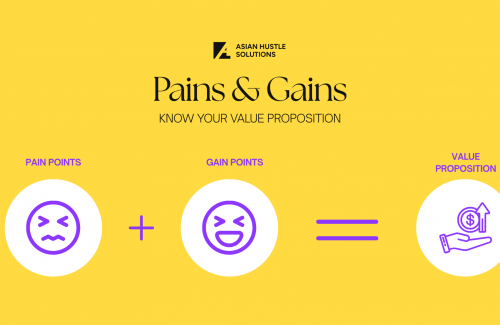
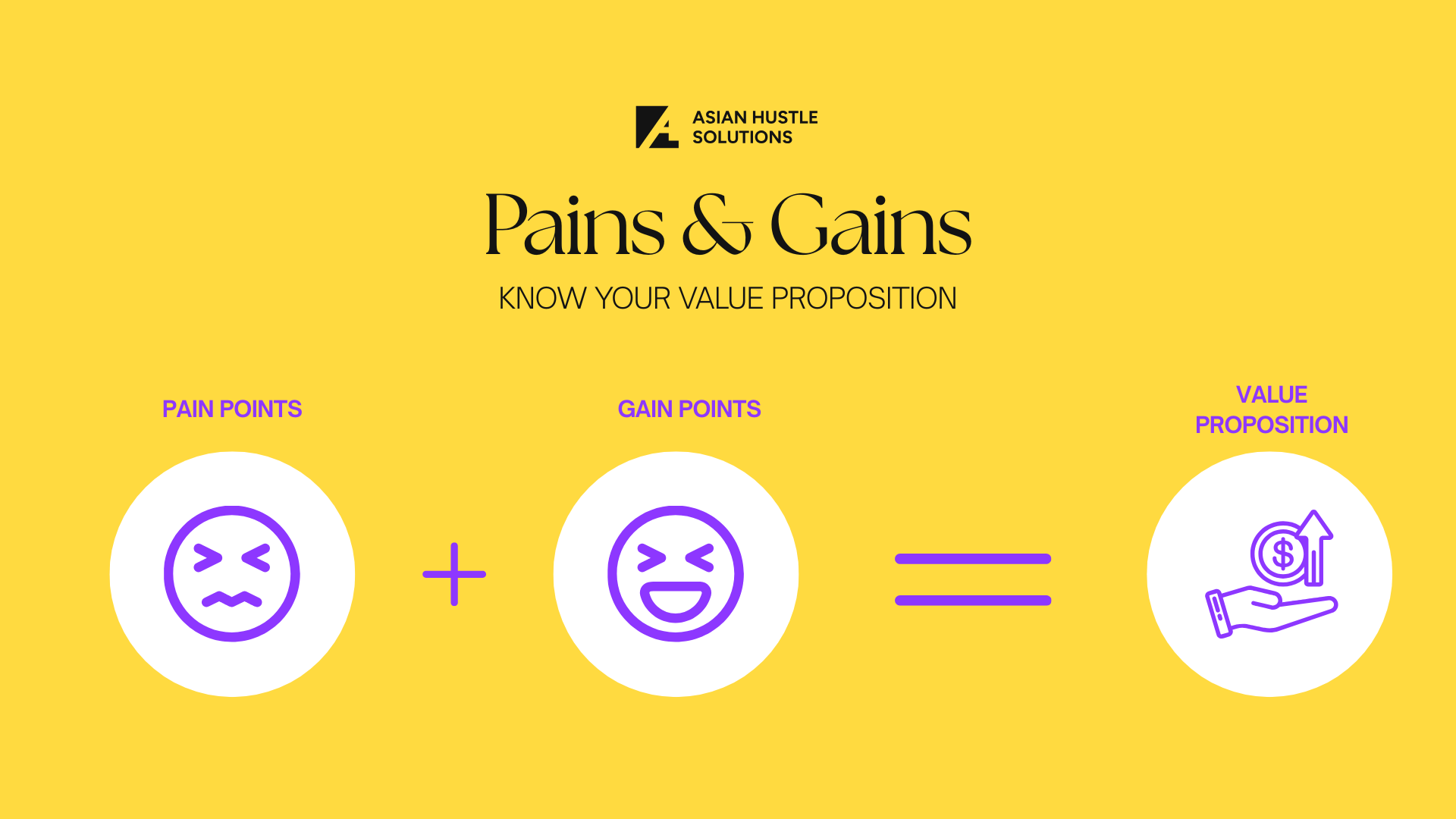
Pain points and gain points are not necessarily new concepts, but some might think they are opposing concepts, when in contrast, the two complement each other. Through customer pain and gain points, you can get a better understanding of your customers’ needs, and offer a unique value proposition.

  • Pain point: As the name suggests, it’s something that “pains” your customers; an issue that they have that needs to be addressed; a challenge that they need to overcome.
  • Gain point: Gain point, on the other hand, is more about you. What can your product or service do for the customers; what can they gain from using your service; what can you help them with?

The two are extremely simple and are a good place to start when you’re trying to advertise your product or service since they consider both your and your customer’s sides to offer a value proposition that is valuable. 

[Book a FREE call with us]
If you want to explore our services more, visit the Asian Hustle Solutions website at AHS.

Development

Winning The Race by Understanding Customer Journey

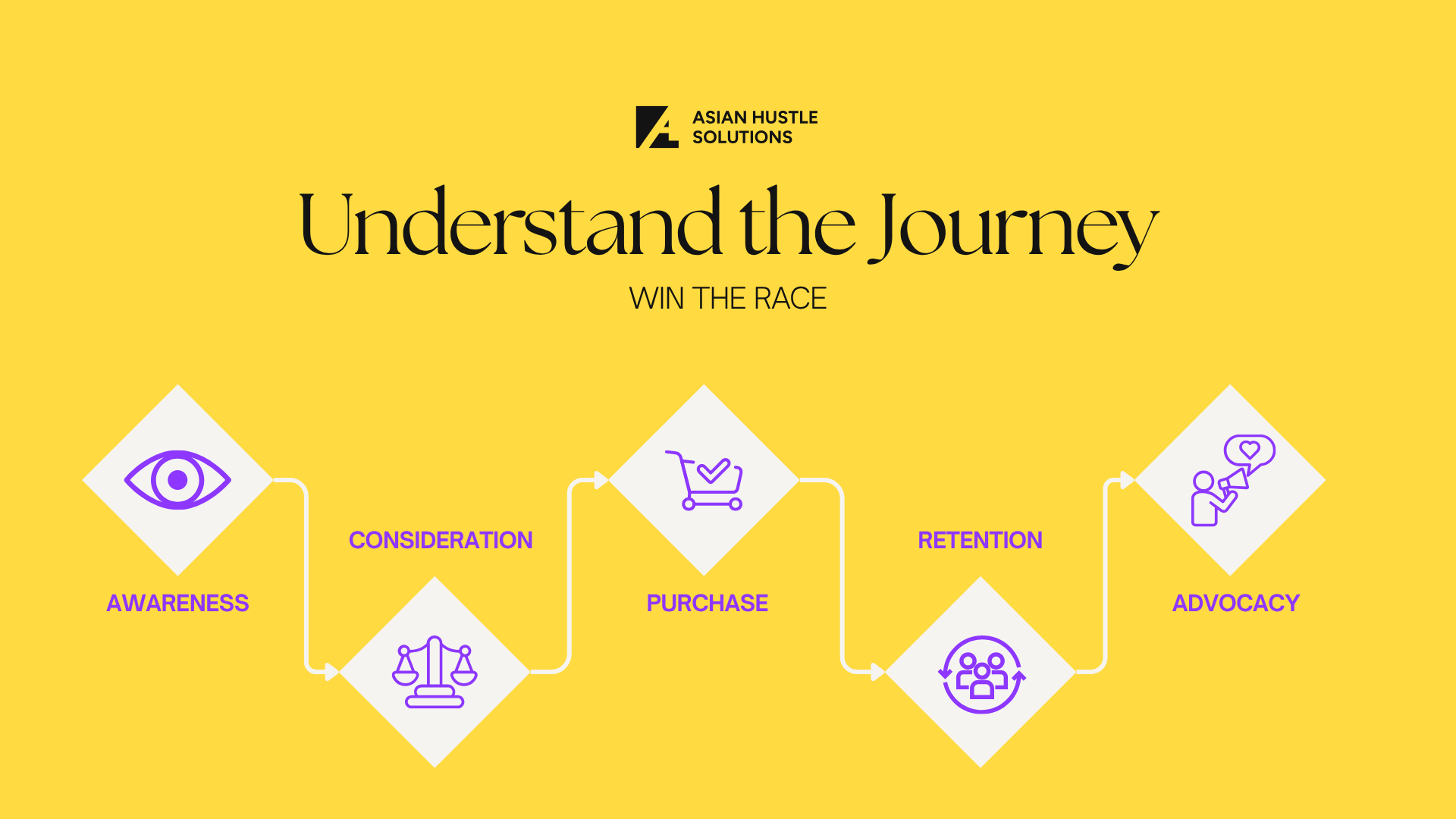
Before becoming a loyal customer, a lead has to interact with your product/service at various stages. This entire process is summarized in the customer journey, divided into 5 main stages:

  • Awareness: The customer becomes aware of your brand and your product, usually through search engines when searching for a solution to their problem.
  • Consideration: The customer is aware of your brands but also your competitors’;, they start wondering which of the options they should choose from.
  • Purchase: The customer makes a buying decision, either from your brand or your competitors’.
  • Retention: After the purchase, you need to consider how to get them to repurchase many more times, since retaining is cheaper than recruiting.
  • Advocacy: At this stage, the customer is basically your brand ambassador., Tthey love your product;, they tell their acquaintances about your product.

Understanding the journey and what stage the audience is at can help you understand their needs and adjust accordingly. Each stage has a different touchpoint as well, so adjusting to said touchpoint makes it more effective and less costly. Understanding the journey can help you win the race.

Why Asian Hustle Solutions?

At AHS, we specialize in helping brands capture attention and inspire action — whether you’re launching a new product or scaling your business, we’ll guide you to marketing that resonates and delivers results.

If you want to learn more about our services, visit the Asian Hustle Solutions website at asianhustlenetwork.com/services/

AHS EMAIL ANGLE (1)-png

Blogs, Development

Getting Back To Basics: 4Ps Marketing Mix

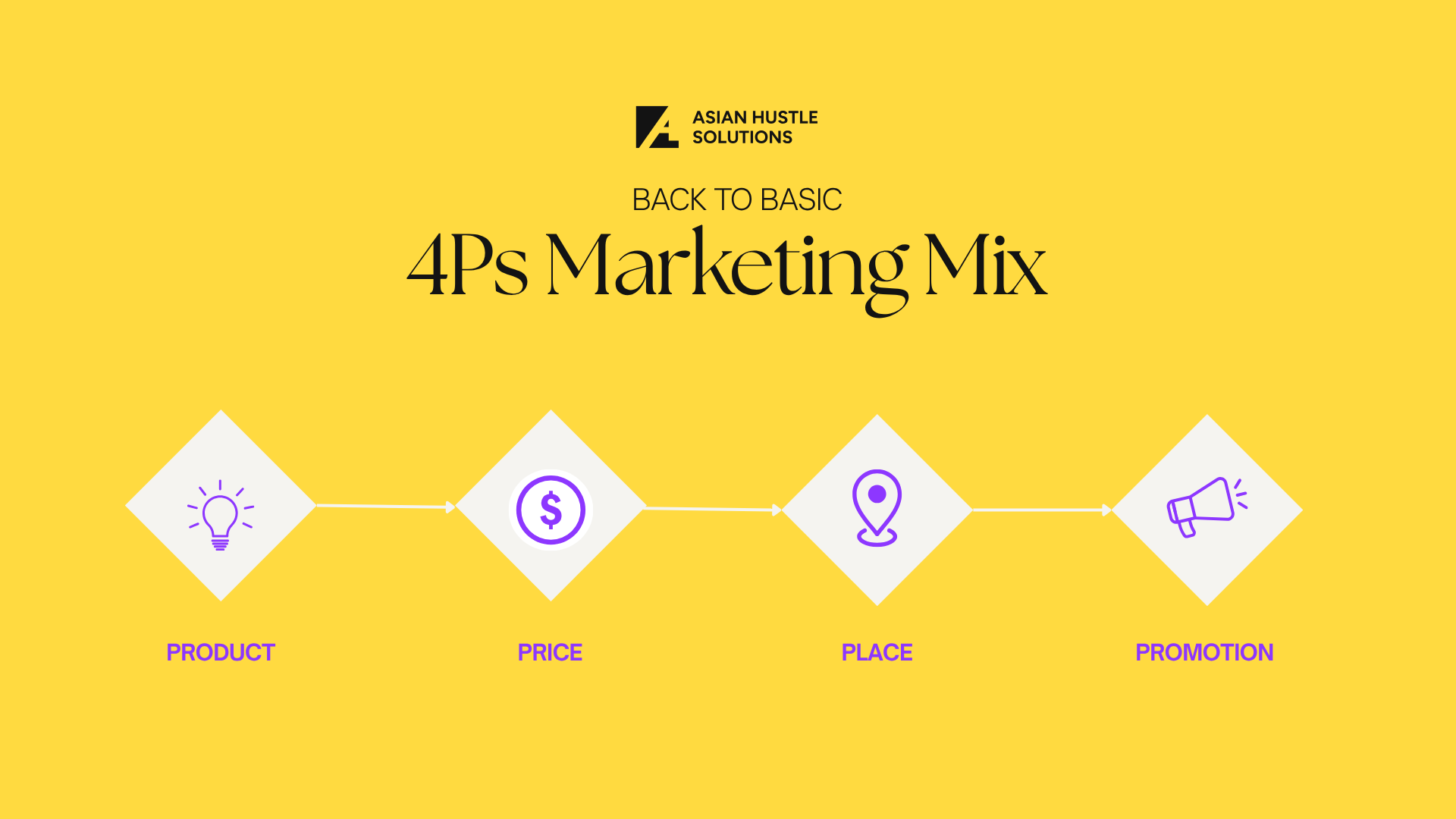
Sometimes, to create an effective marketing strategy for your business means going back to the basics. Popularized by Neil Borden, the 4P’s model is still widely used today, with each P representing a core aspect of the marketing mix:

  • Product: The core of your business, whether it is a physical product or a service. Understanding your product, what differentiates it from the competition, what is unique about it, etc.
  • Price: How much your product should be sold for. This should be based on the supply cost, how you position your product, and whether you should increase or decrease the price based on your target audience.
  • Place: The “where” of your product. Where can the customers purchase your products (online or physical stores, drug stores or supermarkets, etc). More so, it is also where you choose to advertise.
  • Promotion: How you reach your customer, either through advertising, public relations, or promotion, increases your brand awareness.

Why Asian Hustle Solutions?

At AHS, we specialize in helping brands capture attention and inspire action — whether you’re launching a new product or scaling your business, we’ll guide you to marketing that resonates and delivers results.

If you want to learn more about our services, visit the Asian Hustle Solutions website at asianhustlenetwork.com/services/

Stories

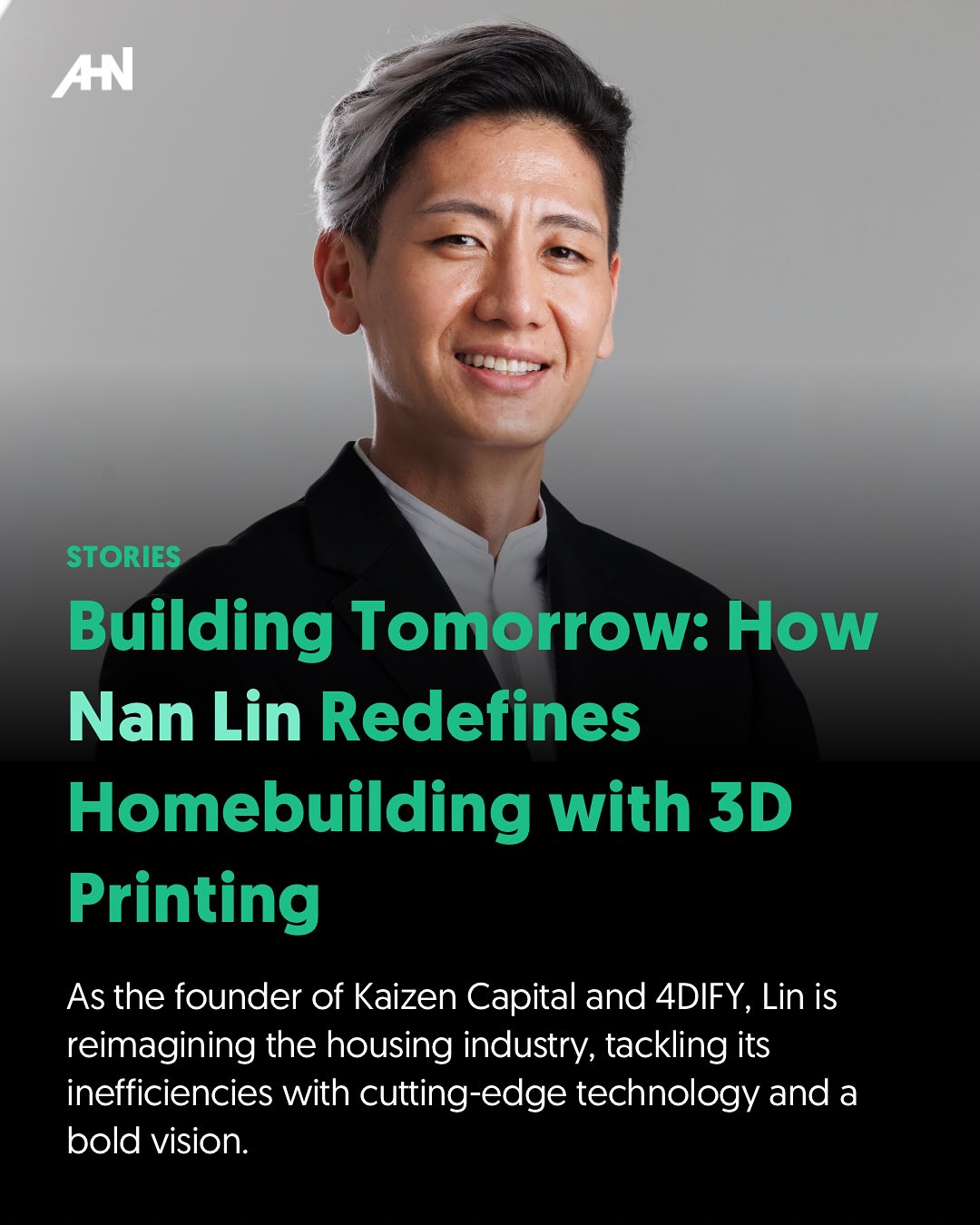
Building Tomorrow: How Nan Lin Redefines Homebuilding with 3D Printing 

For Nan Lin, entrepreneurship isn’t just business; it’s freedom. A freedom earned through sacrifice, relentless execution, and a refusal to accept the limits of a broken system. As the founder of Kaizen Capital and 4DIFY, Lin is reimagining the housing industry, tackling its inefficiencies with cutting-edge technology and a bold vision. His mission? To build stronger homes faster, at lower costs, empowering communities and challenging the status quo.

From Immigrant Roots to Visionary Leadership 

Lin’s journey began at age 10, when he immigrated to America with his mother. While adapting to a new country, he was inspired by his loving parents’ sacrifices, which shaped his relentless drive. “I saw the lengths they went to give me a better life,” Lin says. “Their love and dedication became my compass.” Years later, that resolve led to the creation of Kaizen Capital, where he transforms underutilized properties into vibrant housing solutions: ADUs, subdivisions, condo conversions, and luxury short-term rentals. By unlocking hidden value in land, he delivers market-rate and affordable housing that strengthens neighborhoods.

But Lin saw a deeper problem: traditional construction is slow, costly, and vulnerable to fire, pests, and natural disasters. Frustrated by an industry stuck in the past, he founded 4DIFY to lead a new era of construction through 3D-printed concrete homes.

Nan Lin | Founder and Principal of Kaizen Capital and 4DIFY

3D Printing: The Future of Housing, Today

Lin’s vision for 4DIFY was sparked by a frustrating reality: “Wildfires destroy neighborhoods every year, yet we keep building stick-frame homes that burn like kindling,” he says.

After visiting several 3D printer manufacturers, Lin partnered with New York–based SQ4D. It took nearly a year to secure exclusive licensing rights, navigate regulatory hurdles, and obtain building permits, but he got it done.

Now, 4DIFY is building California’s first community of 3D-printed concrete homes. As this article goes live, their first printed home is nearing completion, despite heavy regulations and a steep learning curve. The team is already outperforming traditional timelines and cost benchmarks. The second and third homes will soon print simultaneously, targeting completion in two months, effectively one home per month at under $200 per square foot.

Despite challenges as an Asian immigrant, Lin managed to transform them into motivation and success. 

“We’re aiming to build at half the cost and in a quarter of the time,” Lin says. “That’s not a dream. It’s the direction we’re heading.”

Built with concrete, reinforced with rebar, and topped with metal roofs, these homes are resilient against fire, wind, earthquakes, mold, and pests. They’re also designed for long-term savings, with lower maintenance, less waste, and reduced energy and insurance costs.

“Critics doubted it would work,” Lin reflects. “But seeing is believing. This is the future.”

A Philosophy of Purpose and Resilience

Lin’s journey has been marked by relentless challenges, some seemingly insurmountable. “Obstacles never stop,” he admits. Yet he transforms adversity into opportunity, fueled by a positive mindset, solution-driven focus, and disciplined execution. His trusted team is his backbone. “No one succeeds alone,” he says. “My team turns the impossible into reality.” This resilience shapes his leadership, blending bold vision with purposeful action to create opportunities, particularly for communities long excluded from wealth-building. “Housing isn’t just a product,” Lin says. “It’s a platform for empowerment.”

Recognition and Inspiration

Lin’s impact is gaining notice. The Sacramento Bee named him one of the Top 20 AAPI Change Makers, and he was honored in the Business Elite Awards’ 40 Under 40. But for Lin, the real reward is inspiring others. “I want to show the next generation of Asian entrepreneurs what’s possible when we claim our seat at the table,” he says.

Lin wants to create opportunities for those marginalized by elevating the future of construction, making it more accessible for his community.

Join the Housing Revolution

Nan Lin isn’t just building homes, he’s redefining what’s possible. Through Kaizen Capital and 4DIFY, he’s creating a future where housing is affordable, resilient, and sustainable. Follow his journey and see the revolution unfold.

Connect with Nan Lin: