Stories

July 10, 2023

SHARE:

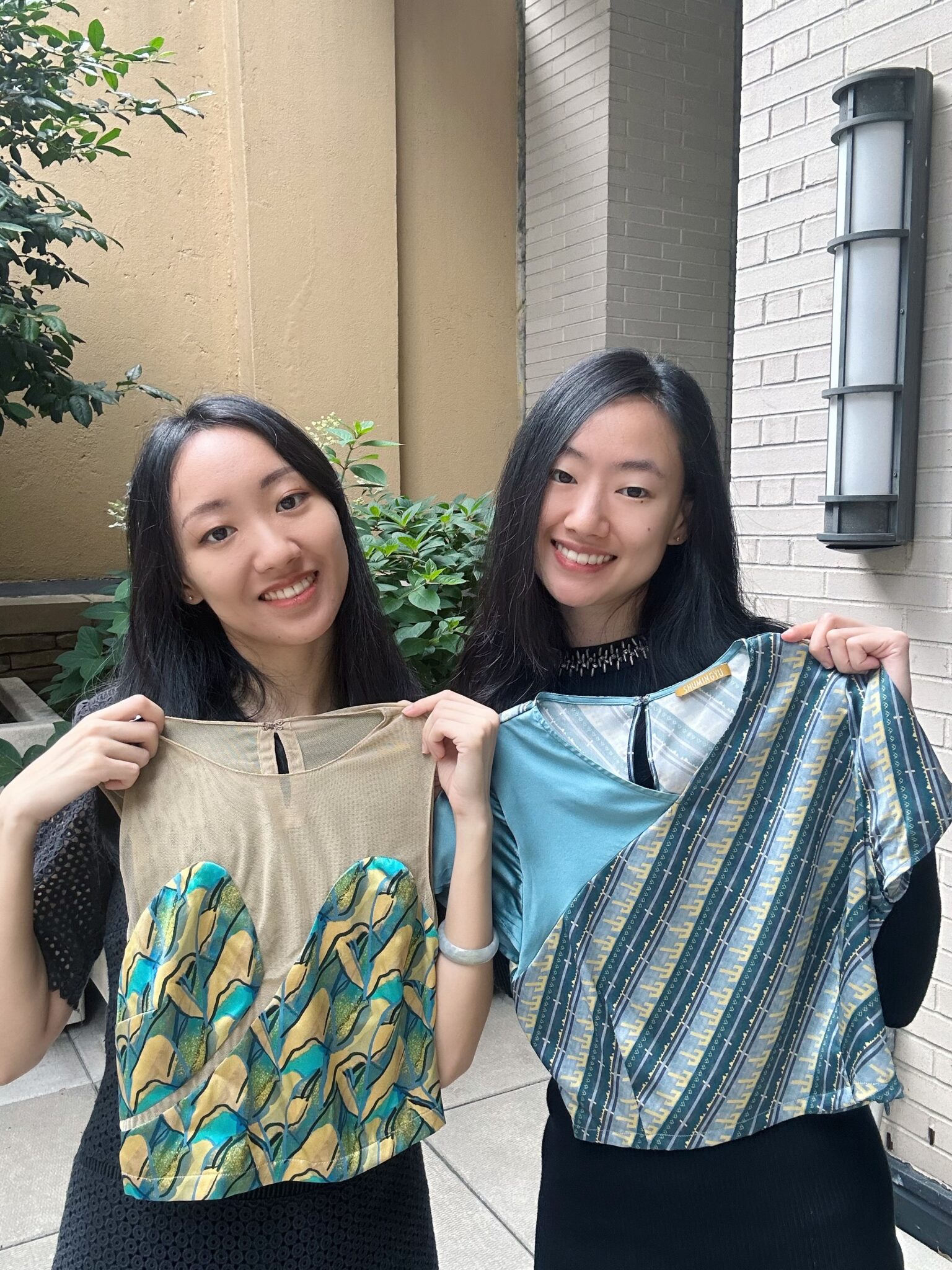
SHUMINGYU is an esteemed designer womenswear brand that finds its roots in the poetic essence of Chinese art.

Alvina Ding and Laura Ding, the talented sister team behind the brand, have embarked on a remarkable venture to preserve and interpret the artistic lineages of China through the medium of fashion.

With their deep personal connection to their heritage as second-generation Chinese Americans, their brand serves as a heartfelt expression of their cultural journey and a platform to share the cultural memories passed down through generations. The name SHUMINGYU holds great significance, as it pays tribute to the profound Chinese saying “落叶归根”, which invokes the powerful imagery of autumn leaves falling towards their roots, returning to the soil that once nurtured it.

Throughout history, Chinese artists have expressed their poetic selves through various art forms such as painting and poetry. SHUMINGYU draws inspiration from this legacy. Alvina, as the designer, and Laura, in charge of marketing, collaborate to create a collection that captures the elegant beauty inherent in Chinese aesthetics.

In an exclusive interview with Asian Hustle Network, Alvina and Laura walked us through their journey of preserving Chinese artistic lineages through fashion.

WHAT INSPIRED THEM TO CREATE SHUMINGYU

Alvina and Laura: We always had a passion for Chinese culture. As Chinese Americans, we were fortunate to grow up in a household that gave us exposure to the beauty of the culture such as its poetry and the arts, despite not being able to visit that often.

The fact that we were physically removed from the country of our cultural heritage, in many ways enabled us to appreciate the culture even more. We spent the next decade in between the U.S. and China, completing our undergraduate degrees in Beijing, kickstarting our early professional careers, and finishing graduate school in the U.S. It was during this time that the idea for SHUMINGYU was conceptualized. 

Alvina: The idea for SHUMINGYU was first planted in my mind in college, where I was formally introduced to the canon of Chinese artistic lineages as a Chinese art history major. I thought it was odd that despite the breadth and nuances of Chinese aesthetics that were crystalized over thousands of years, it was rarely reflected in modern fashion products. To me, culture should not be relegated to a museum. It has meaning only when it is a part of one’s daily life. While I was studying fashion design at Parsons and Laura was in business school, we began to turn this idea into reality. I want this type of beauty to be seen, not only in rarified spaces such as classrooms and museums but by more people through a medium such as fashion that can be a part of our everyday lives. This fuels me as a fashion designer. 

HOW SELF-DISCOVERY INFLUENCED THEIR AESTHETIC AND VISION

During our young adult years living between China and the U.S., we came to understand that identity is multifaceted.

There isn’t one way to be American, Chinese, or Chinese American. Cultural identity and heritage are not limited by where you were born or what period you are living in. It is something that is constantly evolving, passed down through generations, and shaped by the people who are currently living and breathing it.

This motivated us to combine the cultural fluency we gained over the years with design as a universal language to create SHUMINGYU. This is our way of sharing our perspectives on the beauty of Chinese aesthetics and the artistic lineages that have come before us with a global audience.

THE CREATIVE PROCESS

Alvina: I first decide on a particular theme, which is either a genre of Chinese art or a type of craft. Then I dive into research on the theme for a month or two. I read academic papers and art history books to understand the significance of this kind of genre, the elements that influenced its formation, what type of art it had an impact on later, its philosophical underpinnings, where the colors come from, and literary references. I look at the most representative pieces of art from the genre and identify the most distinctive characteristics that will define the overall feel of the collection.

During this process, I am looking at art objects that have graced the courts of emperors, the gaze of connoisseurs, and the hands of skilled artisans. From the free-spirited brushwork of ink paintings, the rhythmic flow of poetry, and the delicate luster of ceramics, all of this informs my final design decisions.

As I do the research, I see designs in my head. I visualize the images and colors and capture what I see into sketches, which I then translate into prints. Once I finish my prints, I think about what silhouettes they would work best on. From then on, it’s about deciding what fabrics work best for each design and seeing how different designs fit together into an overall collection.

SHOWCASING CULTURAL HERITAGE INTO THEIR DESIGNS

Each of our collections has a specific theme, and then we incorporate that theme into the custom prints that we develop, as well as the silhouettes of our designs. For example, our first collection ‘Of Blue Mountain and Verdant Forests’ was designed around the theme of Chinese landscape paintings. Therefore, each custom print that we developed is rooted in a piece of artwork, literature, or philosophy that is connected to landscape paintings. Our hope is that with each piece a customer wears, they can discover a new piece of culture.

Example 1:

The print of our Brushwork Dress is inspired by a brush stroke technique from the Southern Song Dynasty landscape painting The Joy of Harvest. Developed by the painter Li Tang from the Northern Song dynasty, the technique is called the “axe-cut stroke” and uses angular, staccato brushstrokes to depict the rocky surfaces of mountain peaks. The brush stroke derives its name from its visual resemblance to chopped wood and is one of two major brush strokes used to depict the texture of rocks in landscape paintings. The color of the dress is inspired by the golden brown hue of the painting scroll and the style lines are outlined in the shape of mountain ranges. The skirt hem shape is symbolic of the reflection of mountains in the water.

The Joy of Harvest is a masterpiece by Song Dynasty artist Ma Yuan (1160 – 1225), one of the most influential landscape painters of his time.

Example 2:

The print of our Spring Mountains Set is inspired by the mountain ranges from the Sui Dynasty painting Spring Excursion, widely cited as the earliest surviving work of Chinese landscape painting. The print traces the delicate, twisting brush strokes that outline the rise and fall of spring mountains in the distance. The colors are inspired by the luxurious powdered gold, malachite green, and azurite blue pigments used in the painting.

Painted by artist Zhan Ziqian, Spring Excursion was one of the first paintings to give prominence to mountains and rivers over human figures. It is considered a seminal work that marks the genesis of the most influential category of Chinese art for thousands of years to come.

FOSTERING A DEEPER APPRECIATION OF CHINESE AESTHETICS AMONG A GLOBAL AUDIENCE

We want to share the breadth, depth, and nuances of Chinese aesthetics with a global audience through our clothing. By offering an alternative aesthetic view to the exotified and caricatured version of Chinese fashion that has been perpetuated throughout the past century, we want to move beyond the set of narrow motifs that have defined what Chinese fashion can look like and open the door into a world where design is created by those who live and breathe the culture and comes from an informed and nuanced perspective.

Perhaps one of our prints will spark someone’s interest in understanding a particular artistic movement in history or thinking about how Chinese aesthetics is perceived today. If our pieces can inspire people to value culture more and spark conversations, then we’d consider that a success. 

WHAT LIES AHEAD FOR SHUMINGYU

We already have a lineup of themes for our future collections, and some designs are already in the works for our second and third collections. We also want to integrate more types of fabrics, silhouettes, and crafts into our designs.

In addition to clothing, we have future plans to expand into accessories, including handbags and fragrances. We are excited to bring our vision to life, step by step, and hope that others are excited to come along on this journey as well!

CONNECT WITH SHUMINGYU

Instagram: @shumingyuofficial

Website: shumingyu.co
Related Articles

E3JPPIEBT5HCFPAJYT6B5GYEDU-jpg

News

Is the Model Minority Myth an Obstacle to Real Representation?

The Trap of Positive Stereotypes

The original “Charlie’s Angels” was a successful hit, not only because it made $93 million and grossed more than $264 million at global offices, but it also created exposure for Asian American representation.

Lucy Liu plays Alex Munday, a strategist, expert martial artist, and agent. Munday’s parents were Havard professors of economics and philosophy, and she, at an early age, was a child prodigy excelling at chess, equestrianism, fencing, archery, and gymnastics. Besides that, she holds a medical degree, spent her teenage years learning with a Tibetan guru, danced with the Stuttgart Ballet, and was a part-time aerospace engineer and on-call consultant for NASA. 

Lucy Liu as Alex Munday in 'Charlie's Angels' (Image source: 'Charlie's Angels' - 2000)

Lucy Liu as Alex Munday in ‘Charlie’s Angels’ (Image source: ‘Charlie’s Angels’ – 2000)

Does the entire introduction sound familiar? Swap out the name Alex Munday for your overachieving Asian cousin, sibling, or the “top Asian kid” your parents always compare you to, and you’d likely end up with a strikingly similar description.

It is undeniable that contemporary films, comedies, memes, and other forms of content have taken extensive lengths to represent Asian culture. Yet, they have also perpetuated a troubling stereotype. To complicate matters, many within the Asian community unknowingly reinforce these portrayals, cementing these narratives even further.

The article’s purpose is not to mock or diminish the accomplishments of any individual, community, or effort in striving for representation and equality. On the contrary, it is essential to celebrate the contributions of the many talents and media that have significantly advanced global awareness and appreciation of Asian culture and heritage. Hence, the article wishes to provide a nuanced perspective on contemporary topics while providing debate on the norms, beliefs, and habits created in our society.

What is the Model Minority Myth?

According to the University of Michigan, Densho, and other sources, after World War II, the United States underwent significant changes in its laws and policies to address mounting international criticism of racial prejudice and ongoing protests from ethnic communities within the country. 

“Success Story, Japanese American Style” by William Petersen (Image source: Smithsonian APA)

“Success Story, Japanese American Style” by William Petersen (Image source: Smithsonian APA)

As PBS illustrates, new regulations like the Chinese Exclusion Act shifted toward dismantling exclusionary measures and advocating for Asian communities and immigrants, particularly skilled and educated migrants. The University of Michigan further exemplifies, articles like “Success Story, Japanese American Style” by William Petersen began to appear  – praising how despite years of racial prejudice and discrimination, Japanese Americans were still able to achieve great socioeconomic status thanks to hard work and other cultural values of discipline and compliance to social hierarchy. 

By focusing on the facets of income, education level, and low crime rates as the definition of success instead of underlining economic and social factors, Asian Americans are often portrayed as hardworking, disciplined, and intelligent—a concept scholars refer to as the model minority. 

Model Minority Myth in Silencing Activism

While this stereotype may appear beneficial on the surface, Ted-Ed, in collaboration with Densho, emphasizes that there are no “good” stereotypes. As cited by PBS, cultural historian Robert G. Lee argues that such inclusion does not promote equity but instead undermines activism and disregards the struggles of other marginalized groups.

This is significant because the model minority myth obscures disparities within the diverse Asian American community, perpetuating the misconception that Asian identity is monolithic, often reduced to just China, Korea, and Japan. Furthermore, the stereotype marginalizes individuals who fail to meet its expectations, silencing those who speak out against it.

Societal pressure on Asian individuals (Image source: Kamanaoleeward)

Societal pressure on Asian individuals (Image source: Kamanaoleeward)

For instance, an Asian student with subpar grades might be labeled as lazy rather than being understood in the context of contributing factors like economic hardship or family struggles. The danger of accepting “positive” stereotypes lies in their ability to perpetuate harmful narratives and create unrealistic standards, fostering a cycle of self-framing that damages both individuals and the broader Asian community.

When Representation Unintentionally Reinforces Stereotypes

Let’s use another example to understand this dichotomy. 

Ke Huy Quan, the American actor of Vietnamese descent, is well known in the notorious “Indiana Jones and The Temple of Doom”, “Everything Everywhere All At Once”, and “Loki” Season 2. His selection as an exemplar highlights how his journey encapsulates the model minority stereotype and demonstrates how Asian communities may unconsciously perpetuate such narratives.

In “Indiana Jones and the Temple of Doom”, Quan portrays Short Round, a clever Japanese sidekick aiding Dr. Jones on his adventures. Ironically, this character aligns with the early stages of the model minority stereotype. Short Round comes from a disadvantaged background, surviving through pickpocketing, but his association with Dr. Jones transforms him into a more thoughtful and capable individual, elevating his social status by the film’s conclusion.

In “Everything Everywhere All At Once”, Quan embraces the archetype of the modern Bruce Lee or Jackie Chan—a martial arts expert and mentor to the protagonist, reminiscent of Mr. Miyagi in “The Karate Kid”. Finally in Loki Quan plays Ouroboros, a lovable and intelligent technician who once was a writer and a teacher of theoretical physics at Cal Tech. 

Ke Huy Quan (Image source: The Independent)

Ke Huy Quan (Image source: The Independent)

In a meta and somewhat ironic twist, both Ke Huy Quan’s career and the roles he portrays reflect how Asians may unknowingly perpetuate the stereotypes they are often subject to. While Quan’s rise to fame is a testament to his dedication and perseverance, his portrayal of characters like the “witty young sidekick” learning from a Caucasian hero, the martial arts mentor, and the intellectual expert, inadvertently reinforces the very tropes that have shaped the Asian image in media. Despite his immense talent and the love he has earned within the Asian community, these roles contribute to the ongoing cycle of cultural expectations and representation.

Breaking the Myth of the Model Asian

It is entirely debatable that it is not the fault of the actors. We admire Ke Huy Quan for his remarkable journey and his representation of the Asian community. Nevertheless, through observing content produced by modern media, one will recognize certain tropes from the Asian community. 

Steven He satirizes Asian parents, Jimmy O. Yang joking about Asian habits, Lily in “Pitch Perfect”, Rajesh Koothrappali in “The Big Bang Theory”, Louis and Jessia Huang in “Fresh Off The Boat”, and the list goes on. Even the news you see about an “Asian underdog politician” rising to power or the “overlooked Asian business owner” continues to reinforce these themes. While these portrayals are well-intended, they still fall into a pattern of representation that, ironically, reflects the very stereotypes they aim to challenge.

These stereotypes create an environment of competition and segregation in the Asian community, where individuals feel pressured to conform to a specific image. To maintain an idealized representation, certain behaviors become expected, specific careers are favored, and everyone feels compelled to excel in particular areas.

A ramification of this mindset would be far-reaching. For example, economic struggles may be ignored, as the stereotype dictates that all Asians should be successful. Mental health issues among children are dismissed because it is assumed that the Asian parenting and education system naturally fosters resilience. Furthermore, social problems like drug use or teenage pregnancy are seen as impossible within this community because Asians are stereotypically perceived as disciplined and morally upright. These misconceptions, while seemingly small, perpetuate harmful beliefs and ultimately hinder inclusivity, reinforcing negative stereotypes that shape the broader perception of the Asian community.

Shaping Our Own Story in Media and Beyond

“There are more Asians than any kind of race on the planet. That means we are the majority, we dictate normal behavior,” Ronny Cheng states in his comedy skit.

Asia comprises 59% of the world’s population, hence we are the majority. However, this work is not a manifesto calling for the unification of an ideal but serves as a reflection of the society we live in. The media plays a pivotal role in shaping our perception. The argument is not to elicit a conspiracy theory but to help readers ponder the question, how do we want to be represented? Thanks to pioneers like Lucy Liu and Ke Huy Quan, the Asian community has gradually won more exposure from media outlets. Now, it is the turn of the new generation to represent the Asian community in all its diversity and complexity.

Sources:

The Conversation, Pew Research Center, Adoptive Families, 2 Sao, Vietcetera, TruTV, USA Today, Tien Phong, Screen Rant, Marvel, Mary Sue, Indiana Jones Wiki Fandom, Charlie Angels Wiki Fandom, Vanity Fair, Washington Post, Ted Ed, Densho, PBS, University of Michigan.

american-dream-2-scaled-jpg

News

The American Dream: A Promise, a Paradox, and the Asian Experience

The Immigrant Struggle

“We dream of going to America, to change our lives, we believed. But my life changed so much. I felt sad about life, didn’t know the language, and didn’t know the roads. I had no friends, so I felt very sad.” – Phong, a Vietnamese American expat interviewed by the Pew Research Center.

“I sometimes, just a little, wish that I would disappear so that my parents and my sister could be better off.” – Nolan, an Asian American interviewed by the Pew Research Center.

Dreams vs. Reality

The American Dream is often celebrated as a path to success, yet its reality is far more nuanced. Tales of rags to riches from Asian peers suggest its promise, but the Pew Research Center reports that one in ten Asian Americans still live in poverty as of 2024. The issue lies not solely in the Dream itself but in how it is constructed and understood.

For many Asians, the American Dream is synonymous with upward mobility achieved through hard work and resilience—a belief that effort alone can overcome systemic barriers. But resilience, by its nature, demands enduring hardship and accepting foreignness, perpetuating a narrative that reinforces isolation and discrepancy.

The American Dream is synonymous with upward mobility achieved through hard work and resilience (Image Source: Roberto Parada)

The American Dream is synonymous with upward mobility achieved through hard work and resilience (Image Source: Roberto Parada)

The Illusion of Gold

The idolization of a Western nation paved in gold is an illusion that perpetuates xenophobia and the model minority myth. This ideological flaw is alluring and dangerous. We have all heard heartbreaking stories of illegal labor exports and stowaway immigrants. Yet we tend to remember the rags-to-riches stories because it is comforting to view ourselves as the ones who might make it. All while labeling these immigrants as illegal, the other, the individual Asian Americans who will live in poverty. But by doing so, we have fallen trapped in the American Dream, clawing our way to the top for the sake of others. 

After the pandemic, anti-Asian and hate crimes have increased. The encounter paints a reflection of our society, there is no line between the one and the other nine, we are Asians and that is our identity. Then is the American Dream a lie? Not necessarily—but it is far from universal.

Community as the Key

Like all dreams, it is what we make of it.  Whether in America, Asia, or any part of the world, opportunities coexist with difficulties. Moving to another country means tackling obstacles such as language and cultural barriers alongside the burden you once had at home. Statistics show that 61% of Asian adults seek family and friends when facing financial burdens. This can become challenging when migrating to a new country. 

The key lies in recognizing that success is not achieved alone. Building networks and fostering solidarity within communities can challenge the isolating demands of resilience and redefine the Dream as a collective effort toward meaningful progress.

The American Dream is both a beacon of hope and a paradox. For many Asian Americans, the pursuit of upward mobility comes with sacrifices that are often overlooked. Yet, success doesn’t need to be a solitary journey. By embracing shared struggles and fostering a supportive community, one can find hope by redefining what the American Dream truly means.

Sources: Pew Research Center – 1 in 10: Redefining the Asian American Dream (Short Film), Pew Research Center – The Hardships and Dreams of Asian Americans Living in Poverty, Edelman, C&EN, Reappropriate.

A Test-jpg

News

Chicago’s Gangnam Market Rings in Lunar New Year With Food and Tradition

Year of the Snake has arrived, and Chicago’s Gangnam Market slithered into the year with an exciting two-day celebration on January 25 and 26. Since its launch in December 2024, Gangnam Market has quickly established itself as one of Chicago’s go-to spots for Asian culinary delights. This event further solidified Gangnam Market’s vision of bringing Asian culture forward.

The 28,000-square-foot “American-Asian hybrid” grocery store has gathered communities of diverse backgrounds into one place, all honoring and embracing the rich traditions of the Lunar New Year. The weekend celebration offered attendees an exciting lineup of activities, from electrifying cultural performances to mouthwatering food.

One of the event’s prominent features is the lion dance and drumming performance by Yu’s Lion Dance Sports Association of Chicago, captivating audiences with an energetic and meaningful display of fortune and prosperity. Adding a playful touch, Pokémon characters also held special meet-and-greets that attracted children and fans alike. (Who doesn’t love Pokémon anyway?) Guests also received lucky red envelopes with coupons for exclusive prizes at the event.

Lion dancers, drummers, and Pikachu captivate the crowd at Gangnam Market’s Lunar New Year celebration.

Food lovers were definitely not left out, with live demonstrations of Tanghulu-making (Chinese candied fruit skewers) and more than a dozen market vendors offering a taste of classic and contemporary Asian delights, with free food and drink samplings.

One of the event’s sweet treats is Tanghulu – candied fruit on skewers with a crispy sugar coating.

Reflecting on the successful turnout, Gangnam Market owner Kenny Yang expressed his gratitude for the community’s eager participation and commitment to heritage preservation. “We were overwhelmed and humbled by the incredible response, and thank all who came out to celebrate Lunar New Year with us.”

Elegant Cinematic Wedding Thumbnail HD 169 (1)-png

News

GoldenTV Brings More AAPI Stories to Screen With New and Returning Shows

New series and movies are constantly getting announced—GoldenTV, the premier streaming platform dedicated to Asian American Pacific Islander (AAPI) stories, also joined the fun, announcing its highly anticipated 2025 programming lineup. According to an exclusive from Variety, the upcoming slate introduces a series of original content while offering a mix of returning favorites, and special holiday programming.

Exciting New Originals

“Stir the Pot” – Premiering February 7. Hosted by “Bling Empire” star Kelly Mi Li, this one-hour talk show features a hot pot session where AAPI celebrities and notable figures gather and engage in discussions about culture, good, and entertainment. 

“Crossing Over” – Premiering May 1. This docuseries focuses on an aspiring AAPI boy band from Hawaii on their recent journey of breaking into the mainstream as “H-Pop” (Hawaii Pop) artists.

“Follow Me Around” – Premiering Summer 2025. Following emerging creatives on their journey towards major career achievements, this series of both narrative and documentary offers audiences an exclusive sneak peek into their journeys. 

“Golden Made” – Premiering Summer 2025. This documentary series highlights AAPI professionals across different industries, exploring their origin stories and the creative process that brings them to their current success. 

Returning Fan Favorites

“The Takeaway” (Season 2) – Returning Fall 2025. Hosted by Michelle Park, this weekly entertainment news show delivers the latest in AAPI pop culture, including trending stories in film, television, and music.

Special Holiday Programming

In celebration of Lunar New Year, GoldenTV and its sister cable channel ChimeTV present the audience with exclusive holiday programming:

  • Unforgettable Gala – Weekly re-runs of the prestigious gala that spotlights AAPI talents in entertainment, art, and culture. 
  • Unforgettable Gala Red Carpet Special – A behind-the-scenes look at the 22nd Annual Unforgettable Gala, featuring red carpet hosts Jennifer Paz and Jannelle So.
  • “Iron Chef” All-Day Marathon – Classic episodes airing weekly on GoldenTV.
  • Martial Arts Marathon – Action-packed films airing weekly from the Shaw Brothers studio.

Exclusive Licensed Content

GoldenTV and ChimeTV will continue to feature a lineup of fan-favorite licensed programming, including “BTS Global Takeover,” “Cross My Mind,” “Iron Chef,” “Maker Nation,” “Matched,” “Nippon Professional Baseball,” “The Uncle Roger Show,” and “What’s on the Menu?”

A Bold Year for AAPI Representation

“Our Lunar New Year lineup exemplifies our commitment to delivering compelling, diverse, and fresh AAPI stories,” said Golden Media CEO Takashi Cheng. “We are excited to offer a broader variety of content, from talk shows and documentaries to major cultural events. It’s an incredible time for AAPI representation, and we are proud to be at the forefront of this movement.”

With its 2025 slate, GoldenTV continues to push boundaries and amplify AAPI voices, solidifying its place as a premier destination for authentic and impactful storytelling.

Featured Image: GoldenTV