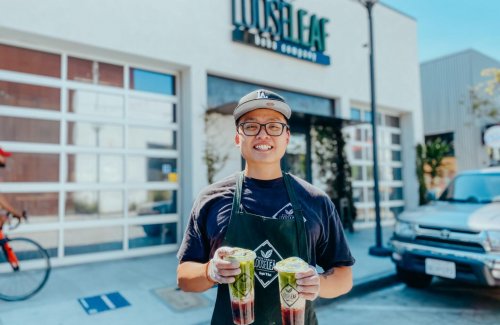
Founded in 2016, Ethan and Dylan sell what first started as Ethan’s Legenade at Summer Concerts, Sports Tournaments, Taste of Elk Grove, and various fundraisers. The brothers also get invited to private events to be speakers so they can share their moving stories.
They speak to youth groups to inspire young kids and were invited on TV in local morning shows Good Day Sacramento, and Fox40 News. On top of that, they manage to keep up with the Honors Program in school, and extracurricular activities.

There are currently 6 locations Legenade Children’s Fund sends to in the Philippines – Marikina, Cebu, Cotabato, Antique, Anao and Mexico in Pampanga. With the help of the catholic convent, Daughters of Divine Zeal, where Dylan and Ethan’s great aunt is a nun there.
They also have volunteers and coordinators the brothers meet through family and friends who still live in the Philippines. For them, it’s very important to have proper connections there to keep these programs going. The program sends help twice per year before the school season starts and during the Christmas season.

Ethan and Dylan shared with Asian Hustle Network their journey as early founders, advice to their peers and future generations, and their hopes to find a mentor to help them grow toward their goals.
13-year-old Ethan runs with their school Cross Country and Track Team, while 16-year-old Dylan is in the Cyber Patriots, a cybersecurity club in school where they compete with other schools nationwide.
Since their launch, the brothers have been in at least 5-7 big events every year — with Elk Grove Giant Pumpkin Festival as the biggest, which attracts more than 60,000 people every year.
The Young and Simple Legendaries
Ethan: Hi, my name is Ethan Black. I’m the CEO of Legenade Children’s Fund. I’m 13 years old, going into 8th grade. I like running, like Cross Country and Track. I like to hang out with friends, and also be on the computer playing games.
Dylan: My name is Dylan Black (16 years old) and I’m a junior at Franklin High School. My interests lie in finance, business, and engineering.


How It All Started
Ethan: Legenade started with a business called Ethan’s Legenade that I started when I was about 7 years old. It means “Legendary Lemonade”. I met another local nonprofit through my mom, and I decided I wanted to help them so I made Ethan’s Legenade and sold lemonade. I gave 50% of the profit that came from Ethan’s Legenade to the local nonprofit. After doing that for about 3-4 years, my grandma helped us turn it into a nonprofit which is known today as Legenade Children’s Fund.
Dylan: My brother wanted to help a charity owned by a friend of ours. To help that charity, he decided to open a lemonade stand and donate 50% of the profits. We attended small events and sold lemonade there, and that’s how we made our initial profits and we expanded from there into other sorts of events.


Legenade’s Big Vision, Mission, and Goal
Ethan: Our motto is “Helping Kids Become Legendary”, which basically means helping them so they can be the best they can be. We mainly focus on children’s education through 5 different programs. Our goal is to help kids and communities all around the world.
5 Legenade’s Programs are: Back to School Program, Future Legends Scholarship, Color the World Project, STEAM Programs, and Community Outreach
Dylan: I would like our nonprofit to have a well-established local and international presence to help kids with the education of all forms. That’s my goal, that’s my vision, that’s my mission.
Achievements and Learnings
Ethan: A few years back in 2019, we got Rookie Business of the Year from the Elk Grove Chamber of Commerce for being the best new business. I guess another achievement is actually turning into a nonprofit, coming from Ethan’s Legenade to becoming an official nonprofit. I’ve learned more about how to run a business. I was probably naive about how to run one when I was first starting out when I was 7. I’m more careful about making decisions. I’ve learned how kids live in other countries.

Whenever I heard stories about the Philippines, it was always worse than the life that we have here, so we shouldn’t take stuff for granted. You’d think that stories like that are exaggerated, but from the photos I’ve seen, it’s not. Their conditions are not ideal. So for example, we ship out toy cars, the ones you pull back to wind up and let go. Then we realized that they can’t play with them because they don’t even have concrete. Their houses are built on dirt. We learned to pay more attention to their living conditions and what they need so we can send them the proper help.
Dylan: Our biggest achievement would probably be becoming an official nonprofit because it allows us to coordinate and organize resources to give to our donation recipients. Another one of our biggest achievements is the number of people we have helped. We’ve helped several thousands of people in some way, shape, or form. I’ve learned that I really like business and finance, and most likely do that in the future as a career. I’ve also learned that people can accomplish a lot and all they need is a little push from an outside force, maybe in the form of a donation.
Legenade’s Current Project
Ethan: Right now, school is about to start so we’re focused on the Back to School Program. We provide backpacks and school supplies to about 1000 students in multiple locations in the Philippines. We have Future Legends Scholarship where we sponsor gifted students and pay for their tuition fees so they can stay in school. A lot of them leave school so they can work to help their families. We help them finish high school at least. Closer to the holidays, we do community outreach locally here in Elk Grove, and Christmas Programs in the Philippines, and send toys and food to the kids and their families.

Dylan: My current project is expanding our sphere of influence to reach more people with advertising and campaigns. Also to get our Legenade bottled at a bottling facility in high numbers so we can get them in vending machines and stores. Relying on donations from people means that the people we are helping are at the mercy of your kindness. When you sell a product, we can more reliably help people. We are grateful to our donors, but it’s better to be self-sufficient so our programs can be consistently well funded.
The Founders’ Hope For Legenade 10 Years From Now
Ethan: I’d like to see Legenade 10 years from now being one of the biggest nonprofits in America, maybe in the Top 10 charities. We also want to help in more places internationally and nationally so instead of just here in Elk Grove, CA, maybe we can find people to help in all 50 states. Also internationally, instead of just in the Philippines, we can help somewhere else in Asia, Africa, or Southern America. We also want to visit our programs in the Philippines and meet the kids we’re helping. We can’t afford that right now so they just send us pictures and videos.
Dylan: I hope that in 10 years, Legenade will have helped many people go to school and get credentials from high school, and even college. Also, be able to help more areas and not just have focused efforts in a couple of cities, but in many places. Education is important because it helps you make good decisions and helps you help other people and it lifts everybody up. I can’t help people if I don’t have an education.
Advice To Young Generation
Ethan: I don’t want to sound generic. Do not wait, or like, don’t procrastinate. If you have an idea and you know it’s good, then go for it. Even if it turns out to be bad, then you can classify that as a learning experience.
Dylan: Your plans don’t have to be big and grandiose. You can start off small and can go from there. Don’t overwhelm yourself by trying to reach huge goals, just spread it up into several smaller goals. And don’t let anything stress you out. Avoid things that stress you out.

Seeking Entrepreneurs and Mentorship
Dylan: Our goal is to get Legenade bottled. I’m hoping to reach out to other entrepreneurs who have gone through the process, and are willing to share what they’ve learned with us.
Ethan: We’re trying to get into mass producing our Legenade, but we have very little experience in doing so. We’re trying to collect as many contacts who can help us make it happen. Of course, we always need donations to keep our programs going. Please consider sharing your blessings. Any amount will help a lot.