News

February 6, 2025

SHARE:

The Ascension to Power

As Trump is re-elected, new reforms and policies are taking shape. Among them is his threat to impose a 25% tariff on Mexico and Canada, alongside a 10% tariff on China—claiming these countries allegedly failed to address illegal immigration and co-conspirators for illegal fentanyl distribution in the United States (US). 

Yet the article is not to stir political debate but to explore the ramifications of these tariffs on consumers and Asian countries. While many news outlets have focused on the potential setbacks in the affected countries, few have explored how others might either suffer or benefit from the situation. Hence, this piece shall highlight how Trump’s ascension to power might become the best opportunity for some Asian economies.

The Price of Tariffs

The Guardian defines a tariff as a tax imposed on foreign goods entering a country. As the world’s largest importer, the US brought in $3.2 trillion worth of goods in 2022, with imports from Canada, Mexico, and China totaling $1.2 trillion in 2023. Trump takes pride in this idea, believing the US government would receive more revenue through these tariffs, coining tariffs as the “most beautiful word in the dictionary” in an interview with Bloomberg. 

Brown University Professor of Economics Şebnem Kalemli-Özcan disagrees by arguing, “For many economists, tariff is actually the worst word in the dictionary.” She explains that ultimately American consumers and businesses will pay the price. As a trade-deficit nation, the US imports more than its exports. According to the Tax Policy Center, a 60% levy on Chinese goods accompanied by a 20% worldwide tariff could raise the costs for the average US household to up to $3,000 in 2025.

As companies face higher costs for goods, they often transfer those expenses to consumers through price increases. This can reduce consumer spending, which in turn lowers business investment and may lead to job losses.

Jason Miller, a professor of supply chain management at Michigan State University reaffirms such claims stating, “Because of the combination of these three countries, it’s going to be difficult to go down an aisle of a grocery store and not see some sort of inflationary effect.” Capital Economics projected that the newly announced tariffs could drive annual inflation up from 2.9% to as much as 4%.

Products affected by Trump’s Tariffs (Image source: BBC)

Nevertheless, Trump’s tariff threats carry weight, as they could impose significant economic pressure on targeted countries, prompting businesses to relocate. According to the BBC, Chinese factories with 500 workers have shrunk to just 200 employees, while American buyers are already exploring alternative manufacturing hubs in neighboring regions outside of China.

Business owner Huang Zhaodong, who recently relocated his factory, told the BBC that customers had pressured him to move production overseas. He agrees with their concerns, estimating that a 10% tariff increase could cost him an additional $800,000 in earnings. “Manufacturing clothes in China under these tariff conditions is simply unsustainable,” he said.

A Victor Emerges

Cases like Mr. Huang’s have proved the challenges that Trump’s tariff has imposed on countries like China. The beginning of the Trump trade war has led businesses to flee to Southeast Asian nations, most notably Vietnam. 

While other Southeast Asian nations also benefit from shifting supply chains, Vietnam has emerged as a top destination due to its growing industrial capacity and strategic location. The country recently rose to become the Association of Southeast Asian Nations (ASEAN) champion with an estimated 40% of all ASEAN exports to North America being from the country alone. Though it is difficult to quantify how many businesses have relocated from China, BBC reports that major brands like Puma, Nike, and Adidas have already moved production to Vietnam. Sources from Vietnam Briefing indicate Intel and Samsung have rapidly ramped up their investment in Vietnam and are projected to reach $100 billion in revenue by 2050. Propelled by robust exports and foreign investments, Vietnam’s economy has recently grown by 7.09%, reaching $476.3 billion—outpacing the 5.05% expansion seen in 2023.

It is debatable whether Trump’s glare will graze upon this nation. Experts debate whether he will target Vietnam with tariffs, as his trade policies often focus on countries with a trade surplus. In 2024, Vietnam held the third-largest trade surplus with the United States at $104.6 billion, accounting for nearly 30% of its total exports. This substantial trade imbalance makes Vietnam a potential target for Trump’s tariff threats. In this scheme, the nation might experience radical changes due to trade balances, exchange rates, supply chains, and foreign direct investment (FDI). However, Vietnam is more likely to benefit from US-imposed tariffs. This prediction is supported by trends from Trump’s first term when the country experienced significant economic growth due to an influx of manufacturers and factories relocating to Vietnam. 

Despite lingering skepticism, Trump has maintained a favorable view of Vietnam. As early as 1980, Trump publicly opposed the Vietnam War and visited the country twice during his first term. His business ventures have also extended to Vietnam, with his organization partnering with Kinh Bac City Development Holding Corporation (KBC) to develop a $1.5 billion complex in Hung Yen Province. Meanwhile, his new confidante, Elon Musk, has positioned Vietnam a key production hub for SpaceX’s Starlink satellite internet project, shifting suppliers and manufacturing from Taiwan to Vietnam to reduce geopolitical risks.

Reversing these investments may be impractical or simply too late. The confidence that both Trump and Musk have placed in Vietnam highlights the country’s growing role in global supply chains. Amid rising geopolitical tensions, Vietnam’s diplomatic strategy—often referred to as the “bamboo policy” for its balance of resilience and adaptability—has strengthened its international position. As long as the country continues to wisely navigate political and diplomatic negotiations and steer clear of populist pitfalls, Vietnam is well-positioned to sustain its economic growth and global influence.

Related Articles

Image Source: Liezel Nudalo Formentera

Uncategorized

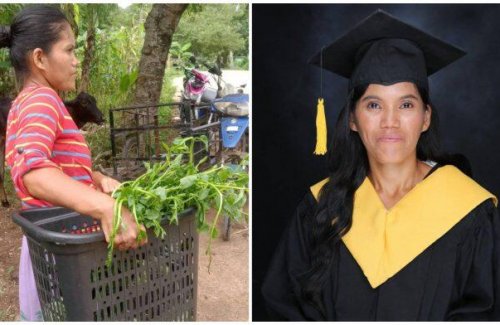
Filipina Mom Started Her Career Selling Vegetables Got Her Degree At 32 To Become A Teacher

Liezel Nudalo Formentera is now ready to work toward achieving her lifelong ambition in the field of education.

Formentera works as a street vendor in Cebu, Philippines, and hopes to improve her family’s situation someday. The only way she can see doing so is to further her education and get a better job. She could not finish elementary and high school, but she was determined and decided to join the DepEd’s ALS (Department of Education’s Alternative Learning System) program. 

ALS is a parallel learning system in the Philippines that gives students an alternative to the formal education they already got. She didn’t have to miss out on her primary education because of ALS.

In 2018, Formentera finished high school, and she began to sign up for college. She went to Cebu Technological University to earn a Bachelor of Industrial Technology with a major in Computer Technology (CTU). 

Because she also has to look after her children while she is in school, there were times when she felt physically exhausted from her work. They also experienced financial difficulties, but her farmer husband assists and supports her. There were times when she wanted to give up on her studies when times were tough, but she considered her children and the life she has worked so hard to provide for them. Thus, she worked harder for it.

She understood that there is no age limit on learning. Today, she remains overjoyed and grateful that she never expected to graduate from college. “Life is like this when you are confronted with hard times; simply pray to the Lord, and your blessing will arrive when you least expect it. This is for my children and my hope for the prosperity of my family. My children will not face poverty as I did.” – she happily shared with their local newspaper, The Philippine Star.

Image Source: Business Wire

Uncategorized

Takashi Cheng Honored With A Special Award For Exemplary Initiatives On Elevating The AAPI Creator Community

The Gala hosted by the Asian Business Association was in full swing during the evening spent celebrating AAAPI contemporaries. The evening’s events revolved around the concept of authentic old Hollywood, and its guest list included several famous personalities. 

Takashi Cheng was honored with the Media Visionary of the Year Award, one of the night’s main highlights. He is one of the business leaders from the Los Angeles community who highlights the accomplishments of prosperous business owners and corporations and has contributed to advancing the ABA’s goals and mission. 

Cheng serves as the Chief Executive Officer of Society One. He is known to be a creative investor and a public intellectual. Cheng has seen many ups and downs, but he credits his success to the American Bar Association (ABA), which he calls a shelter for young professionals seeking mentorship and employment. He attributed a significant portion of his success to the support of his wife and their young children.

Cheng’s Bling Empire castmate and friend Kane Lim called him a visionary. Lim is proud and happy that Cheng is in the spotlight for investing in people and projects that aim to elevate the Asian community. He is amazed at how Cheng invests in people and projects that seek to promote the Asian community.

Besides all the recognition that night, Cheng modestly used his platform to show the world that a large investment in the AAPI creator community is needed to provide a perspective and a complete spectrum of content that better understands the underrepresented. 

Cheng pledged $100 million to create new films, programs, resources, and infrastructure for Asian American business leaders. This showed Society 1’s support for AAPI creators. He concluded that he had “come full circle” from being a spectator in the crowd to receiving recognition from highly regarded community members.

Image Source: Amberlyns Cake / Danica Lynne Casta

Uncategorized

How An Engineering Graduate Trades Hard Hats For Pastry Becomes 6-Figure Baker

For Danica Lynne Casta, an engineer by profession turned baker, success was hers after she risked taking a big step outside her comfort zone. She now manages her online cake business under “Amberlyns Cake.”

The Filipina baker had just graduated from university when the pandemic struck. Danica began to reconsider her professional goals in baking when her family had financial difficulties, so she looked for a short-term position in the online world.  

Danica had limited experience in baking. But through hard work, she persisted in her quest to become a better baker until she became well-known for her delicious “bento cakes”.

The bento cakes were not only delicious but also the perfect size and price for those watching their spending. She also recently launched a “Selfie Mirror Cake” featuring a real mirror on top of the cake. So, you can take one-of-a-kind mirror selfies while taking a snap of your scrumptious cake.

In only one month, she turned a profit into double digits. At that moment, she knew that baking was her true calling in life. “I told my family that I was quitting my job and would be a full-time baker from now on,” she told The Philippine Star, a digital newspaper in the Philippines.

As of writing, Amberlyns Cake (@amberlynscake) got over 178k followers on Instagram and Facebook.

Image Source: CNBC Make It

Uncategorized

25-year-old Who Earns Half A Million Per Year Proves That No One Is Too Young To Be A Real Estate Investor

This millennial will inspire you with his quest for financial independence. Sahil Mehta earns $515,000 a year flipping houses in addition to his full-time job at Golden Gate Sotheby’s.

Mehta grew up in a low-income household. He moved to California at 16, where he started college and graduated early to launch a successful career in real estate. Today, he has already put five rental apartments into the real estate market in Berkeley and has been able to make a profit from them.

He acknowledges that prospective investors require substantial capital even to enter the game. One essential thing he considers in investing his money is making deposits into a personal retirement account. Now, Mehta puts a lot of money into himself and puts away about $10,000 monthly for real estate investments. 

The 25-year-old also invests $1,500 per month, while most financial advisers recommend saving 10% to 15% of income for retirement. Brilliant move to put some of it in an IRA, where it can multiply at 6% to 8% every year.

O’Leary, chairman of O’Shares ETFs and a judge on the new CNBC show “Money Court,” was impressed by Sahil Mehta’s connotations to stock market strategies. “That’s what you’re putting aside for your nest egg when you turn 65.”