Stories

July 30, 2023

SHARE:

The effects of climate change are becoming increasingly evident today. This is why three visionary individuals came together to address one pressing issue: the unsustainable practices in our food system, particularly regarding seafood.

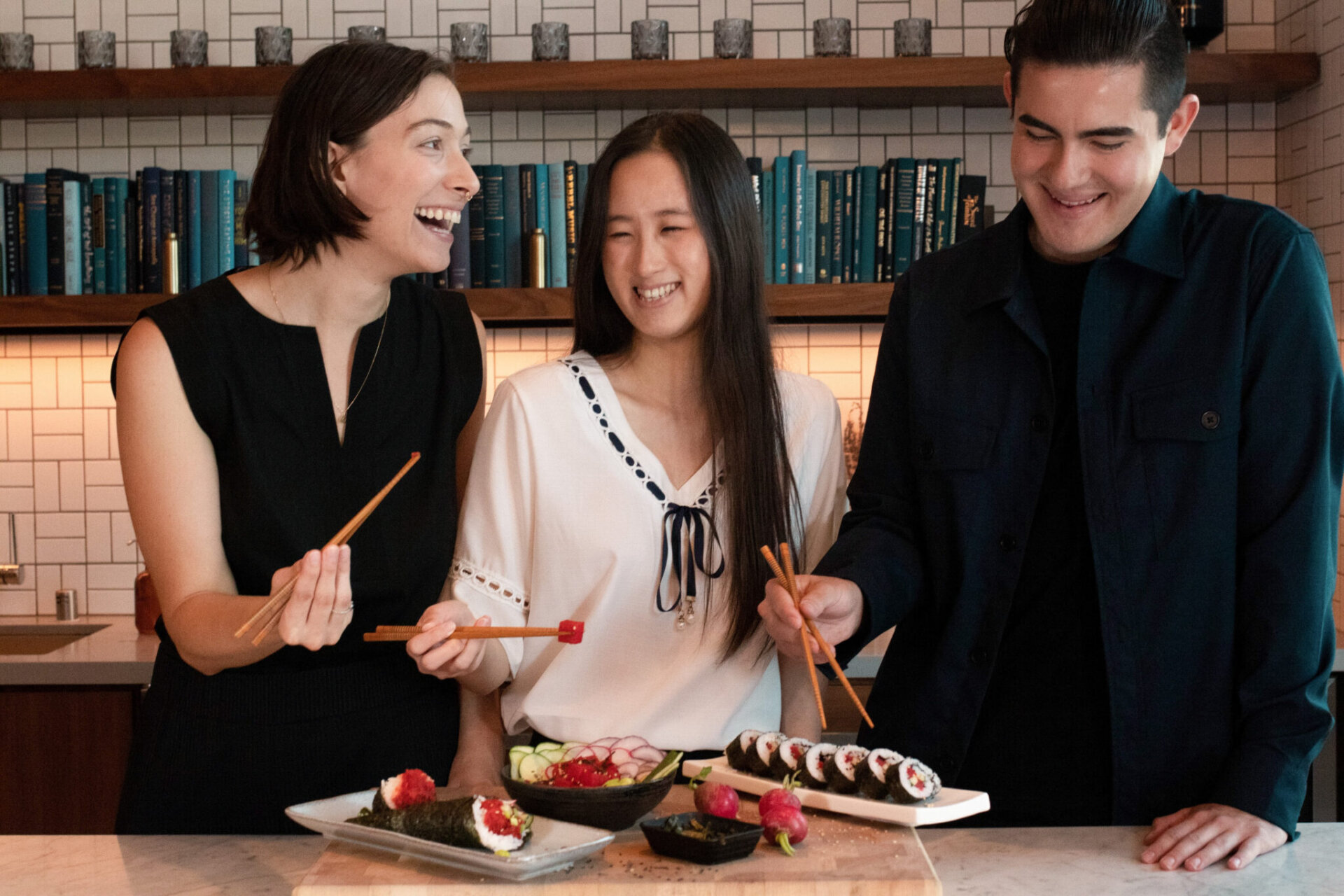
Kelly Pan, Adrian Miranda, and Stephanie Claudino Daffara, the founders of Impact Food, combined their diverse expertise and unwavering commitment to create a positive impact.

Driven by a shared passion for food innovation and ocean sustainability, they embarked on a journey to revolutionize the concept of seafood. Through meticulous research and cutting-edge technology, by studying the composition of animal-based seafood and leveraging their knowledge in food science and molecular biology, they developed their first product, Impact Tuna.

With Impact Food, Kelly, Adrian, and Stephanie strive to redefine the way we approach food. By choosing plant-based seafood, individuals not only enjoy a delectable culinary experience but also contribute to a healthier future for our planet, our oceans, and ourselves.

Read through as we learn more about the remarkable journey of Impact Food and its founders, Kelly, Adrian, and Stephanie, through an exclusive interview with Asian Hustle Network.

IMPACT FOOD’S DYNAMIC FOUNDER TRIO

In January 2020, we met while studying at UC Berkeley in renowned scientist and entrepreneur Dr. Ricardo San Martin’s Alternative Meat Challenge Lab, a product-design-based entrepreneurship course that examines how food is made and why alternative meats are a key solution to creating a more sustainable food system.

A passionate foodie-business student (Kelly), a vegan home chef-computer science student (Stephanie), and a scientist-biochemistry student (Adrian) found each other and decided to combine their fields of expertise to work towards a shared passion for food innovation and ocean sustainability. 

REDEFINING SEAFOOD SUSTAINABILITY

We were inspired by the innovative solutions we saw in terrestrial meat products like beef and chicken, and the science behind creating them. As we brainstormed in class for a protein alternative that could become the center of the plate, we realized that seafood was a wide white space in dire need of new solutions.

With an ever increasing global population, the conventional seafood industry (e.g. commercial fishing and aquaculture) continues to overfish and deplete our oceans but is still unable to keep up with rising seafood demand. 90% of fish stocks have been used up, and we’re rapidly losing biodiversity and destroying marine ecosystems which support all life on our planet, so we need to take action now before it is too late.

This is when we knew we were on a mission to reimagine a more sustainable food system through delicious and nutritious seafood created using plants and scientific innovation. Through Impact Food, we would be able to do our part in alleviating pressure on our oceans and transform our global food system to be better for our people, planet, and animals.

OVERCOMING OBSTACLES IN PLANT-BASED SEAFOOD INNOVATION

At Impact Food, one of our core values is “Delicious Innovation” – to always develop the tastiest, high-quality food.

All seafood species have a very unique, complex taste and texture profile, so we knew that it would be challenging to recreate the sensory experience of conventional seafood. To overcome the challenge of developing realistic seafood texture, we focused heavily on R&D and consulted with industry experts from chefs to scientists and seafood purveyors to truly understand the composition of fish. This knowledge combined with a lot of experimentation allowed us to match the subtle ocean flavor, nutritional profile, and delicate texture of species like bluefin tuna.

Another challenge we faced was scaling our proprietary seafood texturization technology. We were very fortunate to bring on a talented bioprocess engineer last fall, who helped us scale our process and significantly accelerate our commercialization timeline.

IMPACT FOOD’S UNIQUE SEAFOOD PRODUCTION PROCESS

The process of making our first flagship product (raw sushi-grade Impact Tuna) began with extensively studying the scientific composition of seafood and developing a proprietary production process using plants and biotechnology.

Our novel food technology platform relies on our unique texturization process that optimizes and transforms our seafood base (a blend of plant ingredients such as pea protein, algae, & vegetable juice) into a whole-muscle structured seafood product.

In addition to completely removing animal fish from the seafood supply chain, our plant-based seafood is a more sustainable food choice that can always be consistently supplied with exceptional quality. Due to supply chain volatility, the quality and pricing of animal-based seafood products are constantly in a state of uncertainty and harm the entire food system. 

Therefore, we developed a craveable, true replacement for sushi-grade tuna with under 10 plant ingredients and a longer shelf life than conventional tuna. Our product is also high in omega 3, protein, fiber, and potassium with none of the negative consequences such as overfishing and mercury contamination.

IMPACT FOOD’S EFFORTS IN RAISING AWARENESS

Since food is a very social and cultural experience, we realized that we needed to collaborate with the food service industry to reinvent the seafood consumption experience while remaining authentic to traditional cuisines.

Restaurants, chefs, and cafeterias (e.g. corporate and college campuses) play a critical role in introducing customers to new culinary experiences, encouraging trial, and familiarizing them with plant-based seafood and its benefits. By adding these sustainable options to their menus, they are also able to influence a wider audience and drive market demand for seafood alternatives.

Recently, we launched Impact Tuna in Southern California at Pokeworks and became the first fish-free seafood ever offered at the world’s leading poke chain with 65+ locations across the US and internationally. Pioneering this novel dining experience with Pokeworks is a major step for us in creating large-scale demand for sustainable eating and bringing plant-based seafood to the masses.

In addition to our food service partnerships, we also utilize channels such as social media to raise awareness about the benefits of plant-based seafood. Although we only sell our plant-based seafood ingredients to food service, we still prioritize connecting with end consumers via the visual and informational content we share on channels such as Instagram and TikTok.

Recent media coverage about the unsustainable and inhumane practices involved in commercial fishing such as the Seaspiracy documentary has also been immensely helpful in generating awareness about an obscure and complex seafood industry.

SCALING WITH QUALITY AND ENVIRONMENTAL CARE

We have begun commercial production and are currently building out our own manufacturing pilot plant to ensure high-quality control and consistency of our food innovations.

Because our proprietary process can use standard equipment that is traditionally used in other industries, we can reach price parity with conventional seafood and scale to high volumes very quickly. We are continuously investing our resources into R&D and optimizing our supply chain so that we can constantly innovate, and maintain product quality while scaling our production.

To meet increasing market demand while ensuring the quality and sustainability of our products as we scale in the US and soon internationally, we are also building strategic partnerships with and collaborating with other companies (e.g. foodservice distributors, suppliers, restaurants, startups, etc.) to strengthen the ecosystem for sustainable protein solutions. Together, we’ll be able to develop and scale products with better taste, texture, and nutritional value.

IMPACT FOOD’S FUTURE OF DELICIOUS PLANT-BASED SEAFOOD

Our primary driver at Impact Food is to make a positive global impact by creating a future of food that can sustainably feed the world while protecting our oceans and marine life.

We strive to create a global impact and movement of consumers eating more consciously and sustainably. To do this, we need to make our innovations available and accessible everywhere our consumers eat, around the globe.

Today, we’re excited to continue scaling our production, onboard more food service partners, and expand distribution to major markets for seafood such as Japan. Our goal is to reconstruct the center of the plate with a new, tastier whole-muscle seafood experience that is healthier for you and the planet without harming any animals.

Impact Tuna is just the beginning, and we’re excited to leverage our seafood technology platform to expand our product pipeline and recreate various other seafood species using plants. Stay tuna’ed and join us on our voyage to revolutionize the global seafood system. 

CONNECT WITH IMPACT FOOD

Website: eatimpactfood.com

Linkedin: Impact Food

Tiktok: @eatimpactfood

Instagram: @eatimpactfood

Facebook: Impact Food

Twitter: @eatimpactfood
Related Articles

KN106313-jpg

Stories

Gong Grocer by Thai Kee: A 30-Year Legacy of Family, Tradition, and Entrepreneurship

Gong Grocer by Thai Kee is a family-owned and operated Asian grocery business with a legacy spanning over 30 years. In this article, Brian Nguyen, one of the co-founders and a Director of Gong Grocer, shares insights with Asian Hustle Network.

Brian’s family is well-known in the Sydney community for their Thai Kee roots. Their journey originated with their grandfather, Thai Trinh, the esteemed namesake of the family’s original supermarket, Thai Kee. Gong Grocer represents the family’s evolutionary step, a mission to revitalize and modernize the Asian grocery shopping experience.

Brian acknowledges the shifting expectations of customers in physical in-store retail settings, and it’s their goal to meet these expectations in their new stores. As the Co-Founder and Director, Brian brings a unique blend of family tradition, personal journey, and a commitment to delivering an exceptional Asian grocery shopping experience.

A FAMILY OF IMMIGRANTS

Brian’s parents, uncles, and aunties were immigrants who fled Vietnam during wartime. Striving for a new life, they left behind everything in pursuit of opportunities in Australia.

Australia’s policy of multiculturalism provided a unique chance for Brian’s family and immigrants alike. The open embrace of diversity allowed families like theirs to openly celebrate their culture, thrive, and share their rich heritage with the broader community.

The origin of the name Thai Kee comes from their grandfather Thai Trinh, who they lovingly referred to as their “Ah Gong” (阿公), meaning grandfather in their dialect. He was the patriarch, and the original entrepreneur of the family. He sold Chinese donuts to supermarkets, waking up at 2 am each morning to bake them, then walking and hand delivering these donuts to supermarkets by 9 am each and every day.

THE FIRST THAI KEE SUPERMARKET

Despite limited means, Thai Trinh invested $5,000 in the first Thai Kee Supermarket in Cabramatta, providing a foundation for his children. But aside from money and most importantly, he passed onto his children a profound sense of hard work, dedication, and a deep commitment to one another, in their culture, and their community.

These values, instilled by their Ah Gong, form the cornerstone of their family’s identity. Known as “Thai” from Thai Kee to customers, to the family, he’s always been Ah Gong. 

To honor the spirit of their beloved Ah Gong, Brian and his family launched Gong Grocer by Thai Kee, or 阿公超市, paying homage to the heritage and principles instilled by their grandfather. 

FULL-TIME LAWYER TURNED ENTREPRENEUR

As Brian got older and heard more about his family’s stories, he felt a strong desire to carry on their traditions. He saw it as his mission to come up with new and interesting ways to share their culture with the diverse Chinese, Asian, and Australian communities.

Formerly a full-time lawyer, Brian Nguyen took the leap into entrepreneurship, co-founding Gong Grocer alongside his wife Wendy Lin, who herself manages her own successful business, Lioness Fashion.

Brian draws inspiration from his family’s entrepreneurial legacy, rooted in hard work, service, and dedication. The values instilled by his grandfather, Thai Trinh, continue to guide Brian in his pursuit of business excellence and cultural celebration.

OVERCOMING CHALLENGES

In his career and business journey, Brian Nguyen faced significant challenges, notably in time management. Gong Grocer started as a passion project for him. The transition from law to full-time business, alongside his wife Wendy Lin in Lioness Fashion, posed a wild adjustment.

Shifting from a lawyer to a business owner brought its own set of challenges. Balancing the demands of Lioness Fashion, an internationally recognized brand with immediate growth needs, and Gong Grocer, a venture built from scratch, proved to be extremely difficult. The latter involved design, planning, construction, and eventual launch and operations.

To overcome these challenges and achieve success, Brian drew inspiration from his family’s values. He doubled down on hard work and commitment, using them as guiding principles. Recognizing the need for a strong team, he leaned on his family and those around him to build a purpose-driven team that shared his vision. Together, they navigated the complexities, turning Gong Grocer into a thriving reality.

CELEBRATING GONG GROCER’S FLAGSHIP STORE

One of Brian Nguyen’s proudest achievements in this journey is the flagship supermarket store.

“Seeing the tangible transformation coming to life and physical form, from cutting out a giant hole in a concrete floor to creating a whole new level in a shopping centre, and doing this with my family no less, was incredibly rewarding,” Brian shared.

The grand opening events further highlighted the significance of the brand and its story. Brian was genuinely pleased by the support received from the community and the broader public. This positive response reflects the hard work of Brian and his family as entrepreneurs, their active role in the community, and the strong connections they have forged within the industry.

CONNECT WITH GONG GROCER / BRIAN 

Website: www.gonggrocer.com.au

Instagram: @gonggrocer

LinkedIn: www.linkedin.com/in/brian-nguyen-09a067125/

AHN-News-Gangnam-Market

News

Kenny Yang opens first ‘American-Asian Hybrid’ Grocery Store in West Town

Kenny Yang, the owner of Gangnam Market, took over a ground floor market in December 2022 and turned it into an “American-Asian hybrid” grocery store with a deli, produce section, liquor and beer, plus a range of snacks, beverages and other items Yang imports from across Asia. 

Raised in Chicago, Yang attended Harper High School and the University of Illinois Chicago. Yang’s parents run a business named Kent Young Health Products at 2400 S. Wentworth Ave., in Chinatown. After spending a decade working in different cities across East Asia and decided to come back to Chicago to help his parents in the mid-2000s and joined the restaurant business. Besides Gangnam Market, Yang currently owns the Strings Ramen chain, Ken Kee in Chinatown and Gyuro Ramen in the West Loop.

Image source: DLM Photography & Design

Yang hopes this new model will allow customers to try his favorite Asian products as well as items they would find in every American grocery chain.

“I grew up buying a lot of stuff from Whole Foods and Jewels. So for everyone’s convenience, of course, we want to keep their local favorites and add a little spice on the Asian elements,” he said. “It’s actually a bit of local favorites with just a little bit of Asian twist. … But definitely I tried to get things that Asians growing up in Chicago will love.”

Yang shares that the business was named after the popular South Korean district in Seoul and a bit inspired by the hit “Gangnam Style”. By renovating the interior, and adding lights and neon signs for each department, Yang wants to give people a unique destination. He hopes people will like his idea and support the grand opening of the market. Yang is currently still putting the final touches to Gangnam Market but he is ready to unveil his plan to the neighborhood.

Image source: DLM Photography & Design

“I just tried to have something really fun, for our family shopping for the weekend. And then the food court has six, seven concepts, from Asian bakery to American coffee. I just tried to have everything that I love in there,” he said.

You can visit Gangnam Market from 8 a.m.-9 p.m. every day, and enjoy the food court from 11 a.m.-9 p.m.

Featured Image Source: DLM Photography & Design

Stories

San Francisco Design Studio Redefines Sustainable Furniture Perfect for Small Spaces and Urban Living

In a world where living spaces are getting smaller and furniture quality is declining, one entrepreneur is striving to make a difference.

Yvonne Hung, a city-dweller who has lived in some of the world’s largest metropolitan areas, knows firsthand the challenges and constraints of living in small apartments. It can be difficult to have friends over because there isn’t enough space or seats.

For this reason, she founded Otelier in 2020, a San Francisco-based furniture studio with a focus on sustainability, and providing innovative products that are useful even for small spaces.

Yvonne believes that the home is the most intimate social space, and people shouldn’t have to sacrifice that due to a lack of space. Her latest project is called the Quartet, a multi-functional side table that unstacks into four stools.

While the retail industry and consumers have embraced fast furniture with low prices, poor construction, copied designs, and single usage, Otelier is committed to changing that. Yvonne and her team are determined to create sustainable, high-quality furniture that will stand the test of time. With Otelier, urban dwellers no longer have to choose between comfort and the environment, and Quartet is just the beginning of a new era in furniture design.

Quartet, a side table that transforms into four stools.

OTELIER STRADDLES BETWEEN A DESIGN STUDIO AND AN E-COMMERCE BRAND

I’ve always had an obsession with cities—the way they develop over time, how they are shaped by their geographies and industries, and of course how culture and way of life make each city unique.

In fact, I started my career in urban planning, which is what I studied at the Harvard Graduate School of Design. My goal, as cheesy as it sounds, has always been to make the world a better place to live for all. With Otelier, I’m trying to do it at a much smaller scale—the home—because that allows me to get up close and personal with users, and also be hands-on with the creative process.

So much of my design principles still go back to urban planning. For example, I chose to focus on apartment living because higher-density housing is a much more efficient and sustainable way to accommodate a growing population, as compared to single-family homes which encourage urban sprawl. Likewise, sustainability and the cradle-to-cradle approach is always a huge factor in the product design process because protecting the earth is always top of mind.

This generation is going through a lot of changes—higher housing prices, more frequent moving, and smaller apartments are some trends that make life different from what it was 20+ years ago. Activities that used to take place in person, such as work and meetings, now happen online. Social media is both hastening new ideas and increasing anxiety. I think there are many opportunities to address these issues. For me, it’s starting with the most intimate space, the home, and how we can make it a happy experience.

Otelier straddles between a design studio and an e-commerce brand. It’s rare to be both. Most consumer furniture brands aren’t strong on design—there’s a lot of copying of whatever’s trending—and most design studios don’t follow through with the manufacturing and sales process. 

I aspire to do both under Otelier. As a designer, I want to explore and experiment, whether it’s with product ideas, new materials, or collaborations with little constraint. And as an entrepreneur, I want to create an e-commerce brand whose products make an impact at scale.  I’m still figuring out how to do both with very limited resources as a solopreneur.

BIGGEST CHALLENGES AND OPPORTUNITIES IN SUSTAINABLE FURNITURE DESIGN

It seems there’s a race to the bottom in the consumer furniture industry—make it as cheap as possible, sell more, and maximize profits. It’s no wonder why the EPA says the US produces 12 million tons of furnishing waste a year. Not only are these items going into the landfill, but they also contain a lot of non-recyclable and/or non-biodegradable materials. The challenge is that now consumers are trained to believe their furniture should be dirt cheap and don’t realize these problems, similar to the case of fast fashion. 

There’s also a lot of greenwashing everywhere. For example, using recycled plastic bottles is great, but turning them into something that cannot be recycled again is worse than just making another plastic bottle from it because it could then be recycled several more times.

One of my pet peeves is when companies call plastic leather vegan leather. It’s just plastic! Otelier is far from perfect, but I am committed to being honest and looking for the best alternatives that are currently available and financially feasible.

Fortunately, I do think there is a subset of mindful consumers that want high-quality furniture that’s sustainably produced. There are several smaller independent brands, like Otelier, that are trying to address this problem in the furniture space, and a lot of material science and manufacturing companies exploring more sustainable alternatives.

That said, when it comes to innovation on the sustainability front, it’s easy to design or prototype a concept, but much harder to make it commercially viable. I’m fascinated by a lot of the new materials that are currently in development, such as bioplastics. I’m also interested in blockchain for tracking supply chains. But in reality, these ideas are far from being commercially available, especially to small companies like Otelier.

My long-term goal is to have two areas of focus: one for blue sky explorations, including the use of new materials, and a second for producing durable and commercially viable products for the masses. For now, since I’m bootstrapping, the current focus is more on commercially viable products using what’s available today.

There’s plenty we can do now to improve the furniture industry. Taking a methodical approach, I typically break down a product into its materials, manufacturing, logistics & transportation, usage, and end-of-life condition, and then minimize the footprint for each factor. 

MAKING SURE OTELIER PRODUCTS ARE SUSTAINABLE

I use materials that are biodegradable and/or recyclable and minimize the use of petroleum-based plastics for both our products and packaging. The Quartet, for example, uses wood and suppliers that are certified by the Forest Stewardship Council (FSC) to ensure that we’re sourcing from sustainably managed forests. I also use hardwood because it’s more durable since longevity is key to sustainability. Metals are also great for durability and recyclability. My hope is that we create zero landfill waste.  

Otelier is not perfect; I still rely on the existing transportation and energy systems that are available today. For what I cannot control, I use carbon offsets so that our products are carbon neutral. And I also plant trees to compensate for the wood used in our products.

If all businesses take responsibility for their own environmental footprint, we’d be in a much better place.

THE GOAL IS TO ENCOURAGE MENTAL AND PHYSICAL WELLNESS AT HOME

I’m still at a very early stage with Otelier, but I have so many ideas! It takes me a lot of time to develop each since I work alone. 

I think the way this generation lives, post-COVID, requires more flexibility from our home, no matter if you’re living alone or have a family with kids. Some recurring themes in my furniture are multi-functionality and space-saving features. I also am fascinated by objects that are interactive. In a way, I enjoy designing experiences enabled by an object rather than the object itself. For example, the Quartet is a side table that unstacks into four stools. But the goal is to encourage friendship and bonding at home. The furniture is a means to that end.

Eat-Work Table, designed for people working from their kitchen or dining rooms. The height-adjustable table can be used as a dining table.

LONG-TERM GOALS FOR OTELIER

The ultimate goal is to build a brand that creates beautiful and useful furniture that enriches the lives of urban citizens, while also being sustainable and accessible. I hope Otelier will be an international brand, given that apartment living is relevant everywhere. 

From a service perspective, my vision is to create a platform that sells both new and used Otelier furniture.Resale is really a key to countering the fast-furniture problem. Although our furniture is heirloom quality, I think most people of this generation would prefer to just sell their used furniture rather than passing it down to their kids and grandkids. So making resale easy is a service that could benefit everyone.

Innovation is really important to me. I’m not here to create what already exists. I really hope that Otelier can pioneer commercializing some of the sustainable materials that are currently in development. It’s still early days, so there are lots to explore, learn, and create.

CONNECT WITH YVONNE

Website: https://otelier.com

Instagram: @otelier_home

Facebook: @otelierhome

Tiktok: @otelier.com

Kickstarter: https://www.kickstarter.com/projects/otelier/quartet-a-side-table-that-transforms-into-four-stools?ref=8rnt6m

News

Stanford Ph.D. Dropouts Launch AI Video Editing App, Securing $55 Million in Funding

In a groundbreaking move, Pika Labs has unveiled its AI video editing app, reshaping the landscape of content creation. Founded by former Stanford computer science Ph.D. students Demi Guo and Chenlin Meng, Pika aims to simplify the intricate process of video production using generative AI. The journey began when Guo’s team faced challenges in a competition hosted by Runway, a leading AI video editor startup. Undeterred by the setback, they left Stanford in April to establish Pika, with a vision to develop a more user-friendly AI video generator.

Image source: Pika Labs

Since its inception, Pika’s software has garnered immense popularity, attracting over 500,000 users on the social messaging app Discord. According to Forbes, the platform enables users to input text requests, such as “a robot walking on the beach at sunset,” and receive AI-generated videos as replies. With the recent launch of a web app, Pika has expanded its reach to a broader audience, introducing features that allow users to edit and customize objects within videos, enhancing the overall user experience.

Pika’s rapid growth has not gone unnoticed in Silicon Valley, resulting in a staggering $55 million in funding across three rounds. The latest Series A funding, led by Lightspeed Venture Partners with $35 million, values Pika Labs between $200 million and $300 million. Nat Friedman, former GitHub CEO and a leading investor in the AI space, expressed his initial investment in Pika after being impressed by an early demo. The company’s proprietary AI model for video, developed with the support of Friedman’s GPU cluster, sets Pika apart in the competitive AI landscape.

Despite initial skepticism about the difficulty of generating realistic videos, Pika swiftly expanded its capabilities beyond anime creation. The team’s agility and responsiveness to market demands have positioned Pika as a frontrunner in the industry. As Pika looks to the future, CEO Demi Guo emphasizes the goal of redesigning the video-making interface, making it more accessible to everyday consumers. The company plans to use the new funding to grow its team, focusing on hiring engineers and researchers, while exploring potential monetization strategies, such as a tiered subscription model.

Featured Image Source: Forbes