Stories

November 8, 2023

SHARE:

Postpartum care is a critical period for new mothers, yet it is often overlooked in our society.

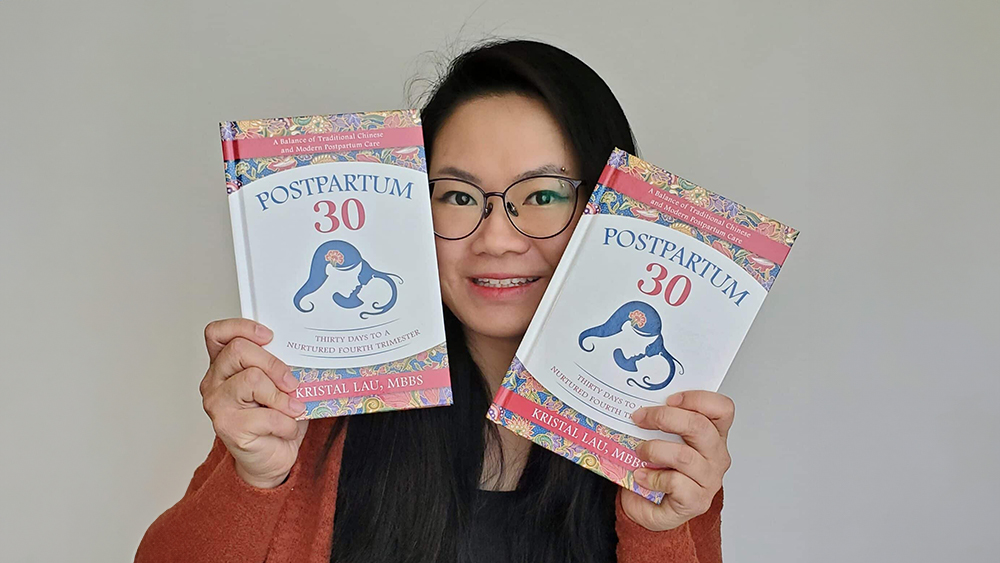
Many women struggle with physical and emotional changes after giving birth, and the lack of support and attention to their needs can lead to postpartum depression and other health issues. This is why Dr. Kristal Lau’s book on postpartum care is a crucial addition to the conversation.

When Kristal joined the AHN community two years ago, she was still pivoting out of her medical career. She shared that her mom has been encouraging her to pursue her idea of writing a book on Malaysian Chinese postpartum confinement practices and include notes from her medical background.

During her confinement month after birthing her first child, Kristal compromised with her mother to modernize some of the confinement practices by medical logic. With a balance of traditional Chinese and modern postpartum care, her book provides a comprehensive guide for modern moms to take care of themselves during this important time while feeling connected to their Chinese roots.

In this article, we will dive into Kristal’s journey as an author. We will also explore why postpartum care should be a mainstream topic and why it is important to prioritize the health and well-being of new mothers.

BECOMING A MOTHER OF TWO

I practiced medicine in Australia as a Basic Physician Trainee before moving to the USA and would’ve chosen to specialize in geriatrics medicine if I hadn’t met my husband.

Ironically, I’ve chosen to work in the perinatal world now, because I used to actively avoid seeing pregnant women patients when I was a junior doctor. I felt intimidated by the responsibility of two lives and potentially more if the patient already had children.

Becoming a mother of 2 while facing the challenges of a modern immigrant from South East Asia to the West (and being a US military spouse) opened my eyes to the importance of postpartum care in setting mothers up to thrive in the postpartum year and beyond. Especially when I was planning for my first confinement practice and had to adapt things to where we were living in rural Alabama. From this experience, I decided that contributing to a small part of the perinatal industry was fitting.

POSTPARTUM 30: THIRTY DAYS TO A NURTURED FOURTH TRIMESTER

The core message of my book entitled “Postpartum 30: Thirty Days to a Nurtured Fourth Trimester” is about preserving a traditional and cultural practice so that it remains relevant to current and future generations. Otherwise, we’d forget!

So, the key components of my book showcase the best of both worlds. I discuss postpartum physiology (what we know today about how the birthing body recovers after birth) and basic Traditional Chinese Medicine (TCM) principles around the postpartum body. 

I have chapters dedicated to adapting confinement practices to fit a modern mom and her family’s needs and lifestyle. I also guide readers on how to respectfully tell their mothers or mothers-in-law that they’d like to practice a modern version of confinement and include them in the picture.

MODERN MOMS WITH CHINESE ROOTS CAN EASILY BENEFIT FROM THIS BOOK

Firstly, it’s written in English! Readers don’t have to know any Mandarin or Chinese dialects (just like me!) to understand the TCM and confinement concepts I discuss in the book.

Secondly, I include historical references about the confinement practice and discuss why certain practices made sense to our ancestors. Finally, I challenge two aspects of the traditional confinement practice head-on. I encourage readers to embrace all the emotions that come with the chaos of the postpartum period instead of pushing them away. And I encourage spouses and partners to be the main confinement support person rather than another family member.

PUBLISHING MY BOOK HAS BEEN VERY SURREAL

I fully invested in writing this book after the overwhelming support from Asian Hustle Network group members when this book was just an idea. I also appreciated the nuances brought up by the AHN members in that defining post which added more to developing my book’s content. My first beta readers were also from the AHN community!

I’ve always wanted to be an author ever since I was a teen, so I can’t believe that I’ve done it! The book has also allowed me to represent a small part of Malaysian and Chinese culture to the world. Plus, it’s my biggest ticket away from medicine and into carving out an unconventional career that works for me!

Making time to write my book was the biggest challenge because I got pregnant with my second baby just after starting a 6-month book coaching program to develop my book. I’ve also been living in Germany since 2020 due to my husband being stationed here at a military base. So, I was writing on and off throughout my pregnancy and postpartum year while juggling our newborn, toddler, deployments, 2 dogs, and trying to thrive in a foreign country. The next biggest challenge was believing in myself, and that I have what it takes to write on this topic.

BALANCE AND EVOLUTION FOR POSTPARTUM CARE

To balance traditional Chinese practices of postpartum care with modern medical logic, I drew from my professional background as a medical doctor and a public health graduate, and my personal background as a Malaysian who grew up with both TCM and modern medicine. I also consulted with my medical peers and a TCM doctor (a connection I made through AHN too!) about how postpartum care from the East and West can meet in the middle.

An example of this balance is compromising on the hair-washing practice. Personal hygiene is a big part of the confinement practice. The strict traditional way is no hair washing for the entire confinement month. A modern compromise is to not wash the hair for the first 2 weeks and once you start washing your hair, make sure to dry it completely while in the warm bathroom before stepping out into a more chilly environment.

As more attention is given to the concept of matrescence, the transition a woman goes through to become a mother, it’s important to recognize the need for nurturing and support during this time.

Physical therapy should be a standard part of postpartum care, as many women suffer from pelvic floor and back pain issues after giving birth. Unfortunately, too many women are told that these issues are “normal” and should be lived with. Pain and discomfort should not be considered normal, and pelvic floor rehabilitation should be a global standard of care for all new mothers, rather than being limited to a few countries or requiring out-of-pocket expenses. The rest of us have to learn how to ask for pelvic floor rehabilitation referrals and likely pay out of pocket for it.

CARING FOR NEW MOTHERS

Two big areas where family members can help a new mother in the postpartum period are to help her feel seen and alleviate her mental load.

Unfortunately, new mothers frequently fade into the background as the newborn baby takes the spotlight. So, holding space for the new mother to grow into her new identity and showering her with attention reminds her that she’s still her own person and that she’s equally important as the baby!

Women and mothers are also commonly the main household manager in many families who do all the planning, troubleshooting, and preempting of troubles. This is the mental load of women and mothers. Alleviating this during the postpartum period isn’t just asking her what help she needs, it’s becoming the Project Manager at home while she recovers.

Asking her what she needs still requires her to plan and troubleshoot, and that doesn’t help lighten her mental load when she needs all the energy to recover from birth and care for the newborn.

MODERN MOTHERS HAVE DIFFERENT NEEDS THAN THE GENERATIONS BEFORE

First, society needs to accept that this generation and the upcoming generation of modern mothers have very different needs and challenges compared to the generation before us and not shame us for it. 

For example, many women in my generation (especially us Millennials in developing countries like Malaysia) have been conditioned to “do-it-all” i.e. excel at our careers and in being a mother. It’s ingrained in us to “mother like we didn’t have jobs and achieve in our career like we didn’t have children”. Why do moms today carry this burden? It’s likely because we were exposed to conflicting messages about womanhood and motherhood while growing up. We were empowered to be anything we wanted and that we could achieve anything we put our minds and hard work to i.e. embrace the modern woman identity. Yet, we’re still pressured to marry before 30 and start having kids while constantly reminded, “Don’t waste your education by becoming a stay-at-home mom!”. Balancing the identities of an empowered modern woman with the traditional (and biological) roles within motherhood is a unique challenge for many moms of our generation.

So, only when society is willing to empathize with this struggle, then they can provide the social, emotional, and mental support to help modern moms thrive as they go through matrescence.

My book normalizes the notion of nurturing mothers from the beginning of their motherhood journey; the postpartum year. I encourage mothers to prioritize themselves and not feel completely guilty about it. And to get comfortable with asking for help and accepting help before things get too overwhelming. It’s nice to be recognized as a SuperMom but it’s also nice to not have to live up to that image.

CONNECT WITH KRISTAL

Instagram: @mamaswingwoman

Facebook: @mamaswingwoman

Twitter: @drkristallau

LinkedIn: Kristal L.

Website: mamaswingwoman.com

Book webpage: tinyurl.com/pp30book

Author webpage: Kristal Lau – Mandala Tree Press
Related Articles

ezgif.com-webp-to-jpg (2)-jpg

News

Lee Su-jin’s Rise from Motel Janitor to Billionaire Entrepreneur with Yanolja

Lee Su-jin, the founder and chairman of Yanolja, one of the world’s leading hotel booking sites, has a remarkable journey from being a motel janitor to amassing a net worth of $1.2 billion. 

Yanolja, a Korean phrase meaning “Hey, let’s play,” began its operations in 2007 and quickly evolved into a popular travel app, boasting over 57 million downloads worldwide.

Lee had a challenging upbringing, losing his parents at a young age and spending most of his childhood with relatives. At the age of 23, Lee found himself working as a janitor at a love hotel, which offers short-term accommodations at hourly rates.

But despite the difficult circumstances, Lee saw an opportunity to save money and invest in stocks. He even attempted a salad business, which unfortunately didn’t work out. However, these experiences laid the groundwork for his future in the hospitality industry.

The love hotel business faced societal stigmas and challenges in the early 2000s, particularly with the passage of an anti-prostitution law in South Korea in 2004. Lee aimed to make love hotels more appealing to a broader audience, emphasizing safety, convenience, and affordability, eventually skyrocketing Yanolja’s success.

The company achieved “unicorn” status in 2019, reaching a valuation of over $1 billion during a funding round. SoftBank Vision Fund 2 further bolstered Yanolja’s growth by acquiring a minority stake for $1.7 billion at a $6.7 billion valuation. Speculation about an IPO arose, but the company prioritized the industry’s post-pandemic recovery.

Beyond its travel booking services, Yanolja expanded its offerings to include Yanolja Cloud, an AI-powered software for hospitality and leisure platforms. Currently, its combined software platforms serve 19 million users, facilitating booking, travel, and property management operations.

 As Yanolja continues to make strides in the global travel industry, its impact extends far beyond its bottom line, transforming an entire sector and enriching the experiences of travelers worldwide.

Featured Image Source: Forbes

ezgif.com-webp-to-jpg (1)-jpg

News

Anjali Barman is the Only Indian Woman at Stanford University’s Special Program and This is How

From a small town called Raniganj in Bengal to the prestigious Stanford University, Anjali Barman’s journey is truly amazing.

She became famous for making an app called ‘Ema’ that lets people chat with their friends. And now, she’s the only Indian woman chosen for the special program at Stanford University.

Anjali kindly shared how she got into Stanford with Local 18 so that other Indian students can learn from her experience. According to her, Stanford has two types of classes for executives. One is for individuals who want to learn something specific. They apply on the university’s website, and if they’re chosen, they get a notification. Some short courses can also be done online.

The second type is for bosses like CEOs and directors. Their organizations apply for them to go to Stanford. Stanford also picks some cool start-up companies from all over the world and invites them. Anjali’s start-up was one of the lucky ones.

Anjali got the invitation because her company did really well. It became famous in other countries, not just India. Stanford noticed how quickly her company grew, and they wanted her to join their program.

Stanford will pay for everything, including her research, study costs, and even her stay there. Anjali is leaving for California soon, and her story shows us that with hard work and smart ideas, we can achieve big things no matter where we come from.

Featured Image Source: Indian Express Bangla

erik (1)-jpeg

Stories

How Erik Sun’s Unwavering Passion for Food Led Him to Entrepreneurship

Erik Sun is a lot of things. More than a businessman, he is a spearfisher, hunter, chef, and now farmer of the finest meats.

Erik is part of restaurants Bestia and Bavel located in Los Angeles, head chef of Intercrew in Koreatown, and 2 more restaurants in San Francisco. The focuses of the restaurants are fun, vibrant vibes with original recipes and unique takes on food.

He is also the founder of Pursuit Farms, perhaps the most interesting of his ventures yet. What started off originally as direct purchasing at the Japanese Auctions to import Wagyu Beef has transformed into a full farm that will support his most anticipated Asian BBQ with Mangalitsa Pork (think Iberico, but even bigger and more dynamic), and fat-tail sheep (so legendary, the first three US Presidents had flocks of these sheep).  

When it comes to ingredients, Erik only chooses or raises the best. 

And to make his pursuit of food even more delicious, he recently launched his new business, XXHEAT – a high-quality seasoning powder to take your food to the next level.

He learned some of the ingredients of this powder from a master chef from Sichuan and decided to blend 5 different chilies and 2 of the highest quality Sichuan peppercorns available in all of Asia.

ERIK AND HIS LOVE FOR SPEARFISHING

Erik Sun grew up in Orange County, California, where he discovered his deep passion for spearfishing and the ocean’s treasures.

What started as a personal hobby soon became a business venture, as he began making spearguns in South Africa and connecting with fellow underwater hunters worldwide. Erik’s love for spearfishing allowed him to experience the physical and mental aspects of diving in a single breath, with each day on the water offering new adventures.

His inspiring story showcases how pursuing one’s passion can lead to remarkable achievements and a lasting impact on a global community.

CONNECTIONS MADE OVER FOOD

Erik Sun’s journey into the food business began with a memorable encounter at a renowned Los Angeles restaurant helmed by the esteemed Italian chef, Gino Angelini. Captivated by the exceptional dining experience and the sommelier’s generous pouring of wine, Erik felt compelled to reciprocate the hospitality in his own unique way.

Determined to express his gratitude, Erik made a bold promise to the sommelier: “I’m going to bring you some fish.” With that, he embarked on a mission to deliver an assortment of seafood delicacies, including lobster, scallops, scorpionfish, and octopus.

When he presented the bountiful catch to the sommelier, the sommelier said, “Show up for dinner tomorrow.” Erik told him that those were for him but the sommelier insisted on inviting him over saying, “If you don’t show up for dinner, you’re never allowed back here.” He prepared an extraordinary feast using the ingredients Erik had brought and they have been friends ever since.

The sommelier turned out to be Ori Menashe. And when Ori expressed his desire to open his own restaurant, Erik was the first to pledge his support, eventually becoming a partner of Bestia Restaurant, and occasionally cooking there.

CHALLENGES THAT ERIK FACED

Erik encountered a lot of challenges while establishing his businesses, particularly in the demanding landscape of San Francisco. The process of obtaining permits and navigating the intricacies of building regulations proved to be a daunting task. The estimates provided by architects and project managers fell significantly short of the actual time required to transform a small coffee shop into a larger restaurant.

To compound matters, the unexpected arrival of the COVID-19 pandemic brought construction to a grinding halt, and Erik dealt with some fraudulent contractors. Shifting his focus away from construction woes, he channeled his energy into enhancing the customer’s journey and creating memorable dining moments.

ABOUT XXHEAT SEASONING

XXHEAT is Erik’s latest venture, introducing a distinctive blend of seasonings that promises to elevate the flavor profiles of various dishes, particularly when used on the grill. The inspiration for this unique blend came from Erik’s desire to infuse meats, including Sichuan fried chicken, with boldness and aromatic richness. The reception of XXHEAT has been overwhelmingly positive, with its captivating fragrance and exceptional taste capturing the attention of culinary enthusiasts.

Erik uses XXHEAT on 烧烤, the Chinese term for barbecue skewers. Unlike many alternatives that offer one-dimensional flavors, XXHEAT boasts a blend of the top two peppercorns and a harmonious combination of five blended chilies.

ERIK’S ADVICE TO FELLOW HUSTLERS WHO WANT TO START A BUSINESS

  1. Start and figure it out – There’s always going to be naysayers but if you believe in it, give it a shot and live with no regrets. Problems will come? Figure them out. Not starting is a worse problem. It’d be like playing poker and never playing a hand, just losing your ante every round.
  1. Research and Development – For me, eating is my “research” and then getting back to the kitchen is the “development.” Try all the top that’s available in your sector and figure out how to make it better.
  1. Customer Service – Focus on your customers and when you get negative feedback, do your best to fix it. At one point, we had a lot of shipping issues and UPS / Covid-related delays. Turning a bad situation into good is powerful and having people who rave about your company/service will keep you in business.

CONNECT WITH ERIK

Pursuit Farms Website: pursuitfarms.com

Pursuit of Food Website: thepursuitoffood.com

XXHEAT Website: xxheat.com

Instagram: @pursuitoffood @pursuitfarms @xxheatofficial

Memphis Flyer-jpg

News

Tuyen Le’s Inspiring Journey from Being a Reluctant Server to a Beloved Chef and Restaurant Owner

Tuyen Le, the owner of Tuyen’s Asian Bistro, has come a long way from her days as a server at her family’s old restaurant, Saigon Le.

Tuyen’s mother opened Saigon Le in 1992. She joined her family at the restaurant, planning to only stay for a day. But she ended up dedicating over 30 years to the establishment. Saigon Le became renowned for its unique dishes, like the little-bitty egg rolls wrapped in lettuce with a special sauce that attracted celebrities like Woody Harrelson, Cybill Shepherd, and MTV’s Jeff Buckley.

When she was working as a server in Saigon Le, Tuyen had a gambling addiction which was evident in the way she served. According to Memphis Flyer, Tuyen didn’t like being a server, but her mother forced her to be one, saying that she can’t say no to her mama.

When Tuyen decided to quit gambling, she turned to cooking. She claimed that she didn’t know she was good at it, until everything she cooked turned out to be good.

Eventually, Tuyen pursued other ventures and started a seafood restaurant named “New Orleans Seafood,” where she served crab legs, lobster, and other items, but no Asian food. However, economic challenges, exacerbated by the pandemic, led to its closure.

Customers were longing for the return of Saigon Le’s authentic Vietnamese flavors, so Tuyen opened Tuyen’s Asian Bistro. Located at 288 North Cleveland, the tiny restaurant focuses solely on Vietnamese cuisine.

Though Tuyen’s Asian Bistro may be small, it is undoubtedly big on flavors and hospitality. Tuyen ensures that every guest feels welcomed and cherished throughout their dining experience, treating them as family.

Featured Image Source: Memphis Flyer