Stories

November 8, 2023

SHARE:

Postpartum care is a critical period for new mothers, yet it is often overlooked in our society.

Many women struggle with physical and emotional changes after giving birth, and the lack of support and attention to their needs can lead to postpartum depression and other health issues. This is why Dr. Kristal Lau’s book on postpartum care is a crucial addition to the conversation.

When Kristal joined the AHN community two years ago, she was still pivoting out of her medical career. She shared that her mom has been encouraging her to pursue her idea of writing a book on Malaysian Chinese postpartum confinement practices and include notes from her medical background.

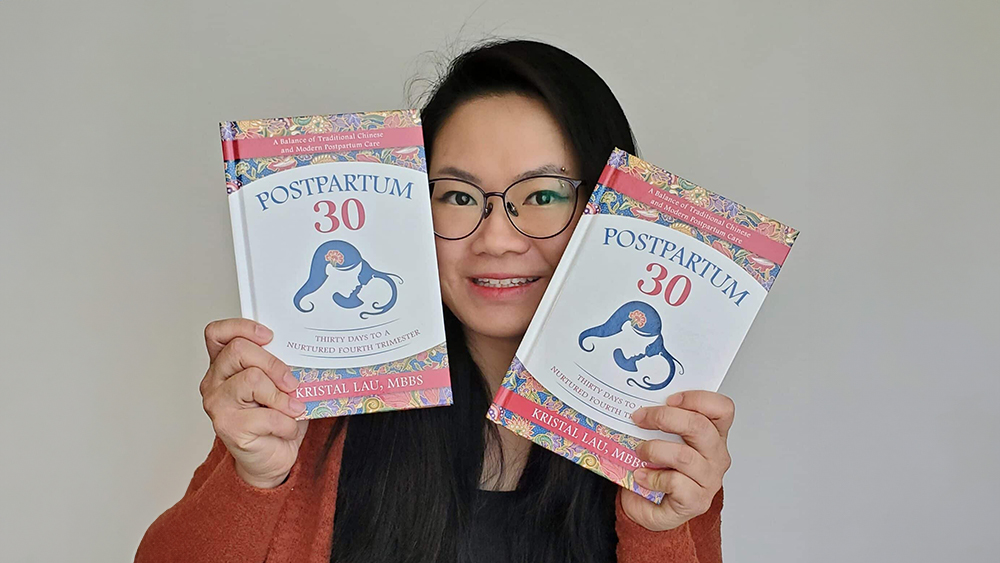
During her confinement month after birthing her first child, Kristal compromised with her mother to modernize some of the confinement practices by medical logic. With a balance of traditional Chinese and modern postpartum care, her book provides a comprehensive guide for modern moms to take care of themselves during this important time while feeling connected to their Chinese roots.

In this article, we will dive into Kristal’s journey as an author. We will also explore why postpartum care should be a mainstream topic and why it is important to prioritize the health and well-being of new mothers.

BECOMING A MOTHER OF TWO

I practiced medicine in Australia as a Basic Physician Trainee before moving to the USA and would’ve chosen to specialize in geriatrics medicine if I hadn’t met my husband.

Ironically, I’ve chosen to work in the perinatal world now, because I used to actively avoid seeing pregnant women patients when I was a junior doctor. I felt intimidated by the responsibility of two lives and potentially more if the patient already had children.

Becoming a mother of 2 while facing the challenges of a modern immigrant from South East Asia to the West (and being a US military spouse) opened my eyes to the importance of postpartum care in setting mothers up to thrive in the postpartum year and beyond. Especially when I was planning for my first confinement practice and had to adapt things to where we were living in rural Alabama. From this experience, I decided that contributing to a small part of the perinatal industry was fitting.

POSTPARTUM 30: THIRTY DAYS TO A NURTURED FOURTH TRIMESTER

The core message of my book entitled “Postpartum 30: Thirty Days to a Nurtured Fourth Trimester” is about preserving a traditional and cultural practice so that it remains relevant to current and future generations. Otherwise, we’d forget!

So, the key components of my book showcase the best of both worlds. I discuss postpartum physiology (what we know today about how the birthing body recovers after birth) and basic Traditional Chinese Medicine (TCM) principles around the postpartum body. 

I have chapters dedicated to adapting confinement practices to fit a modern mom and her family’s needs and lifestyle. I also guide readers on how to respectfully tell their mothers or mothers-in-law that they’d like to practice a modern version of confinement and include them in the picture.

MODERN MOMS WITH CHINESE ROOTS CAN EASILY BENEFIT FROM THIS BOOK

Firstly, it’s written in English! Readers don’t have to know any Mandarin or Chinese dialects (just like me!) to understand the TCM and confinement concepts I discuss in the book.

Secondly, I include historical references about the confinement practice and discuss why certain practices made sense to our ancestors. Finally, I challenge two aspects of the traditional confinement practice head-on. I encourage readers to embrace all the emotions that come with the chaos of the postpartum period instead of pushing them away. And I encourage spouses and partners to be the main confinement support person rather than another family member.

PUBLISHING MY BOOK HAS BEEN VERY SURREAL

I fully invested in writing this book after the overwhelming support from Asian Hustle Network group members when this book was just an idea. I also appreciated the nuances brought up by the AHN members in that defining post which added more to developing my book’s content. My first beta readers were also from the AHN community!

I’ve always wanted to be an author ever since I was a teen, so I can’t believe that I’ve done it! The book has also allowed me to represent a small part of Malaysian and Chinese culture to the world. Plus, it’s my biggest ticket away from medicine and into carving out an unconventional career that works for me!

Making time to write my book was the biggest challenge because I got pregnant with my second baby just after starting a 6-month book coaching program to develop my book. I’ve also been living in Germany since 2020 due to my husband being stationed here at a military base. So, I was writing on and off throughout my pregnancy and postpartum year while juggling our newborn, toddler, deployments, 2 dogs, and trying to thrive in a foreign country. The next biggest challenge was believing in myself, and that I have what it takes to write on this topic.

BALANCE AND EVOLUTION FOR POSTPARTUM CARE

To balance traditional Chinese practices of postpartum care with modern medical logic, I drew from my professional background as a medical doctor and a public health graduate, and my personal background as a Malaysian who grew up with both TCM and modern medicine. I also consulted with my medical peers and a TCM doctor (a connection I made through AHN too!) about how postpartum care from the East and West can meet in the middle.

An example of this balance is compromising on the hair-washing practice. Personal hygiene is a big part of the confinement practice. The strict traditional way is no hair washing for the entire confinement month. A modern compromise is to not wash the hair for the first 2 weeks and once you start washing your hair, make sure to dry it completely while in the warm bathroom before stepping out into a more chilly environment.

As more attention is given to the concept of matrescence, the transition a woman goes through to become a mother, it’s important to recognize the need for nurturing and support during this time.

Physical therapy should be a standard part of postpartum care, as many women suffer from pelvic floor and back pain issues after giving birth. Unfortunately, too many women are told that these issues are “normal” and should be lived with. Pain and discomfort should not be considered normal, and pelvic floor rehabilitation should be a global standard of care for all new mothers, rather than being limited to a few countries or requiring out-of-pocket expenses. The rest of us have to learn how to ask for pelvic floor rehabilitation referrals and likely pay out of pocket for it.

CARING FOR NEW MOTHERS

Two big areas where family members can help a new mother in the postpartum period are to help her feel seen and alleviate her mental load.

Unfortunately, new mothers frequently fade into the background as the newborn baby takes the spotlight. So, holding space for the new mother to grow into her new identity and showering her with attention reminds her that she’s still her own person and that she’s equally important as the baby!

Women and mothers are also commonly the main household manager in many families who do all the planning, troubleshooting, and preempting of troubles. This is the mental load of women and mothers. Alleviating this during the postpartum period isn’t just asking her what help she needs, it’s becoming the Project Manager at home while she recovers.

Asking her what she needs still requires her to plan and troubleshoot, and that doesn’t help lighten her mental load when she needs all the energy to recover from birth and care for the newborn.

MODERN MOTHERS HAVE DIFFERENT NEEDS THAN THE GENERATIONS BEFORE

First, society needs to accept that this generation and the upcoming generation of modern mothers have very different needs and challenges compared to the generation before us and not shame us for it. 

For example, many women in my generation (especially us Millennials in developing countries like Malaysia) have been conditioned to “do-it-all” i.e. excel at our careers and in being a mother. It’s ingrained in us to “mother like we didn’t have jobs and achieve in our career like we didn’t have children”. Why do moms today carry this burden? It’s likely because we were exposed to conflicting messages about womanhood and motherhood while growing up. We were empowered to be anything we wanted and that we could achieve anything we put our minds and hard work to i.e. embrace the modern woman identity. Yet, we’re still pressured to marry before 30 and start having kids while constantly reminded, “Don’t waste your education by becoming a stay-at-home mom!”. Balancing the identities of an empowered modern woman with the traditional (and biological) roles within motherhood is a unique challenge for many moms of our generation.

So, only when society is willing to empathize with this struggle, then they can provide the social, emotional, and mental support to help modern moms thrive as they go through matrescence.

My book normalizes the notion of nurturing mothers from the beginning of their motherhood journey; the postpartum year. I encourage mothers to prioritize themselves and not feel completely guilty about it. And to get comfortable with asking for help and accepting help before things get too overwhelming. It’s nice to be recognized as a SuperMom but it’s also nice to not have to live up to that image.

CONNECT WITH KRISTAL

Instagram: @mamaswingwoman

Facebook: @mamaswingwoman

Twitter: @drkristallau

LinkedIn: Kristal L.

Website: mamaswingwoman.com

Book webpage: tinyurl.com/pp30book

Author webpage: Kristal Lau – Mandala Tree Press
Related Articles

Hona-founder-jpg

Stories

Hona’s Mission to Improve Speech Therapy Access and Quality

In the ever-evolving landscape of healthcare technology, few startups have captured the imagination and promise of Hona. With a mission to empower speech pathologists through innovative AI solutions, Hona stands at the forefront of a transformative wave in healthcare.

We had the privilege of sitting down with Adam Steinle, CEO of Hona, to delve into the inspiration, challenges, and achievements that have shaped their journey.

The Trio Behind Hona

For Adam Steinle, the entrepreneurial spirit runs in the family. “My parents met by building a software company together. I quite literally wouldn’t be here without tech entrepreneurship and it’s always something I aspired to do myself.” he shared. This early exposure to the power of technology and entrepreneurship set the stage for Adam’s own career, which has seen him move from biomedical engineering to roles at Goldman Sachs and Facebook before founding Hona.

As for Danielle Yoesep, Hona’s COO, she found her entrepreneurial path through a passion for building. She fell into entrepreneurship in her last venture within research and wanted to get back to the building. In her last role, she realized that she’s super energized by the early stages of company building.

Shuying Zhang, the CTO, brought a unique blend of technical expertise and a desire to make a real-world impact.  As a former big tech SWE and biomedical engineer, she wanted to find a way to apply her skills to improve healthcare. Further, entrepreneurship allowed her to work in a faster-paced environment with more ownership.

Overcoming Challenges

The journey to success is rarely smooth, and Hona has faced its share of challenges. One of the most significant hurdles was pivoting from their original AI-automated patient intake product. “Despite initial success, we realized it wasn’t effectively addressing provider burnout. We improved one workflow aspect but added complexity with another portal to manage,” Adam explains.

The team made the tough decision to end existing customer relationships and explore more fundamental problems. After a month of interviews and brainstorming, they identified a significant issue in speech pathology that resonated with them. This led to a full pivot into developing vertical software for speech pathologists, aiming to support every aspect of their work. This experience underscored the importance of user feedback and adaptability in product development.

Proud Achievements

One of Adam’s proudest achievements is the ability to consistently surround himself with inspiring and talented individuals. “I’ve consistently invested in my network – from my Facebook RPM program to B-School to YC – and this has paid great dividends. I’ve been able to use this network for resources, advice, and sourcing great teammates.”

As a team, Hona takes pride in the difficult decision to leave comfortable jobs to make a meaningful impact in healthcare. Their dedication to improving the lives of speech pathologists and their patients is a testament to their commitment and vision.

A Vision for the Future

Hona’s mission is clear: to empower speech pathologists to operate independently without the burden of administrative overhead. “We aim to create a dynamic marketplace that efficiently connects speech pathologists with various opportunities, including cash-based services, school contracts, and insurance-covered treatments,” Adam explains.

Their vision extends to developing a platform where speech pathologists can easily build their own client base and manage their practice with minimal administrative work. This approach will allow therapists to focus on providing care while maintaining control over their income and work-life balance. By streamlining the connection between patients and therapists, Hona aims to reduce waitlists and ensure that more people can receive the care they need in a timely manner.

Empowering the Asian Community

While Hona’s primary goal is to support speech pathologists and improve access to speech therapy for all, they recognize the potential benefits for the Asian community. Their initiatives provide flexible work opportunities for Asian speech pathologists and increase access to culturally competent care for Asian patients. By reducing language and cultural barriers to accessing speech therapy, Hona is making it easier to match patients with therapists who understand their specific needs.

Connect with Hona

Instagram: @hona_care

Linkedin: Hona

Facebook: Hona Care

For more information about Hona and its innovative solutions, visit honacare.com.

Wendy Wen

Awaken* newsletter

From Dreams to Reality: Wendy Wen on Founding Senreve and Building Antelope

Wendy Wen, founder and CEO of pet CPG platform Antelope and co-founder of luxury handbag brand Senreve, shares insights on the early days of building the Senreve brand with her co-founder Coral Chung, creating their first iconic Maestra bag, and overcoming the challenges of scaling a startup. She reflects on the importance of focusing on vision, strategy, and hiring the right people, as well as maintaining resilience and equanimity as a CEO. Wendy also discusses her new venture, Antelope, her excitement for its potential, and the lessons learned from her Asian upbringing and entrepreneurial journey.

HanYue: Tell us a little bit about the early days of Senreve. And then what was the biggest challenge you had to overcome?

Wendy: You know, it was really just me and my co-founder Coral sitting across from each other in an empty conference room. We were borrowing an office space from one of our investors. And a lot of it was just kind of dreaming: thinking about what the brand could be. It was actually really, really fun. And I think because it’s before you have any metrics, any real product, anything. So anything is possible. In the early days of us, we were literally just trying to figure out what’s going to be our value proposition, positioning, and how we’re gonna get started. It was super fun. 

HanYue: That sounds fun. Tell us about your first “IT” bag, as you call it.

Wendy: Our first bag was the Maestra bag, which is a convertible bag that becomes a backpack. You can wear it in different ways: you can hold it over your hand on the handle, you can wear it as a crossbody, you can wear it as a shoulder bag, and then you can also wear it as a backpack. It fits a laptop, it’s water resistant, and it’s 100% made in Italy. It has all these nice compartments on the inside, so you can keep everything organized. It’s a beautiful bag that happens to be really functional, especially for the modern working woman who needs to carry a laptop. 

HanYue: Tell us a little bit about how you and your team created this popular bag.

Wendy: So I loved bags. Coral loved fashion. Personally, we just wanted something that was really beautiful and also worked with my busy professional life. So it kind of stemmed from a personal need. 

HanYue: Wow, that is amazing to hear. You really found a way to personally connect with the product that you’re building. Let’s switch gears a little bit, to what you’re currently building. Do you feel better prepared for a second go at entrepreneurship?

Wendy: Absolutely. Yes. There are always ups and downs in any startup journey, and I think I made a lot of mistakes with Senreve. 

I think, first of all, I didn’t necessarily focus on the important things. I was always kind of doing urgent things. Graham Weaver (a lecturer at GSB and founder of Alpine Investors) talks a lot about that matrix of important, not important, urgent, not urgent. As a founder, you really want to be operating in the non-urgent, important bucket. 

An example of what I didn’t focus on enough before would be our hiring culture. Instead, I was focusing on getting things done, which in retrospect, might not have been the best use of my time. For Antelope, I’m much more disciplined about how I spend my time. I really believe that the founder and CEO job should just be vision and strategy. Setting that vision, getting alignment across your team on that vision, helping your team truly understand how their work and their outcomes tie up to the grand vision, and what the dream outcome needs to look like. That’s one big rock for me. 

Another one is just hiring the right people. The people who are going to be better than you, at each division, at each function. Hire the best people who will help you dream up something better than what you can dream of, and then make it into a reality. So now I am always pushing for the dream candidate. After that, it’s about developing them, keeping them motivated, and building the culture so that they can thrive.

When I was at Senreve, I was younger, more junior, and much more just about blocking and tackling and getting things done. Now I try to think more about scalability. I think the third piece that I’ve learned, and just gotten a lot better over the years, is just being resilient. 

Part of being an entrepreneur and a CEO is maintaining a certain equanimity in the face of problems. I have to maintain an objective distance from the company. Because if you hold on to it too tightly, and it becomes life or death, then every problem can catch you off guard. Versus, if there’s a natural kind of distance, then you have space to treat everything as just a small problem or puzzle that you have to fix.

It makes you as a CEO think a lot more clearly, and a lot more strategically. Because at these higher levels, your main job is making decisions. It’s not fixing the problem. It’s about finding the right architecture, the right people, the right processes, and structures so that your team can fix the problem. And so having that equanimity as a muscle, to deal with the ups and downs, is a really important part of my job as CEO. 

HanYue: That’s really powerful. I love your learning about equanimity. Looking forward, what is your biggest challenge right now you want to solve?

Wendy: Our biggest challenge right now is to hire a chief supply chain officer. I have a big gap in operations and supply chain. So if anybody is really good at that kind of stuff, come to me! 1

I am also learning along the way, from 10 different colors to now 500 SKUs of pet treats, supplements, food, and dental treats with expiration dates. You have to get your planning and forecast super accurate. Every piece of the logistics needs to be precise and accurate in order to meet your demand. And it also has to be efficient from a cost perspective. We really need a C-level executive who has enough experience and lots of great attributes, so she/he can continue to learn and grow with us.

HanYue: Amazing. We hope someone in our subscriber base has this special talent! What are you most excited about next? 

Wendy: So many things excite me! I think Antelope is the next P&G/Honest Company of pet products. And we’re just getting started. And there’s just so much low-hanging fruit opportunity that we haven’t yet tapped. Every channel we are in can be grown by 10x. And I think that’s super, super, super exciting. It’s exciting to continue to educate pet parents. So many pet parents are not aware of the preservatives in their existing dog food, what the right content and makeup should be in their food, and what supplements they can give their dog to prevent cancer, arthritis, and joint pain. So I am super excited by this potential. 

HanYue: I think that there’s really nothing that compares to the potential as an early-stage founder. You can see this big dream just slowly unfolding in front of you. A lot of our new founders will be fundraising and thinking about working with their investors. I know you work very closely with Graham and Alpine Investors. Would love to hear a bit more about that partnership, and your advice on finding great mentors. 

Wendy: The relationship I have with Alpine and Graham has been just 20 out of 10 if I had to give it an NPS score. It’s beyond my wildest expectations what great partners they are. They provide the right level of support, but then they’re really hands-off. They’re empowering and trusting. And oftentimes, honestly, I think about how Alpine is treating and managing me, and how I should train and manage my executives and my direct reports, because they’re a really unique private equity fund that truly, truly has a heart of gold and focuses on people first. 

In terms of advice for how students can go out and build mentorship, and relationships with professors and people in their career. It’s simple –  just talk to them. Don’t be afraid to reach out. Make sure you follow up. That’s what I did to fundraise for Senreve. And those relationships have followed me through to Antelope.

I met Graham, in an MGE (Managing Growing Enterprise) class when he was practicing to become a lecturer at GSB. He was shadowing Dave Dodson back then. And I just had a conversation with him about what I wanted to do after school. That’s the most common question he gets nowadays, right? The students always go to a professor at Stanford and ask, what should I do with my life? Should I go back to private equity? Should I do this? And I remember, I think he actually offered me a job at Alpine as a CIT (CEO in Training), but I just didn’t want to move anywhere location-wise. So I politely declined.

Graham told the story about the genie goal in his class: if you have three wishes from the genie, what would your goals be? So when I was getting started with Senreve, I called him and I said, I think I’m gonna go pursue my genie goal – to cofound this handbag company. And he angel invested. It was really nice that he was willing to do that, and I think it came from the fact that I just asked and I had that prior relationship with him and reached out. 

After Senreve, when I was starting Antelope, I reached out again. So I think it’s just making sure you keep in touch with your professors. I remember going through every single person that I might have interacted with at the GSB. I was co-president of WIM (women in management), and I organized a ton of these speaker events. So I would email every one of the speakers I’d come into contact with. Many of them became mentors and some knew people in the handbag industry that could help. I was shocked that some of them remembered me. Most students don’t realize that all they need to do is a little bit of legwork and follow-up. Every time you go to a networking event, follow up. Even after a few months, send them an email, updating them on where you’re at. That’s how you build a relationship. It’s really not that hard. 

HanYue: That is really inspiring and empowering. The notion that a really good mentor relationship is just a few emails away is so powerful. 

Wendy: Definitely. Diane Von Furstenberg came to Stanford to speak once. After that, I was like, you know what, I’m just going to send her an email. And I said, “Hey, I loved your talk. I read your book, now I’m starting a handbag company. Would you mind talking to me?” And she replied, the same day, and said: “Here’s my number. Call me tomorrow at 9 am.” And that’s Diane Von Furstenberg. I think students overestimate how often these people get reached out to. I think you are probably thinking that – oh they get so many emails and pings. But the reality is that they probably don’t get that many. 

HanYue: Amazing. I want to switch gears a little bit again. If you don’t mind, we’d love to hear a little bit about your upbringing. How has being Asian impacted your entrepreneurship journey or maybe just the mentality of life? 

Wendy: I am Chinese, I grew up in Southern California to immigrant parents, who wanted me to be a doctor just like every other Chinese family. I remember doing like my freshman year summer internship in medicine and just being so bored. I was stuck in a lab all day. I think I was too extroverted to follow that path. I’m really dynamic. I love meeting people. I love talking, I love pitching. I get a high from pitching – probably why I enjoy entrepreneurship. And something just clicked. I realized that that medicine path wasn’t for me.

I think what my Asian upbringing helped with though was, that my parents were really good about rewarding effort and not outcomes. They always told me, “Hey, Wendy, it’s not about the grade that you get, if you get an A-minus, but you didn’t try, we will be disappointed in you. But if you got a B plus, and you tried your absolute best, we will be extremely proud of you.” They just wanted me to maximize my potential. And I think that notion really propelled me to just give it all to everything I do. If I’m going to put my mind to doing something, I want to knock it out of the park and do it really well. 

In terms of pursuing entrepreneurship, though, that is really not in my parents’ DNA, I think what happened is that they provided me with so many opportunities, by coming to the US and allowing me to have this American education, so that I just got so inspired and absorbed all these American thoughts. And I’m very American, obviously. But I still had the work ethic from my Asian upbringing. That, coupled with such family support, gave me the confidence to pursue what I really, really want to do, which is building companies. 

Mark Leslie, he’s another one of my angel investors and mentors, said, there are only three reasons why people want to start a company: one, it’s to make a lot of money. Two is to make a difference in the world. And then three is to build something of lasting value. He said usually people fall within one of these three camps. And I think for me, it’s definitely the last one like I just love building things. I love building culture. I love building a team, and I like building products. 

I also think being bilingual helped us expand into other regions for Senreve. We were in Singapore, Taiwan and Hong Kong. I think having multicultural blood and experiences in me, makes me more adaptable and flexible, and more resilient, potentially, because I know how to learn about a different culture. You know how to build a life somewhere else. That’s the entrepreneurial spirit. 

HanYue: So to sum it up, it’s like that notion of ‘give it your best’ that coupled with a little bit of risk-taking that allowed you to find out what you want to do and really go for it. On top of that, being open-minded and flexible when it comes to like, new obstacles, different experiences, and new regions. Those are amazing takeaways. You have accomplished a lot already. Do you have a few favorite moments from the past or favorite stories that you want to share?

Wendy: There was a time at my last company retreat for Antelope when I celebrated my birthday and the team surprised me with a birthday cake, a sash, and a crown. All 80 of our employees celebrated my birthday with me. And I thought that was really special. Because our team is so talented, they’re so smart. And for them to choose to contribute their talent, to Antelope’s vision – I take it very personally, I take it as a favor they’re doing for me. Seeing everybody in that room, working towards this Antelope vision was so inspiring. Running this company is the best job I could have asked for. 

HanYue: That is really heartwarming. You really build a great team and a great culture. And then you got to observe it taking on a life of its own! 

Wendy: Yeah, it did take on its own form. That’s the thing. I think seeing the moments when Antelope is taking on its own life just makes me so joyful. Our social media team is amazing. Last year, I remember seeing an Instagram post pop up on Bocce’s Bakery, which is one of our brands. The post was like PupChella – it was a play on Coachella. And they had a lineup of all these artists that were like, dog-named. Like Bark Pink, and Tailvin Harris. It was so cute. It was so funny. And I was so proud of my team. This team is so creative. And I was so proud to see their creativity come to life. 

HanYue: Wow. That sounds phenomenal. I think that is actually all my questions. Thank you so much. Wendy! 

Wendy Wen’s journey from Senreve to Antelope exemplifies the power of vision, resilience, and strategic focus in entrepreneurship. Her insights offer valuable lessons for aspiring founders on building successful and impactful companies.

  1. Since the time of this interview, Antelope was able to hire a great Chief Supply Chain Officer. ↩︎

Stories

Creators Podcast: Ryan Alexander Holmes Embraces Multiculturalism With Comedy and Storytelling

AHN and Meta Prosper have partnered on a new podcast series highlighting API creators. Meta Prosper is dedicated to amplifying and supporting the API community and driving economic growth and equitable representation. The Creators Podcast series delivers stories on how creators achieved success and created impact through their platforms, serving as an inspiration for the community.

Venture into the fifth episode of Creators Podcast for an insightful exchange with Ryan Alexander Holmes, a Los Angeles-based actor and content creator. With his multicultural background of Chinese and African influences, Ryan shares his thoughts on content creation, creative process and his journey to embrace his mixed heritage through comedy and storytelling. 

The 34-year-old from LA makes comedic videos that celebrate both his African and Chinese blood. However, it was never an easy journey of cultural reconciliation. 

Being the only Black child among his friends, his Asian roots were mostly neglected but rather, he was told to conform to African American stereotypes, even though he still spoke Chinese and celebrated Chinese festivals at home. 

This story has a happy ending. Ryan now has fully embraced his biraciality and proudly shares it on his social media content. The acceptance was the long-established cultivation from his family and community. Ryan’s fraternity, Kappa Alpha Psi, was where he retrieved a vivid sense of Black excellence and discovered his passion for social advocacy. 

Family is also another driving force in his life. “I grew up with my Asian side in LA. My Black side lives in Jacksonville (Florida); we visit them often.” Raised by his Chinese grandmother, he still had a cherished bond with his Black grandmother who lives far away from him. These relationships have taught him different expressions of love, both valued and cherished by Ryan.

With a mission to advocate for broad minority representation in Hollywood and encourage self-love, Ryan utilizes social media to highlight the harmony and beauty of multiculturalism.

Amidst movements like Black Lives Matter and Stop Asian Hate, Ryan’s content emphasizes unity, showing that diverse communities can coexist harmoniously.

“I don’t necessarily want to disrupt or change Hollywood. I just want to be myself… I’m not really interested in watering down what I have to say to fit what Hollywood thinks what people want.” 

CONNECT WITH RYAN ALEXANDER HOLMES

Instagram: @ryanalexh

Threads: @ryanalexh

Website: ryanalexanderholmes.com

Stories

This AAPI Female-Run Startup Pioneers Accessible and Affordable Photography

Photography is not just about capturing images. For some, it can be about preserving memories, telling stories, and expressing emotions.

In today’s visually-driven world, high-quality photography has become more important than ever, yet it often remains out of reach for many due to its high costs.

Enter Shoott, an AAPI female-run startup co-founded by Jennifer Tsay and Jennifer Yeh, redefining photography with an innovative, affordable approach. Their pay-per-photo model offers free 30-minute sessions, allowing clients to pay only for the photos they love, creating a win-win situation for both photographers and clients.

Jennifer Yeh (left) and Jennifer Tsay (right) co-founded Shoott after recognizing the financial struggles many photographers face in the gig economy.

In June 2018, they tested this idea in New York City, and it worked. Clients loved the convenience and affordability, and photographers appreciated the improved logistics and reduced travel time. The company grew rapidly during the pandemic, expanding to over 60 cities in the US and increasing revenue from $807K in 2019 to $9MM in 2023.

In an exclusive interview with Asian Hustle Network, Jennifer Tsay shared Shoott’s inspiring journey, the challenges they faced, and their vision for the future.

The Inspiration Behind Shoott

As an actor and creative, Jennifer Tsay saw firsthand how most artists struggle because their lives are gig to gig. You may have one gig a week, two in totally different places, or sometimes none at all. This led them to develop a business model with two complementary goals:

  • Goal #1: Improve logistics for the photographer.
  • Goal #2: Create a hard-to-resist offer for clients.

This blossomed into Shoott’s unique model which offers free photo sessions with clients only paying for the photos they want, and photographers benefiting from Shoott handling all marketing, scheduling, and logistics on top of a minimum hourly rate plus commissions.

A joyful family of four poses together, captured by Shoott

Early Challenges and Indicators of Success

Starting Shoott came with the typical hurdles of first-time entrepreneurship. The team had to learn quickly, constantly test hypotheses, and maintain strict alignment on goals. They also faced skepticism from photographers who feared exploitation. Shoott navigated this by ensuring transparency and creating a model where photographers’ earnings were directly tied to the company’s success. Positive client feedback and growing demand confirmed they were on the right track, with Shoott maintaining a 4.8 star rating on Google and expanding to over 60 cities in the US.

Staying Relevant in a Changing Industry

Shoott stays ahead by engaging with photographer communities, reading industry trends, and listening to feedback from clients and photographers. This constant evolution helps Shoott remain relevant and meet the changing tastes and demands of its clientele.

According to Tsay, “It’s also crucial to always stay sharp on what’s trending on social media in terms of tastes and demand. What do people like? What do people value? What are people trying to convey about themselves? This has so many implications for what we provide as a service and also how we approach our brand as a whole – to run a brand is to be continually evolving!”

Community Impact and Contributions

Shoott’s mission is twofold:

  • To support freelance photographers in the community by providing a reliable source of supplemental income so artists can stay artists if they so desire; and
  • To help people in the community capture their life moments both big and small with a beautiful and affordable photography service. 

“We truly hope our offer creates more demand for professional photography – anything we can do to promote and normalize the habitual support of artists is a major win in our book!” Tsay shared.

A Memorable Client Story

One touching story comes from Lydia, a solo parent who praised Shoott for capturing authentic moments with her daughter. Despite financial constraints, Shoott’s affordable model allowed Lydia to obtain high-quality photos that she otherwise couldn’t afford.

Diversity and Inclusion

Shoott is an AAPI female-run startup that prioritizes diversity and inclusion. They ensure varied representation in their marketing and hire team members from diverse backgrounds. Understanding the different personal commitments of their team, Shoott offers a flexible work environment, accommodating various needs while ensuring dedication to the job.

Personal Rewards

When Shoott started, their primary goal was to see if they could create a business model to balance all parties and create an ultimate win-win-win for clients, photographers, and staff. “We didn’t know if we could do it, but we had to try,” Tsay shared.

“What’s been personally rewarding is to see that we could start with this really ambitious goal and actually make it a reality. It sounds nuts to be able to make a business that offers free photo sessions work, but we just achieved profitability last year for the first time. It’s so gratifying to see that when we put our minds to something, we can make things work. And on top of that, we provide a service that is fundamentally about gratitude and love – how many people can say that?”

Shoott co-founders Jennifer Yeh (left) and Jennifer Tsay (right), celebrating their journey from an ambitious goal to a profitable reality, provide a service centered on gratitude and love for all parties involved.

Message from Jen and Jen

In addition to our free 30 minute consumer offer, we’re so proud to be building out our headshot and branding offer for teams, organizations, and conferences. We realized how many people hate having their photo taken and we wanted to provide a fun and empowering experience for folks while delivering high quality photos to support their endeavors. If your team is in the market for new and affordable headshots, please let us know!

Connect with Shoott

IG: @shoottphotos

TikTok: @shoottphotos 

Facebook: Shoott

LinkedIn: Shoott