Stories

November 8, 2023

SHARE:

Postpartum care is a critical period for new mothers, yet it is often overlooked in our society.

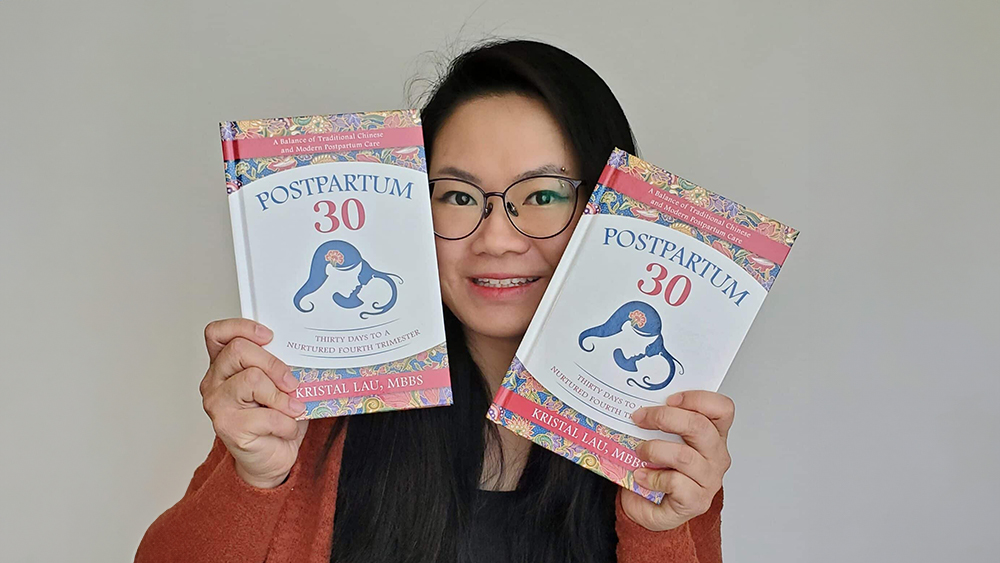
Many women struggle with physical and emotional changes after giving birth, and the lack of support and attention to their needs can lead to postpartum depression and other health issues. This is why Dr. Kristal Lau’s book on postpartum care is a crucial addition to the conversation.

When Kristal joined the AHN community two years ago, she was still pivoting out of her medical career. She shared that her mom has been encouraging her to pursue her idea of writing a book on Malaysian Chinese postpartum confinement practices and include notes from her medical background.

During her confinement month after birthing her first child, Kristal compromised with her mother to modernize some of the confinement practices by medical logic. With a balance of traditional Chinese and modern postpartum care, her book provides a comprehensive guide for modern moms to take care of themselves during this important time while feeling connected to their Chinese roots.

In this article, we will dive into Kristal’s journey as an author. We will also explore why postpartum care should be a mainstream topic and why it is important to prioritize the health and well-being of new mothers.

BECOMING A MOTHER OF TWO

I practiced medicine in Australia as a Basic Physician Trainee before moving to the USA and would’ve chosen to specialize in geriatrics medicine if I hadn’t met my husband.

Ironically, I’ve chosen to work in the perinatal world now, because I used to actively avoid seeing pregnant women patients when I was a junior doctor. I felt intimidated by the responsibility of two lives and potentially more if the patient already had children.

Becoming a mother of 2 while facing the challenges of a modern immigrant from South East Asia to the West (and being a US military spouse) opened my eyes to the importance of postpartum care in setting mothers up to thrive in the postpartum year and beyond. Especially when I was planning for my first confinement practice and had to adapt things to where we were living in rural Alabama. From this experience, I decided that contributing to a small part of the perinatal industry was fitting.

POSTPARTUM 30: THIRTY DAYS TO A NURTURED FOURTH TRIMESTER

The core message of my book entitled “Postpartum 30: Thirty Days to a Nurtured Fourth Trimester” is about preserving a traditional and cultural practice so that it remains relevant to current and future generations. Otherwise, we’d forget!

So, the key components of my book showcase the best of both worlds. I discuss postpartum physiology (what we know today about how the birthing body recovers after birth) and basic Traditional Chinese Medicine (TCM) principles around the postpartum body. 

I have chapters dedicated to adapting confinement practices to fit a modern mom and her family’s needs and lifestyle. I also guide readers on how to respectfully tell their mothers or mothers-in-law that they’d like to practice a modern version of confinement and include them in the picture.

MODERN MOMS WITH CHINESE ROOTS CAN EASILY BENEFIT FROM THIS BOOK

Firstly, it’s written in English! Readers don’t have to know any Mandarin or Chinese dialects (just like me!) to understand the TCM and confinement concepts I discuss in the book.

Secondly, I include historical references about the confinement practice and discuss why certain practices made sense to our ancestors. Finally, I challenge two aspects of the traditional confinement practice head-on. I encourage readers to embrace all the emotions that come with the chaos of the postpartum period instead of pushing them away. And I encourage spouses and partners to be the main confinement support person rather than another family member.

PUBLISHING MY BOOK HAS BEEN VERY SURREAL

I fully invested in writing this book after the overwhelming support from Asian Hustle Network group members when this book was just an idea. I also appreciated the nuances brought up by the AHN members in that defining post which added more to developing my book’s content. My first beta readers were also from the AHN community!

I’ve always wanted to be an author ever since I was a teen, so I can’t believe that I’ve done it! The book has also allowed me to represent a small part of Malaysian and Chinese culture to the world. Plus, it’s my biggest ticket away from medicine and into carving out an unconventional career that works for me!

Making time to write my book was the biggest challenge because I got pregnant with my second baby just after starting a 6-month book coaching program to develop my book. I’ve also been living in Germany since 2020 due to my husband being stationed here at a military base. So, I was writing on and off throughout my pregnancy and postpartum year while juggling our newborn, toddler, deployments, 2 dogs, and trying to thrive in a foreign country. The next biggest challenge was believing in myself, and that I have what it takes to write on this topic.

BALANCE AND EVOLUTION FOR POSTPARTUM CARE

To balance traditional Chinese practices of postpartum care with modern medical logic, I drew from my professional background as a medical doctor and a public health graduate, and my personal background as a Malaysian who grew up with both TCM and modern medicine. I also consulted with my medical peers and a TCM doctor (a connection I made through AHN too!) about how postpartum care from the East and West can meet in the middle.

An example of this balance is compromising on the hair-washing practice. Personal hygiene is a big part of the confinement practice. The strict traditional way is no hair washing for the entire confinement month. A modern compromise is to not wash the hair for the first 2 weeks and once you start washing your hair, make sure to dry it completely while in the warm bathroom before stepping out into a more chilly environment.

As more attention is given to the concept of matrescence, the transition a woman goes through to become a mother, it’s important to recognize the need for nurturing and support during this time.

Physical therapy should be a standard part of postpartum care, as many women suffer from pelvic floor and back pain issues after giving birth. Unfortunately, too many women are told that these issues are “normal” and should be lived with. Pain and discomfort should not be considered normal, and pelvic floor rehabilitation should be a global standard of care for all new mothers, rather than being limited to a few countries or requiring out-of-pocket expenses. The rest of us have to learn how to ask for pelvic floor rehabilitation referrals and likely pay out of pocket for it.

CARING FOR NEW MOTHERS

Two big areas where family members can help a new mother in the postpartum period are to help her feel seen and alleviate her mental load.

Unfortunately, new mothers frequently fade into the background as the newborn baby takes the spotlight. So, holding space for the new mother to grow into her new identity and showering her with attention reminds her that she’s still her own person and that she’s equally important as the baby!

Women and mothers are also commonly the main household manager in many families who do all the planning, troubleshooting, and preempting of troubles. This is the mental load of women and mothers. Alleviating this during the postpartum period isn’t just asking her what help she needs, it’s becoming the Project Manager at home while she recovers.

Asking her what she needs still requires her to plan and troubleshoot, and that doesn’t help lighten her mental load when she needs all the energy to recover from birth and care for the newborn.

MODERN MOTHERS HAVE DIFFERENT NEEDS THAN THE GENERATIONS BEFORE

First, society needs to accept that this generation and the upcoming generation of modern mothers have very different needs and challenges compared to the generation before us and not shame us for it. 

For example, many women in my generation (especially us Millennials in developing countries like Malaysia) have been conditioned to “do-it-all” i.e. excel at our careers and in being a mother. It’s ingrained in us to “mother like we didn’t have jobs and achieve in our career like we didn’t have children”. Why do moms today carry this burden? It’s likely because we were exposed to conflicting messages about womanhood and motherhood while growing up. We were empowered to be anything we wanted and that we could achieve anything we put our minds and hard work to i.e. embrace the modern woman identity. Yet, we’re still pressured to marry before 30 and start having kids while constantly reminded, “Don’t waste your education by becoming a stay-at-home mom!”. Balancing the identities of an empowered modern woman with the traditional (and biological) roles within motherhood is a unique challenge for many moms of our generation.

So, only when society is willing to empathize with this struggle, then they can provide the social, emotional, and mental support to help modern moms thrive as they go through matrescence.

My book normalizes the notion of nurturing mothers from the beginning of their motherhood journey; the postpartum year. I encourage mothers to prioritize themselves and not feel completely guilty about it. And to get comfortable with asking for help and accepting help before things get too overwhelming. It’s nice to be recognized as a SuperMom but it’s also nice to not have to live up to that image.

CONNECT WITH KRISTAL

Instagram: @mamaswingwoman

Facebook: @mamaswingwoman

Twitter: @drkristallau

LinkedIn: Kristal L.

Website: mamaswingwoman.com

Book webpage: tinyurl.com/pp30book

Author webpage: Kristal Lau – Mandala Tree Press
Related Articles

250605 (1)-jpg

Blogs, Development

Fishing for Success: Using the STP Model to Grow Your Brand

Marketing is like fishing—there are plenty of fish in the sea, but each type requires a different approach. Knowing your audience is not an open-and-shut case. It is the process of researching, analyzing, and evaluating your audience base. 

The following framework, STP, serves as your fishing rod—helping you cast with purpose and reel in the right catch.

S – Segmentation

The world isn’t a monolith. People have diverse needs and preferences—but some will share common demands that align with what your business offers. 

That’s why audience segmentation matters. By understanding the unique traits of each group, you can identify which ones are the best fit for your brand. 

audience-segmentation

T – Targeting

Now, after you have an overall picture of the market, it’s time to focus your efforts. Targeting means selecting the specific segment—or segments—that your brand is best positioned to serve. 

This is where you shift from broad insights to strategy, adapting your message, products, and services to meet their needs.

target-audience

P – Positioning

Now, it’s not just about who you are—but it’s also about who they think you are. 

Positioning answers the question: Why should they choose you? Whether it’s your values, pricing, design, or experience, positioning helps you own a unique space in the market.

brand-positioning

Why Asian Hustle Solutions?

To grow your brand, the goal isn’t just to reach a large audience—it’s to build a loyal segment that will stay with you over time. Getting to know this audience takes patience and insight. That’s where Asian Hustle Solutions comes in to support you every step of the way.

If you want to learn more about our services, visit the Asian Hustle Solutions website at asianhustlenetwork.com/services/

chester-yow-png

Stories

From Singapore to New York: How Chester Yow Turned Doubt Into Drive

Breaking New Ground in a Foreign Land

For Chester Yow, the decision to leave Singapore, his hometown, wasn’t an excursion but rather a mission. After two years in the military, Chester aimed to challenge his own comfort zone, venturing far away from the familiar into the unknown of a new country on the other side of the world. “I wanted to prove that I can be successful in another country, in another city,” he shares. While it is common that many Asians would like to take the stable route to be near their community, Chester wanted to flip the script and rewrite his story.

Drawn to the fast pace and competitive spirit of New York City (NYC), Chester quickly realized that real estate was made for him—because for a person who doesn’t enjoy 9-to-5 office jobs like Chester, real estate allows the flexibility while maintaining the discipline needed to survive in NY. It is this combination of freedom and responsibility that has become the driving force for him to start building a network from scratch in this city that never sleeps.

Chester Yow, a Licensed Associate Real Estate Broker and Founder of the Chester Yow Team at SERHANT, smiling confidently in professional attire.
Chester Yow | Licensed Associate Real Estate Broker and Founder of Chester Yow Team at SERHANT

Shattering Stereotypes in the Heart of New York

“If you can make it there, you’ll make it anywhere.” It’s a common, inspirational pipeline when speaking of New York. It’s inspiring enough to imply that challenges will always remain—not to bring you down, but to toughen you up. Chester’s no exception. With a heart filled with unrelenting passion and determination, it was still not enough—especially when dealing with racial discrimination and prejudice.

As a fresh-off-the-boat Asian in the U.S., he soon faced the harsh realities here—that discrimination can be both subtle and publicized at the same time. “You do get looked down on as a ‘minority’ at times, and people tend to judge or doubt you faster. I sometimes get, ‘Wow, your English is so good’ (English is the spoken language of Singapore), or ‘Why aren’t you a doctor, lawyer, or accountant?’” he recalls.

Chester Yow, a Licensed Associate Real Estate Broker and Founder of the Chester Yow Team at SERHANT, who overcame early challenges in the U.S. such as racial discrimination and cultural differences, smiling confidently in professional attire.
Chester faced many challenges during his early days in the States, including racial discrimination and cultural differences. 

But instead of surrendering to the stereotypes, Chester leveraged them as inspiration. “I work harder than the next person, I study harder, I make sure I’m more prepared, I do everything necessary in my power so that there’s no doubt in anyone’s mind to question my capabilities.”

And his effort paid off. By exceeding expectations and proving himself with actual results, Chester is, step by step, changing common misconceptions—not only for himself but also for an Asian working in real estate in New York. Then, even those who doubted him reached out to him for work.

What grounds me is knowing why I work so hard and who I’m working for—my family, my loved ones, my future self 30 years down the road, and my own future family. I’m working hard for them. Having that quiet confidence to keep my head down and keep going is crucial, too.

The Life-Changing $450 Million Development Project

“Tough times don’t last, tough men do”—a quote from my military days that has stuck with me. Ryan Serhant also says, “You are allowed to quit—just make sure it’s on your best day.” You control your own destiny, and building mental toughness is essential to success. Mentorship is crucial for any entrepreneur, and one of Chester’s mentors can be traced back to his military days.

That advice led to a breakthrough in his career. One of the biggest turning points came in 2017, when Chester helped launch a $450 million luxury real estate project in Manhattan. As part of the SERHANT. team, he had the opportunity to bring the project to Ryan Serhant—one of the industry’s most prominent figures—and collaborate directly with his top-tier team.

Ryan Serhant (left) and Chester Yow (right) standing together, both in professional attire, smiling confidently.
Ryan Serhant (left) and Chester (right)

“That project didn’t just help me close more deals (and earn more), it grew my network with consumers and other top agents, to learn the ropes of new development, and to work and learn closely with Ryan, thus growing my career exponentially,” Chester shared. It was an experience that catapulted his career and opened doors that might’ve otherwise taken years to access.

Staying Rooted on Unfamiliar Ground

As someone who grew up in Asia, Chester was raised with a mindset rooted in caution and logic. “We’re often taught to think of the worst-case scenario, to lead with reason, and to stay guarded and conservative. But that can sometimes come off as negative or dismissive,” he said. Living and working in the U.S. challenged those values and pushed him to adopt a more balanced approach. “I’ve learned not just to be prepared for the worst, but also to lead with optimism, follow my heart, and be vulnerable. Embracing failure and change has been key to my growth.”

That flexibility in mindset has helped Chester adapt and thrive in a fast-paced environment like New York. Even after many years away from Singapore, he’s maintained a strong connection to its culture and community. He regularly attends events and is active in organizations that support Asians in NYC. “There are so many ways to stay connected to being Singaporean and Asian here,” he shared. “I have a great group of friends and partners—we collaborate, support each other’s businesses, and stay rooted in our culture. In fact, 70% of my clients are Asian, and working with them helps me stay connected as well.”

Connect With Chester Yow

“Work hard, work smart, stay persistent, and block out the noise around you. Find a purpose that gets you out of bed every day and use it as your daily motivation. Hold on to the people who believe in you—and forget the ones who don’t.”

Website: Chester Yow

Instagram: @chester.yow

250529_AHS-EMAIL-MKT-jpg

Blogs, Development

Winning with Keywords: How AHS Boosts Your Search Results

Words are not just a compilation of letters—there’s power and impact beneath them that can alter your brand’s SEO performance. Here are three tips to choose keywords with the right strategy and the right timing.

Look for Problem-Based Words

Instead of targeting what people want, focus on the audience’s problems. Before they want to buy, they have to be seen first. Scout public forums to find how users address their problems.

problem-based-words

Analyze SERP Intent, Not Just Search Volume 

Not every high-volume word should be used if the top results associated with that word are irrelevant to your content type.  Always check the SERP (search engine results page) to see Google’s current favorites—blogs, products, videos, etc.

focus-on-serp-intent

Track Keyword Trends by Season or Event

Utilize tools like Google Trends to identify rising keywords linked to seasons, holidays, or industry events. With the right timing, these short-term spikes will help drive quick traffic.

track-keywords

Why Asian Hustle Solutions?

At AHS, we help brands grow smarter with SEO that starts with strategic keyword analysis. By understanding search intent, trends, and real user problems, we find the terms that actually drive traffic and conversions—not just clicks.

If you want to learn more about our services, visit the Asian Hustle Solutions website at asianhustlenetwork.com/services/

Julie-Kim-cover-jpg

Stories

Breaking Boundaries and Making Laughter with Julie Kim

From the Boardroom to the Comedy Club

Julie Kim didn’t begin her career in comedy—she initially followed the stereotypically ‘Asian’ path of stable jobs in academia and office work. Born and raised in Toronto to a Korean immigrant family, her upbringing took place in a tight-knit, two-bedroom apartment above her family’s grocery store. “At one point, there were seven people in the apartment,” she recalls. “And for a solid six or seven years, I slept on the pull-out sofa bed in the living room.”

With multiple degrees under her belt—including a Master’s and two attempts at a PhD—she straddled the worlds of business, education, and motherhood. Amidst the hustle and bustle, there remained a silent passion in her for a creative life. “At first, I wanted to speak well to stand out among a sea of old white men in boardrooms,” she says. “I also wanted to do a difficult, admirable thing. It was a checkbox.”

Julie Kim | Comedian

A Dramatic Shift to Comedy

Julie didn’t quit everything overnight to pursue comedy. She experimented with it while holding multiple stable jobs, contract roles, while also pursuing her PhD, oscillating between full and part-time focus on her studies. But passion has a way of growing, and eventually, she did what she had to—crossing what she describes as ‘a bridge between conventional pursuits and creative pursuits.’ She stepped away from academia, turned down secure opportunities, and entered a world full of uncertainty and creative risk.

However, Julie was no stranger to the industry’s harsh stereotypes. She faced mistreatment and discrimination, navigating everything from blatant racism to sexism disguised as condescension.  “One booker tried to push me out of the scene because I winced when someone tried to make me kiss him against my will,” she shares.  “A few local comics hated or resented me from the start because I didn’t ‘need’ to do comedy—as if they deserved it more because I had other options. It was a different kind of discrimination I hadn’t encountered before, but for sure it taught me to stay far, far away from the bitter ones in this industry.”

Jumping to comedy, Julie Kim’s now one of Canada’s most sought-after comedians.

Despite this, Julie pressed forward like the boss that she’s always been. “I had to learn how to produce and promote my own shows. And that built tenacity,” she says. “Now, I’m centered in my identity. My cultural identity and my confidence in it are central to much of the  success I’ve had in the past few years.”

Today, she’s one of Canada’s most sought-after comedians, performing alongside stars like Ronny Chieng, Atsuko, JR de Guzman, and more as she headlines major comedy clubs across North America. “This is the best time of my life,” she says. 

“I’m having the time of my life. But also, I’m still working on a little scarcity mentality and the feeling of constant survival mode,” she shares. “Part of me really enjoys that and part of me needs a new car and a real vacation.”

Being a Mom on the Mic

Being a mother in comedy isn’t easy—especially when constantly on the road. Julie has faced criticism from all sides: family members, fellow parents, and the weight of societal expectations. ‘I deal with it by blocking people out of my life or turning them into jokes—or both,’ she says with a laugh.

Her journey as a mother isn’t separate from her comedy—it is integral to it. “To do my work well, I need to be grounded, happy, and creative. So I try more and more to take care of myself to be those things,” she reflects. “I think it’s an accomplishment to still be writing and performing after more than a decade of true hustling. It’s taken a lot of grit, perseverance, some audacity, and foolishness.”

Julie Kim’s experience as a mother isn’t separate from her comedy career.

Julie Kim’s list of accolades is stacked: writing and producing Simu Liu’s iconic I Am Canadian monologue at the JUNO Awards, winning a 2023 Canadian Screen Award, and headlining four sold-out Just for Laughs shows in Toronto.  She’s also written for Kim’s Convenience and Run the Burbs, two shows centred around Asian Canadian families that have reached global audiences. 

As she continues to tour across North America, Julie is also working on upcoming television and film projects and producing her new podcast, Bothered. Next, she will prepare for a new 2026 tour of her solo storytelling show called ‘No One Special’ and writing her first book. 

Connect With Julie Kim

Website: https://www.juliekimcomedy.com/shows 

Podcast: https://www.juliekimcomedy.com/podcast 

Instagram: @juliekimcomedy

YouTube: @JulieKimComedy 

Facebook: Julie Kim

TikTok: @juliekimcomedy