Stories

September 2, 2023

SHARE:

Meet Jennifer Guo and Adam Szakacs, a couple with a creative vision. They wanted their child to cherish both her Chinese and Jewish roots, despite living far from family. So, they invented something extraordinary.

Inspired by their grandmothers’ unexpected friendship over mahjong, they reimagined the game as “Not Your Ma’s Jong.” This isn’t just any game; it’s a lively card version of mahjong that celebrates their backgrounds. It carries a powerful message – embracing your heritage and sharing it with others is something to be proud of.

Through Not Your Ma’s Jong, Jennifer and Adam hope to bring people closer. By sharing traditions, they aim to show that understanding each other’s cultures can create harmony.

In an exclusive interview with Asian Hustle Network, Jennifer and Adam share their journey in creating “Not Your Ma’s Jong.” Read through as we get a glimpse of how this game could help forge connections and celebrate diverse cultures.

Whether celebrating certain holidays, traveling together to meaningful places, or simply making a memorable recipe together, spending quality time together is the most important thing – and playing a game like Not Your Ma’s Jong is one way to spend time together.

Jennifer Guo

Can you tell us about the inspiration behind creating Not Your Ma’s Jong and how it connects to your Chinese and Jewish heritage?

Jenn: I learned how to play mahjong as a kid by watching my grandma play in China. Mahjong was a part of our daily lives and at the center of every family occasion. For me, mahjong is a way to connect with those memories.

My grandma used to split her time between her home in Xi’an, China, and Toronto where she stayed with my parents. In 2014, we brought my grandma to visit Adam’s granny who was healing from a hip injury. My grandma speaks only Mandarin, so we started by translating some simple hellos and small talk. It was so special to have them meet and communicate with each other.

Adam: At one point, we were talking about their respective cultures and the things they enjoy. My granny plays a lot of card games and also mentioned mahjong. Jenn’s grandma’s eyes lit up, and she told us about playing throughout her life. Jenn’s grandma is certainly the more avid player, but once my granny’s hip recovered and she was back home, they were able to play together.

Jenn: When I was pregnant with our first daughter in 2018, we started thinking about how we could connect our children with their cultures and heritage. I realized that living in Canada, they would not have the same exposure to Chinese traditions like mahjong as I did growing up. We started thinking about ways to honor the memories we had of growing up with our parents and grandparents and decided to create a simplified version of mahjong, which became Not Your Ma’s Jong.
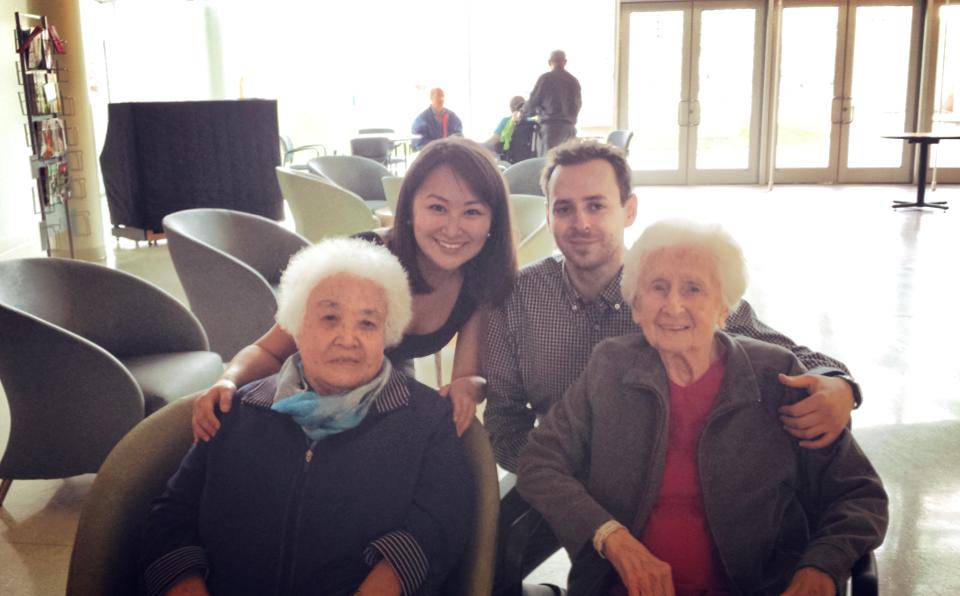
Jenn and Adam with their grandmas

As an international card game played around the world, what do you believe makes Not Your Ma’s Jong unique and appealing to a diverse audience?

Adam: We realized that even though our grandparents played mahjong and we played with them, we never played with our friends. We started asking around and kept hearing the same thing–most of our friends had heard of mahjong or seen their families play, but few knew how to play themselves.

Jenn: Not Your Ma’s Jong is a simplified version of mahjong, using 75 cards as opposed to 144 tiles in the traditional game. The rules are also simplified to create a fast-paced and fierce game that anyone can pick up quickly. When we started playing test versions with our friends, the excitement showed us we were on to something!

Could you share some examples of how you incorporated Chinese and Jewish emblems into Not Your Ma’s Jong? How do these cultural elements enhance the gameplay experience and foster cultural understanding?

Jenn: We wanted to dedicate the game to our grandmas. Many of the cards are symbols from growing up with them – some with Adam’s Jewish granny, and some with my Chinese grandma. Some center around memories of family feasts we’d eat together, gifts they’d give us, or how they made us feel – and while the symbols are specific to our cultures, those memories and feelings are universal.

Other cards are a bit whimsical – we imagined what their friendship could have been if they had lived near each other earlier in their lives. Things like doing tai chi together in a park, or building a muscular snowman together! We wanted to make them relatable for people who grew up in any culture, with special winks for people who grew up Chinese or Jewish.

What are some of the challenges you faced while developing and popularizing Not Your Ma’s Jong? How did you overcome those challenges, and what lessons did you learn along the way?

We had a lot of fun creating Not Your Ma’s Jong – but turning it into a product and making people aware of it was hard! After the initial Kickstarter campaign, the remaining games sat in our home for over a year until we started to get some media attention. We were fortunate that a blog article turned into a newspaper feature which then got our story and the game featured on TV twice! Hasbro took an interest at that point, licensed the game and it’s now being sold around the world. This showed us that people love it once they hear about it! That initial exposure was the hard part.

Can you share any heartwarming stories or feedback you have received from players of Not Your Ma’s Jong?

Adam: The initial Kickstarter campaign was a very personal experience for us. We received stories and repeat orders from some of the earliest recipients of the game, sharing how they played with their parents, children, or nieces and nephews, and how it caused them to reminisce about their own family stories when they saw the illustrations on the cards. We still love getting emails and seeing reviews from people who feel a connection to the game.

What advice would you give to individuals or families who are seeking to explore and celebrate their own cultural heritage? How can games like Not Your Ma’s Jong play a role in this process?

Jenn: It was important to us to not let our families’ cultures and memories fade away for our daughters, and creating this game was one of our ideas to do that. I know it’s hard – especially with young kids – but I think it’s important for parents to think back on their childhoods and choose some of the traditions that they want to continue with their children. Whether celebrating certain holidays, traveling together to meaningful places, or simply making a memorable recipe together, spending quality time together is the most important thing – and playing a game like Not Your Ma’s Jong is one way to spend time together.

In conclusion, what message or lasting impact do you hope Not Your Ma’s Jong will leave on players and society as a whole?

Jenn: The world can sometimes feel so divided – we hope people see this game, and the story behind it, as a small example of how people with different cultural backgrounds and languages can find common ground and develop a friendship. We hope they get a glimpse into Chinese and Jewish cultural experiences and relate with their own experiences too!

CONNECT WITH NOT YOUR MA’S JONG

Instagram: @notyourmasjong

Threads: @notyourmasjong

Website: notyourmasjong.com
Related Articles

Image Source: Dominic Lorrimer/ Australian Financial Review

News

Australian Logistics Tech Firm Shippit Procures Singapore Startup Luwjistik for $11M

Shippit has announced that it will pay $18 million to buy the logistics SaaS platform Luwjistik, based in Singapore. 

Founded by longtime friends William On and Rob Hango-Zada in 2014, with a mission to improve shipping for small businesses, as they have personally experienced the drawbacks of online shopping.

After two years of operations in the region for the Sydney-based company, the Australian logistics tech company co-founder and co-CEO William On has relocated to Singapore to lead the new expansion and manage the existing 50-person Luwjistik team.

This comes after the company raised $65 million in Series B2 funding, which helped operations in Southeast Asia, and almost seven months after it bought the last mile logistics tech platform Premonition.

Shippit’s inclusion of Luwjistik’s co-founders, who bring extensive industry experience and connections to the table, is expected to revolutionize the company’s approach. The acquisition of Luwjistik will also enable the company to provide tailored solutions for the Southeast Asian market. Therefore, Shippit can be the best option for many who manage their warehouse or search for a logistics partner.

The startup works with carriers such as Ninja Van, J&T Express, and JNE Express, as well as logistics companies such as Maersk, POS Malaysia, Lion Parcel, and Summer International.

Within a month of launching Luwjistik, the duo raised US$1.1 million (AUD$1.7 million) in a seed round led by East Ventures, including MDI-Arise Finches and Global Founders Capital.

William anticipated a significant increase in e-commerce in Southeastern Asia, which will continue if Shippit and Luwjistik join forces. Currently, they can provide a one-stop platform for enterprises and the expanding SME segment, particularly in Indonesia, Malaysia, the Philippines, and Thailand.

More than 40 million deliveries were booked via the Shippit platform in the fiscal year 2022. Since its inception in 2014, Sydney-based Shippit has fulfilled e-commerce orders worth $5.5 billion for more than 3,500 retailers.

“I strongly believe that by combining our strengths, we can continuously innovate and offer the most impactful, reliable, and relevant solutions to a fast-changing, dynamic market.” – William shared with Business News Australia.

Image Source: Social Bella

News

A Millennial’s Gamble Pays Off As Her New Beauty Product Line Has Just Raised Over $225M

When the pandemic struck, all Chrisanti Indiana wanted to do was help her family and create jobs in her community.

Nonetheless, as the pandemic worsened, each day appeared to be a gamble. She gambled on her dreams, created her employment opportunity, and risked everything for her family because she had no safety or security options.

The Indonesian co-founder, and chief marketing officer of Social Bella, surprised everyone by taking her successful online store offline. In 2019, her online beauty and personal care store, Sociolla, already had two physical locations in Indonesia. It currently operates 47 outlets in Indonesia and 16 in Vietnam, making its earnings multiplied by ten by the end of 2021.

It started after Indiana had finished her studies in Australia in 2015 when she moved back to Jakarta, where she conceived the idea for Sociolla.

Chrisanti found that Australia was a great place to stock up on her favorite cosmetics because of the abundance of international brands. There couldn’t have been a bigger contrast with Indonesia.

With a combined $13,000, Indiana, her brother, and a close friend founded Social Bella to provide customers with access to legitimate goods and services.

“Since we started, we ensure that we only work with authorized distributors or brand owners,” Indiana said. 

The three founders of Sociolla had bigger plans than just building an online store. They have expanded beyond offline stores to become a global beauty and personal care product distributor. In Indonesia, they also became an associate partner for numerous international brands.

‘We want to ensure that we are scaling up and reaching more and more consumers. If Social Bella becomes a unicorn, it’s a bonus.” – Chrisanti Indiana shared with CNBC.

Image Source: DoorDash

Blogs, Development, Ideas, Stories

What Separates DoorDash Founder Tony Xu From The Rest Of The Tech Billionaire

Learn more about Tony Xu, the co-founder, and CEO of DoorDash, the most extensive service in the US for delivering food. Xu is a Chinese-American tech billionaire who has worked for eBay and PayPal in the past, but he attributes his current success to the experience he gained working as a dishwasher.

DoorDash went public in December 2020 after being co-founded in 2012 by a group of excellent Stanford University students, including Xu. Today, the platform has more than 6,000 employees and more than half the market share in the food ordering and delivery industry. Company earnings for 2021 were reported to be over US$4.8 billion.

Xu shared that he once felt discriminated against when surrounded by other entrepreneurs who were different from him. As the sole Asian-American cofounder of the company, he proudly and responsibly accepted the challenge. He is aware that there are not nearly as many Asian-American CEOs or other types of founders, so he remains a minority throughout this setting. He believes it serves as a gentle reminder always to recognize that and to maintain a lowly but humble attitude.

Not only has Xu found success with DoorDash, but he also serves on the board of directors for Meta, the parent company of Facebook, and was named to Fortune’s 40. He is also a huge NBA fan, leading to DoorDash becoming the league’s first official food delivery partner.

As of 2022, Xu’s net worth was estimated at US$1.3 billion, placing him at #2,190 on Forbes’ list of billionaires.

Image Source: Paulo Chun / NBC News

Stories

Fifth-generation Entrepreneur Reimagines NYC Chinatown Landmark While Preserving Cultural Traditions

Even though times are tough and New York’s Chinatown is on the verge of dying, there is one place where things appear to be mostly the same as they have always been.

Since Mei Lum started volunteering as a child, Wing on Wo & Co has been run by her family. Brilliant and creative heritage enterprises have withstood generations of economic ups and downs. Mei represents her family’s legacy and New Yorkers and future generations of Chinatown residents.

The 32-year-old fifth-generation owner has bigger plans. Mei revived Wing on Wo’s late-19th-century ambiance. The store was a meeting place, credit union, and informal post office for low-income Chinese employees during the Chinese Exclusion Act.

She wants to run things because she has always wanted to expand the store’s conceptual boundaries. “A business doesn’t have to be so economically driven. There can still be genuine connections, which sustain a community,” she told The Guardian.

Wing on Wo is still primarily run by the original family for over a century. For 30 years, Mei’s father Gary has chatted with clients at the counter. Lorraine, her mother, handles the website and order processing. Her 105-year-old grandmother, Nancy, promotes the store’s hand-painted wine cups, fish-shaped glazed vases, and elegant dinner plates on Instagram.

In 2016, her grandmother intended to sell the family-owned porcelain specialty shop, which was worth close to $10 million. Mei took over the business to preserve it and create a community hub. She was planning to study international relations at Columbia University, but she now wants to run the family business. She wanted the store to be a hub for activists and artists to fight gentrification and displacement.

As a result of the pandemic, Mei decided to focus her efforts on online sales, digital advertising, and social media. To ensure that the business is preserving tradition and shaping the future of Chinatown, she has added several new initiatives, such as youth programs, an artist residency, and a ceramicist fair.