Stories

November 4, 2025

SHARE:

When Nisha Desai and Alice Zhang met at Harvard Business School, neither of them expected that a casual conversation about their frustrations with therapy would spark the idea for something much bigger.

As they juggled graduate school and their own mental health, they often felt therapy wasn’t built for people like them – they spent more time explaining their background to their therapists than actually healing. 

They realized it wasn’t just them – there’s a gap in mental healthcare that left many in the Asian and multicultural community feeling unseen and misunderstood.

That shared realization became the seed for Anise Health: a platform built to make therapy culturally attuned, accessible, and truly effective for the AAPI community.

A Problem They Both Knew Too Well

Before their paths crossed, both founders had already seen the same issue from different directions.

Nisha, who grew up in Florida in a family of healthcare entrepreneurs, had always been drawn to questions of access and equity in care. After studying finance and marketing at the University of Pennsylvania’s Wharton School and earning her MBA from Harvard, she worked in healthcare investing and later in digital product management at Humana. It was there, while helping build a mental health app, that she started hearing a troubling pattern from thousands of users – the same barriers she had personally faced.

Nisha recalls that people weren’t saying therapy didn’t work. They were saying it didn’t fit, that they didn’t feel understood.

Alice, meanwhile, came to the same conclusion through her own deeply personal experiences. Born in China, raised across Japan and Canada, and now based in New York, she calls herself a “third culture kid.” Her multicultural background gave her adaptability, but also a sense of never fully belonging anywhere.

That feeling resurfaced when she sought therapy during business school. Despite being fluent in English, she found herself translating her own emotions for her therapist – explaining why criticism from parents felt like love, or why pursuing excellence felt non-negotiable.

Alice remembers feeling exhausted after each session, explaining her background again and again, and leaving each time feeling unseen.

Alice Zhang (left) and Nisha Desai (right)

Building a Culturally Grounded Model of Care

After that pivotal conversation at Harvard, the two women began mapping out what culturally attuned mental health care could look like. They spoke to clinicians, patients, payors and community leaders, testing how cultural nuance could be integrated into evidence-based therapy and coaching.

They envisioned a new kind of care model: one that didn’t require clients to educate their therapists or set aside their cultural identity at the door. Instead, therapy would start from a place of understanding.

“Alice and I really built Anise to be what we believe our community has needed during our upbringing. What we kind of wished for ourselves through our own personal journeys with therapy.”

But building what didn’t yet exist came with challenges. They had to prove — to investors, clinicians, and even the broader healthcare system — that cultural context wasn’t just a “nice to have,” but essential to effective care. Many mental health professionals hadn’t been trained to deliver culturally adaptive therapy, so Anise Health had to design that framework from the ground up: provider training programs, accurate diagnostic tools, tailored care plans, curated resources and a scalable model for personalized, culturally attuned care.

Their persistence paid off. What started as late-night brainstorming sessions between classes evolved into a fully fledged mental health platform that blends clinical rigor with cultural empathy.

Growing the Movement

Since its founding, Anise Health has facilitated over 10,000 paid appointments and built a network of 60+ licensed providers across multiple states. The company is now expanding through insurance partnerships that make culturally attuned care more affordable and accessible.

Behind the scenes, Nisha leads operations and product design, while Alice drives partnerships and provider training.

Their complementary strengths, coupled with a shared sense of purpose, have helped Anise Health raise $6.4 million in funding and gain recognition as one of the top 10 most innovative Asian Pacific-led companies to watch by NYSE, Y Combinator, and Gold House.

Redefining the Future of Mental Health for Asian Communities

For both founders, Anise Health’s success goes beyond numbers. It’s about shifting how mental health is understood and delivered, starting with a community that has long been underserved and stigmatized.

“Our goal isn’t just to make care available,” Nisha says. “It’s to make it effective, culturally relevant, and sustainable within the healthcare system.”

By creating a new gold standard of culturally attuned care, Nisha and Alice aren’t just helping Asian Americans access therapy that finally feels like it speaks their language – they’re reimagining what inclusive mental health care can look like for everyone.

Learn more about Anise Health at anisehealth.co
Related Articles

Image Source: Jane Nguyen / NBC News

Uncategorized

Kenneth Mejia Sits As Los Angeles’ New and First Filipino American City Controller

Taking the lead with a 21-point advantage, Kenneth Mejia, is now Los Angeles’ newly-elected City Controller assuming city-wide office after cutting the edge against City Councilmember Paul Koretz.

The 32-year-old is the first Filipino American to take the position. As a CPA and community militant, Mejia is pleased to embody the distinct community of L.A.

“We have a very diverse population in L.A. and I feel very proud and honored to represent that community and coming from a minority background makes you more empathetic about the people you’re fighting for,” Mejia said as quoted in NBC News.

He achieved a double-sweeping win after attaining more votes than any mayoral candidates and concluding the election with over 100,000 votes higher than Koretz, a radical and experienced public officer, which accordingly is a sign of many Angelenos’ renouncement of the status quo.

Mejia was also once an organizer of the L.A. Tenants Union who initiated the legalization of homelessness and made the concerned authorities liable for it.

The newly-elected City Controller mentioned that he eyes transforming the system and making it worker-friendly. He likewise shared that a controller is “the city’s accountant and paymaster,” which is different from high-profile City Council positions since he cannot promulgate a legislation or amend the city budget. These restrictions fit him wonderfully as a CPA and organizer, making his work more intriguing.

“You don’t really have to push an agenda when you’re running to present data and show numbers,” Mejia continues, “They have a story in themselves,” he added.

After the City Council decided to ban homeless encampments 500 feet from schools and daycare centers, Mejia calculated how many camps will be affected and created a digital map of 1,900 schools and daycare centers in the city, showing that 20% of the walkways would no longer be available as a campsite. Mejia’s staff employed computer technology to be more transparent to the public, especially regarding finances.

Image Source: Christopher DeVargas / Las Vegas Magazine

Uncategorized

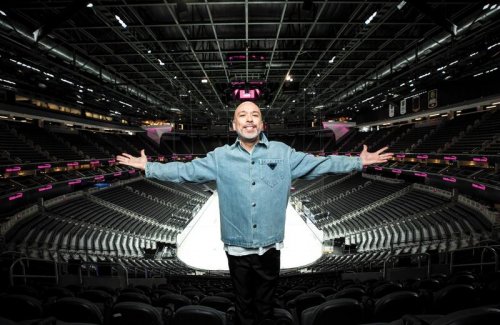
Jo Koy Makes History As The First Ever Comic Main Attraction At T-Mobile Arena

After Jo Koy’s recent successes, including the release of his two wildly popular Netflix specials,” In His Elements and Comin’ In Hot”, and the publication of his autobiographical debut book, entitled “Mixed Plate: Chronicles of an All-American Combo”, he is set to star as the first comic main attraction at Las Vegas’ T-Mobile Arena on November 19.

This year, the Filipino-American actor-comedian embarked on his first nationwide arena tour for Easter Sunday, a feature film based on those personal anecdotes and his other comedic content that hit theaters which also starred Lydia Gaston, Eugene Cordero, Tia Carrere, and Lou Diamond Philipps. 

It was a life-changing experience for the 51-year-old, and he plans to continue creating films from behind the camera and helping other Filipinos, Asian Americans, and artists from different races.

Jo Koy first experienced comedy while still a student in Las Vegas and will return to the same city to fulfill his dream of becoming the first primary comic attraction to play at T-Mobile Arena.

“When I play T-Mobile Arena, I discover that I’m the first cartoonist to ever do it, which is sort of cool,” he told Las Vegas Magazine, “There are other venues in Las Vegas, including some very large ones, but T-location Mobile’s right on the Strip has a unique appeal,” Jo Koy adds.

He also mentioned that performing at arenas and other famous places abroad is beyond anything he could have imagined and that the realization of it drives him crazy.

After finishing the book and movie he’s been working on for several years, Jo Koy said that the process was challenging because there were many obstacles and firsts to tackle; it was the first time a Filipino actor portrayed the main character in a Hollywood production. He felt good about himself and appreciated Dreamworks and Universal for helping him.

“I want to keep creating. I want to highlight the other talent that is out there because I have been addicted to being in front of the camera,” Jo Koy continued, “Knowing how difficult it was for me, I want to keep the door open and showcase more potential, not just Filipino talent but talent from other countries and races that want to be recognized — I want to see what I can do to help make it happen.”

Jo Koy also disclosed that he has his eye on a number of up-and-coming stand-up comedians, such as Matteo Lane, with whom he is now working, Asif Ali, and JR De Guzman.

Image Source: Wu Tsai Foundation

Uncategorized

Brooklyn Nets Owners Launched The Largest Business Accelerator for Minority-led Startups

After George Floyd’s controversial death in 2020, growing VC investments in businesses founded by people of color became a top priority. According to Crunchbase, just 2.4% of VC financing between 2015 and 2020 went to Black or Latinx enterprises. Funding for black entrepreneurs quadrupled to $1.8 billion in 2021. This year, however, saw a sharp decline in investments in minority founders.

Entrepreneur and co-owner of the Brooklyn Nets, Clara Wu Tsai, launched BK-XL, the biggest business accelerator that aims to support 12 startups founded by Black, Indigenous, and other minority founders in 2023 by investing up to $500,000.

In an interview with The Associated Press, Wu Tsai stated that a shortage of finance is a major barrier to wealth growth for BIPOC businesses. She and her husband Joseph Tsai believe investing in BK-XL would be the greatest approach to overcome this challenge and generate wealth for the entrepreneurs and the jobs they create.

Wu Tsai stressed that she aims to highlight the underutilized entrepreneurial potential in Brooklyn to assist the neighborhood get back on its feet. She also thinks that BK-XL will demonstrate to the rest of the nation that investing in Black businesses pays off and is a smart move.

She added that any money made from investments in the BK-XL startups will be put back into Brooklyn-based companies. “The best way to demonstrate our faith in Brooklyn and Black-owned businesses,” she continued, “is to invest in them and demonstrate to the rest of the world that they are wise financial decisions.”

Prior to the release of BK-XL, Tsai’s Social Justice Fund also introduced “EXCELerate” last year, which offered no-interest loans to Black-owned small companies in need of assistance in order to recover from the closures caused by the COVID-19 pandemic.

As part of her strategy to leverage a combination of investments and donations to achieve goals for the neighborhood, she stated that BK-XL will shortly be followed by a philanthropic grant program to assist other businesses in Brooklyn.

All Brooklyn-based, BIPOC-led firms may submit a BK-XL application starting on December 5. But only companies in industries where the Tsais have the expertise, like e-commerce, will be approved.

Image Source Ken Chan Facebook

Uncategorized

Pandemic Turns Filipino Actor Ken Chan Into A Serial Entrepreneur

Ken Chan, a 29-year-old Filipino actor, proves that the pandemic has not only caused bad things but has also brought good fortune to some, being a celebrity-turned-entrepreneur after losing his job during the crisis.

Ken swiftly expanded his franchised iFuel gas station with 10 branches in different parts of the country in just a year. He also opened Cafè Claus, a Christmas-themed café, which has extended into three branches around Metro Manila, Philippines.

Nonetheless, he also braved the wellness industry with his Aromagicare Luxury Massage Chair. He mentioned that his triumph is also because of saving and spending wisely. 

Ken said he had taken to heart the financial lesson his parents had taught him wherein he learned not to overspend on himself.

During his recent interview, Ken said that he takes pride in the fact that he rarely makes purchases for himself and even makes the most of his cars while they are still roadworthy.

The actor realized during the pandemic that artists should secure their fallback in case they lose their jobs in the industry.