Stories

May 2, 2024

SHARE:

As we celebrate Asian Pacific American Heritage Month, we pay tribute to the Bill Imada Top 50 Unsung Heroes, individuals whose extraordinary acts of bravery, selflessness, and community service have often gone unnoticed.

Nominated by the community and acknowledged during the Uplifted Conference 2024, these heroes represent a diverse array of backgrounds and accomplishments, each leaving an indelible mark on the community.

Join us in honoring these Unsung Heroes, amplifying their remarkable achievements, and recognizing the profound impact they’ve had on shaping a more inclusive and empowered society.

The Bill Imada Top 50 Unsung Heroes 2024

Glenn Boulware

Sr. Director, Ethnic Expansion, Weee!

Glenn Boulware is the Senior Director, General Manager (Merchandising & Marketing) at Weee!, the premier online grocery platform serving Asian communities in the US. In this capacity, Glenn oversees the expansion of ethnic markets, including assortment management, supplier acquisition, category management, new user acquisition, content marketing, and user retention strategies.

Jess Choi

Asian Segment Lead, Northwestern Mutual

Jessica Choi is a dynamic and influential leader in the field of Diversity, Equity, and Inclusion and currently serves as the Asian Segment Lead at Northwestern Mutual. With over two decades of experience in corporate and nonprofit leadership, she empowers individuals to excel while fostering inclusive work environments. Jess has earned prestigious awards for her community engagement, leveraging her academic achievements and practical experience to drive business success.

jason chu

Idea Architect / Rapper, Team Not Lazy

Jason Chu is a prominent figure in the national Asian American scene, known as both a rapper and activist. With his high-energy performances and hard-hitting lyricism, Jason’s music has been featured in various mediums including video games, film, and TV shows like Valorant, Joy Ride, and Mayans MC. Beyond music, Jason is an activist educator, offering clarity and urgency on issues of history, racial justice, and Asian American political and social identity.

Andrew Dinh

Director of Talent, Clique-Now

Andrew Dinh serves as the Director of Talent at Clique-Now, a company focused on nurturing the careers of prominent Asian talent. He brings years of experience in influencer marketing and hosting webinars and workshops for platforms like TikTok and Vigo Video. Prior to talent management, he spent over a decade in education, teaching in various public and private schools in Los Angeles.

Joy Fan

Founder, CEO, re/tell

Joy Fan is a trailblazer in the retail and real estate sectors with over 15 years of experience. She recently launched a B2B booking platform using machine learning to match online brands with excess space in mixed-use storefronts, providing a solution to the evolving needs of the $17 trillion real estate industry. Additionally, she actively works with Mayor Eric Adam’s NYC Small Business Advisory Commission, ACE NEXT GEN, and NYC Chapter Lead of Stand with Asian Americans.

Christian Franz

Founder, Friends of Franz Podcast

Christian Franz is the driving force behind the Friends of Franz Podcast, a globally streamed platform aiming to debunk medical misinformation, humanize healthcare workers, and advocate for minority representation in medicine. As a registered nurse in New York City, Christian’s expertise spans cardiac surgery recovery, cardiology, and public health. He’s also the Creative Lead of “The Asian Care Unit,” promoting mentorship and activism within the API healthcare community. Beyond healthcare, Christian is a successful content creator with two YouTube Silver Creator Awards, focusing on lifestyle and entertainment topics.

Katsuhiro Furuyama

Co-President, Ascend NorCal

Katsuhiro Furuyama boasts over a decade of active involvement, starting as NorCal Co-Vice President in 2019 and currently serving as Senior HR Business Partner at Robert Half. Recognized on the DE&I Influencers list by Staffing Industry Analysts, he is committed to fostering diversity, equity, and inclusion (DE&I) in the workforce. Amidst evolving headlines, Katsuhiro remains steadfast in making DE&I a top priority, tirelessly working to transform the work environment into an inclusive space where everyone thrives.

Julia Gouw

Former President and COO of East West Bank

Julia Gouw, retired President and COO of East West Bank, is a five-time “25 Most Powerful Women in Banking” honoree. Recognized for her leadership, she champions Asian representation in entertainment, serving on the board of trustees for the Academy Museum of Motion Pictures and being honored as an “Entertainment Game Changer” at Asia Society Southern California’s 2021 U.S. She was also recently inducted into 2023 Outstanding 50 Asian Americans in Business by the Asian American Business Development Center (AABDC).

Peter Huang

Co-Founder, Golden Guide

With over two decades of experience, Peter Huang has provided leadership and operational oversight for various nonprofits, corporations, and startups, driving sustainable growth and maximizing revenue potential. Specializing in performance marketing, Peter excels in developing strategies for multi-channel marketing services, including go-to-market strategies, advertising campaigns, and lead generation.

Jane Hyun

Founder & CEO, Hyun & Associates Inc.

Jane Hyun is renowned as a leading authority in leveraging culture and diversity to drive business growth and innovation. She has worked with corporate clients worldwide, guiding leaders to bring their full selves to the workplace through her Cultural Fluency in Leadership program. With bestselling books like “Breaking the Bamboo Ceiling” and numerous media features including CNN and Harvard Business Review, Jane is committed to closing the Asian leadership gap in corporate America.

Ariba Jahan

Head of Transformation at Anomaly and Founder of Up Next In Tech

Ariba Jahan fosters change in the technology and creative sectors, using her voice to initiate vital discussions and create impact. As Head of Transformation for North America at Anomaly, she spearheads innovative solutions in digital products and organizational strategy. Ariba also founded Up Next In Tech, a podcast discussing emergent industries and responsible innovation. Her work tackles societal issues like mental health awareness and COVID-19 education.

Michelle MiJung Kim

Author & Activist, The Wake Up

Michelle MiJung Kim is the award-winning author of “The Wake Up: Closing the Gap Between Good Intentions and Real Change”. She is CEO and co-founder of Awaken, where she has consulted hundreds of giant organizations and executive leaders. Michelle also serves on the board of Asian Americans for Civil Rights and Equality (AACRE) and has been named LinkedIn’s Top Voice in Racial Equity, Fast Company’s Queer 50, and Medium’s Top Writer in Diversity three years in a row.

Jennifer Kong

Community Leader

Jennifer Kong is a powerhouse community leader known for her commitment to making a positive impact. As the Executive Director of Asians in Advertising and a member of TeachAAPI, she contributes her versatile skills to drive growth and empower others. Jennifer also supports Asian founders and community leaders through initiatives like ACE NextGen and AHN, using her warmth and approachability to foster collaboration and meaningful change.

Sumi Krishnan

Entrepreneur, Dream Life

Sumi Krishnan is an entrepreneur and artist most known for founding and building a 200-person IT and management consulting firm, which serves healthcare and national security solutions for 8 federal government agencies. With a Master’s from Harvard Kennedy School, she led growth for a civics-education platform called Resistance School and recently started pursuing her passion as a singer-songwriter in LA.

Natassia Kwan

Attorney & Activist, Sheppard Mullin LLP

Natassia Kwan, recognized by the American Bar Association as a “Top 40 Young Lawyer-On the Rise,” serves as National Alumni Co-Chair of the ABA Judicial Internship Opportunity Program (JIOP) and Co-Chair of the Minority Bar Coalition (MBC) and AABA Women’s Committee. As an immigrant and mother, Natassia is passionate about impacting positive change for future generations. Natassia also served as a Parliamentary Researcher in the United Kingdom House of Commons, culminating in a presentation to Prime Minister Gordon Brown.

Michael W. Lai

CEO & Co-Founder, AsianFeed

Michael W. Lai is the CEO and co-founder of AsianFeed, a leading Asian-centric digital media brand with over 500,000 followers and 25 million monthly reach. He also co-founded Century Glow, a skincare brand, and Potluck Showdown, an Asian-inspired entertainment brand, collaborating with major organizations like Netflix, Disney, and the White House. Michael’s innovative work has earned him a Long Island Innovator of the Year recognition, and a Clinton Foundation grant award.

David Lam

Founder, Tech2table

David Lam is the visionary behind Tech2table, leveraging his extensive experience as a Product Leader in big tech and startups. With over a decade of expertise advising and investing in various companies, David founded Tech2table as a social enterprise in April 2022. His mission is to foster a community-driven approach to empower individuals in the tech industry, ensuring everyone has a seat at the table. In less than a year, Tech2table has amassed over 500 members, established partnerships, and facilitated meaningful connections through innovative in-person dinners and experiences, with plans for global expansion underway.

Joshua Lee

Founder & CEO, Ardius

Joshua Lee is the Founder and CEO of Ardius, a SaaS platform acquired by Gusto for its expertise in tax credit optimization. With over 13.5 years of experience at Ernst & Young, Joshua led their West Coast Practice for Quantitative Services. He previously founded Two Coins Group and VentureTwelve, venture building studios that developed MVPs and spun out promising ideas into companies, resulting in over 8 exits. Currently serving as a venture partner/advisor/scout at multiple firms, Joshua’s family office invests in early-stage companies and advises startups like OrderGuru, Xrossworld, and ServiceMob.

Michelle Lee

Counsel, Stand with Asian Americans

Michelle Lee is a volunteer counsel with SwAA with a focus on supporting the Workplace Justice Initiative. Michelle most recently served as the General Counsel of Investments at Portfolio Advisors, a private investments firm with over $40 billion in assets under management during her nearly 15-year tenure. Prior to her role with Portfolio Advisors, she worked at Latham & Watkins as a corporate attorney. She graduated from Yale University and earned her law degree from Yale Law School. She is currently based in the New York area.

Soo Jin Lee

Executive Director, Yellow Chair Collective

Soo Jin Lee is a licensed marriage and family therapist, executive director of Yellow Chair Collective, and cofounder of Entwine Community. Integrating her background in fine arts, she emphasizes holistic healing and creativity in her work with individuals and groups. Furthermore, Soo Jin has co-authored a book, ‘Where I Belong: Healing Trauma and Embracing Asian American Identity,’ which provides a vital resource and healing guide for the Asian and Asian American community.

Amy Lew

API Community Supporter

Over the past decade, Amy Lew has dedicated her time to volunteer work, supporting various API non-profit organizations in the Los Angeles area. She has been actively involved with organizations such as CAPE, the Chinese American Museum, and East West Theater. Notably, she co-chairs the non-profit APA Holiday Toy Drive, which aims to provide toys to API beneficiary organizations in the LA area during the holiday season.

Helen Ma

National President, Project by Project

Helen Ma, a first-generation Chinese American born in Colombia, has dedicated herself to community service since middle school. With a background in Human Resources, she excels at aligning organizational goals with employee engagement objectives. Beyond her career, Helen serves as the National President of Project by Project, a volunteer-driven AAPI organization supporting underserved causes. She brings five years of experience in this role, previously serving as the San Francisco Chapter President.

Elenor Mak

Founder & CEO, Jilly Bing

Elenor Mak is a seasoned entrepreneur with a track record of success in both venture-backed companies and corporate innovation teams. She created Jilly Bing to break down stereotypes and provide a positive reflection of Asian-American girls through dolls. Prior to that, she co-founded Keaton Row, an e-commerce fashion company, and led the go-to-market strategy for Target’s Entrepreneur-in-Residence team. Elenor also played a pivotal role at Madison Reed, overseeing the opening of flagship locations on both the East and West coasts.

Tracey Nguyen Mang

Founder, Vietnamese Boat People Podcast & Nonprofit

Tracey Nguyen Mang left Vietnam at the age of three during the refugee exodus. In 2018, Tracey started Vietnamese Boat People (VBP), to preserve stories from her community and empower others to explore their family histories and personal narratives. Through VBP, Tracey transforms oral histories into accessible storytelling formats, lending VBP grants from institutions like the New Jersey Council for the Humanities, PRX/Google Podcast Creators Program, and NatGeo.

Jessica Millete

Founder, co-mrkt

Jessica Millete is the founder of co-mrkt, a community in Los Angeles empowering emerging AAPI creators through events and collaborations. Established in response to anti-Asian violence, co-mrkt spreads joy and supports small businesses while amplifying AAPI voices. Jessica, balancing her full-time job in music sync licensing, dedicates her free time to building and nurturing co-mrkt, driven by her passion for fostering creativity and community.

George Chunkau Mui (梅 振 球)

Founder, Asian American Executive Network

George Chunkau Mui is the Managing Partner of Global Consultants United and the Founder of the Asian American Executive Network (AAEN). He has 20 years of experience in R&D and Product Management at Lucent Technologies. In 2019, he retired from the U.S. Department of Commerce – Minority Business Development Agency. He’s dedicated to community service and has received numerous awards for his contributions. He founded AAEN in 2013 to bring executives and advocates together, organizing impactful events that benefit the community.

Linda Nguyen

Founder, The Ugly Bao

Witnessing her parents’ scarcity and career barriers, Linda Nguyen founded The Ugly Bao as a mission-driven, company focusing on hiring, training, and mentoring immigrant and first-American born folks. Her team embraces whatever life’s challenges and turns them into hopeful goals.

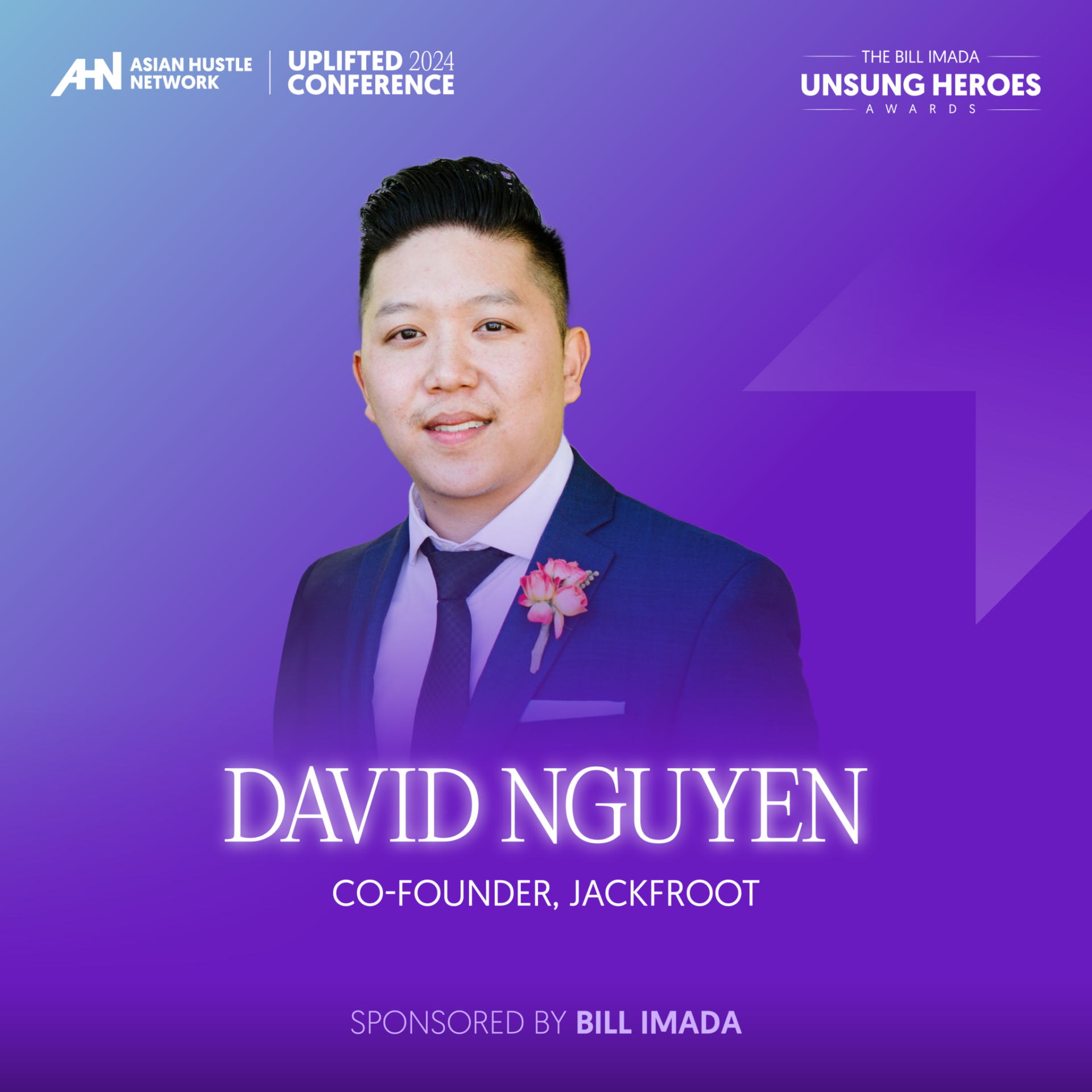
David Nguyen

Co-Founder, Jackfroot

David Nguyen was a beloved leader in the AAPI community, known for his mentorship, advocacy, and diverse talents. To many, he embodied kindness and inclusivity, having experienced the challenges of being a minority firsthand. David’s vision for Jackfroot was to create a platform where individuals could express themselves without fear of discrimination or bullying. Through his dedication to amplifying Asian American voices and championing social justice, David inspired countless individuals to stand up for what is right. Though he is no longer with us, David’s legacy lives on through Jackfroot and the lives he touched.

Anne Nguyen Oliver

Founder – CEO, House Of M Beauty

Anne Nguyen Oliver’s skincare line specializes in gentle treatments for sensitive and postpartum skin, using medicinal saffron as a key ingredient. She is passionate about inspiring the next generation of Vietnamese Americans and others to pursue their dreams and give back to the community through philanthropic endeavors.

Paige Park

Senior Loan Officer, CrossCountry Mortgage

As a dedicated loan officer, Paige Park specializes in transforming the dreams of homeownership into reality. With a track record of success, Paige takes pride in guiding individuals who have faced rejection by multiple banks to the coveted status of loan approval, empowering clients to overcome obstacles and secure the financing needed.

Esther Park

Content Creator

Esther Park, a Korean American content creator and mother, is deeply committed to the non-profit and social justice sectors. Beyond sharing motherhood and lifestyle content, she views her platform as an opportunity to effect positive change, advocating for justice and equity in a troubled world. Esther’s authentic, engaging, and down-to-earth content resonates with her followers, fostering genuine connections and meaningful engagement.

Kat Pham

Director of Partnerships & Marketing, ACE NextGen

Immigrating to the U.S. from Vietnam, Kat Pham navigated the challenges of being a first-generation immigrant and found her dream workplace in ACE NextGen, where she contributes in empowering women of color. Her contributions are proven by her work empowering AAPI millennial entrepreneurs. Beyond her career, Kat is also a yoga practitioner, mindfulness mediator, and nature lover, who strives for harmony in both physical and mental well-being.

Linda Phung

Founder, ImaginAsian Productions

With a background in events, public relations, fundraising, and youth mentorship, Linda Phung founded her own production company specializing in Asian Entertainment and promoting Asian artists. Her goal is to further uplift her community while encouraging others to get involved. Linda also volunteers her time to philanthropic causes that aim to serve underprivileged communities and advocates for the challenges the ethnic community faces.

Bhavani Rao

Founder, South Asian Women In Entertainment and Co Founder, South Asians in Entertainment

Bhavani Rao is a multifaceted entertainment industry expert known for her talents as a producer, writer, leader, and mentor. With a focus on integrating diverse cultural elements into storytelling, she has a broad range of experience in television programming, production, transmedia storytelling, and development. She is the founder of South Asian Women in Entertainment (SAWIE), dedicated to amplifying the voices of South Asian women in Hollywood to achieve greater representation and inclusion.

Stephanie Seow

Head of North America, LOVEBONITO USA LLC

Stephanie Seow is a seasoned marketing and retail strategist in the fashion eCommerce sector straddling Asia and the US. She has helped the marketing teams to foster cultural diversity and high growth of venture-backed companies. As the North American lead for Love, Bonito, Stephanie resonates with the brand’s story as a first-generation Asian American woman, making her the perfect fit to introduce Love, Bonito to the U.S. market.

Priya Shah

Founder & CEO, The Simple Good

Priya Shah, a catalyst for social consciousness, is breaking barriers and empowering communities as a Chicago-based artist, entrepreneur, and creative visionary. Through her non-profit, The Simple Good, she empowers youth globally, earning recognition from the Obama Foundation, Crain’s Business Magazine, and Forbes for her unique perspective on humanity.

Lakhi Mangahram Siap

Chief Community Connector, Chicago Asian Network

As the founder of the Chicago Asian Network (CAN), Lakhi Mangahram Siap has spent over 15 years volunteering & providing pro-bono marketing services to AAPI organizations. While his leadership within the Filipino Young Leaders Program (FYLPRO) as a founding member & Immersion Program Director has bridged the gap between the Philippines and the U.S., he also extends his commitment to other organizations such as ACENextGen, Node, Gold Futures, Kapwa Capital, & the CalAsian Chamber and the outsourcing consulting firm TAIO.CX that supports Philippine talents.

Quynh Chau Stone

President, The Source of Hope

Quynh Chau Stone, or QC, is a dynamic figure juggling roles as a minority business owner, CEO of Stone Construction Consultants, real estate strategist, devoted mother, and tireless advocate. Leading The Source of Hope, QC spearheads initiatives aiding underprivileged communities, distributing over 5000 meals monthly, mentoring, and promoting holistic health. QC embodies compassion, resilience, and unwavering dedication to service, serving as a beacon of hope and inspiration.

Chris Tashima

Co-Founder, Cedar Grove Productions

Chris Tashima, an LA-based actor and director, gained recognition as the Oscar® winning director of “Visas and Virtue,” where he also starred as Chiune Sugihara. He’s appeared in notable indie films like “Americanese” and received a Best Actor nomination for “No No Girl.” Chris began his career at East West Players and has directed stage plays such as “Nihonmachi: The Place To Be.” He’s a member of industry organizations including the Academy of Motion Picture Arts and Sciences and SAG-AFTRA.

Chris Truong

Founder – Firefighter, Ondori Hydration

Chris Truong is a firefighter/paramedic serving a large Asian community in Orange County, CA, driven by his passion to assist others and improve community engagement. Recognizing a communication gap between emergency services and the Asian community, he founded Ondori Hydration, offering the first electrolyte drink mix with authentic Asian flavors and no added sugar. In a similar way to how he became a firefighter, he started Ondori because of the need for more representation and a way to unite different communities and people.

Jeff Tsai

Founder, Operation Ninjas

Jeff Tsai specializes in empowering C-Level Executives and Business Visionaries to navigate challenges and achieve their goals. Currently serving as the National Operations Manager of ACE NextGen, Jeff is dedicated to enhancing infrastructure to meet community needs. His previous roles include Operations Director at Project by Project and Advisor at Sunny Side, focusing on mental wellness app development. With a background in Ecology & Evolution from UCSC, Jeff brings a unique perspective to creating functional workplaces in dynamic environments.

Tim Wang

Founder, TDW+Co

Tim Wang founded TDW+Co in Seattle’s Chinatown in 2004 with a vision of inspiring positive and social impact within diverse communities. Since its inception, TDW+Co has produced over 1,000 campaigns for 100 brands in 30 languages, including notable projects like the 2020 Census and COVID-19 public education campaigns. Beside TDW+CO, Tim maintains his voluntary duties for social justice and DEIB, serving as a board member for Asian Americans Advancing Justice, 4As, ThinkNW and LA, and St. Jude Children’s Research Hospital.

Wendy Wo ng

Founder, JuneAdaptive.com

Wendy Wong is a proud Chinese-Canadian female founder and first-generation immigrant from Hong Kong. Having close family members who live with disabilities and a background in Fashion and Tech, Wendy founded JuneAdaptive.com to help people who live with disabilities find easy-dressing clothing. Featured in various media outlets, JuneAdaptive.com has positively impacted hundreds of families and individuals living with disabilities.

Henry Wu

Founder / Editor in Chief, Timid Magazine

Henry Wu brought together his passions for design and photography to launch Timid Magazine. Serving as both founder and editor-in-chief, Henry leads a talented team in shaping the editorial and aesthetic direction of the magazine, which aims to uplift diverse voices and foster connections through impactful storytelling. Alongside his role at Timid, Henry is also a digital designer, focusing on product development and visual storytelling. As a self-taught fashion photographer, his work has been featured in esteemed publications such as Men’s Health, Elle Singapore, Vogue Italia, and People magazine.

Tara Yang

City Commissioner, The City of Green Bay

Tara Yang has dedicated over a decade to amplifying marginalized voices and fostering inclusivity. Recognizing systemic barriers, Tara secured her place at decision-making tables and supported the City of Green Bay Mayor, Eric Genrich, in developing GB’s first anti-discriminatory ordinance, and won an appointment as the first Asian American City Commissioner for Green Bay. In 2020, she founded Green Bay’s first Asian American Resource Center to ensure that the Asian community receives critical support.

Gloria Chang Yip

Managing Director, Head of Asian Wealth Initiatives, JP Morgan Private Bank

Gloria Chang Yip is the Managing Director and Head of Asian Wealth Initiatives at J.P. Morgan Private Bank. Specializing in assisting founders and entrepreneurs with wealth management, she oversees client relationships in lending, wealth planning, trust and estate planning, and charitable giving. Previously, Gloria held roles at Cartier and is actively involved in promoting Asian American interests and equal education opportunities. She serves in leadership positions for organizations like Asian Americans Advancing Justice Southern California and TeachAAPI, and provides executive advisory support to BrainTrust.

Linda Yoon

Founder & Co-Owner, Yellow Chair Collective

Linda Yoon is the founder, co-director, and licensed psychotherapist at Yellow Chair Collective, specializing in Asian mental health. With over a decade of experience, she has served Asian and immigrant communities in various mental health settings such as workshops on responsive care, wellness, and ADHD. She is also the co-author of “Where I Belong: Healing Trauma and Embracing Asian American Identity,” and co-founder of Entwine Community.

Michelle Yu

Emmy Award Winning Journalist, Law and Crime Trial Network

Michelle Yu is an Emmy Award-winning reporter and anchor having covered breaking news and sports for more than a decade. She is currently an anchor on Law & Crime Trial Network, founded by Dan Abrams Media. She is the first Asian female sportscaster in New York City and also travels around the country as a host for various tennis tournaments including the US Open. Before SNY, she was at NY1 News.

Carrie Zhang

Founder, Asian Mental Health Project

Carrie Zhang, activist and founder of the Asian Mental Health Project, advocates for mental health equity, focusing on AAPI and LGBTQIA+ communities and survivors of sexual violence. Established in 2019, her project aims to empower Pan-Asian communities in accessing mental healthcare. Carrie’s work has gained recognition in media outlets like Vogue and TIME, and was even featured in the Academy Award-winning movie “Everything Everywhere All at Once” by A24.

Tianyi Joe Zhu

Co-Chair, Leaders Forum

Tianyi “Joe” Zhu, the Co-Chair of Leaders Forum, was honored as one of the “Top 50 Outstanding Asian-Americans in Business” by the Asian-American Business Development Corporation in 2017 and as a Business Leader of Color by Chicago United in 2019. He was also named one of the “Top 40 Asian Pacific Americans Under 40 in Politics & Public Affairs” by NAAPPPA in 2020. Additionally, Joe serves on the Chinese Mutual Aid Association executive board, an immigrant organization that has served over 1.3 million people in its 40-year history.

Related Articles

SGV2N5MGRBP33CZ56U2JGAY3RE-jpg

News

Tariffs Hit Home: How Asian American Communities Bear the Brunt

While Trump claims tariffs will significantly impact the countries they target, experts argue that consumers and businesses will bear the brunt of the consequences.

Research by The Budget Lab at Yale University estimates that price levels may rise to 2% this year, equivalent to $3,000 per average household. Another report from D.C. stated that the new tariffs on China affect about 14% of U.S. imports and may raise costs to $25 billion annually. As the tariff war escalates, everyday consumers will face even higher prices.

Asian American communities and businesses are particularly vulnerable. In New York’s Chinatown, 28% of residents already live below the poverty line. With many companies relying on imports from Asia, owners are uncertain about their survival.

Mott Street in Manhattan's Chinatown (Image source: NBC News)
Mott Street in Manhattan’s Chinatown (Image source: NBC News)

“Here in Chinatown, especially, we have many elderly residents on fixed incomes,” says Edward Lau, owner of a traditional medicine shop in San Francisco’s Chinatown. With 90% of his stock sourced from Hong Kong and China, he worries, “If it gets very expensive, their spending power will be lower. Chinese immigrants will ultimately be harmed the most.”

Taylor Chow, owner of American Tai Wah Trading Corp, adds, “The Chinese community in Chinatown has been hit hard most because we consume a lot of imported ingredients. A lot of products only come from China. Even if manufacturers try to move their production line to Vietnam, to Malaysia, to Singapore, it’s not that easy.”

Supply chain disruptions and rising costs are straining small Asian American businesses. Since the community depends on these shops for cultural goods, they, too, will feel the pressure.

Mei Lum, owner of Lum’s Store, the longest-operating business in Manhattan’s Chinatown, explains, “Our working-class community here in Chinatown is definitely, in these circumstances, always being hit the hardest. And a lot of them have told me that their solution to mitigating these circumstances has been to eat those costs and only raise those prices by a smidgen, just to make sure they’re affordable for the people that frequent their establishments. How long can they sustain that?”

Mandy Lau helping a customer pick ginseng (Image Source: The Chronicle)

The erosion of these businesses could lead to cultural loss, impacting food, traditions, and ceremonial products. Lucas Li, whose family runs Lion Trading in San Francisco, specializing in feng shui and spiritual supplies, says, “When they get expensive, it makes it harder for Chinese people, for their families to maintain those traditions and do it at the proper steps. When customers shop at local businesses and small businesses, they’re not just buying a product, they’re basically investing in the community, supporting families, and protecting our traditions.”

Large online retailers like Shein, Temu, and AliExpress are also affected. While it is unclear how much product prices will rise on these e-commerce platforms, experts predict delivery delays and price hikes due to tariffs. Youssef Squali, an analyst at Truist Financial, notes, “The vast majority of these orders are valued less than $800, which means all or virtually all of them are going to get caught in that.”

Ultimately, Asian Americans may feel the greatest impact. As Linda Chao, a resident of Oceanview, states, “When there are tariffs, it won’t fall on China, it’ll fall on us. It can’t be helped. I also don’t have time to go and protest. I feel there’s nothing we can do.”

Sources: NBC News, The Chronicle, AP News, University of Virginia, The Guardian

Midjourney AI in UI design-jpg

Design

How to use Midjourney AI in UI design

As AI increasingly makes its way into the UI designer’s toolkit, Midjourney is fast becoming one of the most popular image generators. 

With a simple text prompt, you can use Midjourney AI to create custom digital artworks, whip up an app screen, design individual UI elements, and generate colour palettes—all in a matter of seconds.

For UI designers, this can really accelerate the ideation process and help you expand your own creativity. 

So how does Midjourney AI work? And how can you leverage it in the UI design process? Let’s take a look. 

What is Midjourney AI and how does it work?

Midjourney is a generative AI tool created by Midjourney, Inc.—an independent research lab based in San Francisco.

Midjourney AI generates images and digital artworks based on text prompts. If you enter a prompt asking for an image of a mermaid swimming underwater surrounded by marine life, Midjourney will generate four versions for you to choose from. The more specific your prompts, the better—but we’ll get to the art of prompt-writing for Midjourney in a later section. 

Midjourney works within the Discord platform. Discord is an instant messaging app, commonly used to create communities where users can chat via text, voice, and video. Discord essentially facilitates communication between the user and the Midjourney bot.

Midjourney uses two key machine learning technologies:

  • Large Language Models (LLM): this is how Midjourney understands and interprets the text prompts provided by the user.
  • Diffusion Models (DM): in very simple terms, this technology converts random visual noise into a meaningful image. You enter a text prompt, which sparks a field of visual noise. The AI then progressively removes that noise in incremental steps, eventually resulting in an image that resembles what you’ve asked for. 

Now we know what Midjourney is and how it works, let’s drill down to some key functions and features. 

What can Midjourney AI do? Key features

Midjourney’s core function is to convert text prompts into images. This allows you to generate unique digital artworks and graphics in a range of styles. 

You can guide the image generation process by applying custom parameters to your prompts. You might specify a certain aspect ratio, for example, or a particular style such as ‘watercolour’ or ‘flat design’. 

You can also customise the quality of your images by specifying, within your prompt, a value for the rendering quality. You might specify ‘q 1’ (that’s the default quality level) or request that images be rendered to a higher quality by specifying ‘q 2’ in your prompt. 

Once you’ve entered your prompt, Midjourney will give you four different image versions. You can choose to upscale a particular version, which will increase the size/dimensions of the image and also improve the quality. 

Beyond image generation, Midjourney serves as a great source of community and inspiration. You can share your creations and browse images created by others, allowing you to see what’s possible with Midjourney and sparking ideas for your own work. 

How to get set up on Midjourney AI

To use Midjourney AI, you’ll need to create both a Discord account and a Midjourney account. 

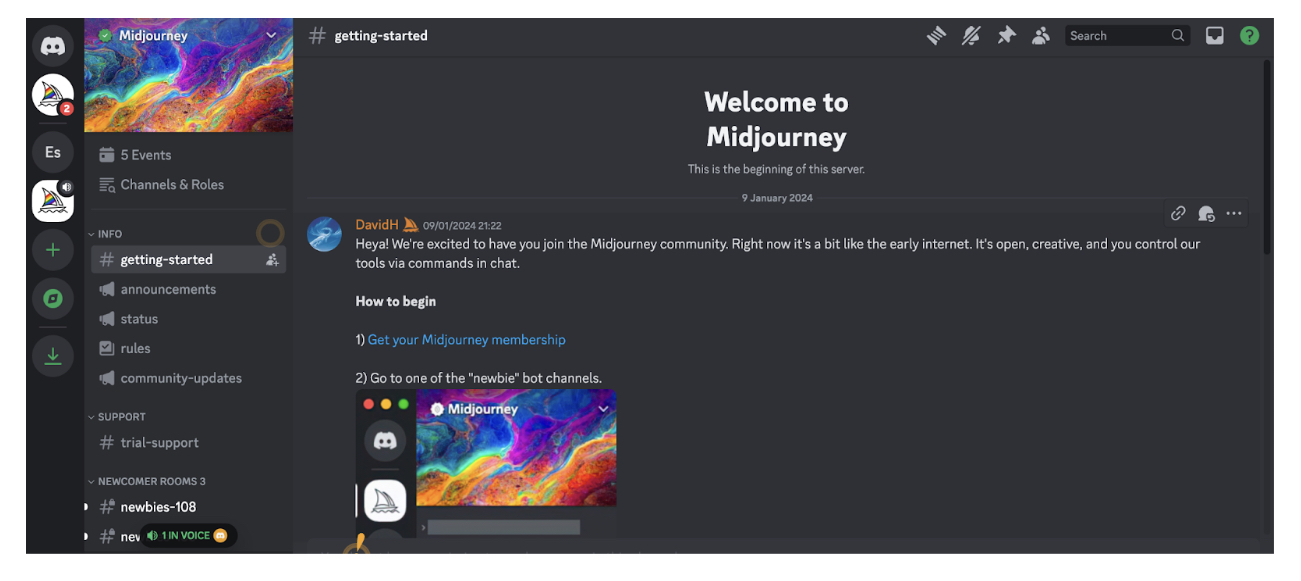
If you’re not already a member, first head over to the Discord platform and follow the instructions to create your account. Once you’re signed up, join the official Midjourney Discord server by clicking the ‘Accept invite’ button. 

You’ll then find yourself in the “Getting started” channel, where you can create your Midjourney account (if you haven’t already done so) by clicking “Get your Midjourney membership” (visible in the chat):

This will take you to a separate page, the Midjourney showcase, where you can click “Sign up” in the bottom left corner to create your Midjourney account. 

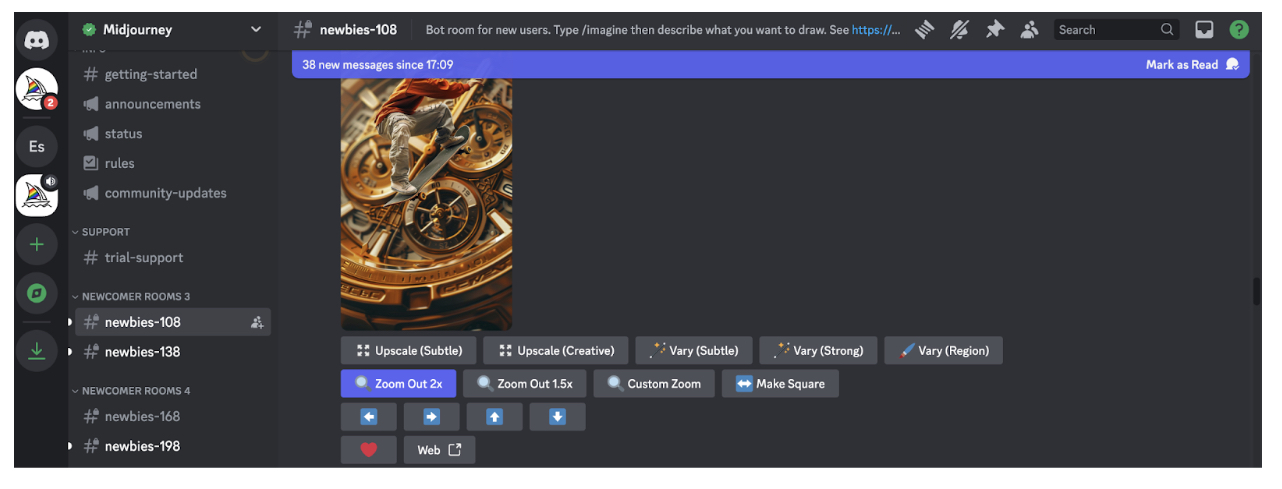
Once you’re signed up and logged in to Midjourney, you can navigate back to the Midjourney Discord server and enter one of the so-called “newbie” bot channels. You’ll find available newbie channels on the left-hand side.

You can then enter your own prompts into the chat box to start generating images. 

At the time of writing, Midjourney is no longer offering a free trial for new users. If you want to start prompting, you’ll need to sign up for a paid subscription. 

How much does Midjourney AI cost?

Midjourney offers four price tiers:

  • Basic Plan for $10 per month or $96 per year with an annual subscription (that’s around €9 per month / €89 per year)
  • Standard Plan for $30 per month or $288 per year with an annual subscription (that’s around €28 per month / €267 per year)
  • Pro Plan for $60 per month or $576 per year with an annual subscription (that’s around €55 per month / €533 per year)
  • Mega Plan for $120 per month or $1,152 per year with an annual subscription (that’s around €111 per month / €1,066 per year). 

For more information about each price tier and what’s included, visit the official Midjourney pricing page.

How to use Midjourney AI in UI design (with example prompts)

Midjourney can generate custom visuals in a matter of seconds—making it an incredibly interesting tool for UI designers. You can use Midjourney to quickly create screens and individual UI components, come up with themes, styles, and colour palettes, and generate unique digital artwork. 

Note, however, that the graphics you create with Midjourney won’t necessarily be directly usable—and working with Midjourney doesn’t eliminate the need to create your own screens and elements using the usual UI tools like Sketch and Figma. If you generate an app screen with Midjourney, for example, you’ll still need to actually create that screen from scratch yourself. 

Where Midjourney really comes in useful is helping you to explore different ideas and concepts and gather inspiration. You might use your AI-generated artwork to inspire mood boards, kick-start an ideation session, or serve as a guide for certain layouts or colour schemes. 

With that, let’s consider some examples of how to use Midjourney for UI design. 

Use Midjourney AI to generate app screens 

If you’re designing for mobile, Midjourney can help you ideate layouts and designs for various app screens. If you’re designing a dating app, for example, you might try the following Midjourney prompts:

  • /imagine a vibrant and fun login screen for a dating app, with an eye-catching background, username and password fields, and buttons for login and social media sign-ins
  • /imagine a user profile screen for a dating app, featuring a large profile picture at the top, user bio, interests, and match percentage displayed in a clean layout
  • /imagine a match screen for a dating app, showing potential matches with profile pictures, a brief bio, and buttons to like, dislike, or super like
  • /imagine a chat screen for a dating app with a clean interface, message bubbles, timestamps, and an input field at the bottom

Create UI components such as icons, buttons, and logos 

Perhaps you want inspiration for the finer details of your app or website. In that case, try using Midjourney AI to create individual UI components such as icons, buttons, and logos. Here are some prompt examples to guide you:

  • /imagine a set of modern buttons for a mobile app, including primary, secondary, and disabled states, using a black and white colour scheme
  • /imagine a collection of minimalist icons for a mobile app, including icons for home, search, messages, settings, and notifications
  • /imagine a sleek and modern logo for a dating app, incorporating elements of connection and love, with a vibrant colour scheme

Generate theme and style concepts 

In the early stages of the design process, you might focus on coming up with an overall visual style for your website or app—and Midjourney can help with this, too. Specify your vision or initial ideas and let Midjourney bring them to life. 

Consider the following prompt examples:

  • /imagine a light mode theme for a productivity app, featuring white backgrounds, soft grey UI elements, and navy blue highlights
  • /imagine a dark mode theme for a music app, with black backgrounds, dark grey UI elements, and neon pink highlights
  • /imagine a vibrant and colourful theme for a creative design app, with bold colours like orange, pink, and teal, playful typography, and dynamic UI elements

Create custom website imagery 

Imagery plays an important role in UI design, helping to reinforce brand identity and enhance the visual appeal of your website or app. 

Whether you want to create cartoon-style illustrations, abstract artwork, or realistic images of products, places, or people, Midjourney can generate custom imagery that reflects your brand and vision. 

Here are some examples of how you might prompt Midjourney to generate images for different use cases:

  • /imagine a stunning hero image for a tech startup website, featuring abstract technology elements and a modern cityscape in the background
  • /imagine a set of custom illustrations for a health and wellness website, featuring people doing yoga, eating healthy, and meditating
  • /imagine a unique background image for a creative agency website, with abstract shapes and vibrant colours

Generate colour palettes 

Perhaps you want help coming up with the perfect colour palette, or you’ve already got a colour scheme in mind and want to see how it looks in practice. Again, Midjourney is an excellent source of inspiration here. Simply specify the kind of look and feel you’re aiming for and Midjourney can generate multiple colour palettes accordingly.

Consider the following prompt examples to guide you:

  • /imagine a pastel colour palette for a wellness app, featuring soft shades of mint green, blush pink, lavender, and light grey
  • /imagine a bold, split-complementary colour palette for a fitness app, comprising three colours
  • /imagine a monochromatic colour palette for a finance app

How to write effective prompts for Midjourney AI

As with all generative AI tools, the quality of the output depends on the quality of the input. In other words, it’s up to you to tell the AI what you want—and to master the art of prompt-writing for the specific tool you’re using. 

Here are some tips to help you write effective prompts for Midjourney AI:

  • Start each prompt with the /imagine command, followed by a description of what you want the AI to create.
  • Keep it simple and specific. To quote the official Midjourney guidelines for prompt-writing: “The Midjourney Bot works best with simple short phrases that describe what you want to see. Avoid long lists of requests and instructions.”
  • Specify what you want the image to include, rather than what you don’t want it to include. Even if you specify “no flowers” in your prompt, the AI will likely only focus on the word “flowers” and therefore create an image that does indeed contain flowers. If you absolutely want to exclude something from the image, use the “no” parameter. For example: – – no flowers.
  • If necessary, specify your desired aspect ratio using the following parameter: – – ar [value]. If you wanted to generate an app screen, you could specify – – ar 16:9.
  • Use the stylize parameter to control the level of artistic flair that Midjourney injects into each image. If you imagine that the default level, 2500, gives you a medium level of stylization, you can dial it up or down by specifying values higher or lower than 2500. If you wanted to generate an image of a garden that’s more realistic than artistic, you might specify – – stylize 500. If you wanted to create an image of a garden that looks magical and fantastical, you might specify – – stylize 3500.
  • Use the quality parameter to adjust the level of quality and detail in the image. – – q 1 is the default, so work from that value to dial the quality up or down. 

Most importantly, be prepared to experiment. The more you use Midjourney, the more intuitive the art of prompt-writing will become. You’ll start to get a feel for what works and see how different words, phrases, and parameters influence the output. 

Ethical considerations when using Midjourney AI

If you’re using Midjourney AI (or indeed any AI tools) throughout the design process, you must take care to use it responsibly. Here are some of the most important ethical considerations to bear in mind.

Intellectual property and copyright

When generating images with AI, be careful about replicating existing images or artworks created by other artists or designers. You might use a famous logo for inspiration, for example, but you wouldn’t want to emulate the style too closely to the point of copying. 

Deceptive and misleading content

This is like the visual equivalent of fake news—creating image-based content that deliberately deceives, misleads, manipulates, or spreads misinformation. Don’t do it!

Stereotypes and bias

It’s well-documented that AI can and does perpetuate harmful stereotypes and biases. As a human user, you must be diligent about actively looking out for such biases and taking steps to mitigate them.

Strive to generate images that are inclusive and representative of diverse groups. If you generate an image that doesn’t feel inclusive or could potentially exclude or harm certain people, don’t use it. You can learn more about the importance of designing inclusive content in this guide. 

As a general rule: always review AI-generated content with a critical eye, and use your better judgement. As a human user, it’s your responsibility to consider the impact of any content you create—and to ultimately decide what makes it into the public domain. 

The takeaway

Midjourney AI can generate custom images in seconds, making it an excellent tool for gathering inspiration, sparking your own creativity, and ideating and exploring different design concepts, layouts, and styles. 

Whether you use it to generate fully-fledged app screens, individual UI elements, impressive artworks, or colour palettes: Midjourney AI is a powerful addition to your UI design toolkit. 

Ready to get started with Midjourney AI? Experiment with different prompts and use cases, explore other Midjourney users’ creations, and be mindful of the ethical considerations we’ve laid out in this guide. You’ll soon be generating images like a pro! 

What is UX

Design

What is UX design?

What does UX stand for? Learn more about what UX means, why it’s so important and what defines good UX.

“UX” stands for “user experience.” It describes the quality of the experience an end user has with a specific product, service, company or brand.

Although it’s often talked about in relation to digital products, like apps and websites, UX can relate to anything that an end user can interact with or encounter.

Take the example of going into your local bank to open a new account. If the process is quick and simple with clear instructions, easy-to-find information and friendly customer service, you’d come away feeling like you had a good user experience.

The same goes for ordering something online or using an app on your phone. If you’re able to accomplish your desired tasks with minimal effort, you’ll find the user experience to be a pleasant one.

UX doesn’t relate to one specific thing. It’s the sum of all the smaller parts that determines whether the overall encounter between the product/service and the user is a positive one. You can think of it as the impression the user leaves with and whether or not they’d be keen to repeat the experience. To learn more, keep reading.

What is user experience (UX) design?

If UX describes the quality of a user’s encounter with a particular product or service, UX design is the process of creating and shaping these experiences, with the goal of making them positive, pleasant and valuable for the end user.

UX design isn’t about how a product looks; that’s just one aspect of the overall user experience. It’s about ensuring that the product is logical, functional, easy to navigate and generally user-friendly.

There are 5 elements of UX design to consider:

  1. Strategy: Deciding which objectives the product should meet, including both end user goals and client/business stakeholder objectives.
  2. Scope: Fleshing out the details of the product, determining which features and functionality it should offer.
  3. Structure: Mapping out the structure of the product, considering how users will navigate from one point to the next and what information they’ll need to move around the product and accomplish their goals.
  4. Skeleton: Drilling down to the finer details of how each page should be structured and which elements (buttons, menus and other content) will go where.
  5. Surface: Considering the user’s sensory experience of the product, defining how the product will look in terms of colors, imagery, spacing, typography and so on. This is where UI design comes in.

Where does the term “UX” come from?

The term “UX” was invented by Donald Norman, a cognitive psychologist who started working at Apple in the early 1990s. He took on the role of User Experience Architect, making him the first (known) person in history to have UX in their job title.

Explaining the origins of UX, Donald Norman said:

“I invented the term because I thought human interface and usability were too narrow. I wanted to cover all aspects of the person’s experience with a system, including industrial design, graphics, the interface, the physical interaction and the manual.”

What is the difference between UX and UI?

If you’ve heard of UX, you’ve probably also heard of UI. The terms are often used together but it’s important to be clear on the difference between them.

UX is a much broader term, covering everything that influences how a user feels when they use a product or service. It’s a comprehensive discipline that involves research, analysis, and understanding user needs. 

UI stands for “user interface”, which is the point of interaction between an end user and a digital product. It’s a more narrow discipline that involves the visual design of the screens, buttons and other touchpoints you might use to navigate an app or a website. 

The way the user interface (UI) is designed has an impact on the overall user experience, so UI is an important part of UX.

UXUI
Stands for “user experience”Stands for “user interface”
A broad disciplineA narrow discipline
Involves the quality of the experience as a wholeInvolves the design of the user interface
Concerned with research, analysis, and understanding user needsConcerned with visual design

You can learn more about the difference between the two, as well as how they go hand-in-hand, in this guide to UX vs. UI.

Why is UX important?

UX is important for two reasons: business value and human value. Let’s look at both.

The business value of UX design

If you have a positive experience with a product or service, you’re more likely to use it again and become a loyal customer. You might even recommend it to friends and family. That’s great for the brand reputation, which ultimately determines whether or not the product or service is successful and profitable.

On the flip side, a negative user experience leaves a bad impression of the product, service or brand. If it’s less than satisfactory, you’ll be inclined to go elsewhere, like a competitor with better UX.

Wherever there are two similar products or services offering the same functionality, the one with the best UX will always win out. UX is therefore crucial for winning and keeping customers, developing a positive brand reputation and, ultimately, for driving profit and business growth.

In sum, the business value of UX design includes:

  • A competitive edge in the market
  • Increased sales and revenue
  • Higher conversion rates
  • Better word-of-mouth marketing
  • A strong brand reputation
  • Improved customer loyalty and retention

We compiled some interesting statistics about the business value of UX, like the fact that 66% of customers are willing to pay more for a great user experience. 

The human value of UX design

In addition to being valuable to businesses, end users also value good UX even if they don’t know it. UX influences whether we enjoy an experience or not and whether products and services are efficient and easy or frustrating and difficult. 

In addition, UX determines whether products are accessible and inclusive for as many users as possible. Whether they are disabled, come from a different place with different needs, or have different requirements, good UX make products and services accessible for all.

What defines good UX? The fundamental principles of UX design

Defining good UX can be tricky. It’s not down to one specific thing. There are seven principles of UX design that all designers should follow. They are:

  • User-centricity — Design products and services in a way that centres the user’s needs and helps to solve their problems.
  • Consistency — This can mean keeping your designs consistent across all pages, screens, and products within the same product family. It can also mean meeting the user’s expectations for the kind of product you’re designing.
  • Hierarchy — This includes putting more important elements in more prominent positions in both a site’s information architecture and in the visual hierarchy. 
  • Context — Consider the circumstances in which your products of services will be used and how that will effect the user experience.
  • User control — Give the user the right amount of control over their interactions with a product, such as being able to reverse or undo errors to a text message without throwing the whole user experience into disarray.
  • Accessibility — Ensure your product or service is accessible to as many users as possible, including people with disabilities or in other environments.
  • Usability — Usability relates to how easy a given product is to use and it’s influenced by things like:
    • Learnability – how easy it is for a user to learn how to use the product for the first time.
    • Efficiency – how quickly and seamlessly the user is able to complete their goals and tasks.
    • Memorability – how easy it is for the user to jump back into the product after not using it for a while.
    • Errors – how many errors does a user typically make when using the product.
    • Satisfaction – how pleasant or enjoyable is the product to use.

What is the UX design process?

The UX design process focuses on identifying and solving a problem for a specific target audience. It includes:

  • Conducting user research to understand who you’re designing the experience for and what problems they need solving.
  • Narrowing it down to one problem and coming up with potential solutions.
  • Designing the chosen solution.
  • Making prototypes to test and validate the design, i.e. to make sure it will actually solve the user’s problem.
  • Developing the prototypes into a fully-fledged product or service which people can use.
  • Continuously improving the product/service (and thus the user experience) based on continuous testing and feedback.
ROI

Development, Technologies

How WordPress Website Development Complements Digital Marketing for Better ROI

While dealing with the rapid tempo of today’s digital market, online presence has to be considered crucial for developing businesses. Companies seeking a higher ROI should focus on two key factors: effective website development and strategic digital marketing. WordPress, being one of the most popular content management systems in the world, plays an important role in improving both. The combination of WordPress website development with proper digital marketing strategy will do a manifold increase in ROI for the business.

The Role of WordPress in Modern Website Development

With over 40% of websites across the earth powered by WordPress, that fact should say it all. Its flexible, ease of use, and has power-rich features. All these make it a go-to platform for businesses seeking to establish or improve their digital presence. Now, let’s get into detail as to why WordPress is an essential tool in website development.

  • Custom Web Development with WordPress: Every business differs; so does each business and its needs while considering website development. WordPress makes it easier to develop custom websites for any business. Be it a blog, an e-commerce platform, or corporate website; there’s no limit in the areas of customization in WordPress. To this end, web design companies ensure that businesses leverage all benefits of using WordPress by providing them with customized websites that are functional, user-friendly, and visually appealing.
  • E-commerce Capability: The easy integrability of WordPress with e-commerce solutions such as WooCommerce makes it suitable for every business involved in the selling of products or services online. E-commerce WordPress websites are highly customizable and performance optimized. WooCommerce can hence be used to track sales, manage inventory, or even introduce a payment gateway from a single point.
  • SEO-Friendly Design: One of the important things with WordPress is that it has an SEO-friendly structure. Optimizing websites for search engines is done at an advantage through WordPress, where such SEO plugins as Yoast SEO and All in One SEO dictate guiding the user in optimizing their site for better visibility. The cutting-edge functionality of editing meta tags, titles, and descriptions may help businesses improve their places in search engine rankings and hence drive more organic traffic.
  • Mobile-Friendly and Responsive: With mobile traffic surpassing desktop traffic, it is crucial that your website be responsive. There are hundreds of WordPress themes and plugins that automatically optimize your website for mobile devices. Increased user experience, better SEO for your site, and not losing potential customers on mobile devices-this is what business gets from having a mobile-friendly website.
  • Secure and scalable: WordPress gets updated on a routine basis to meet industry standards with security updates. For scaling businesses, WordPress sites can adapt to increased traffic and be able to add new features without reduced performance, making it a very sustainable option for website development.

How WordPress Improves Digital Marketing Strategies

Digital marketing strategies are indispensable for the development of businesses, while at the heart of every successful marketing strategy is an optimized WordPress site. Here’s how WordPress can help to improve your digital marketing campaigns.

  • SEO-friendly Structure: WordPress has been coded in clean code, which enables search engines to crawl and index your site efficiently. SEO plugins like Yoast SEO actually provide actionable insights to help you optimize those pages and posts for better rankings. With features such as XML sitemaps, meta tags, and alt attributes, WordPress helps businesses with search engine optimization to ultimately drive more organic traffic to their websites.
  • Content Marketing Made Easy: Content is king when it comes to digital marketing. WordPress will enable users to publish their blog posts, products, and landing pages without requiring thorough coding skills. It provides the opportunity to create content on a regular basis and publish it for better search engine ranking and attracting targeted traffic.
  • Smooth Integration with Social Media: WordPress integrates seamlessly with social media. Plugins like Social Warfare allow showing social sharing buttons on business pages for easy visitor content sharing. Social media integration improves the capability of businesses to extend their visibility and reach out more effectively to their audience.
  • Conversion Optimization: WordPress supports multiple tools to improve conversion rates, starting from simple contact forms up to advanced solutions, which include heatmaps and A/B testing. Additionally, companies can efficiently track the interactions of users, improve their digital marketing skills, and work on leads and sales.
  • Analytics and Data Tracking: Amongst the rest of the plugins, integrating Google Analytics or some other data-tracking software into WordPress is fairly easy. Data analytics are very important for refining digital marketing tactics, candidly knowing the users’ behavioral mentality, and improving ROI. In WordPress, it is easy to set up campaign success; similarly, data-driven decisions are also easy to make.

How WordPress Website Development and Digital Marketing Work Together for Better ROI

A combination of WordPress website development along with digital marketing strategies helps a business return on a higher investment. Herein lies the reason why:

  • Improved Visibility: WordPress has an SEO-friendly design, which makes it easy to rank high in search engines. A website that’s optimized will help businesses raise visibility without the paid advertising, which in turn means more organic traffic and drives up ROI.
  • Increased Conversions: A friendly and attractive WordPress site means great user experience, which directly influences conversions. Whether it is to generate leads, sell more, or even build an email list, WordPress sites are designed in a way to move users along the conversion funnel.
  • Affordable Marketing: WordPress allows seamless integrations of different marketing tools, ranging from email marketing platforms to CRM systems, not excluding social media plugins. This reduces the need for other software, which might be costly, hence giving businesses a chance to run effective marketing campaigns without spending an arm and a leg.
  • Scalability for Changing Trends: WordPress websites are immensely adaptable and scalable. This will enable businesses to respond swiftly to ever-evolving digital marketing trends. New features and functionalities can easily be added in with plugins and hence you keep your site relevant and competitive.

Why Choose AHN Group for Your Business Needs?

The selection of the right web development company is very crucial for your digital marketing success. At AHN Group, we offer custom WordPress development designed to meet the unique needs of your business.

Why AHN Group stands out:

  • Expertise in Custom WordPress Development: With our team, you are assured of custom WordPress website development backed by years of experience in implementing your business goals. Whether one is looking for a simple blog or a fully-fledged e-commerce site, we will cover it.
  • Focus on SEO Optimization: We prioritize SEO in each website we build. From clean code to optimized meta tags, our WordPress websites are designed to rank higher on search engines and attract more visitors.
  • Responsive and User-Friendly Design: We value the importance attached to mobile-friendly design. All our WordPress websites are fully responsive, prioritizing, an excellent user experience across all devices.
  • Full Digital Marketing Integration: At AHN Group, it’s not about building just websites, but creating a well-integrated digital platform that will be useful in executing your digital marketing strategies. Our WordPress website designs cater to your SEO, social media, and email marketing needs among others.
  • Ongoing Support: We provide ongoing support in order to keep your WordPress website updated, secure, and optimized for performance continuously.

Conclusion

WordPress website development and digital marketing prove to be indispensable means of business growth in today’s competitive market. By leveraging the power of WordPress and integrating smart digital marketing strategies, businesses can increase their return on investments. With AHN Group, one can design a custom WordPress website for the company that looks great but also drives real results. Working with AHN Group on WordPress website development is the right step toward digital success for businesses that want to increase their online presence and maximize ROI.

Still concerned about your business needs? Don’t wait any longer—contact us today and experience the magic for yourself by partnering with us as your digital guide!