Stories

July 5, 2023

SHARE:

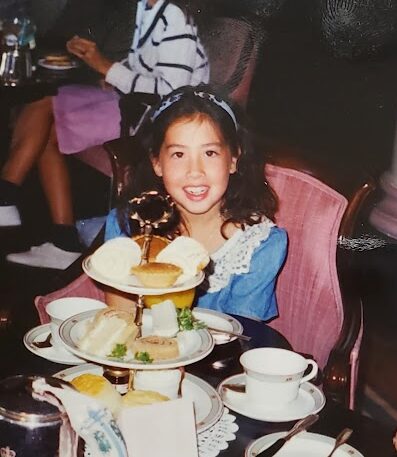
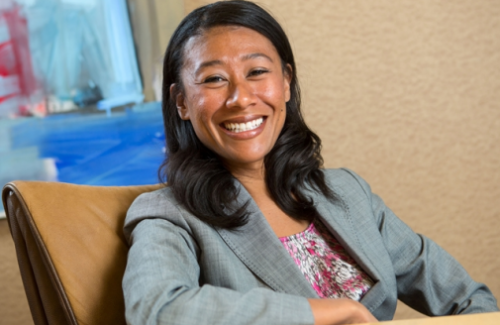
Christine Holmes grew up feeling different from her peers due to being a bi-racial Taiwanese-American.

Christine was often referred to as either the “Asian girl” by her non-Asian friends and the “White girl” by her Asian peers until eventually, they referred to her as “Whasian girl,” which she liked because it represented both of her ethnicities.

She struggled to embrace her cultural background and wished to be fully White. It took her long before she learned to love her identity and cultural heritage, but she did.

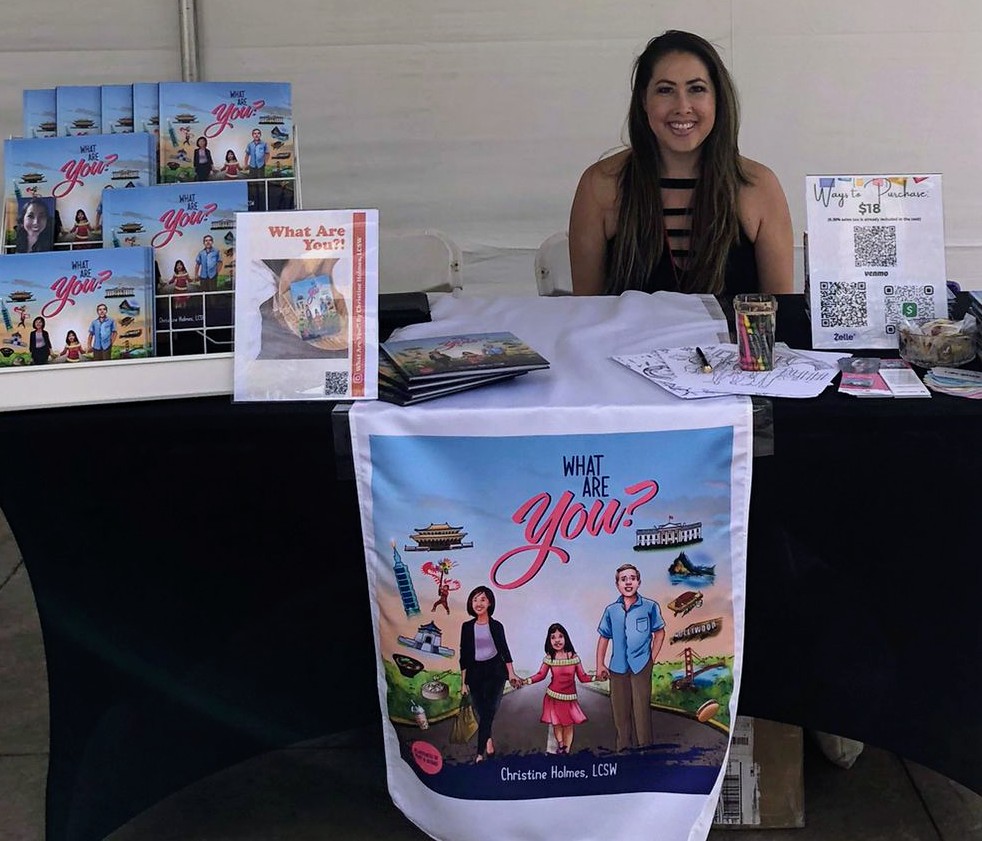
Inspired by her personal experiences, she wrote the book “What Are You?” to provide representation in children’s literature for mixed Asian children.

The book touches on her personal struggles with food and language, among other things, and highlights the importance of representation in literature for children who come from mixed cultural backgrounds.

GROWING UP WITH A TAIWANESE MOTHER AND AN AMERICAN FATHER

Christine grew up in Irvine, CA, where the population was predominantly white and Asian. However, there were very few mixed children, which made Christine feel very different from her peers, who were either fully White or fully Asian.

As a child, Christine was immersed in Chinese School, Chinese Choir, piano, and tennis, which made her feel even more different from her peers because most of them were fully Asian.

Christine’s dad, who is White but very much into Asian culture and a world-renowned Master of martial arts, made it very important for them that Christine knew her Taiwanese/Chinese culture. Christine’s mother cooked Chinese food for most dinners, and her first language was Mandarin.

Their home is filled with beautiful Chinese/Taiwanese antiques, and they used to visit Taiwan every year until Christine was in junior high/high school.

CHALLENGES OF BEING THE “WHASIAN” GIRL

“To my White friends, I was the Asian girl but to my Asian friends, I was the White girl until I got into high school and my friends decided to call me the “Whasian” girl which I preferred since it represented both of my ethnicities.”

Christine felt different from everybody growing up, which bothered her internally. In fact, she had a teacher in her Chinese school that wasn’t very nice to her because even though she can speak Chinese, she couldn’t write Chinese like the other children. This treatment left Christine feeling isolated and alone, until she eventually quit Chinese school altogether.

Her non-Asian friends also often made comments about the food her mom would bring to potlucks or the bags she would use to pack her lunch, making her feel ashamed of her culture. When her mom spoke Mandarin, her non-Asian friends would be offended and ask why she had to speak Mandarin in front of them. She would have to explain that it was sometimes easier for her mom to speak in her native language than speak English. This made her feel uncomfortable, and she would get angry at her mom for it.

At this point, she wished that she was fully White, perhaps because being White and blonde was considered the most beautiful when she was growing up. Her mom used to pinch her nose to make it look “taller” and less stubby like a typical Asian nose. Some of her Asian peers even told her that she was lucky to be at least half White compared to them being fully Asian.

THE TURNING POINT

It wasn’t until college that she fully embraced being mixed and started to love her identity. Christine found herself surrounded by a diverse group of friends who not only accepted her but celebrated her mixed heritage.

“In college, most of my friends were either mixed or of different ethnicities other than White or full Asian. And, they embraced me,” she said.

They appreciated the unique perspective she brought to the table and encouraged her to embrace her identity. For the first time in her life, Christine felt truly proud of her background and of who she is.

WRITING THE BOOK

Christine’s personal experiences served as the inspiration behind her book, “What Are You?” which is a story about her life growing up as a mixed-race individual in a predominantly white and Asian community.

Christine wrote the book when she realized there were no books that represented mixed Asian children. Despite being able to find books for her own children who are half Black, she couldn’t find any for children who were mixed Asian. So, she decided to create something that represented kids like herself.

“I think the part of the book that was most emotionally challenging was writing about the food and how embarrassed I was about my mom packing me Asian food even though I secretly loved it.” Christine admits to feeling a lot of guilt now as an adult for all the times she blamed and got mad at her mom as a child.

REPRESENTATION IN CHILDREN’S LITERATURE

Christine strongly believes in the power of representation and the need for diverse books that accurately reflect the experiences of mixed-race individuals. Having grown up without any books that reflected her own identity, she recognizes the importance of seeing oneself represented in literature.

She saw firsthand how much her own children appreciated books with characters that looked like them and had similar cultural backgrounds. Writing her book, “What Are You?”, she received overwhelming positive feedback from other mixed Asian individuals who wished they had a book like this when they were children.

Despite increased awareness and acceptance of mixed-race identities in modern times, Christine recognizes that children may still struggle with their identity and the pressure to choose one ethnicity over the other. Her book seeks to empower mixed-race children to embrace and celebrate all aspects of their identity.

OVERJOYED BY THE POSITIVE FEEDBACK

Christine initially had doubts about the book’s reception due to her own insecurities about putting herself out there. However, the encouraging and uplifting words from her readers have exceeded her expectations.

“I was featured on a TikTok page, twice, by someone with 1 million followers, who’s sister bought the book for her. She shared that my book had emotionally resonated with her in many ways. It was then that I realized the impact that my book has had on some people.”

HOPE FOR THE FUTURE

Christine hopes that her book will inspire readers to embrace their identity, no matter where they come from. She wants readers to know that they don’t have to choose between different cultural backgrounds and can be proud of their unique mix.

“I hope they embrace their cultural background, and they are proud of their roots.”

By highlighting her personal experiences, Christine hopes her book will contribute to a larger conversation about identity and belonging in our society today, and ultimately help break down barriers and build more inclusive communities.
CONNECT WITH CHRISTINE

Website: publishyourgift.lpages.co/christine/

Instagram: @whatareyoubook  

Facebook:  What Are You? Book

TikTok: @whatareyoubook 
Related Articles

Image Source: Las Vegas Review Journal

Uncategorized

Patricia Lee Sculpts History as First Black Asian American To Succeed Seat F In Nevada Supreme Court

Following her victory over the other two candidates, Patricia Lee made history by becoming the first Black and Asian American attorney to hold the vacant Department F seat on the Nevada Supreme Court.

Lee was chosen by Gov. Sisolak from among the candidates put out by the state Judicial Selection Committee to take the place of Justice Abbi Silver, who resigned from her position due to “unexpected circumstances” and a desire to spend enough time with her family.

Being an attorney in Las Vegas, Lee contended with Washoe County District Judge Scott Freeman and Clark County District Judge Tierra Jones.

The Reno Gazette-Journal cited Sisolak saying, “I am thrilled and honored to appoint Patricia to serve on the Nevada Supreme Court. The breadth and depth of her skill set, as well as her personal and professional experience, make her an excellent addition to the State’s highest court.”

Lee will begin serving her term in January 2025 and must run for reelection in two years in order to preserve her position.

Lee’s mother, a native South Korean, and father, an African-American soldier, brought her up in South Korea. She majored in psychology and communications at the University of Southern California, where she also participated in the Black Students’ Union and had her first political experience.

She started working at Hutchison & Steffan in 2003, concentrating on family law, trademark law, medical claims billing, and business and commercial disputes. She later joined the firm as a partner.

Lee is a skilled attorney with a history of being chosen as the chair of the Nevada Crime Commission by the then-Gov. Jim Gibbons, a volunteer with the Children’s Attorney Project in Las Vegas who advocates for abused and abandoned children, has handled pro bono cases at the Legal Aid Center of Southern Nevada.

Nonetheless, Lee is not just a dedicated lawyer but also a devoted family woman being a mother to Brianna and Devin, and a wife to Ronnie.

Image Source: South China Morning Post

Uncategorized

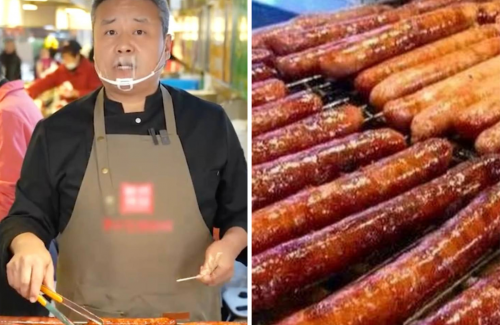
Bankrupt Chinese Restaurant Owner Bounces Back To Pay $6.4 Million Debt Through Sausage-Selling

“We are born with nothing. Why be scared of starting all over again?” says Chinese Tang Jian after starting up a street food stall in Hangzhou, China following his business bankruptcy which left him with $6.4 million.

At 52, the former millionaire Chinese restaurant proprietor is positive of earning funds to pay his multi-million debt by selling barbecued sausages.

Thus, his optimism put netizens in awe as a person, who despite losing his 16-year-old business venture and everything he had because of the unsuccessful investment in the landscape engineering industry, is still hopeful of being able to recover from the downfall.

Tang was once a successful businessman starting at the age of 36. However, because of the fruitless outlay, he was compelled to sell everything he founded through his business including his restaurants, homes, and cars.

Still unable to pay his debts in full, Tang decided to put up the small-time sausage-selling business.

Tang proudly exclaimed that “Every sausage is genuinely filled with meat, and there is no starch in it. When compared with those sold in amusement parks or markets, ours will make you feel safer,” as quoted in South China Morning Post.

Upon knowing that his story trended in social media, Tang explained that it was because all of us face our own challenges in life, however, we must always have that strong spirit of winning each battle. 

He also said that he is really determined to settle his debts although still uncertain when it would be.

Tang shared that bravery is a key to overcoming hardships and going on in life and that we should always seek strength, especially during hard times.

Uncategorized

Virginia Embraces Diversity and Korean Culture, Celebrates First Kimchi Day

Being home to one of the biggest Korean communities in the nation, Virginia had its first-ever Kimchi Day on November 22, through the Korean American Women’s Association.

Held at the Good Shepherd Evangelical Church in  Springfield, the festivity was materialized especially for this motive: acknowledge kimchi as a nonnative dish in Virginia which is specially imported for the increasing number of Korean American citizens in the country. It also reflects how the state has embraced diversity.

During the celebration, roughly 150 people of different colors converged to make their own kimchi, following the traditional and neat process of kimchi preparation. 

Originally, families and acquaintances converge to happily prepare the ingredients, store them in jars, and place them underground for fermentation producing a savory, piquant, and sugary kimchi. This is done every November, a month after harvesting cabbage.

On the other hand, it was officially moved to be celebrated in January through Irene Shin (D), the foremost Korean American servant in the House of Delegates, who acquired two-way support for her proposition.

For Koreans, kimchi is beyond being a cuisine. It narrates Korea’s past, its folks’ tenacity, and its landscape which Koreans are more than proud of. Kimchi is a celebration of family and blessings.

Northern Virginia and Annandale seem to be “Korea Towns” as Korean establishments like diners, worship places, food markets, bakeries, and beauty shops in Hangul inscriptions are all over. The state and Korea have found strong connections with each other that Fairfax County Economic Development Authority can even be found in the latter’s capital.

A Korean American mentioned how Kimchi Day appreciates the essence of exporting not only the product but of Korean culture; a manifestation of how the US whole-heartedly accepted acculturation.

Image Source: Tufts Daily

Uncategorized

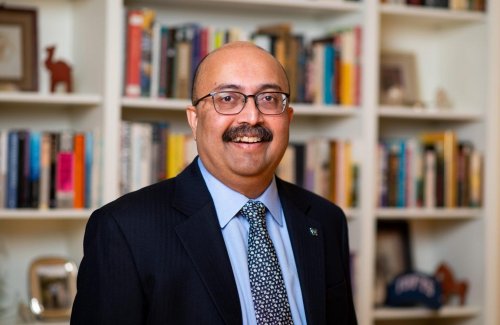
Sunil Kumar To Sit As The First Person Color President of Tufts University in 2023

The Board of Trustees commissioned Indian politician Sunil Kumar as the 14th president of Tufts University, Massachusetts in 2023 succeeding President Anthony P. Monaco, after the latter’s 12-year term.

Kumar is currently a provost and Vice President for Academic Affairs at Johns Hopkins University and was once the dean of the University of Chicago Booth School of Business with a Ph.D. in electrical engineering and is a competent operations manager.

The head of the commission on presidential search and BOT, Peter Dolan, proudly exclaimed that Kumar’s never-ending dedication to providing first-rate tertiary education and extraordinary track in leadership, teaching, and interpersonal skills are essential as a presidential successor. 

Furthermore, Kumar’s colleagues at Johns Hopkins mentioned him as a wholesome partner and co-worker who has the distinct qualifications of an outstanding leader.

Looking back at how Kumar started, he is a son of a police officer who attained his master’s in Computer Science Automation at the Indian Institute of Science, Bangalore two years after he completed his bachelor’s degree at Mangalore University in 1990. While having his master’s, he met a professor from the University of Illinois who enlisted him in the prestigious university for a doctorate program which he finished in 1996.

Kumar had his first teaching experience at Stanford Graduate School of Business where he exclaimed how was amazed to be paid for the work he is passionate about and after more than a decade there, he became the Dean of the University of Chicago Booth School of Business, leading him to the provost and senior vice president posts in Johns Hopkins in 2016.

Nonetheless, he said that being a mathematician served him well in his profession.

Prior to being named as the new president, Kumar already has his eyes on Tufts because of its pursuit of serving not just those who are inside the school but the wider community outside its premises.

As the newly-elected leader to sit on July 1, 2023, Kumar’s mission is to reach out to people to a greater degree by giving them an opportunity to know the school by experience and make that experience extraordinary.