Stories

December 1, 2023

SHARE:

In a world where living spaces are getting smaller and furniture quality is declining, one entrepreneur is striving to make a difference.

Yvonne Hung, a city-dweller who has lived in some of the world’s largest metropolitan areas, knows firsthand the challenges and constraints of living in small apartments. It can be difficult to have friends over because there isn’t enough space or seats.

For this reason, she founded Otelier in 2020, a San Francisco-based furniture studio with a focus on sustainability, and providing innovative products that are useful even for small spaces.

Yvonne believes that the home is the most intimate social space, and people shouldn’t have to sacrifice that due to a lack of space. Her latest project is called the Quartet, a multi-functional side table that unstacks into four stools.

While the retail industry and consumers have embraced fast furniture with low prices, poor construction, copied designs, and single usage, Otelier is committed to changing that. Yvonne and her team are determined to create sustainable, high-quality furniture that will stand the test of time. With Otelier, urban dwellers no longer have to choose between comfort and the environment, and Quartet is just the beginning of a new era in furniture design.

Quartet, a side table that transforms into four stools.

OTELIER STRADDLES BETWEEN A DESIGN STUDIO AND AN E-COMMERCE BRAND

I’ve always had an obsession with cities—the way they develop over time, how they are shaped by their geographies and industries, and of course how culture and way of life make each city unique.

In fact, I started my career in urban planning, which is what I studied at the Harvard Graduate School of Design. My goal, as cheesy as it sounds, has always been to make the world a better place to live for all. With Otelier, I’m trying to do it at a much smaller scale—the home—because that allows me to get up close and personal with users, and also be hands-on with the creative process.

So much of my design principles still go back to urban planning. For example, I chose to focus on apartment living because higher-density housing is a much more efficient and sustainable way to accommodate a growing population, as compared to single-family homes which encourage urban sprawl. Likewise, sustainability and the cradle-to-cradle approach is always a huge factor in the product design process because protecting the earth is always top of mind.

This generation is going through a lot of changes—higher housing prices, more frequent moving, and smaller apartments are some trends that make life different from what it was 20+ years ago. Activities that used to take place in person, such as work and meetings, now happen online. Social media is both hastening new ideas and increasing anxiety. I think there are many opportunities to address these issues. For me, it’s starting with the most intimate space, the home, and how we can make it a happy experience.

Otelier straddles between a design studio and an e-commerce brand. It’s rare to be both. Most consumer furniture brands aren’t strong on design—there’s a lot of copying of whatever’s trending—and most design studios don’t follow through with the manufacturing and sales process. 

I aspire to do both under Otelier. As a designer, I want to explore and experiment, whether it’s with product ideas, new materials, or collaborations with little constraint. And as an entrepreneur, I want to create an e-commerce brand whose products make an impact at scale.  I’m still figuring out how to do both with very limited resources as a solopreneur.

BIGGEST CHALLENGES AND OPPORTUNITIES IN SUSTAINABLE FURNITURE DESIGN

It seems there’s a race to the bottom in the consumer furniture industry—make it as cheap as possible, sell more, and maximize profits. It’s no wonder why the EPA says the US produces 12 million tons of furnishing waste a year. Not only are these items going into the landfill, but they also contain a lot of non-recyclable and/or non-biodegradable materials. The challenge is that now consumers are trained to believe their furniture should be dirt cheap and don’t realize these problems, similar to the case of fast fashion. 

There’s also a lot of greenwashing everywhere. For example, using recycled plastic bottles is great, but turning them into something that cannot be recycled again is worse than just making another plastic bottle from it because it could then be recycled several more times.

One of my pet peeves is when companies call plastic leather vegan leather. It’s just plastic! Otelier is far from perfect, but I am committed to being honest and looking for the best alternatives that are currently available and financially feasible.

Fortunately, I do think there is a subset of mindful consumers that want high-quality furniture that’s sustainably produced. There are several smaller independent brands, like Otelier, that are trying to address this problem in the furniture space, and a lot of material science and manufacturing companies exploring more sustainable alternatives.

That said, when it comes to innovation on the sustainability front, it’s easy to design or prototype a concept, but much harder to make it commercially viable. I’m fascinated by a lot of the new materials that are currently in development, such as bioplastics. I’m also interested in blockchain for tracking supply chains. But in reality, these ideas are far from being commercially available, especially to small companies like Otelier.

My long-term goal is to have two areas of focus: one for blue sky explorations, including the use of new materials, and a second for producing durable and commercially viable products for the masses. For now, since I’m bootstrapping, the current focus is more on commercially viable products using what’s available today.

There’s plenty we can do now to improve the furniture industry. Taking a methodical approach, I typically break down a product into its materials, manufacturing, logistics & transportation, usage, and end-of-life condition, and then minimize the footprint for each factor. 

MAKING SURE OTELIER PRODUCTS ARE SUSTAINABLE

I use materials that are biodegradable and/or recyclable and minimize the use of petroleum-based plastics for both our products and packaging. The Quartet, for example, uses wood and suppliers that are certified by the Forest Stewardship Council (FSC) to ensure that we’re sourcing from sustainably managed forests. I also use hardwood because it’s more durable since longevity is key to sustainability. Metals are also great for durability and recyclability. My hope is that we create zero landfill waste.  

Otelier is not perfect; I still rely on the existing transportation and energy systems that are available today. For what I cannot control, I use carbon offsets so that our products are carbon neutral. And I also plant trees to compensate for the wood used in our products.

If all businesses take responsibility for their own environmental footprint, we’d be in a much better place.

THE GOAL IS TO ENCOURAGE MENTAL AND PHYSICAL WELLNESS AT HOME

I’m still at a very early stage with Otelier, but I have so many ideas! It takes me a lot of time to develop each since I work alone. 

I think the way this generation lives, post-COVID, requires more flexibility from our home, no matter if you’re living alone or have a family with kids. Some recurring themes in my furniture are multi-functionality and space-saving features. I also am fascinated by objects that are interactive. In a way, I enjoy designing experiences enabled by an object rather than the object itself. For example, the Quartet is a side table that unstacks into four stools. But the goal is to encourage friendship and bonding at home. The furniture is a means to that end.

Eat-Work Table, designed for people working from their kitchen or dining rooms. The height-adjustable table can be used as a dining table.

LONG-TERM GOALS FOR OTELIER

The ultimate goal is to build a brand that creates beautiful and useful furniture that enriches the lives of urban citizens, while also being sustainable and accessible. I hope Otelier will be an international brand, given that apartment living is relevant everywhere. 

From a service perspective, my vision is to create a platform that sells both new and used Otelier furniture.Resale is really a key to countering the fast-furniture problem. Although our furniture is heirloom quality, I think most people of this generation would prefer to just sell their used furniture rather than passing it down to their kids and grandkids. So making resale easy is a service that could benefit everyone.

Innovation is really important to me. I’m not here to create what already exists. I really hope that Otelier can pioneer commercializing some of the sustainable materials that are currently in development. It’s still early days, so there are lots to explore, learn, and create.

CONNECT WITH YVONNE

Website: https://otelier.com

Instagram: @otelier_home

Facebook: @otelierhome

Tiktok: @otelier.com

Kickstarter: https://www.kickstarter.com/projects/otelier/quartet-a-side-table-that-transforms-into-four-stools?ref=8rnt6m


Related Articles

Image by Lorephil Toledo

Uncategorized

Filipina Single Mother in Canada Grew Her Cleaning Job Into a Million-Dollar Janitorial Business

We’ve all heard the stories of people who have started with next to nothing and come out ahead. They are able to turn their passions into successful businesses while providing them with a sense of purpose. But what does it really take to become a successful entrepreneur? 

As a Filipina single mom who built a business in Canada, Lorephil Toledo had to overcome a lot of challenges before achieving success. She is now the CEO of her own company and an inspiring Filipino dreamer for female entrepreneurs around the world. 

At a young age, Lorephil was already used to running her own business. She used to sell clothes, shoes, and underwear at school to pay for her own food. She has never been shy, and she even uses her skills to provide tutoring services in order to increase her income. 

In 2011, Lorephil sought work in Canada. Her oldest was 2 and her youngest was 11 months. She was unhappy because she had to spend so much time away from her children in order to earn. 

She overcame homesickness and missed her children by cleaning. “I found myself distracted by cleaning houses because I was homesick. I’m dreaming that my children are in here while I’m doing housework. I felt good every time I cleaned the house,” she explained.

Lorephil quickly realized that she could turn her pastime into a profitable business. Lorephil started the successful CanaJan Inc., a janitorial services company. Through her entrepreneurial spirit and hard work, Lorephil was able to serve the community with the best janitorial services.  

She started out on her own and now oversees a team of 15 people. More than 350 of her clients are consistent, and she brings in millions of dollars annually. She is a multi-award winner, having been named Entrepreneur of the Year, New Citizen of the Year, and New Business of the Year in addition to being named Ambassador of the Filipino Canadian Trades. She was also invited to speak by the provincial government of Alberta.

When sharing her story, Lorephil mentioned a few of the lessons she has learned along the way. She encouraged everyone to have big goals. She believes that there is no impossibility in life, even for the poor, and that there should be no limit to one’s dreams. 

She advises to work hard, “If you want to succeed, you have to work hard for it.” She felt dreams can’t come true without labor. She worked seven days a week for her company. She got four hours of sleep, skipped holidays for five years, and reinvested her money.

Lorephil is a firm believer in the saying “ “Don’t Quit.” She is confident that every difficulty can be overcome and that there is always a way out.

She upholds that in order to properly serve your customers, you must first properly serve your team. This is her reason for treating her employees well and providing free services to her regular customers. She added,  “If you give something to the universe, it will come back double times.”

Image Source: JG Summit

Uncategorized

The Notable Filipino Entrepreneur Who Used His Peanuts Enterprise To Establish An Empire

“Choose to be an entrepreneur because then you desire a life of adventure, endless challenge, and the opportunity to be your best self.” — a remarkable statement from “Big John”, the founder and former chairman of JG Summit, one of the largest companies in the Philippines. 

John Gokongwei, a Filipino businessman, investor, and philanthropist, died in 2019 at age 93, but his legacy and business lessons continue to inspire. John created JG Summit, a worldwide conglomerate with assets in one of the Philippines’ largest Telecommunications companies PLDT, Manila Electric Company, and other international companies.

John’s grandfather, Pedro Gotiaoco, was one of Cebu’s richest persons in the 19th century. He was from Fujian province in China and was the owner of the massive trading firm Gotiaoco Hermanos. However, their family went bankrupt during the Great Depression, leaving them homeless.

John, his mother, and five siblings returned to China while his father stayed in the Philippines. At 14, he started selling peanuts to support his family. He quickly realized a bicycle would help him get more done. He saved money and eventually had enough to sell his goods in nearby cities.

At 17, he followed in his family’s footsteps and entered the trading business. He used a small boat to transport goods between Cebu and Manila. 

In order to put his siblings through school in China, he had to double his work. After the war, John saw it as an opportunity to expand his trading business internationally. Amasia Trading, his first company, sold and bought goods in the United States, Manila, and the Visayas region. 

Resulting from his fruitful dealings in Amasia Trading, John finally got to see his family again. When they get back to the Philippines, they helped run their father’s business which is American-Asia Trading. 

He then got interested in the cornstarch sector but needed the funds to get started. After numerous banks turned him down to secure a loan, Dr. Albino Sycip of China Bank lent him P500,000 ($8900). John founded Universal Corn Products in 1954, and eventually expanded into variety of products, it became Universal Robina Corporation (URC).

URC became one of the country’s major food and beverage firms, while one of the Philippines’ largest business empires, the JG Summit Holdings continues to grow. He also founded Consolidated Food Corporation (later CFC), Cebu Pacific Air, and Robinson Retail Holdings. According to Forbes, John was the third richest Filipino at the time of his death.

Big John’s success was largely a result of his management style and leadership abilities, in addition to the fact that he has proven to be a crafty business leader. He will be forever remembered as a self-made billionaire who began by selling peanuts and was one of the most enduring entrepreneurs in history. 


Image Source: Brian Flaherty / The New York Times

Uncategorized

Former Reddit CEO Ellen Pao On Being A Confident Woman In The Male-Dominated Tech Industry

Greater diversity in tech overall could solve some of the industry’s biggest problems, including fighting disinformation, hate speech, and harassment in online spaces, said the former Reddit CEO, Ellen Pao in a recent podcast interview.

While women have made achievements in tech, their numbers are still low. A survey from AnitaB.org, a global group for women engineers, predicts it could take 12 years for women to see equality in the industry.

In 2012, Pao sued her then employer Kleiner Perkins Caufield & Byers for gender discrimination in San Francisco. The jury sided with the VC firm, but Pao became the face of the issue.

Pao shares with Jennifer Palmieri in her podcast that facing the Silicon Valley guys’ club inspired her to lead Reddit in 2014. During her time as the CEO of one of the biggest discussion websites, she didn’t have imposter syndrome as she had always thought that she had seen so many “horrible” male CEOs and board members.

The Taiwanese-American felt confident in her qualifications despite the Silicon Valley narrative that favors Caucasian and male college dropouts. “Maybe I’m not going to be perfect, and maybe I’m going to make mistakes, but it’s not going to be like some of these other mistakes I’ve seen.”

One of Pao’s priorities, when she was at Reddit, was strengthening the anti-harassment policy and clearing the site of nude pictures and revenge porn. Critics of the plan, mostly men, argued such measures were a form of censorship.

Today, however, Pao thinks that current tech leaders are driven to not prohibit hate speech because it boosts social media engagement and profitability.

As the majority white, male, and affluent tech leaders don’t see and experience problems the same way marginalized communities do, Pao believes that they can’t solve these issues.

Pao credits her mother, who is an engineer, for instilling in her a strong sense of right and wrong, which led her to speak up when she witnessed overqualified women and colleagues of color not getting promoted at the same pace as White men.

Image Source Colin Boyle/Block Club Chicago

Uncategorized

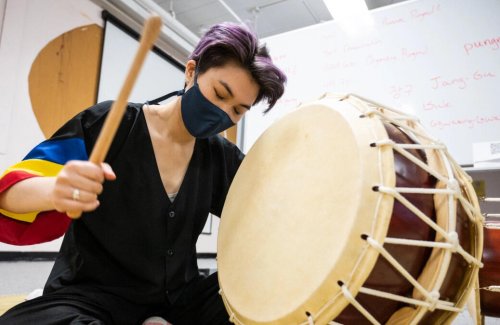
North Side Immigrant Rights Group Foster Community By Folk Drumming

Hana Center, a nonprofit organization for Asian American and immigrant rights, provides neighbors new opportunities to teach them traditional Korean folk drumming, which activists frequently use in their advocacy. 

Community engagement coordinator Won Joon Lee tells Block Club Chicago that the group teaches Pungmul, a Korean folk tradition with deep historical roots. It originated in Korea’s pre-industrial farming culture and used the hourglass-shaped janggu (a double-sided drum) to protest immigration and racism. 

Lee explained that during the Japanese occupation of Korea from 1910 to 1945, public gatherings were prohibited except for musical performances, making Pungmul a form of resistance. 

In 2017, two long-standing organizations,  the Korean American Community Services, and the Korean American Resource and Cultural Center were combined to become Hana Center, named from the Korean word for “one.”

The organization has a long history of youth Pungmul programming, but this summer marked the first time the non-profit offered classes for adults interested in advocacy work. 

The first-ever class will proceed after the initial session of eight weeks has passed. As the new program expands, the instructors intend to continue enrolling new students in it on an ongoing basis.

Hana Drum School instructor Inah Jeong said Pungmul drumming is loud as planned, and they are culturally and politically distinct. Korean immigrants may connect with Chicago immigrants and join the immigrant rights and citizenship march, she tells Block Club Chicago.

The ensemble delivered its first drumming class this summer, but new students are always welcome to join in. Residents and community organizations can benefit from such events, according to the center’s administrators.

Choi tells Block Club Chicago that the current situation is both exhausting and frightening, but she believes the strong and loving communities they form may provide joy even in difficult times.

Their communities enable them to change the world now and in the future. The goal according to Choi is to turn community building into advocacy that targets racial, gender, and economic concerns along with immigrant rights.

Hana Center is located at 4300 North California Avenue in Irving Park. It also offers services to address needs related to citizenship and immigration, housing, and other areas.