Stories

January 18, 2023

SHARE:

First Slurp! 

Food is a way for us to connect and tell stories by engaging all of our senses. Nielsen Noodles is a series where we gather to share our own stories while discussing insights and current events over a bowl of instant noodles. We virtually shared a bowl of noodles with Michael Lai, CEO and Co-Founder of Famous Media Group and AsianFeed, along with Randall Yip, Founder and Executive Editor of AsAmNews; two trailblazers in AANHPI news and journalism. 

(Top) Randall Yip , (Bottom L-R) Patricia Paturangi, Michael Lai

Which noodle dish did you choose to bring to the conversation?

Randall brought a bowl of wonton noodle soup from his family’s favorite hole in the wall, sharing, “All of my favorite items thrown into one… I picked this because it reminds me of my mom …  she loved to sit around the table and get the family together and just talk, that was her excuse to get the family together.”  

Michael shares, “I brought my favorite brand of instant ramen, I usually add an egg and some bok choi… I always remember coming home from practice, my parents were a little too tired to cook so we all would eat instant noodles and share conversations about our days. Memories and nostalgia from childhood are what these noodles remind me of.” 

Tell us about your news outlet, what is the story behind founding each of your outlets?

Randall recalled growing up in a time where the only Asian American role model on TV was Bruce Lee. While he and his friends idolized the kung fu star, he felt his community was missing critical daily representation in news.

“I wanted to share a different light, we tried to focus on Asian Americans who were role models breaking stereotypes. On the second front, we wanted to have a daily news site because Asian Americans were missing a news site where you could follow Asian American News on a daily basis. So from the very beginning, we’ve operated 365 days a year and we have not deviated from that, ” says Randall.

Michael comes from a different generation of representation. While striving for authentic storytelling connects both Michael and Randall, Michael aims to build a community of Gen Zers through short form, sociable content.

 “We’re an Asian-centric digital media brand, founded just last year, and grown to more than 200,000 followers across social channels. Designed at conception as a media brand to celebrate the shared cultural experiences of the younger generations in America and around the world. 

Growing up I was one of three Asian Americans in my entire school district, I often felt alienated from my Asian American identity. Outside of my parents, there weren’t really many opportunities for me to connect with others who shared my culture and ethnic background… My goal was to create a digital space that I feel I would have benefited from when I was younger, where stories that were important to me were the focus and where I could connect with others who shared similar cultural experiences.” says Michael. 

Why is it so important that diverse media be well-represented in the industry?

Nielsen research has found that certain shows with diverse representation both in front and behind the scenes, attracted more of that audience group – we want more of what’s familiar. From a similar standpoint, it’s also important to have diverse-owned media equally represented in the media ecosystem. 

“There are so many diverse community-centric stories to be told. The only way to make sure these stories are told in an authentic manner is for them to be told by members of the community in front of the camera, and behind the camera as well. It’s so important because there are so many cultural nuances and contextual clues that I think are important. Audiences these days can really tell when something is just superficial versus something that is truly authentic and a project designed to forward and advance the community,” notes Michael. 

He continues to say, “Especially this younger generation growing up, I think there are so many independent content creators emerging, creating amazing content that resonates not only with their own individual community, but also with the broader community at large. I think that is super important, and a trend that will continue to really advance the representation.”

Why is it so important for advertisers to invest in Asian American-owned media?

When we think of advertisers, we often think of Fortune 500 companies and major brands but in a community, such as Asian Hustle Network, we have inspiring entrepreneurs building Asian American-owned businesses. This year Nielsen started a Diverse-owned Media Initiative to help raise visibility of diverse media suppliers so they have a fair and equitable chance to get in front of ad buyers. 

Randall says, “I think the smart brands realize that they can’t continue doing what they have been doing. They need to expand their reach and customer base.” 

Michael says, “[Advertisers] are really starting to realize that Asian Americans are an important audience too. I think we’re one of the most rapidly growing consumer demographics in terms of pace of growth and authentic messaging is important… For advertisers to want to connect with those audiences, I think it’s extremely important, specifically for Asian Americans, to diversify their marketing budgets to allocate some of that budget for those audiences. 

Michael explains further “It’s not just Asian-Americans consuming this content, there are so many instances where K-POP, BTS, Blackpink, Squid-game, Korean dramas, as well as other Asian Entertainment groups. It’s just amazing how widespread it has become, it’s not just Asian-Americans, it’s really everybody is engaging as a whole in these stories that are inherently culturally Asian-based.

Final Slurp!

Michael and Randall have many things in common, especially their desire to champion equity in journalism, entertainment, and storytelling.

Randall urges up-and-comers: “Every brand comes with its own story, every entrepreneur has their own story to tell. Don’t be afraid to tell your story and don’t be afraid to pitch it to media outlets. You’re going to find that there will be a lot of interest…Be Inspiring!” 

Media is where the unique stories and voices of our community can be found. As our community becomes even more diverse, providing opportunities for greater equity in media and enabling more diverse voices becomes even more critical. The people behind the stories who are from our community — from journalists to media owners — continue to stand together to open up more opportunities for future generations of storytellers. Thank you Michael and Randall for paving the way with your passion and commitment.

Watch the full Nielsen Noodles episode here!

Learn more about Nielsen at www.nielsen.com.
Related Articles

Image Source: Considered Objects

Stories

Japanese-American Designer Sara Sakanaka Revamps Vintage Kimonos Into Modern Clothing

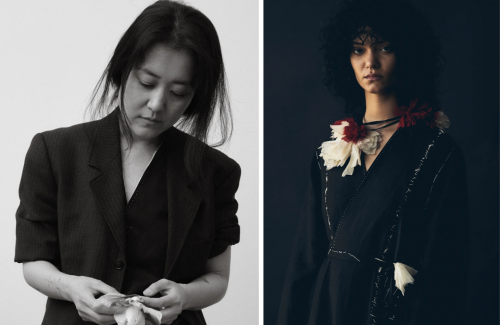
Each of us has a unique way of imparting the memories, stories, and mementos we want to pass on to our future generations. As for 39-year-old Japanese-American designer Sara Sakanaka, the way is by incorporating ancient tales into modern clothing.

In her studio in Brooklyn, Sara preserves a little drawstring bag that her grandmother sewed for her decades ago. One of Sakanaka’s oldest mementos, this heirloom represents a long-standing ideology and was made from leftover fabric.

You will also find in her studio, folded stacks of rescued textiles waiting for her to stitch them into something new, exactly like her grandmother used to do as a hobby.

After her grandmother passed away, Sara began studying the kimonos she had inherited from her. She realized that giving these garments a second chance through reconstruction was a means of healing and re-establishing her identity and cultural roots.

Her initial creation was a classic, collared, button-down shirt. She embroidered a tiered patchwork flower fashioned from leftover silk scraps inside each garment she produced.

“There’s this whole idea that objects have lives,” she says in a Vogue interview. “I like to see every piece as a truly considered object in that way,” thus, naming her label as Considered Objects.

Considered Objects offers tapered silk slacks, oversized coats, two-toned vests, draped dresses, and hand-sewn accessories. Each item is made of recyclable materials, and within each garment is a silk scrap flower and a tag. Each shirt comes with a drawstring bag, a keepsake designed to be handed on like the one she inherited from her grandma.

Image Source: Business Insider / Linkedin

Stories

These Two South Asian Millenials Are Breaking Cultural Barriers To Empower Women’s Financial Freedom and Literacy

“Our culture has countless strict gender roles, one of which is that men manage money and women don’t,” Aashka Piprottar, the founder of Boss Betis, told Wealthy Wolfe’s Parween Mander over email. “So while men get to discuss money openly and proudly, women, if they ever discuss it, do so in hushed, quick voices.”

Those gender roles convinced Aashka from a young age “that I was just destined to be ‘bad with money’ and I would just have to rely on my father — and then in the future, probably my husband — to manage the money for me,” she adds. 

Boss Betis is a community-based platform to destigmatize the conversation around money, specifically the unique challenges faced by desi women. The platform wants to instill that financial freedom and literacy are essential to women’s empowerment. 

While Wealthy Wolfe is a digital financial coaching & education platform for women of color from immigrant upbringings specifically.

Aashka also told Parween that she’s unlearned the harmful money narratives of her childhood through working in the wealth management and financial wellness space.

By 27, Parween had a $150,000 net worth, so she could support herself and her parents without feeling burdened. She advised that we must put on our financial oxygen masks first, as well as to start a  “Parent fund” account to save money for our families in case they need it, “This is a way to set a financial boundary so that you don’t feel resentful or sabotaged if they require funds from you.” Parween wrote on Business Insider.

Understanding the complexity of the South Asian culture, Parween has helped one of her clients to set up strategic savings accounts to separate her money, while still contributing funds when her client’s parents asked for it.

Parween affirms that cultural expectations and narratives play a huge role in their ability as South Asian women to make different decisions, especially when it comes to their money and building wealth. 

Image Source: Omakase Restaurant Group

Stories

Omakase Restaurant Group: How These Two Immigrants Went From Dishwasher And Busboy To Co-Founders

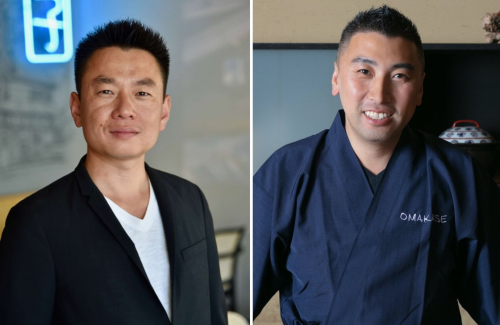
Kash Feng, co-founder and CEO of Omakase Restaurant Group, moved to the Bay Area at age 18. He was the only child of factory workers, so when he moved to the U.S. in 1999 with his buddies, he borrowed $20,000 from relatives and friends, promising to return them.

Feng started working as a dishwasher at a Chinese restaurant in the East Bay, and was quickly promoted to busboy. He progressed through various industrial occupations, frequently juggling three jobs at once, while also taking English classes.

In 2007, he met Jackson Yu, who eventually became his business partner and executive chef of Omakase sushi restaurant. Like Feng, Yu also had modest beginnings. At 16, he and his parents left China and moved to the Bay Area. 

Yu was a Japanese buffet busboy and gas boy on his days off. He was once asked to help out when the sushi chef cut his fingers one day. Yu then became so skilled that he could manually shape 2,000 identically sized sushi rice balls per day. Other sushi establishments took notice of this, including the well-known Ebisu in the Sunset, where he worked for five years to master sushi making.

They were both 26 when they decided to start their own restaurant business, Live Sushi, pooling all their savings and borrowing from relatives. Their restaurant was a hit from the beginning. Eventually, they were able to pay off all their loans, and the rest is history.

Now, Omakase Restaurant Group is an ever-growing empire, with different establishments all over San Francisco.

Image Source: Shark Tank

Stories

Software Engineer Turned Crocheting Hobby Into A Six-figure Business Takes $450k Deal on ‘Shark Tank’

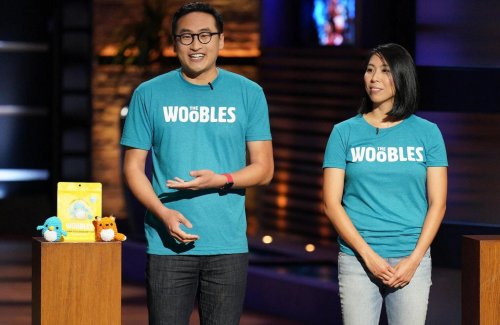
Justine Tiu, a former Google Classroom software engineer, started crocheting to unwind after work. After realizing its appeal, she and her ex-Wall Street director husband, Adrian Zhang, launched The Woobles, a crochet kit company.

On Friday’s “Shark Tank,” the two explained the hobby’s vast appeal. The firm made $3.1 million last year and $5.3 million since launching two years ago.

All five Sharks quickly decided they wanted a piece of the company, and they showed they were willing to betray their business partners to get it.

The Woobles is a crafting kit company that offers patterns, step-by-step video tutorials, and all the materials needed to do amigurumi crochet, a Japanese fiber art form, even if you are a complete beginner. Once your kit arrives with all the materials, a login code gives you step-by-step written and video instructions to make your craft and helpful hints when you get stuck.

Tiu and Zhang ultimately received a $450,000 investment offer from sharks Mark Cuban and Lori Greiner. In exchange, the company, which at the time of filming was on pace to generate $7 million in yearly sales, gave Cuban and Grenier a split of 6% equity.