Stories

September 13, 2023

SHARE:

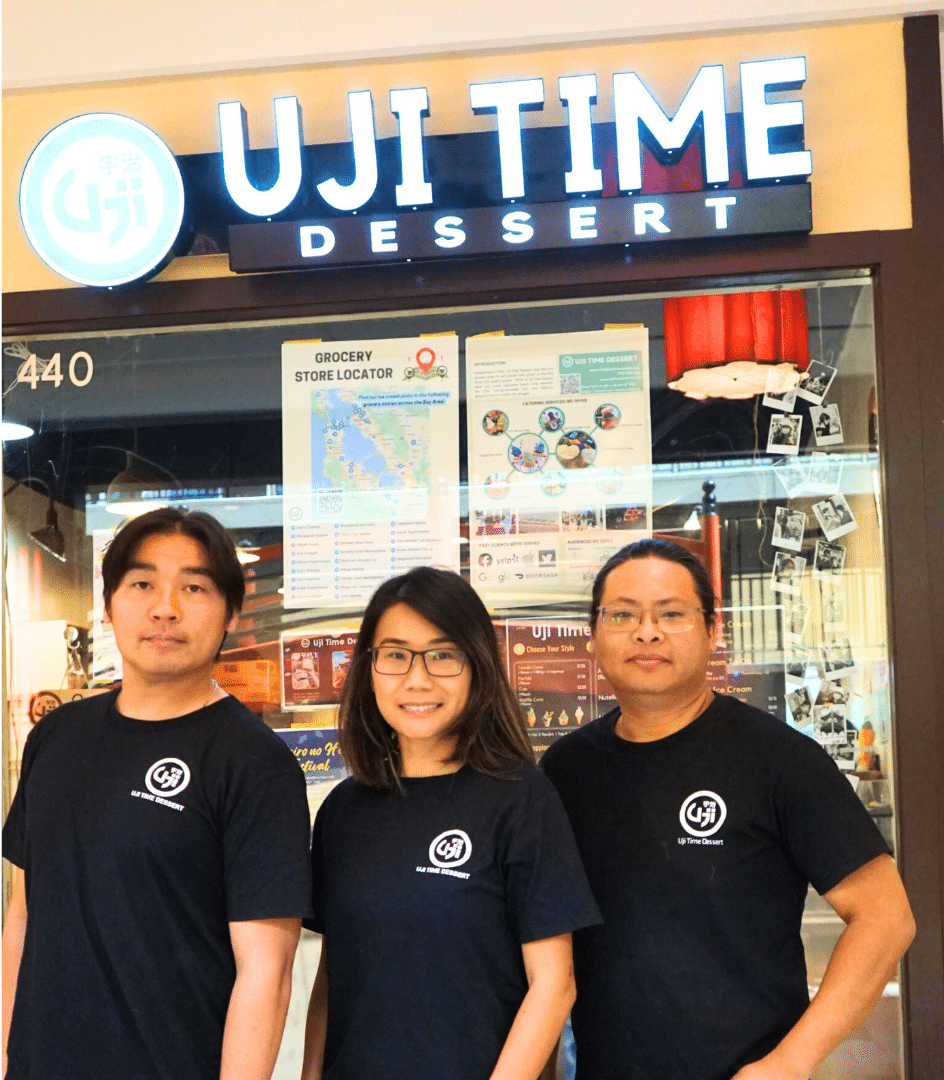
Sharon Ku, born and raised in Hong Kong, is one of the co-founders behind Uji Time Dessert, a delightful dessert store in the Bay Area.

Sharon has been working in the food industry for the past 15 years since she graduated from UC Berkeley with a major in Nutrition Science.

Through Uji Time Dessert, Sharon and her team bring together the best of East Asian flavors and desserts, making them accessible to everyone. The pop-up store’s authenticity and creativity garnered massive success, and it became the first dessert shop of its kind in the Bay Area.

In an interview with Asian Hustle Network, Sharon Ku shared her journey as an entrepreneur. Read through as we discover how she turned her passion into a thriving business, and how she found inspiration within the community.

HOW IT ALL STARTED

Uji Time Dessert opened its first pop-up store in April 2016. Together with John Ip and Benson Leung, we have been taking far east flavors and desserts and making them mainstream in the Bay Area. Our famous Fish Cone, called Taiyaki, is our take on the traditional Japanese dessert in the shape of a fish, usually filled with red bean paste. The pop-up was a great success because of its authenticity. Uji Time Dessert was the first dessert store selling Taiyaki soft serve in the Bay Area.

Uji Time Dessert loves to combine and meld elements from multiple traditional desserts to create affordable treats for everyone. Our goal is simple – think of Uji Time Dessert when you crave Japanese fusion-style desserts.

Uji Time Dessert regularly offers Instagrammable, fun, and delicious desserts and ice cream for all ages. It has transformed into a full-scale dessert cafe, from Fish Cone (Taiyaki), black sesame soft serve, lychee ice cream mochi, Matcha Latte, Earl Grey puddings, to Hojicha and Genmaicha ice cream. Depending on the season, Uji Time Dessert offers limited production seasonal flavors, such as strawberry rose and lavender in soft serve or ice cream.

During COVID, we connected with many local businesses to do cross-promotion and share resources. We offer our stores as pick-up locations for other business owners. Other business owners help to promote our brand and products.

In 2022, Uji Time Dessert expanded its footprint to Seattle, Washington, and Albuquerque, New Mexico. Uji Time Dessert continues to seek opportunities to serve our customers.

NAVIGATING THROUGH THE COVID-19 CHALLENGES

COVID hit hard across Bay Area San Francisco in 2020. Our sales dropped to 0% as we only sold soft-serve ice cream. Our stores were forced to close for 3-12 months. We closed two stores permanently.

Despite COVID-19 challenges, we expanded from 0 to 25 local supermarkets. Closing three stores didn’t stop us; we opened three new locations and have more coming in Palm Springs and New Mexico with our licensed partners.

These difficulties brought our team closer and made us stronger. From a small ice cream shop, we now distribute to various locations in the Bay Area. The growth and partnerships showcase our resilience and quality. I’m inspired and confident in our continued success.

SUPPORT AND INSPIRATION WITHIN THE COMMUNITY

I’m grateful to the Asian Hustle Network community for sharing inspiring stories of persistence, and for the connections I’ve made in this group.

I met Jing who has a passion for helping small businesses, the owner of Kaya Bread, and other inspiring individuals. Connecting with like-minded entrepreneurs and supporting my brand growth has been invaluable. 

Once again, I want to express my gratitude to the Asian Hustle Network for providing a platform that facilitates learning, sharing, and gaining inspiration. I am truly thankful for the opportunity to be part of this community and to share my story of resilience, growth, and the joy of forging connections to support others in building their own brands.

Processed with VSCO with fa1 preset

VALUABLE LESSONS AS A SUCCESSFUL ENTREPRENEUR

I would suggest everyone not to give up.

We should not focus on what might stop us from achieving our goals. We should think of what we can do to make a change. Don’t be afraid and try to reach out. Many experienced entrepreneurs would love to share their experiences and thoughts with you.

CONNECT WITH UJI TIME DESSERT

Instagram: @ujitimedessert

Tiktok: @ujitimedessert

Facebook: Uji Time Dessert

Related Articles

Image Source: Brendan Duong

Stories

A Secret Business Purchase Grew Into A Multi-million Dollar Enterprise

Tess Nguyen who is a trained physiotherapist was searching Gumtree, Australia’s marketplace, for a physiotherapy clinic to buy. Instead, a sleepwear ad called Midnight Mischief captured her eye, “I’d never heard of personalised pyjamas, and I was pretty up-to-date with trends, so I sent an inquiry,” she told 7life.

She consulted her friends who have accounting and business experience and told Tess it was worth nothing and advised her not to buy it. However, she liked the pyjamas’ style and name, plus she was able to bargain the business down to $15,000. So, a month later she bought the business.

Tess kept the purchase secret from her family. The business was going slow during the first two years, and running the business while working as a full time physiotherapist, took its toll.

When 2020 hit, the business was ready for the huge demand prompted by COVID and people staying at home. The big moment was when TV presenter Jules Sebastian posted a photo of herself wearing Midnight Mischief pyjamas.

The brand grew 165% in the year to July 2021. And Tess has gone from pyjama girl to Pyjama Queen – selling a set every 10 minutes. The designs retail for about $99.95 – and her sleepwear empire is now turning over $2.3 million.

“I’m so glad I did it and I’d tell anyone else to do the same,” Tess told 7Life, “Just go for it. You can figure it out as you go along. It’s worked for me.”

Image Source: Chris Pizzello/ Invision /AP file

Stories

Awkwafina Knows Best About How She Is Still More Financially Great Living On $500 A Month

Even though the Crazy Rich Asians actress’ wealth is likely in the millions, she believes that a mere $500 per month is sufficient to cover her expenses.

The 32-year-old actress recently told Harper’s Bazaar that her money philosophy goes back to when she was building her Awkwafina musical and comedy persona, which she used as an outlet for her creativity while she worked a day job in book publicity.

Her grandmother brought her up in a one-bedroom apartment in Queens, New York. Because her family’s restaurant went out of business and they were forced to sell their home, she has developed a greater appreciation for monetary gain than any other aspect of her life.  

Awkwafina remembers that funds were tight at home and that she would stay up late with her grandma, who worried about paying the bills.

She also claims that despite being in a better financial position to support her family and herself, she still maintains a just-the-basics mentality. The actress has been known to buy clothes at Target and not spend much money on anything. She set out with the simple objective of covering her living expenses. 

She explains to Harper’s Bazaar, “I went into this mode off, if I can make $500 a month, that’s all I need.” 

Awkwafina’s motivation and success are attributed mainly to her refreshingly optimistic view of financial considerations. She has kept herself busy acting in the years since, including launching her comedy series on Comedy Central and becoming the first Asian-American actress to win the Golden Globe for best actress for her lead role in the 2019 drama “The Farewell.”

Image Source: Photograph by Ken Richardson Boston Magazine

Stories

Chef Tracy Chang Gives Back To The Community Through The Language Of Food

Restaurateur Tracy Chang started the nonprofit Off Their Plate and Project Restore Us through the COVID-19 pandemic in 2020. 

The owner of the Japanese tapas restaurant,  PAGU, started Off Their Plate as a way to feed healthcare workers, and Project Restore Us sends nutritious and culturally appropriate grocery boxes to families living in food deserts. Both groups work to support local kitchens run by women and BIPOC and volunteers.

As a chef, Tracy also finds herself more in tune with customers than ever before. As someone who grew up lactose intolerant, she sources ingredients responsibly and remains mindful of the way guests feel after they leave her restaurant. This is also part of her restaurant’s ethos.

Her grandmother has also influenced Tracy’s cooking. Although her grandmother didn’t speak English, she spoke the language of food really well, said Tracy, and that was something that always resonated with her.

For Tracy, her personal experience has definitely come into play — trained in Spain but worked at a Japanese restaurant, and she grew up with a lot of Japanese and Taiwanese food, “The menu at PAGU is autobiographical and about my experience learning very specific dishes and techniques from people like my grandmother, my mentor and some of the chefs I’ve worked with.” she told TimeOut.

Image Source: CNN

Stories

Young Tech Startup Founders In Asia Make Mental Health Support Accessible To Break Stigma

Breaking down societal stigma and creating a new mental healthcare system for the Asia-Pacific area are two of Theodoric Chew’s objectives, founder of the digital mental health app, Intellect.

Founded in 2019, the mobile app frequently monitors users’ moods, delivers rescue sessions and exercises, and lets them chat with therapists in real-time. 

The 26-year-old explained that mental health is just as important as physical health, “You and I face things like stress, burnout, sleep issues, and relationship struggle as well.” he told CNN, “ That’s where actually a lot of us should start working on our mental wellbeing.”

Since early 2020, the startup serves over 3 million Asia-Pacific users in 15 languages. According to CNN Business, the Singapore-based mobile app has raised $20 million in its Series A funding, the largest amount raised by a mental health start-up in Asia.

Early this year, Singapore and Jakarta-based digital mental healthcare start-up, Ami, has raised at least $3 million from a number of investors, including Meta, the owner of Facebook. The firm was founded by Justin Kim, a Forbes 30 Under 30 Asia alum with Beknazar Abdikamalov.

Both digital mental health companies are targeting employers in their business models, where companies can subscribe to provide staff unlimited, private access to their services.

According to the WHO, depression and anxiety disorders cost the global economy $1 trillion a year in lost productivity. In March, it was reported that anxiety and sadness surged 25% worldwide in the first year of the pandemic.