Stories

October 7, 2026

SHARE:

Richard Nguyen grew up on the east side of San Jose, where he became caught up in street life at a young age. Looking back, he believed the path he was on could have ended with either prison or an early death.

Then came the moment that made him reconsider where his life was headed.

He overheard his mother speaking with friends about their children. She talked about relatives who had graduated from college, while Richard felt she had little she could proudly say about him.

“She couldn’t say anything good about me,” Richard recalled.

His mother was raising the family on her own, and hearing her disappointment became a wake-up call. Richard knew he couldn’t continue down the same path and decided he needed to find a different direction.

He took a job he found on Craigslist for $10 an hour, unsure of where it would lead. It became his entry point into an industry where he would spend the next 15 years learning and building experience.

What started as a decision to change his life would eventually become the foundation for something much bigger.

Years later, that experience would bring him together with Jack and David Nguyen and a growing group of IT hardware businesses.
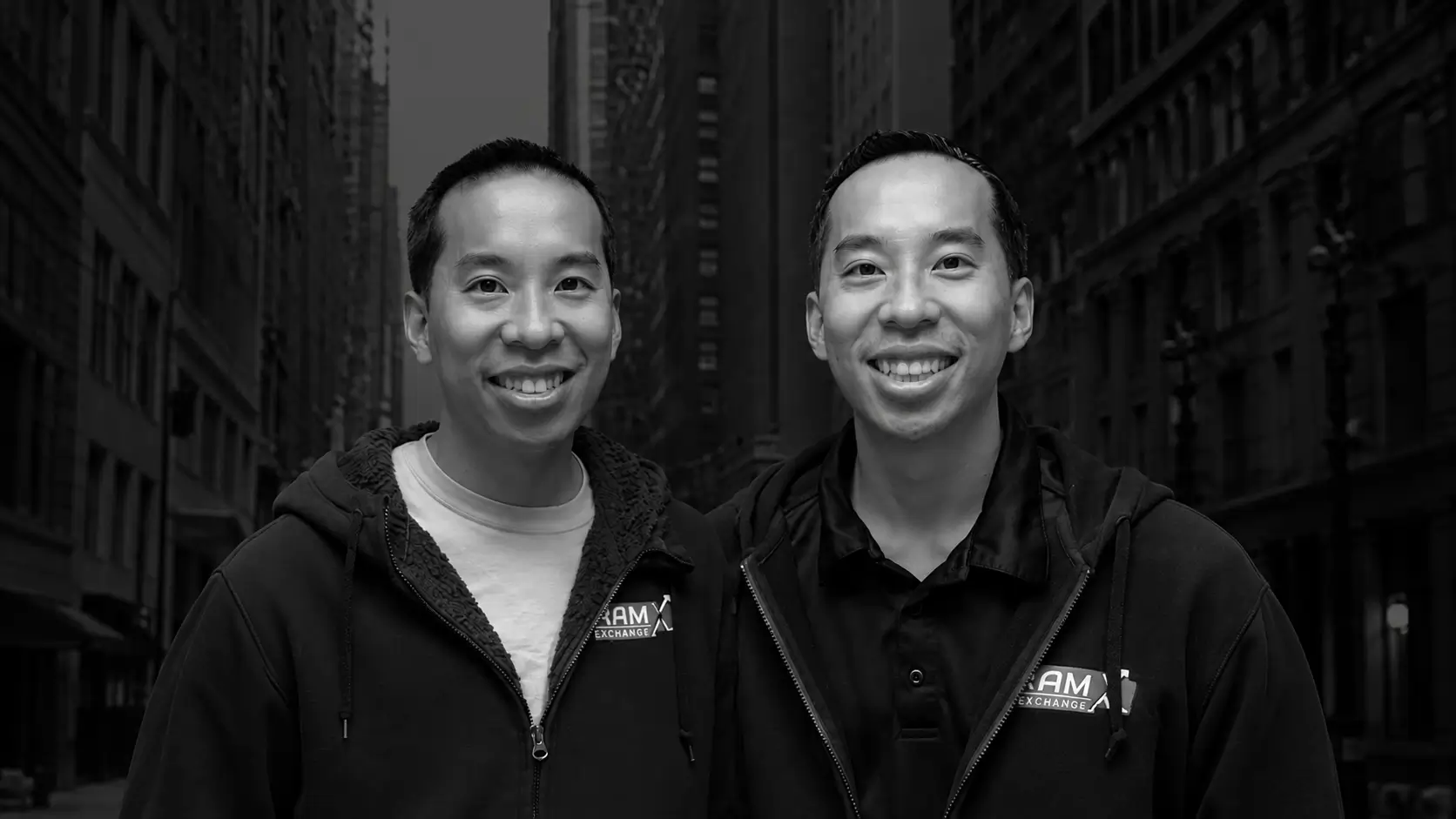
Twin brothers Jack and David Nguyen

The Brothers Behind the Business

Years before Richard partnered with them, twin brothers Jack and David Nguyen were already building their footprint in the IT hardware industry.

Around two decades ago, they saw an opportunity in used computer equipment and began reselling components, primarily semiconductors and RAM. That business became RAM Exchange, which eventually grew into what Jack described as a $50 million-a-year company.

From there, the brothers expanded into servers, networking equipment, drives, and other data center hardware through IT Server Exchange.

By then, Richard had spent years building his own expertise in the same industry. Their paths were about to come together.

Bringing Richard Into the Business

Richard was working for a competitor at the time, but his experience and reputation had already caught Jack and David’s attention. They knew his understanding of the IT hardware business and respected the grit, loyalty, and work ethic he brought to his work.

Eventually, Richard took a risk of his own and started E-XPIRE, focusing on IT asset disposition, secure data destruction, and electronics recycling.

As E-XPIRE grew, Jack and David saw more than Richard’s industry experience. They saw someone who could build a business, lead a team, and execute.

But Richard had already taken the risk of becoming an entrepreneur himself. Bringing him into their business would require more than offering him a position.

The opportunity became a partnership. E-XPIRE and IT Server Exchange merged, bringing Richard’s ITAD expertise together with Jack and David’s established hardware business. Richard became an equal partner in IT Server Exchange and took on the role of COO.

“We gave him the keys,” Jack said.

The merger brought together two complementary sides of the industry and created an opportunity to build something larger. Richard came in ready to rethink how the operation worked, and Jack and David gave him the freedom to make the changes he believed the business needed.

Their roles complemented each other. Richard took the lead on operations, execution, and building the team, while Jack and David provided the business foundation, resources, and support behind him. Jack described himself and David as Richard’s “pillars.”

Together, they continued growing RAM Exchange, IT Server Exchange, and E-XPIRE. Today, the partners say the three companies are on track for around $300 million in combined annual revenue.

What began with Richard taking a chance on himself and building E-XPIRE ultimately became the start of a partnership that would help reshape IT Server Exchange and support the growth of the wider business group.

Leading Through Culture

For Richard, how the team works is just as important as how the business grows.

He describes a culture built around speed, loyalty, and getting things done. Internally, the team uses the phrase “GSD,” short for “get stuff done.”

Richard also sees his employees’ livelihoods as a personal responsibility.

“I work 18-hour days because it’s for my team and my family,” he said.

David credits Richard with creating a culture where employees feel that same sense of loyalty toward the company.

That philosophy is shared by all three partners. Jack said one of their biggest sources of pride is not simply revenue growth, but the impact their businesses have had on employees and their families.

Finding a Reason to Keep Going

For Richard, success still traces back to the conversation he overheard more than two decades ago.

Today, David says Richard’s mother lights up when she talks about him.

“Every time I see her, she smiles,” he said. “She’s so proud of Richard.”

Richard’s advice for people who feel the odds are against them is simple.

“Anyone can make it,” he said. “You just gotta find a reason to do it.”

More than two decades after that conversation, Richard has given his mother plenty to be proud of. That same drive now carries into the work Richard, Jack, and David are building at E-XPIRE.

While companies race to adapt to AI, Jack, David, and Richard focus on what powers it: infrastructure. Their businesses support its lifecycle, from hardware to responsible decommissioning.

Today, E-XPIRE helps businesses securely destroy sensitive data and responsibly manage retired IT equipment. As technology continues to evolve, so does the need to handle what gets left behind.

Learn more about E-XPIRE and its work in IT asset disposition, data destruction, and electronics recycling.

📍Website

Related Articles

unnamed

Stories

How Christopher Thang Juggles Medical School and Entrepreneurship With Time Optimization Strategies

You don’t really need to feel motivated to start — you just need to start! (easier said than done, right?)

While it’s also important to understand why you put off doing something and what causes it, what’s even more important is overcoming it.

Christopher Thang is a medical student at the University of Texas Medical Branch. He is also an Online Fat Loss Specialist certified by the National Academy of Sports Medicine.

His current mission is to help busy working professionals lose 15+ lbs in 60 days with his Progressive Eating Strategy and fitness-lifestyle optimization systems.  

Read through as Christopher shares how he manages his time as both a full-time medical student and entrepreneur.

The Chronic Procrastinator

Now, I am not saying I have the busiest schedule out there, and I definitely do not. But, I’ve included a breakdown of my time-saving strategies below that help me find time to work on my business, study for medical school exams, and travel across the US to meet clients.

My deep dive into time management started in college. I was a chronic procrastinator and always rushed to meet deadlines the night before they were due. This left me super anxious and my disorganized tendencies, unfortunately, caused me to arrive late to almost everything. It got so bad that I showed up late to or forgot about work meetings, social events, and even important family gatherings.

Eventually, I had enough of winging my schedule every day (some days I didn’t even know I had tasks due). I tried countless things to improve my time management, and after a few years of trial and error (still ongoing), I came up with these 3 approaches that helped.

I was a chronic procrastinator and always rushed to meet deadlines the night before they were due. This left me super anxious and my disorganized tendencies, unfortunately, caused me to arrive late to almost everything.

-Christopher Thang

Strategy 1: Time Block Everything

Simply put, I time block my entire day out on Google Calendar as the day goes along. It may sound intense, and it honestly is… But, after I delegate tasks, meetings, and other life events, I gain structure and peace of mind for the day. I’m also able to look back at each day to see what I can be more efficient on.

Now, I don’t time block out every single minute of each day a week in advance (would be overwhelming), but I plan ahead for important events. By including things such as meal prep, working out, and business meetings, I can make a micro-commitment beforehand to fit these things into my schedule.

On the day of such events, I time block my day in 15, 30, or 1 hour+ chunks. Once I gain control and understanding of my time, I leverage it to do more work in less time throughout the day (of course, I have to be realistic when time blocking out tasks). I’m also able to enjoy social events, family time, and travel without worrying about work which brings me to Strategy 2.

Strategy 2: 100% Work or 100% Relaxation

Building off of Strategy 1, I stick to a hard rule of either working 100% or relaxing 100%. I take every effort to avoid the gray area in between, where I’d end up working inefficiently or trying to relax (and failing) because work is on my mind.

So, on my calendar, I include 15-minute blocks labeled “Break” (when I’m dividing up work into several chunks using the Pomodoro Method) and long hours blocked off for “Social Events” or “Family Time.”

Of course, life happens frequently, and sometimes events may take longer/shorter than expected or something may come up that interrupts my entire schedule. This brings me to Strategy 3 below.

Strategy 3: Plan Ahead, But Be Flexible

Whenever something unexpected happens, I time block it out in my calendar and shift everything down (Google Calendar lets me click and drag events around on my phone really easily).

Sometimes I shift down tasks so much that I have to move them on to the next day (if possible), but I remind myself to stay realistic if life suddenly hits on some days.

Connect with Christopher 

Now, I didn’t develop these approaches overnight, and they took time to develop into daily habits.

However, I hope my strategies would be able to inspire others to stay mindful of their time and perhaps try some of my approaches to elevate their personal lives and hustles.

Linkedin: Christopher Thang

Instagram: @christopher.thang

Website: https://www.hgbtconsulting.com/free-case-study

Image Source: CBS

News

Eric Kim To Lead CBS Entertainment and Studios As New Executive Vice President

Eric Kim has been recently promoted as CBS’ Executive Vice President for Current Programs after serving as Senior Vice President in the same company where he worked for 11 years.

He succeeds Amy Resisenbach who has just advanced as President of CBS Entertainment.

Kim will now be functioning in his new position to oversee the primetime and daytime programs.

Reisenbach mentioned in Deadline that in working with Kim for more than ten years, she has always been amazed by the latter’s remarkable expertise in programming, in working with showrunners, and in dealing with people whom he works with.

While still the SVP, Kim supervised comedy and drama series production in Blue Bloods, FBI: Most Wanted, FBI: International, and CSI.

Kim had a strong background in the field working in live-action series for Nickelodeon and Teen Nick for two years and was the then-VP for Current Programming at the CW for 3 years.

Moreover, Kim has been a part of the creative team that launched the new network when The WB and UPN networks merged as well as the executive at UPN from 2004 to 2006.

Kim entered the world of the entertainment industry by working for Jonathan Demme on the Academy Award-winning Philadelphia. 

He is a graduate of the University of Pennsylvania where he took a Bachelor of Arts in English Literature.

CBS TV Studios President David Stapf said, “His (Eric’s) leadership has earned the trust and respect of both the industry and his colleagues at the Studio and Network. As Eric steps into this new role, I’m looking forward to seeing the impact he makes both within the creative community and on our series that are enjoyed by global audiences.”

Image Source: Tammy Sun Linkedin

Stories

Through Personal Experience, Tammy Sun Starts Up Carrot Fertility Company To Help Women Start Families

At 34, Tammy Sun went looking for egg fertilizing services as she thought of starting a family of her own someday. But in her quest, she, unfortunately, found out that she has “premature ovarian failure.”

The mysterious disorder indicated negative effects on Tammy’s fertility that she had to go through several egg-freezing cycles which cost her $40,000.

Working in Evernote tech company that did not have fertility treatment benefits, the medication was very costly for her.

With this in mind, Sun put up Carrot Fertility, a fertility care provider, in 2016.

Carrot Fertility partnered with different companies to include fertility services in their health coverage where employees can avail of egg freezing, IVF, adoption, pregnancy, menopause treatments, and others.

In MSNBC, the CEO and founder stated that “The company was born out of a desire to make sure that every single person, regardless of their age, their sex, their sexual orientation, gender identity, marital status, race or geography would have equal access to high-quality care.”

Not only did the service provider address women’s concerns but also men’s as according to her, fertility is a human health issue for both sexes.

A year after Carrot’s onset, it has already acquired over $200 million in investments from first-class firms and is now a partner of above 800 companies.

Supporting millions of workers, including their families, Carrot is set to process claims worth $500 million.

Tammy also revealed that 95% of their clients remain in their respective jobs because of Carrot.

Unlike other businesses which declined during the pandemic, more than a three-fold increase in the use of the platform was observed during the time and up until now as many availed of mental and emotional health services.

Many companies partnered with Carrot to encourage employees to stay especially during the Great Resignation period.

Now, Carrot Fertility is the leading global platform for fertility healthcare and family-forming benefits.

Image Source: Richie Fernandez Facebook

News

Filipino Family Grows COVID Financial Aid From Government Through Fishball Sauce Business

Filipino Richie Fernandez, a new entrepreneur, was able to launch a business venture that now generates a five-digit income with the help of $100 in financial aid from the government.

During the height of the pandemic lockdowns, Richie and his family chose to grow the help by opening Manong’s Fishball Sauce, “We thought of how to grow and prolong the money,” Richie said.

With his family’s fondness of eating street food fish balls but at the same time considering the limitations posed by the pandemic at that time, the family decided to sell bottled fishball sauce so people could just enjoy it at home with their own-cooked fish balls.

The modest family business prospered through hard work and perseverance. Not only do they sell their product in the Philippines but they now also export to Japan, Australia, Austria, and the US.