Eunice Chen’s Táng Transforms Childhood Night Market into a Moving Animated Story
Stories
March 24, 2025
SHARE:
After transitioning from her career as a teacher to an animation artist and illustrator, the talented Eunice Chen once again decided to test her abilities by creating an animated short film project called Táng (糖).
“人算不如天算” — in Chinese belief, every encounter is predestined and our current state is the fruit of past karma. One life ago, we were somehow, unknowingly, cultivating our karmic connections, which ultimately led to this present life’s encounters or coincidences.
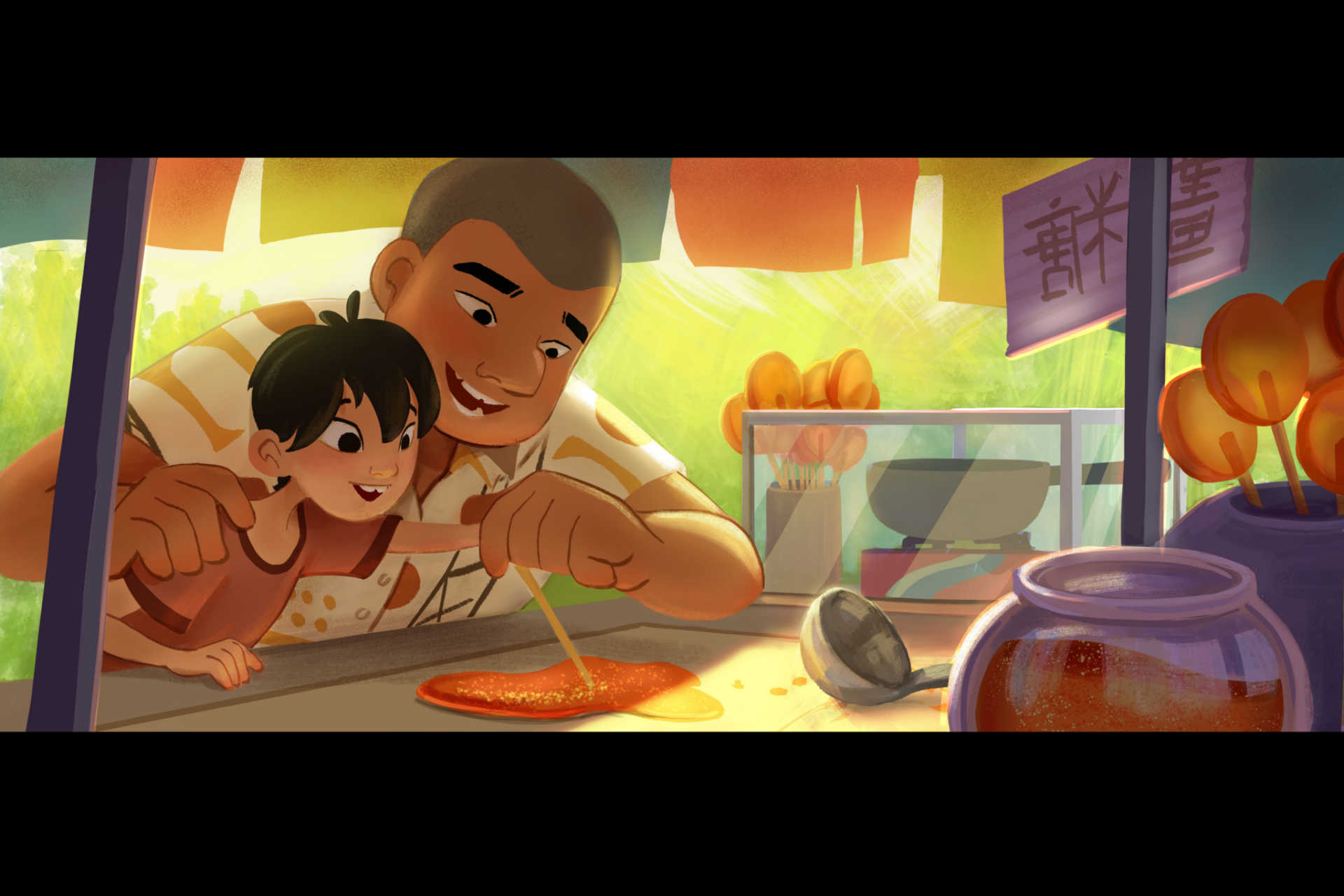
Táng is a movie about one of those by-chance encounters as well that integrates the art of 糖画 (tánghuà). Through the lens of tánghuà – a traditional Chinese sugar-painting art, this unexpected relationship arrives and flourishes into a confounding yet paramount work of fatherhood, family, and fate.
THE INSPIRATION BEHIND TÁNG
Growing up between the U.S. and Taiwan, Eunice developed deep-rooted cultural memories that shaped her appreciation for her heritage. In this new venture, she continues exploring culture—this time, through nostalgia.
Where should we begin? Back to her childhood in Taiwan, like every other child, Eunice loved going out and visiting open-air markets. Bustling lines of food vendors, jittery echoes of chatters, and also a rare occasion when one can play games without their parents’ side eyes, open markets are the idols of many young children in Taiwan. It is also where she was introduced to the art of sugar-painting.
Reflecting on this memory, Eunice shares:
Yes, the idea of this story first came from my childhood memories of visiting open-air markets and night markets in Taiwan. Whenever I visited those markets, I would always make sure to visit the candy stalls, where master candy makers sculpted these lollipops that were amazing pieces of art and also very tasty confections. And I’ve always had a giant sweet tooth, so I started my film out of a place of joy.
The short film centers around the meaningful connection between a sugar-painting street vendor (left) and a student.
A REFRESHING TAKE ON FATHERHOOD AND FAMILY
In Chinese families, “血浓于水” (Blood is thicker than water) has long been a staple for centuries—that family is of utmost importance, and the bloodbound places more value than strangers. It is only natural that the concept of a “chosen family” may irk some, who put a sense of filial piety and duty in high regard.
Of course, it feels almost peculiar for Eunice Chen – the eldest child, who has switched careers, from landing a “safe” job at teaching to taking a more off-the-beaten-path direction towards doll-making and now…animation artist and now…film director!! So expect the unexpected layers and nuances Eunice has painted Táng. Táng is more than just a love letter to Taiwanese night markets. It’s one that Eunice picks up the lack of positive portrayals of father-and-son relationships in the Asian community.
“When someone makes art or a film, sometimes they are painting a world they wish they had or would like to see in the future. I wish I had seen more strong bonds between Asian fathers and sons as I grew up,” Eunice shares.
While Táng’s messaging can cover this complex matter only to a certain extent; here, Eunice is after something more personal for many Asians: “a healing balm” for those with similar experiences. However, Eunice adds that she’s been seeing a lot of change in parenting recently. She says, “I am super proud of how intentional and hands-on Asian fathers from my generation (and beyond) have been with their children!”
Now, Eunice is bringing Táng to life, but she needs our support.
A scene involving the art of sugar-painting.
JOIN THE JOURNEY: SUPPORT TÁNG
The idea for Táng came to Eunice during a storyboarding class, when asked to create quick story concepts. Táng was one of the ideas she came up with, leading her to develop a script—her first ever. While world-building and character design might be her forte, the real challenge followed: securing funding. Facing multiple rejections, it took one “yes” from what she thought would be her final meeting to reignite her determination.
The initial funding allowed her to assemble a small but passionate team, who have since created the film’s first three minutes. Now, they need additional support to complete the project, leading to the launch of their Kickstarter campaign.
But independent films—especially ones that bring forward Asian heritage and underrepresented narratives—need tremendous community support.
Supporting the Táng crowdfunding campaign is a step forward to preserving a piece of cultural heritage while amplifying nuanced Asian fatherhood stories, and ensuring that art like this can continue to thrive.
“Keep working on your art and portfolio. Get to know people already working in the industry and learn from them. And make art that comes from the heart and makes you happy. It’s going to be very difficult, especially given the current state of things in the animation industry as a whole, but if this is truly what you want, then don’t give up!”
Shadiah Sigala co-founded HoneyBook, a $2 billion financial management software platform for small businesses, motivated by her ability to negotiate uncertainty while gathering information and making decisions.
When Shadiah was a child, her Mexican mother together with her two siblings moved to southern California. Despite most of her family members being unable to attend college, she was an honor student whose lifelong ambition was to acquire the greatest degree of education.
Shadia attended Pomona College for Latin American Studies and Harvard Kennedy School for public policy. As a result, she established a strategy for reaching goals she wasn’t sure about.
Before becoming an accomplished millennial, she finished her master’s degree and became the highest-earning member of their family as a project manager at Aetna, a health insurance company, where she learned about entrepreneurship, realized she is a “builder,” and thought starting her own company was the best option.
However, Shadia realized that she wouldn’t be happy there since she wouldn’t be valued. Shadia ultimately started a personal chef business in 2010, using her Pomona College alumni network to find well-off grads who wanted someone to cook for them.
In 2012, another realization occurred to her that cooking wasn’t for her. Shadiah then decided to move with her then-husband to San Francisco and found tech. She arranged informative interviews with everyone in the sector and learned that the problem she wanted to tackle was one she’d experienced as a business owner: no effective method to handle backend logistics like emails, payments, and bills.
With the three Israeli business people who have a similar concern as hers, they decided to digitize all these tedious procedures that micro small firms must complete to free them up to genuinely focus on doing what they love.
Using that concept, Shadia established HoneyBook in 2013 and worked there for five years according to CNBC.
As her most recent business, Shadia co-founded Kinside in 2018, a child-care marketplace that is available to employees that offers new parents a centralized location to look for daycare in their neighborhood, which has reached over $16 million, according to Crunchbase.
Letting fear and excitement be one’s guide and being open-minded is what Shadia advises to other aspirants.According to her, opportunities that “feel like they are beyond your pay grade” are exactly how stellar is made.
Highlighting the impact of the Asian-American pop culture publication Giant Robot, the debut of the latest episode entitled “Giant Robot: Asian Pop Culture and Beyond” was finally aired last October 26 in the acclaimed arts and culture series ARTBOUND on KCET.
The episode showed Giant Robot’s examination of Sawtelle Boulevard as a Japanese-American neighborhood, sparking interest in Asian and Asian-American popular culture which resulted to a long line of Asian American artists who won recognition on a global scale.
Established in 1994, Giant Robot was a bimonthly journal that focused on Asian popular culture that soon included works by Asian-American artists including David Choe and James Jean.
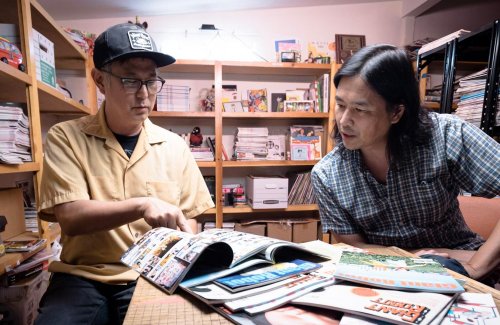
Eric Nakamura began publishing Giant Robot as a digest-sized zine. The piece covered a variety of subjects, including trendy Asian American independent filmmakers, Japanese punk rock, and contemporary Hong Kong films. National media sources including the New York Times, Wired, and LA Weekly published the story.
In 2001, Nakamura opened his first store named “Giant Robot Store” in Sawtelle Japantown and expanded in 2003.
Giant Robot co-founder, Martin Wong edited all 68 issues of the glossy magazine on Asian, Asian-American, and new hybrid culture from 1994 to 2010, when it was still a punk zine. His wife Wendy Lau served as Giant Robot’s graphic designer beginning with issue 18. Even today, Martin continues to publish zines and contribute to them.
The popular weekly television program and online site ARTBOUND captures the essence of California’s expanding arts and cultural scene and investigates how it is transforming the state into the world’s creative capital.
The KCET Original series investigates and clarifies contemporary cultural challenges, offering insightful in-depth study of how the arts and culture impact society.
“In a way, I was poor. I was hungry, maybe not for food but for self-achievement. I thought there must be something more I can do than just being a housewife. I was very determined to succeed, in whatever came my way,” thus said Julie Gandionco as quoted by the Inquirer, the Philippines’ local newspaper.
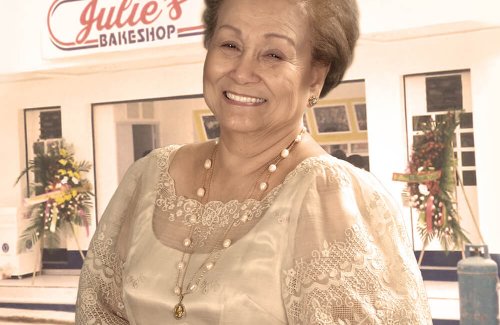
In January 1981, then-50-year-old Julia Gandionco opened Julie’s Bakeshop to satisfy her thirst for proving that she is more than a housewife.
Julie’s Bakeshop gloriously celebrates being one of the Philippines’ largest bakery chains with more than 500 branches all over the country, which can be traced back to Mandaue City on the Island of Cebu as its place of origin.
In the 1970s, Julie was a canteen concessionaire at a rattan company, and subsequently became a manager of its sister company. She also opened another canteen a year later.
Having these three canteens being managed, she felt the rising demand for bread which made her take the chance of opening a bakeshop, despite having zero knowledge of baking.
Julie stressed that her bakeshop exists because of “a growing need for bread products and a strong trust in God,” and that she desires to encourage and uplift other mothers to dream big and strive for their goals.
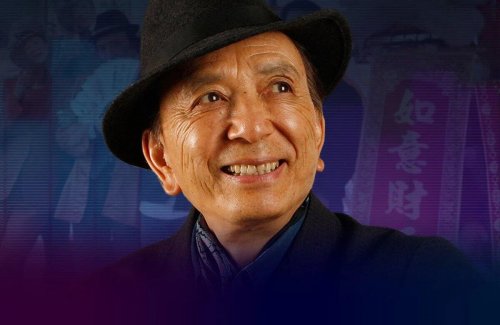
During the Critics Choice Association (CCA)’s Inaugural Celebration of Asian Pacific Cinema & Television, veteran actor James Hong received the prestigious Icon award along with a few other awardees.
The veteran actor reflects on his over 700 roles and how Asian representation has changed: “When I was a kid, ‘The Good Earth’ was played by Caucasian leads that taped their eyes up.”
In his speech, Hong commended Asian-American creatives for “carrying through” work to advance their careers in the entertainment world and emphasized that his ultimate goal was to stop hatred and boost the whole level of Asian-Americans.
“To see an organization collect all these people together and work together and stop this hatred for Asians is our main goal, I think, and just boost the whole level of Asian-Americans,” Hong mentioned to the PA News Agency.
Held at Fairmont Century Plaza, CCA’s celebrity-filled event highlighted both new and experienced talents and featured other notable figures from the Asian film industry.
At the age of 93, the veteran vigorously demonstrated a few martial arts movements for the photographers with a smile on his face during the occasion.
In his more than six decades-old career, Hong is a well-accomplished actor with hundreds of film and television credits who co-founded the East West Players in 1965, making him more than deserving to receive the Icon award.
The actor stated that CCA is perhaps one of the pioneering organizations that promote culture.