The world of home decor is a place where creativity and self-expression know no bounds. It’s a space where artists and makers come together to craft unique and meaningful designs that add a personal touch to people’s homes.
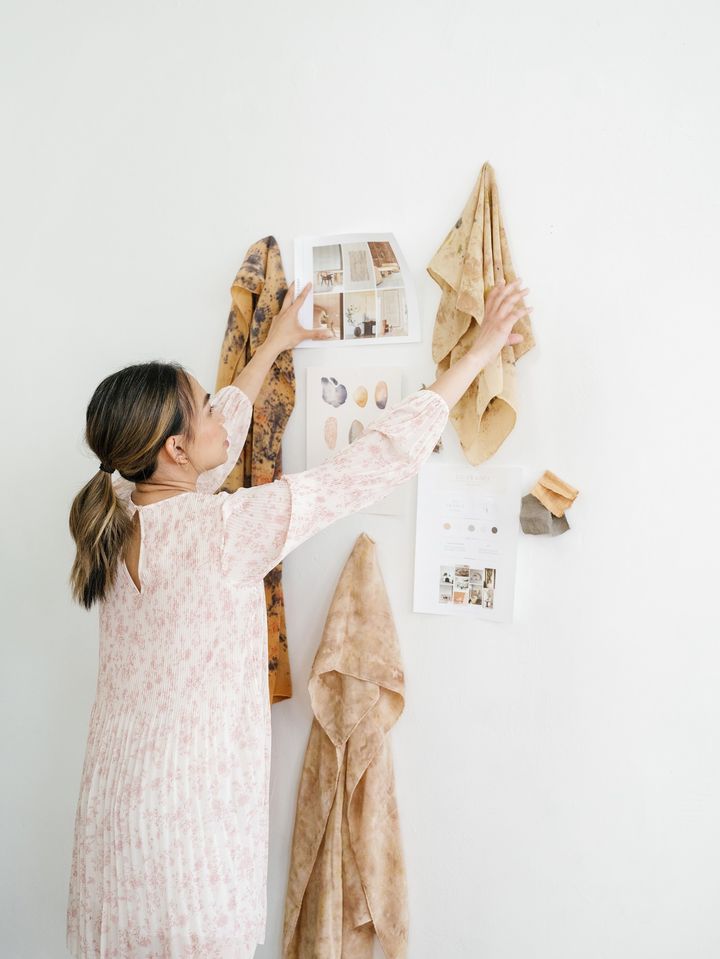
In the heart of San Diego, California is France Malvar. Her story is one of hope, passion, and self-discovery. After 14 years as an early childhood educator, France took a leap of faith and pivoted her career to become a natural dye artist and create Lu France Interiors, a home decor brand for intentional design. For the past two years, she’s been pouring her heart and soul into her work, crafting pieces that are as beautiful as they are sustainable.
France carefully chooses the businesses and artisans that her brand partners with. Her previous collections were made in collaboration with small businesses all over the world, mostly in the Philippines, to support the local weavers and artisans in her homeland.
I HOLD FOND MEMORIES GROWING UP IN THE PHILIPPINES
I’m pretty blessed to have had a childhood full of memorable experiences and surrounded by people who have in one way or another shaped me.
I grew up in my Papa’s ancestral house in the Philippines before my parents eventually built their own, which became our home, and I have nothing but good memories of both. Summers and Christmas breaks were spent with my cousins and we would spend weeks at our Lola’s house, or at our Tita and Tito’s home, or somewhere exploring a new place together.
As my parents got settled in their respective careers, we progressed to traveling more or going out — driving up to Tagaytay, spending Sundays at the park, exploring all sorts of shops and markets, or eating out. They also gave us the opportunity to explore different sorts of activities and I took a special interest in ballet, starting classes at the age of 3 and then continuing through the start of high school before moving to other forms of dance through college. A lot of my memories involve recitals and shows and having my family there to support me.
I don’t know what defines a typical childhood. But I do know that I hold fond memories growing up in the Philippines. Even to this day, there are moments that I get so nostalgic for every time, and I am grateful for all of them.
TRANSITIONS CAN BE SCARY, PIVOTS AT LEAST TO ME ARE TERRIFYING
Much of my young adulthood has always been about pivots.
Growing up, a career in medicine is what I’ve always been exposed to. A lot of times I’d tag along with my sisters to our Papa’s clinic or I’d wait for Mama in hospital break rooms and offices. Whether those instances were by design or simply out of necessity, I always thought I’d just follow along and take a science course to eventually pursue a career in medicine in one form or another.
So I studied Sports Science in college. During an Adapted Physical Education class, I realized that I liked teaching children. It gave me so much joy seeing how even the smallest actions you make and the lessons you share, impact their days and eventually their lives. After graduation, I applied for teaching jobs with a focus on music and movement, and fitness for young children. I figured I could take my Sports Science degree, my love for dance and movement, and use it to pivot to a career teaching children.
My first job offer out of college was from a school in Singapore, but I chose to stay in the Philippines and worked for a year there before moving to the US. I eventually took a certificate in early childhood education and spent 14 years in that industry working both in the US and the Philippines. It was a career I loved (and honestly actually miss). While I continued to teach, I also kept dabbling in the different art forms I’ve taken a liking to. I took design workshops to relieve my stress – styling, floral arrangement, natural dyes, etc.
When the pandemic happened and schools shut down, I enrolled in Interior Design online and started honing my love for all things design, leaving a career I’ve known for 14 years and taking my love for natural dyes and design a step further by launching my business.
Transitions can be scary, pivots at least to me are terrifying. I’m the type of person who is constantly planning. I need to know where I will be, and what I will do at certain points in my life. When changes happen and I need to adjust, that throws me off and my anxiety kicks in. But I think for the most part it is exactly because I am a planner and because I willingly chose these pivots from Sports Science to early childhood to now, a natural dye artist and small business owner, there was more excitement than anxiety as I took every transition.

LU FRANCE INTERIORS IS AN EXTENSION OF MYSELF
Much of who I am as a designer and artist are rooted deeply in my being Filipino and more specifically, my experiences and memories I have growing up in the Philippines. That’s true for the things that catch my eye whether it be handcrafted wood pieces, ceramics, or the spaces I gravitate to, I crave rooms and spaces that are “maaliwalas,” full of warmth with a lived-in look, calming, and organic.
The stories that shape my collections are all stories from home. The candle scents I have in collaboration with Terra, a Filipino-American brand, are inspired by my life growing up in the Philippines. Every single scent has a story, a distinct memory attached to it.
The stories that guide and serve as the foundation for my naturally dyed pieces are all inspired by memories from the Philippines too. Sometimes a moment from years ago inspires me or a Filipino word that resonates with me moves me to make a tangible piece of art. Or sometimes an event back in the Philippines moves me to create a whole collection of naturally dyed textiles. I previously dropped a whole collection inspired by the campaign of former Vice President Leni Robredo! What I can’t articulate, I translate in the form of my naturally dyed textiles, always hoping to share a piece of my being Filipino with others.
My values also play an important role in the people I choose to work with. I have a collaboration collection with Anthill, a social enterprise based in Cebu, Philippines. My thrust for love of community, sustainability, amplifying the work of Filipino artisans, and sharing their stories are some of the values I found in Anthill too.
And while I proudly work with non-Filipino makers too and curate pieces from artisans and businesses around the globe, the same design influences from my life in the Philippines and the same values guide me in choosing what to pick and who to work with no matter where they come from. I say this often, Lu France Interiors is an extension of myself. It’s me in brand form and while I do not constantly scream about my being Filipino, I think if you browse through my website or follow me on social media, you’ll see why I don’t have to — it’s just naturally, constantly, permanently, and beautifully a part of my identity.
ALLOWING MYSELF TO ASK FOR HELP FROM OTHERS HELPED ME TO RIDE THE HICCUPS THAT USED TO KEEP ME UP AT NIGHT
As with any other small business, I think the financial uncertainty that comes with building and running a brand is the most challenging part of building a business. The design process comes easily to me (at least thankfully, for the most part, it does!).
My years of teaching children and dealing with difficult parents have also helped me in dealing with customers and suppliers. But navigating slow seasons, courier mishaps, and other unexpected issues that affect cash flow were challenges that really kept me up for nights at some point since I launched my brand. But I’m really lucky to have the constant support of family who all go above and beyond in helping me pursue and monetize this passion, the support of friends, and the support of a very loyal audience who all continue to spread the word about my brand.
I also found comfort and strength in knowing that I am not the only small business owner who has had to deal with the hardships post-pandemic and I’ve learned much from my fellow makers, artists, and owners. I pivoted to pushing for more wholesale opportunities for my natural dye work so that they are stocked in more retail stores, I joined more pop-up markets to introduce my brand to audiences that social media doesn’t reach, and I adjusted in terms of collection batches and when and how I launch and restock pieces.
The brand is a continuous work in progress for sure as much as I am too as a person and I think changing my perspective on how I view these challenges and using them as learning curves and allowing myself to ask for help from others helped me to ride the hiccups that used to keep me up at night. It’s okay to ask for help and to admit when you need it!
THE PHILIPPINES IS AND WILL ALWAYS BE MY HOME
That’s not to say that America isn’t because it is too and I’m super grateful for that. But I think wherever I go and whatever I do, the foundation on which my identity is anchored is firmly rooted in calling the Philippines my home. I feel like it has always been my comfort zone, most of my friends are there and I feel like I navigate everyday life more confidently over there.
I’m an introvert and I think that has been magnified so much more here in the US. But you know how situations force you to adjust and adapt? I think I’ve become much braver living here, I push myself to do things I wouldn’t have tried back in the Philippines. I know it sounds cliche but America has really opened doors for me in terms of providing an environment for me to explore and create opportunities for myself and for others. Moving here has been a journey of self-discovery and it still is. This adoptive country of mine has taught me that I am more than one thing and that it isn’t too late to try something else.
If you told me while living in the Philippines that I’d one day call myself a natural dye artist, own a home decor brand, have pop-ups at stores like Madewell, join markets and art exhibits at galleries, and connect with strangers turned customers turned friends through social media, I would have laughed and said you are crazy. Yet here I am surprising myself every single day, bravely going out of my comfort zone, opening myself up to people, and rediscovering a deep sense of love and immense gratitude for 2 countries that I proudly call home.

CHANGING CAREERS SHOULDN’T BE TAKEN LIGHTLY
I’ll probably raise a few eyebrows in saying this but I don’t believe in the “Do what you love, love what you do” statement or advice. I think that doing a pivot and considering a major career change entails not only sacrifice but careful planning and much… so much patience.
Every situation is different, we all come from different paths and I recognize that it is a privilege to be able to pivot to a new career and explore a whole new industry without worrying about what to eat the next day or where to sleep. So I think before you make that leap you should thoroughly, carefully, consider your situation, your needs, and your goals.
If you need to stick to doing something that you don’t love at the moment so that it gives you a little more cushion for the pivot you are planning then hang in there for a little bit longer and use your dream as your motivation. Changing careers, especially leaving a stable job with a stable, monthly income shouldn’t be taken lightly. But when you do, if you are able to, give it your all. Do it wholeheartedly, give it 110% of your time and effort, and stick to it. Stick to it long enough for as long as it makes you happy, for as long as the joy you get from it outweighs the sacrifices you make to make it work. And do not ever forget your WHY. Let your WHY guide you always.
CONNECT WITH FRANCE
Instagram: @lufranceinteriors
Website lufranceinteriors.com
Facebook @lufranceinteriors