Stories

July 18, 2025

SHARE:

For Nan Lin, entrepreneurship isn’t just business; it’s freedom. A freedom earned through sacrifice, relentless execution, and a refusal to accept the limits of a broken system. As the founder of Kaizen Capital and 4DIFY, Lin is reimagining the housing industry, tackling its inefficiencies with cutting-edge technology and a bold vision. His mission? To build stronger homes faster, at lower costs, empowering communities and challenging the status quo.

From Immigrant Roots to Visionary Leadership 

Lin’s journey began at age 10, when he immigrated to America with his mother. While adapting to a new country, he was inspired by his loving parents’ sacrifices, which shaped his relentless drive. “I saw the lengths they went to give me a better life,” Lin says. “Their love and dedication became my compass.” Years later, that resolve led to the creation of Kaizen Capital, where he transforms underutilized properties into vibrant housing solutions: ADUs, subdivisions, condo conversions, and luxury short-term rentals. By unlocking hidden value in land, he delivers market-rate and affordable housing that strengthens neighborhoods.

But Lin saw a deeper problem: traditional construction is slow, costly, and vulnerable to fire, pests, and natural disasters. Frustrated by an industry stuck in the past, he founded 4DIFY to lead a new era of construction through 3D-printed concrete homes.
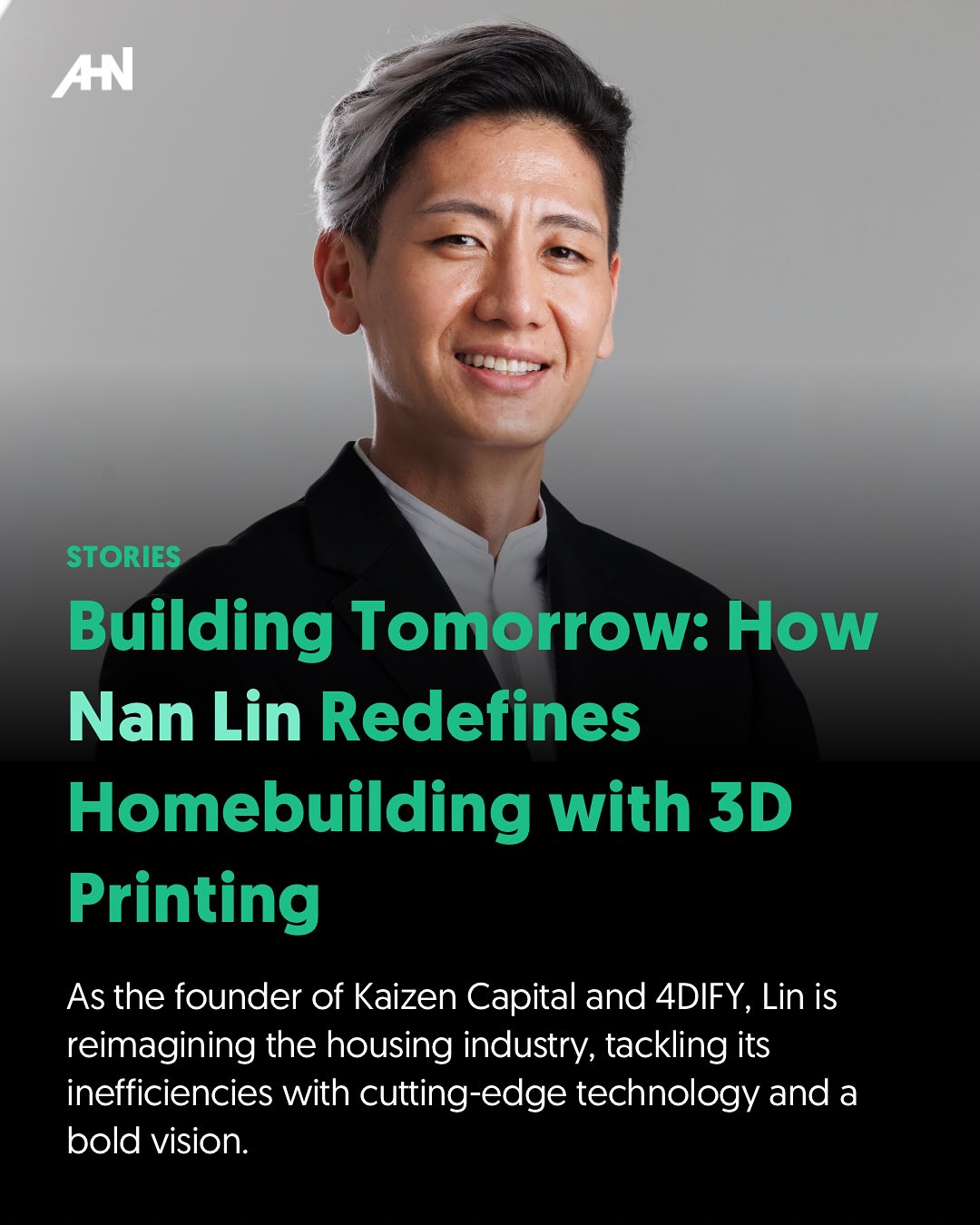
Nan Lin | Founder and Principal of Kaizen Capital and 4DIFY

3D Printing: The Future of Housing, Today

Lin’s vision for 4DIFY was sparked by a frustrating reality: “Wildfires destroy neighborhoods every year, yet we keep building stick-frame homes that burn like kindling,” he says.

After visiting several 3D printer manufacturers, Lin partnered with New York–based SQ4D. It took nearly a year to secure exclusive licensing rights, navigate regulatory hurdles, and obtain building permits, but he got it done.

Now, 4DIFY is building California’s first community of 3D-printed concrete homes. As this article goes live, their first printed home is nearing completion, despite heavy regulations and a steep learning curve. The team is already outperforming traditional timelines and cost benchmarks. The second and third homes will soon print simultaneously, targeting completion in two months, effectively one home per month at under $200 per square foot.

Despite challenges as an Asian immigrant, Lin managed to transform them into motivation and success. 

“We’re aiming to build at half the cost and in a quarter of the time,” Lin says. “That’s not a dream. It’s the direction we’re heading.”

Built with concrete, reinforced with rebar, and topped with metal roofs, these homes are resilient against fire, wind, earthquakes, mold, and pests. They’re also designed for long-term savings, with lower maintenance, less waste, and reduced energy and insurance costs.

“Critics doubted it would work,” Lin reflects. “But seeing is believing. This is the future.”

A Philosophy of Purpose and Resilience

Lin’s journey has been marked by relentless challenges, some seemingly insurmountable. “Obstacles never stop,” he admits. Yet he transforms adversity into opportunity, fueled by a positive mindset, solution-driven focus, and disciplined execution. His trusted team is his backbone. “No one succeeds alone,” he says. “My team turns the impossible into reality.” This resilience shapes his leadership, blending bold vision with purposeful action to create opportunities, particularly for communities long excluded from wealth-building. “Housing isn’t just a product,” Lin says. “It’s a platform for empowerment.”

Recognition and Inspiration

Lin’s impact is gaining notice. The Sacramento Bee named him one of the Top 20 AAPI Change Makers, and he was honored in the Business Elite Awards’ 40 Under 40. But for Lin, the real reward is inspiring others. “I want to show the next generation of Asian entrepreneurs what’s possible when we claim our seat at the table,” he says.

Lin wants to create opportunities for those marginalized by elevating the future of construction, making it more accessible for his community.

Join the Housing Revolution

Nan Lin isn’t just building homes, he’s redefining what’s possible. Through Kaizen Capital and 4DIFY, he’s creating a future where housing is affordable, resilient, and sustainable. Follow his journey and see the revolution unfold.

Connect with Nan Lin:

Related Articles

Image Source: Brendan Duong

Stories

A Secret Business Purchase Grew Into A Multi-million Dollar Enterprise

Tess Nguyen who is a trained physiotherapist was searching Gumtree, Australia’s marketplace, for a physiotherapy clinic to buy. Instead, a sleepwear ad called Midnight Mischief captured her eye, “I’d never heard of personalised pyjamas, and I was pretty up-to-date with trends, so I sent an inquiry,” she told 7life.

She consulted her friends who have accounting and business experience and told Tess it was worth nothing and advised her not to buy it. However, she liked the pyjamas’ style and name, plus she was able to bargain the business down to $15,000. So, a month later she bought the business.

Tess kept the purchase secret from her family. The business was going slow during the first two years, and running the business while working as a full time physiotherapist, took its toll.

When 2020 hit, the business was ready for the huge demand prompted by COVID and people staying at home. The big moment was when TV presenter Jules Sebastian posted a photo of herself wearing Midnight Mischief pyjamas.

The brand grew 165% in the year to July 2021. And Tess has gone from pyjama girl to Pyjama Queen – selling a set every 10 minutes. The designs retail for about $99.95 – and her sleepwear empire is now turning over $2.3 million.

“I’m so glad I did it and I’d tell anyone else to do the same,” Tess told 7Life, “Just go for it. You can figure it out as you go along. It’s worked for me.”

Image Source: Chris Pizzello/ Invision /AP file

Stories

Awkwafina Knows Best About How She Is Still More Financially Great Living On $500 A Month

Even though the Crazy Rich Asians actress’ wealth is likely in the millions, she believes that a mere $500 per month is sufficient to cover her expenses.

The 32-year-old actress recently told Harper’s Bazaar that her money philosophy goes back to when she was building her Awkwafina musical and comedy persona, which she used as an outlet for her creativity while she worked a day job in book publicity.

Her grandmother brought her up in a one-bedroom apartment in Queens, New York. Because her family’s restaurant went out of business and they were forced to sell their home, she has developed a greater appreciation for monetary gain than any other aspect of her life.  

Awkwafina remembers that funds were tight at home and that she would stay up late with her grandma, who worried about paying the bills.

She also claims that despite being in a better financial position to support her family and herself, she still maintains a just-the-basics mentality. The actress has been known to buy clothes at Target and not spend much money on anything. She set out with the simple objective of covering her living expenses. 

She explains to Harper’s Bazaar, “I went into this mode off, if I can make $500 a month, that’s all I need.” 

Awkwafina’s motivation and success are attributed mainly to her refreshingly optimistic view of financial considerations. She has kept herself busy acting in the years since, including launching her comedy series on Comedy Central and becoming the first Asian-American actress to win the Golden Globe for best actress for her lead role in the 2019 drama “The Farewell.”

Image Source: Photograph by Ken Richardson Boston Magazine

Stories

Chef Tracy Chang Gives Back To The Community Through The Language Of Food

Restaurateur Tracy Chang started the nonprofit Off Their Plate and Project Restore Us through the COVID-19 pandemic in 2020. 

The owner of the Japanese tapas restaurant,  PAGU, started Off Their Plate as a way to feed healthcare workers, and Project Restore Us sends nutritious and culturally appropriate grocery boxes to families living in food deserts. Both groups work to support local kitchens run by women and BIPOC and volunteers.

As a chef, Tracy also finds herself more in tune with customers than ever before. As someone who grew up lactose intolerant, she sources ingredients responsibly and remains mindful of the way guests feel after they leave her restaurant. This is also part of her restaurant’s ethos.

Her grandmother has also influenced Tracy’s cooking. Although her grandmother didn’t speak English, she spoke the language of food really well, said Tracy, and that was something that always resonated with her.

For Tracy, her personal experience has definitely come into play — trained in Spain but worked at a Japanese restaurant, and she grew up with a lot of Japanese and Taiwanese food, “The menu at PAGU is autobiographical and about my experience learning very specific dishes and techniques from people like my grandmother, my mentor and some of the chefs I’ve worked with.” she told TimeOut.

Image Source: CNN

Stories

Young Tech Startup Founders In Asia Make Mental Health Support Accessible To Break Stigma

Breaking down societal stigma and creating a new mental healthcare system for the Asia-Pacific area are two of Theodoric Chew’s objectives, founder of the digital mental health app, Intellect.

Founded in 2019, the mobile app frequently monitors users’ moods, delivers rescue sessions and exercises, and lets them chat with therapists in real-time. 

The 26-year-old explained that mental health is just as important as physical health, “You and I face things like stress, burnout, sleep issues, and relationship struggle as well.” he told CNN, “ That’s where actually a lot of us should start working on our mental wellbeing.”

Since early 2020, the startup serves over 3 million Asia-Pacific users in 15 languages. According to CNN Business, the Singapore-based mobile app has raised $20 million in its Series A funding, the largest amount raised by a mental health start-up in Asia.

Early this year, Singapore and Jakarta-based digital mental healthcare start-up, Ami, has raised at least $3 million from a number of investors, including Meta, the owner of Facebook. The firm was founded by Justin Kim, a Forbes 30 Under 30 Asia alum with Beknazar Abdikamalov.

Both digital mental health companies are targeting employers in their business models, where companies can subscribe to provide staff unlimited, private access to their services.

According to the WHO, depression and anxiety disorders cost the global economy $1 trillion a year in lost productivity. In March, it was reported that anxiety and sadness surged 25% worldwide in the first year of the pandemic.