Stories

July 18, 2025

SHARE:

For Nan Lin, entrepreneurship isn’t just business; it’s freedom. A freedom earned through sacrifice, relentless execution, and a refusal to accept the limits of a broken system. As the founder of Kaizen Capital and 4DIFY, Lin is reimagining the housing industry, tackling its inefficiencies with cutting-edge technology and a bold vision. His mission? To build stronger homes faster, at lower costs, empowering communities and challenging the status quo.

From Immigrant Roots to Visionary Leadership 

Lin’s journey began at age 10, when he immigrated to America with his mother. While adapting to a new country, he was inspired by his loving parents’ sacrifices, which shaped his relentless drive. “I saw the lengths they went to give me a better life,” Lin says. “Their love and dedication became my compass.” Years later, that resolve led to the creation of Kaizen Capital, where he transforms underutilized properties into vibrant housing solutions: ADUs, subdivisions, condo conversions, and luxury short-term rentals. By unlocking hidden value in land, he delivers market-rate and affordable housing that strengthens neighborhoods.

But Lin saw a deeper problem: traditional construction is slow, costly, and vulnerable to fire, pests, and natural disasters. Frustrated by an industry stuck in the past, he founded 4DIFY to lead a new era of construction through 3D-printed concrete homes.
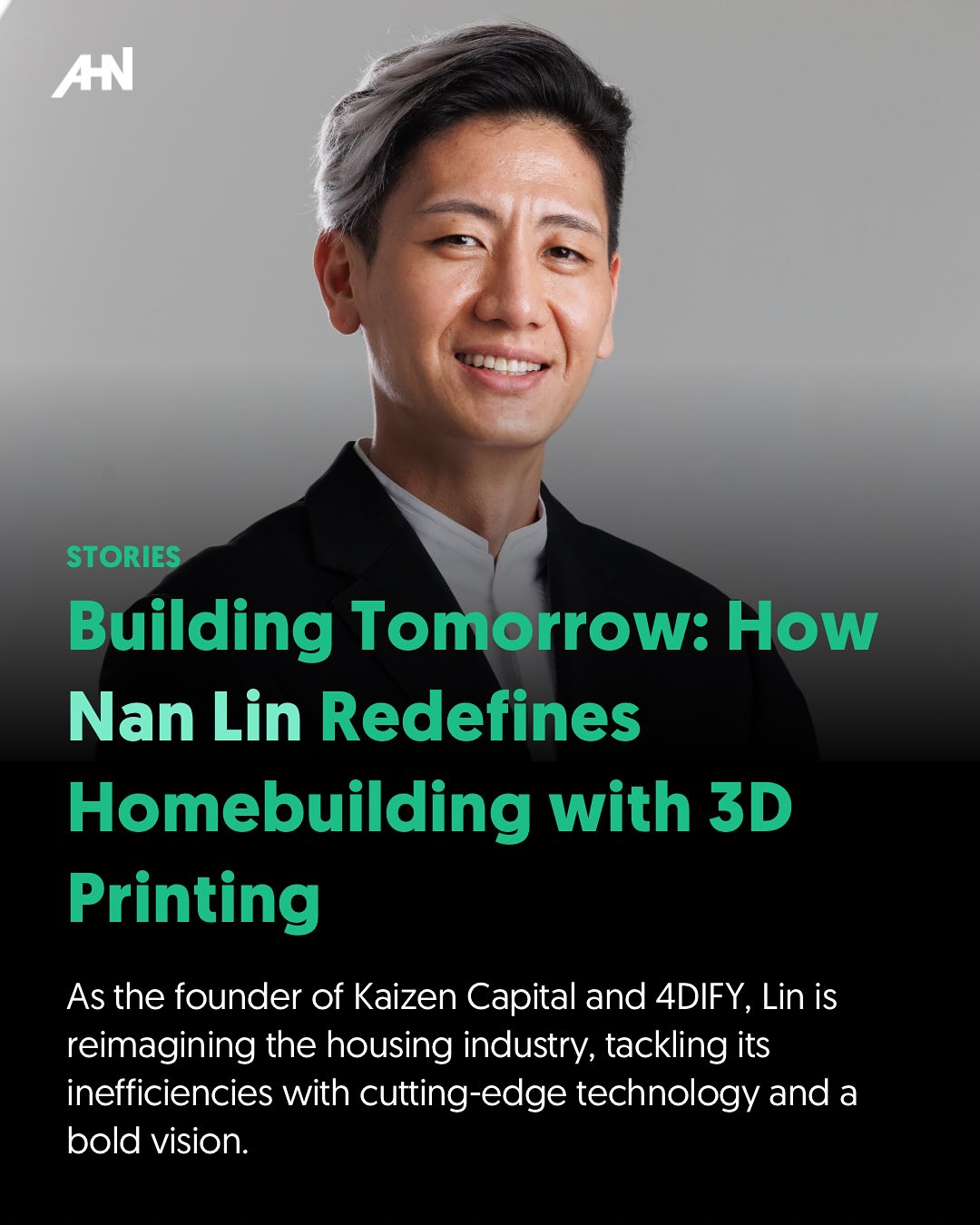
Nan Lin | Founder and Principal of Kaizen Capital and 4DIFY

3D Printing: The Future of Housing, Today

Lin’s vision for 4DIFY was sparked by a frustrating reality: “Wildfires destroy neighborhoods every year, yet we keep building stick-frame homes that burn like kindling,” he says.

After visiting several 3D printer manufacturers, Lin partnered with New York–based SQ4D. It took nearly a year to secure exclusive licensing rights, navigate regulatory hurdles, and obtain building permits, but he got it done.

Now, 4DIFY is building California’s first community of 3D-printed concrete homes. As this article goes live, their first printed home is nearing completion, despite heavy regulations and a steep learning curve. The team is already outperforming traditional timelines and cost benchmarks. The second and third homes will soon print simultaneously, targeting completion in two months, effectively one home per month at under $200 per square foot.

Despite challenges as an Asian immigrant, Lin managed to transform them into motivation and success. 

“We’re aiming to build at half the cost and in a quarter of the time,” Lin says. “That’s not a dream. It’s the direction we’re heading.”

Built with concrete, reinforced with rebar, and topped with metal roofs, these homes are resilient against fire, wind, earthquakes, mold, and pests. They’re also designed for long-term savings, with lower maintenance, less waste, and reduced energy and insurance costs.

“Critics doubted it would work,” Lin reflects. “But seeing is believing. This is the future.”

A Philosophy of Purpose and Resilience

Lin’s journey has been marked by relentless challenges, some seemingly insurmountable. “Obstacles never stop,” he admits. Yet he transforms adversity into opportunity, fueled by a positive mindset, solution-driven focus, and disciplined execution. His trusted team is his backbone. “No one succeeds alone,” he says. “My team turns the impossible into reality.” This resilience shapes his leadership, blending bold vision with purposeful action to create opportunities, particularly for communities long excluded from wealth-building. “Housing isn’t just a product,” Lin says. “It’s a platform for empowerment.”

Recognition and Inspiration

Lin’s impact is gaining notice. The Sacramento Bee named him one of the Top 20 AAPI Change Makers, and he was honored in the Business Elite Awards’ 40 Under 40. But for Lin, the real reward is inspiring others. “I want to show the next generation of Asian entrepreneurs what’s possible when we claim our seat at the table,” he says.

Lin wants to create opportunities for those marginalized by elevating the future of construction, making it more accessible for his community.

Join the Housing Revolution

Nan Lin isn’t just building homes, he’s redefining what’s possible. Through Kaizen Capital and 4DIFY, he’s creating a future where housing is affordable, resilient, and sustainable. Follow his journey and see the revolution unfold.

Connect with Nan Lin:

Related Articles

Image Source: Carla Tramullas / MycoWorks

Uncategorized

MycoWorks’ Sustainable Mushroom Leather Raised Over $187M From General Motors and Hollywood A-Listers

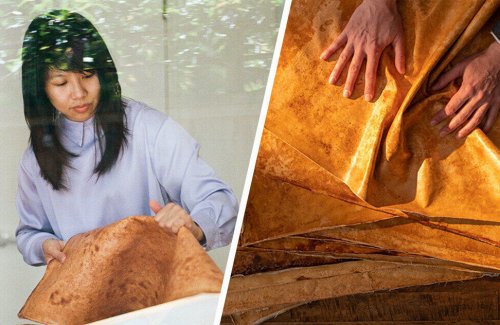
“Growing the future has only just started. This industry will continue to surprise people,” says Philip Ross, co-founder of MycoWorks, a mycelium material founder and producer.

As the innovator of high-quality mushroom “leather” for the luxurious Hermes bags, the business acquired $187 million from Natalie Portman, John Legend, and General Motors and will soon cover the latter’s electric car interiors.

Ross unintentionally discovered leather-like material in reishi mushrooms, a fungus he farmed for his cancer and AIDS more than four decades ago. He then became a mycelium artist and featured his fungus-based works at famous museums.

According to Sophia Wang, co-founder of MycoWorks whom Phil met six years before they founded the firm while working together on art ventures, Ross’s discovery marked the “leather’s” birth to the globe.

Wang and Ross continued to discover more about mycelium and later realized that the material is enticing to buyers who don’t like synthesized contaminants and materials which are produced from animals.

Alongside raising their funding source, the company also conducted a groundbreaking at South Carolina Factory with the aim of attaining a sufficient supply of their fancy product.

With about 200 employees, Matt Scullin, the company’s CEO, said that the “Brands are making very significant changes to address what is really a growing demographic of people who want to buy sustainable products that have provenance and traceability and a lower carbon footprint, lower water use—and mycelium does all of those things.”

Compared to animal leather, the mushroom leather-like material is far more environmentally friendly as the former adds up to about a million tons of carbon dioxide which is tantamount to 30 million cars’ yearly emissions.

Despite environmental and animal issues, people prefer biomaterials or “next-gen” materials over the past decade making it in-demand as multi-billion dollars are invested in the industry.

Nonetheless, Hermes’ firm in France is soon to release its $4,200-worth “Victoria” bag made from MycoWorks’ amber-hued exquisite mycelium.

Image Source: Ricci Chocolates & Michiko Liquete Facebook

Uncategorized

Mom Without Prior Baking Experience But Through Perseverance Finds Success With Homemade Chocolates

Despite having zero experience in baking, this mom entrepreneur was able to give birth to Ricci Chocolates, now branded as the “Home of the Best Tasting Truffles in Baguio City, Philippines” 

Mitchiko Liquete clarified that she is a dessert lover but never a chocolate fanatic. Initially having no interest in making desserts nor in cooking, she capitalized on believing in herself with the vision of making her products look off-the-peg.

To better her craft, Mitchicko heeded the DTI’s Kapatid Mentor ME (KMME) free online training program in September 2022 to learn about branding and marketing while in a ‘hit and miss’ process in chocolate-making, which she considered as a great help for business-starters like her. 

Mitchiko’s 100% homemade premium chocolates got 20 to 30 boxes of sales per day that eventually reached over and above 2,000 to 3,000 packs weekly and enabled the company to supply more than 100 resellers and distributors nationwide.

The success of Mitchicko’s purely hand-crafted, first-class, and domestically produced chocolates paved the way for opening four stores and actualized $17,000 income in one year alone making Mitchiko more than proud.

She plans to expand her sweet business by making Ricci Chocolates visible in every mall in the Philippines.

Image Source: Plant Habitat Facebook

Uncategorized

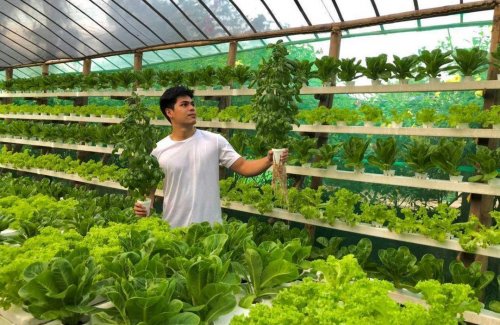
This Filipino Millennial Started With $20 To Pursue Hydroponics Farming Business

Nothing is impossible for this 21-year-old Filipino who engaged in modern farming with only $20 as a starting capital.

Despite being dissuaded by his grandfather who wanted him to become an engineer, Harold Zapata was determined to uplift farming, recognize farmers, and attest that farmers are the providers of our staple food and without them, it would be challenging for us to live.

As a farmer, his grandfather believed that farming is tantamount to poverty which made him influence his grandson to pursue a different profession.

However, the farmer’s blood runs in Harold’s veins, with Harold’s minimal capital and resourcefulness, he initially started hydroponics farming using used styrofoams which he asked from vendors in their local market.

Unlike traditional farming, hydroponics farming is cheaper as it is a type of farming where plants are grown in water and not in soil and a farmer would spend money only on styro cups, coco peat, feeds, and nutrients.

As a beginner, he only had a miniature greenhouse that could hold 80 pieces of lettuce and made him earn as much as $300 a month, which gradually allowed him to expand his business.

Harold’s hobby-turned-business serves him as a source of income not only from the harvests but from offering for-sale seedlings, building greenhouses, and providing consultations with his customers.

He also exclaimed that pursuing one’s interest unlocks many possibilities and that farming also teaches life lessons.

Image Source: Boy Isaw Instagram

Uncategorized

Hard Work Pays Off For Bringing Filipino Street Food “Boy Isaw” To New York, Now Makes 14$K A Month

The Filipino street food vendor admits that perseverance and hard work were really his main capitals in achieving his dream.

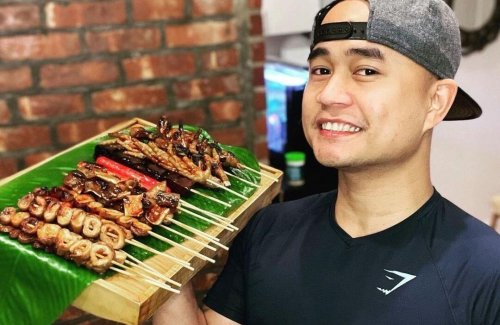
After introducing one of the most popular Filipino barbeque street food, “ihaw-ihaw,” especially the isaw (grilled chicken or pork intestines), to New York, Filipino street food seller Robin John Calalo has seen the fruits of his labor, earning more than $14,000 each month.

His shop, “Boy Isaw,” became well-known among fellow Filipinos and even foreigners who yearned for a taste of isaw, betamax (coagulated chicken blood), adidas (chicken feet), and other Filipino street food. 

Robin’s success came as a surprise considering that his small firm only had $50 when it was founded in 2019, during the onset of the pandemic. He claims that while in the supermarket, he suddenly made the decision to open his BBQ food cart due to a craving for Filipino food with his friends and family as the first customers.

According to Business News Philippines, Boy Isaw peddles in food bazaars and engages in online selling where he posts for-sale ready-to-grill street foods.

Aside from grilled food including hotdogs, chicken, and others which he posts on his Instagram, he also serves rice and chicharon bulaklak (deep-fried pork intestine) which is also a bestseller.