Christina is a dancer and the studio director of Lisa Performing Arts located in Bay Area. Through her dance performances, she tells stories about Chinese culture, including the ways people live, their mannerisms, and their unique clothing, all while passing down their unique stories from generation to generation.
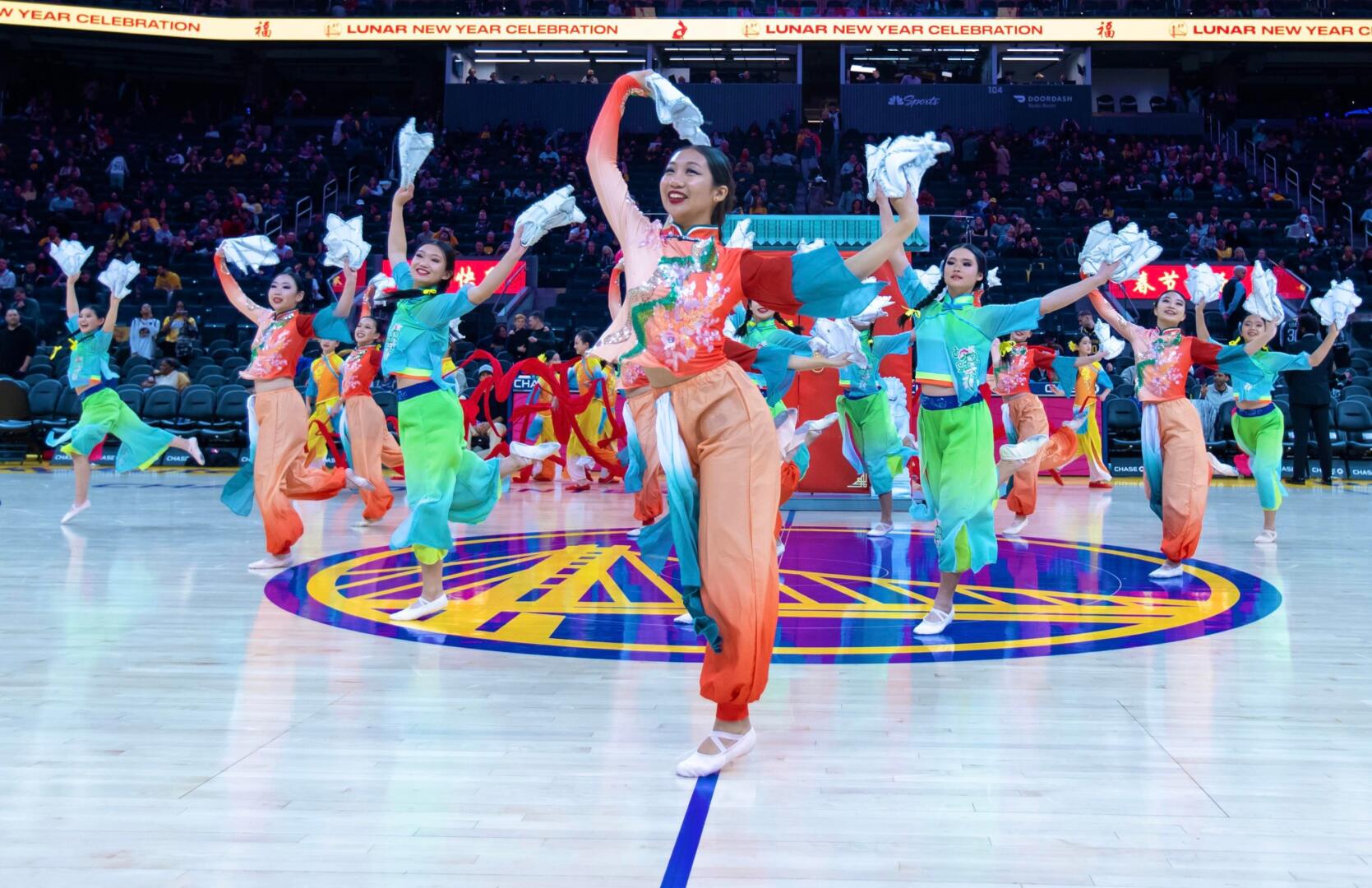
Christina’s journey has been filled with success and opportunities for her dancers to showcase their Asian American dance styles. They have competed at international competitions, premiered on NBC TV, and performed at various high-caliber events. Most recently, they were given the privilege of performing a halftime show for the NBA Golden State Warriors.
The troupe brought a unique and cultural experience to the game featuring the dynamic handkerchief dance, graceful and fluid movements of the ribbon dance, and intricate lantern dancing. The performance was the first of its kind, featuring “authentic Chinese dance” and a combination of fusion styles they have learned.
Read through as Christina delves deeper into the creative process of choreographing a new dance, her recent performance at the NBA Golden State Warriors halftime show, and the importance of celebrating one’s cultural identity.
BRIDGING THE GAP BETWEEN AMERICAN AND ASIAN CULTURES
Growing up as an Asian American, I experienced a lack of representation of Chinese culture in mainstream American platforms and faced the challenge of reconciling my traditional Chinese culture with the dominant American culture, which often excluded Asian Americans and perpetuated stereotypes.
I found solace in Chinese dance — a beautiful and intricate art form often overlooked in mainstream American platforms. My passion for bridging the gap between American and Asian cultures began when I started learning Chinese dance, which surprised me because not many people knew about it beyond the “lion dance.”
Chinese dance involves advanced technique, beautiful costumes, and a variety of unique dance styles, including Mongolian, Tibetan, Dai, Classical, and more. However, I noticed a lack of appreciation for Chinese dance at school rallies, outside performances, and dance competitions.
As I grew older, I realized that to bridge the gap between American and Asian cultures, I needed to find a way to blend the two in a way that was accessible and appealing to both. I was inspired by the success of Bollywood dance in America and dreamed of Chinese dance becoming just as popular. To achieve this, I realized it was necessary to incorporate elements of mainstream styles such as “contemporary” movements, technique, and storytelling, while adding our own Chinese dance elements such as costuming, music, and style.

I worked to create an “East meets West” fusion style of dance that combined both American and Chinese elements. I hoped to bring together teachers and dancers of both backgrounds to learn and appreciate each other’s styles and create unique fusion styles as Asian Americans.
Through my work in Chinese dance, I have seen a growing interest and appreciation for the art form from people of all ethnicities. I am proud to have helped spread awareness and understanding of Chinese culture and have given a voice to Asian Americans in the performing arts world.
Looking forward, I hope to continue to promote authentic representations of Chinese dance in mainstream media and to build a more diverse and inclusive society by encouraging greater cultural understanding and appreciation. My goal now is to form connections with Hollywood networks to ensure that authentic Chinese dance is portrayed in film and music videos and to prevent cultural appropriation.
I believe that the performing arts provide a universal language through which we can all communicate and that by embracing and celebrating our cultural identities, we can build a more harmonious and united world.
BEING ASIAN IS A STRENGTH, NOT A WEAKNESS
My interest in dance began at a young age. My mother was a professional dancer in China who opened her own dance studio in the US. I was exposed to a variety of dance styles, which allowed me to form strong friendships with people of all ages and backgrounds. Through dance, I not only learned about movement and performance, but also about teamwork, leadership, and resilience.
As I grew older, I became passionate about promoting and showcasing Chinese culture through dance. Chinese dance is a unique and vibrant art form with a rich history and tradition. It has a diverse array of costumes, props, and ethnic styles, as well as stunning technical skills, it was a hidden gem waiting to be shared on a larger platform. I felt that it was important to share this cultural identity with others and to show that being Asian is a strength, not a weakness.
Today, I am proud to say that our studio is well-known and respected in the Bay Area. Through our performances and outreach, we have been able to promote Chinese culture and inspire others to celebrate their own cultural identity.
I felt that it was important to share this cultural identity with others and to show that being Asian is a strength, not a weakness.
-Christina Wang
THE CREATIVE PROCESS
When choreographing a new dance, my creative process starts with considering the group of dancers I’ll be working with for the season. I think about each dancer’s individual strengths and how to create unity among the group. This includes deciding on a dance style that fits the group and identifying which dancers will perform which roles.
I then search for songs that will sound intriguing to the audience and consider modernized versions of traditional Chinese music if possible. Next, I find costumes that are in-season and on-trend to bring a contemporary Chinese feel to the performance. I also draw inspiration from trending technical work and group lifts that can work well with the group, as well as any props we may be using. The movements and facials themselves tell the story, and I choose ethnic styles that reflect the particular cultural traditions we’re exploring.

When creating a production piece, I try to tell a story that is easily understood by the audience. To achieve this, I brainstorm ideas inspired by TV shows, movies, and Chinese folklore that can be given an added twist through the use of props. For example, for our piece “The Legend of Avatar: East meets West,” we used props to tell the story of using Earth’s four elements.
Production pieces are more complex to choreograph, as I need to think about how different sections will mesh, color coordination for costumes, smooth transitions between segments, and how to coordinate rehearsals for a large group of people. I also need to consider which parts of the performance to cut or keep, depending on whether we’re performing for a competition or for a show. It’s a true team effort, with many people involved behind the scenes, including visionaries, teachers, prop makers, parents, costume designers, music editors, and dancers who make the vision come to life.
A PRICELESS MEMORY
The dance troupe’s recent halftime show performance for the NBA Golden State Warriors was a truly special and memorable experience. As the first Chinese dance studio to put on a full dance production at the Chase Center, it was an incredible honor to be able to showcase Chinese culture on such a large platform. While martial arts and lion dance have been featured in the past, Chinese dance had never been given the same opportunity until now.
This milestone not only allowed us to introduce Chinese dance to a wider audience who may not have seen it before, but it also provided a priceless memory for our dancers.
BREAKING DOWN CULTURAL BARRIERS
In addition to positive feedback on our technique and performances, we’ve also received comments on how our troupe’s performances have helped to promote cultural awareness and diversity.
People have expressed appreciation for the opportunity to learn about Chinese culture through our dances, and many have shared how our performances have inspired them to explore and appreciate their own cultural heritage. We’ve also received word that our performances have helped to break down cultural barriers and build bridges between different communities. It’s all very encouraging and it keeps us motivated to continue doing what we do.
EMBRACING YOUR CULTURAL IDENTITY
For young Asian Americans who may be struggling with their cultural identity, my advice is to embrace your uniqueness and find your community. Don’t be ashamed or embarrassed about your heritage, as it is a valuable part of who you are.
Surround yourself with like-minded individuals who share your values and can help you grow. You can seek out cultural groups or organizations in your area, attend cultural events, or connect with others through social media.
Additionally, try to think outside the box and find creative ways to integrate your cultural identity with what people are already comfortable with, while highlighting the unique aspects of your heritage.
Finally, don’t be afraid to take risks and pursue your passions, even if they may not fit the mold of traditional expectations. By embracing your cultural identity and celebrating your heritage, you can become stronger and more confident and inspire others to be the same.
Don’t be ashamed or embarrassed about your heritage, as it is a valuable part of who you are.
-Christina wang
VISION FOR THE FUTURE
Looking ahead, my vision for the future of my dance troupe and work in promoting Asian culture is to continue expanding our reach and impact. One of my top goals is to provide more opportunities for our dancers to perform at high-caliber events such as the White House, the Olympics, and major award shows like the Oscars and Grammys.

Beyond these major platforms, I hope to see Chinese dance become a more integrated part of the arts and cultural scene, potentially even becoming part of school curriculums to expose young people to this beautiful art form at a young age.
In the long term, I would love to take our work to the next level by establishing a Chinese American dance studio with a dance-specific talent agency sector, through which casting directors would be able to select dancers who can perform authentic Chinese dance for film, media, and commercials. This would create more opportunities for dancers to showcase their skills and help to further promote and introduce Chinese culture to a bigger audience.