Stories

August 25, 2022

SHARE:

When looking at an Asian-American woman, certain implicit biases exist. They are often judged as being too meek, timid, or passive to achieve their goals. They may be held back by such an evaluation, preventing them from realizing their full potential.

It was difficult for Asian-American lawyer Debra Wong Yang to speak up throughout her early career. In the long run, she realized that her inability to stand up for herself did not only hurt her but also her clients.

“Eventually, we all find a voice — my advice is to just make sure the one you ultimately adopt is actually yours,” she advised in her essay published by Law360.

Yang graduated from law school in 1985 when women were still relatively powerless in the legal field. Since she was still working toward the goal of following the path she had chosen, she has faced many challenges along her journey. She has witnessed it all, from the very traditional Chinese upbringing she received to the various sacrifices, frustrations, and challenges she must face on a day-to-day basis in her chosen field.

After years of practicing law and facing challenges in the courtroom, she came to a number of important realizations that helped her become a successful attorney. She remembered when she thought up some strategies that she hoped would assist her in communicating effectively with others. 

Yang also tried to conquer her fear, and her motivation helped her cope with the situation and make further progress. With a lot of the many books she has read on leadership, she knows she has finally found her own approach to developing herself. 

She aspires on detailing how she was preparing for her court session with an outline of her questions and concerns, and other litigants will be able to better manage their time with counsel. She realized she was getting better at defending her clients in court because she was able to keep her attention solely on the issues and evidence in her case.

When she was currently going through a period of learning and challenges, she learned that holding a position of authority does not guarantee respect from subordinates. She came to understand that one of the responsibilities of a leader is to address concerns raised by those who doubt one’s abilities.

In her courtroom sessions, Yang strongly suggests analyzing the situation first and looking for authentic solutions carefully. She strongly believed that the solutions to some problems sometimes are not immediately obvious and have never been tried before, or that it’s extremely straightforward. However, she is challenged to keep turning the issue over and over in her mind until she begins to see it from a new perspective.

Yang also stressed the importance of having mentors to turn to for advice and insight. She was assertive in her belief that one should be guided by the process of sitting down, thinking it through, and acting in a way that is most beneficial to them. She went on to say that if the message comes from within, the receiver will perceive it as more genuine and at ease.

In 2002, She was appointed by President George W. Bush as United States Attorney and became a former judge serving the Los Angeles County Superior Court. The fact that her success can be attributed to her strong leadership and the bravery that she possesses as an individual is a reason why she wields her power. 

Not only does Yang share her own experiences, but she also provides valuable advice that other women can use to advance their careers. She stated, “My wish for each of you is that you will be brave when facing self-doubts, challenges, and obstacles. That you will dig deep, reach out if needed, do the research, make the tough decision and not be afraid of losing.”

The fact that Yang, an Asian American woman-in-law, was able to take control of her power demonstrates that one’s race should not determine the opportunities available to them or the path they choose to take in their professional advancement. However, by maintaining a positive attitude and giving oneself the power to make decisions, one will be able to live up to the standards and goals that have been established to assist in one’s own success.


Related Articles

seattle opera-jpeg

News

‘Bound’ Premieres at Seattle Opera Illuminating the Struggles and Triumphs of Asian Americans

Huang Ruo’s captivating chamber opera, “Bound,” made its highly anticipated premiere at Seattle Opera’s Tagney Jones Hall.

The opera sheds light on the enduring discrimination faced by Asian Americans, a social issue that has persisted since the enactment of the Chinese Exclusion Act in the late 1800s. Huang Ruo, a prominent Chinese composer, openly explores these themes, creating a thought-provoking, visually stunning, and musically intense work. Teaming up with librettist Bao-Long Chu, a Vietnamese poet, both artists made their Seattle Opera debuts, showcasing their impressive talents and expertise.

“Bound” narrates the experiences of second-generation Asian immigrants who grapple with their cultural heritage while striving to be fully embraced as Americans. Inspired by the true story of a high school student imprisoned due to truancy, the opera delves into the conflicts between individual aspirations and familial obligations. 

The characters in “Bound” are intricately bound in their own ways. Diane Tran, the protagonist portrayed masterfully by Karen Vuong, grapples with the rules and expectations of being a second-generation Asian adult, constantly torn between her family, work, and education. Khanh, Diane’s mother, haunted by guilt and memories, remains tied to her immigrant past. Judge Moriarty, who sentences Diane to imprisonment, represents an unjust system lacking empathy and understanding.

Huang shared with The Seattle Times that he aspires to fill every performance with a diverse audience, showcasing how opera reflects the lives and times of contemporary society. He firmly believes that opera is not solely for the elite few, as it reflects the diverse experiences of many.

Featured Image Source: Seattle Opera

cnbc-jpg

News

CEO Rose from Poverty to Build a Billion-Dollar Startup in Indonesia

EFishery, an agritech startup in Indonesia, has achieved unicorn status with a valuation of $1.4 billion, following a successful Series D funding round.

The company, co-founded by Gibran Huzaifah, who grew up in a disadvantaged neighborhood in Jakarta, raised $200 million in the latest funding round, led by Abu Dhabi’s 42XFund, with its value tripling from more than $410 million in 2022.

Notable participants in the funding round include Malaysia’s state pension fund Kumpulan Wang Persaraan, ResponsAbility Investments AG, 500 Global, and existing investors such as Northstar Group, Temasek Holdings Pte, and SoftBank Group Corp.

EFishery serves approximately 70,000 fish and shrimp farmers in Indonesia, providing them with technological solutions for their aquaculture operations. The recently secured funding will enable EFishery to fuel its expansion plans in Indonesia and India. Moreover, CEO Gibran Huzaifah expressed his ambition to pursue an initial public offering (IPO) in either the United States or Indonesia within the next two years.

According to Bloomberg, Huzaifah aims for EFishery to become a global leader in the aquaculture industry over the next five years, with an IPO potentially taking place as early as 2025.

Huzaifah grew up in the vicinity of slums in eastern Jakarta facing financial hardships due to his father’s job loss during his university years. With limited resources and no support network in a new city, Huzaifah found himself seeking shelter in various places, including the university campus and local mosques. At one point, he endured a three-day period without food. 

The personal story of CEO Gibran Huzaifah from poverty to building a billion-dollar startup serves as an inspiration to anyone facing adversity, showing that success can be achieved regardless of one’s humble beginnings.

Featured Image Source: CNBC

golden gate ventures-png

News

Jeffrey Paine Unveils the Secrets of Building a Successful Start-up

Entrepreneurship is often regarded as a skill that can be taught, but according to Jeffrey Paine, co-founder of Golden Gate Ventures, certain innate personality traits play a crucial role in a founder’s success.

According to The Peak Magazine, Paine believes that while 80% of entrepreneurship can be learned, the remaining 20% is an inherent quality. He emphasizes the importance of fluid intelligence, the ability to process information and make decisions with limited data and tight deadlines. However, he also highlights the need for founders to be disagreeable yet humble to make effective decisions.

Golden Gate Ventures was born out of Paine’s desire to solve a funding gap he observed in the South-east Asia (SEA) startup ecosystem. Alongside Vinnie Lauria, Paine launched the venture capital firm to bridge the gap between start-ups in the region and investors from the Bay Area.

Since its inception, Golden Gate Ventures has invested in nearly 70 companies across SEA, Greater China, and the US, including successful ventures like Carousell and RedMart. The firm is now expanding its operations in Vietnam, recognizing the country’s potential for growth and its pool of technical talent.

Paine identifies Vietnam, Singapore, and Indonesia as the region’s Startup Golden Triangle, each offering unique advantages for entrepreneurs and investors. Singapore boasts capital, talent, and ambitious founders with a global outlook. Indonesia’s large market size and potential returns make it an attractive investment destination. Vietnam, on the other hand, stands out with its technical talent and ability to tackle complex projects such as Web3 and cryptocurrency.

Looking ahead, Paine predicts that starting a business in the next decade will become more challenging due to a maturing startup ecosystem and the control exerted by a few dominant players. Entrepreneurs will need to identify untapped opportunities and build companies that can adapt to changing trends.

Golden Gate Ventures aims to support founders in this evolving landscape through its Founder First initiative, providing financial, human, and social capital to equip entrepreneurs for success.

Featured Image Source: Golden Gate Ventures

8newsnow-jpg

News

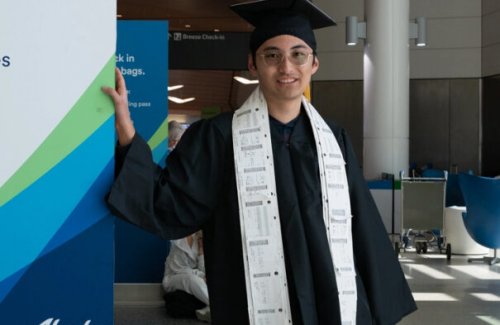
This LA Grad Student Flew Through an Academic Year to Save on Rent

A resourceful graduate student from Los Angeles has gained attention for his clever solution to cut down on housing costs while attending the University of California, Berkeley.

Known as Bill, he shared his story on Reddit in a post titled “I survived living in LA and commuting to Cal by plane over the past academic year to save on rent, AMA (ask me anything).”

Bill’s strategy was simple yet unconventional: he flew between Los Angeles International Airport (LAX) and San Francisco International Airport (SFO) multiple times a week for classes. Waking up early, he caught a 6 a.m. flight from LAX to SFO and then took the 8:30 a.m. train to reach Berkeley on time.

Despite the grueling nature of his commute, Bill approached it as an adventure rather than a burden. He never missed a class during the academic year.

Bill also managed to track his expenses, spending a total of $5,592.66 on flights between LAX and SFO. This included costs for train fares, parking, gas, inflight WiFi, and flights with different airlines.

Bill’s unique approach to saving on rent has impressed a lot of people, showing that creative solutions can help overcome financial challenges in pursuit of education.

Featured Image Source: 8NewsNow