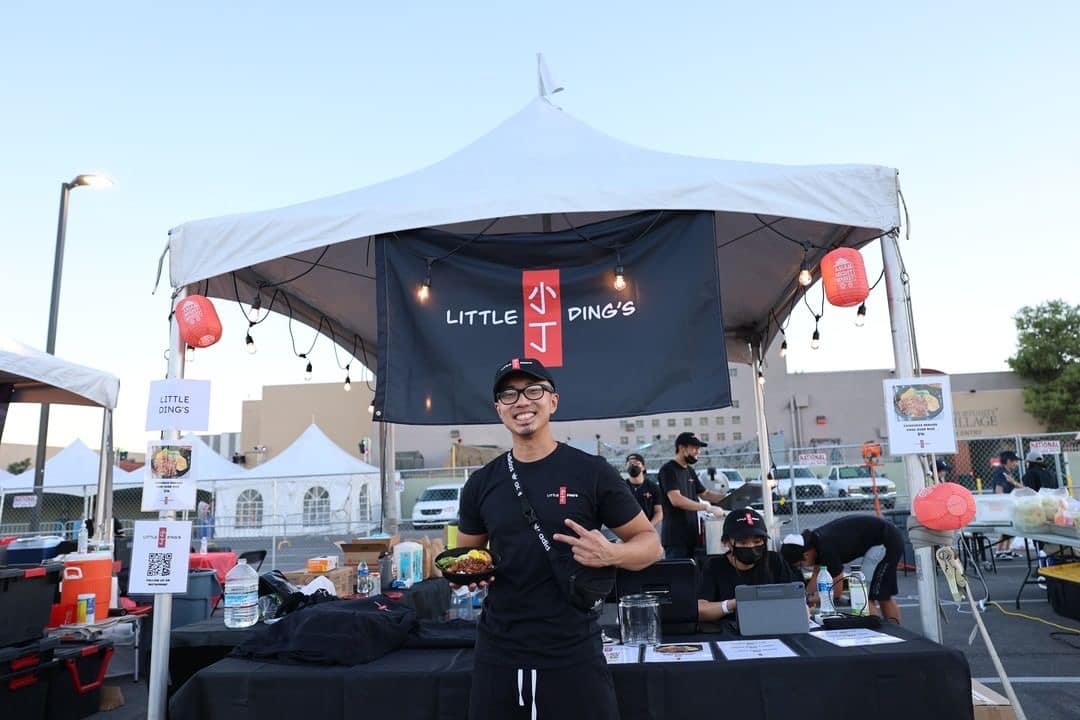
A successful engineer by day and an entrepreneur by night, that’s what Derek Ting is.
Derek followed his passion for entrepreneurship and launched FREESTYLE a few years back, a brand with the purpose to help and inspire individuals out there to pursue their own path in life through sharing stories, empowering messages, bold designs, and building a community. But he didn’t stop there.
Without a professional experience in the kitchen or background in culinary, but with a dream of sharing Taiwanese cuisine with more people in the world, he brought Little Ding’s to life.
In an interview with Asian Hustle Network, Derek shared insights into his entrepreneurial journey. Join us as we delve into Derek Ting’s remarkable story, uncovering the secrets to his success and the invaluable lessons he has learned along the way.
DEREK’S JOURNEY BOTH AS AN ENGINEER AND ENTREPRENEUR
I graduated back in 2019 with an engineering degree while working to launch my first real brand/business, FREESTYLE, but I wasn’t always into business or entrepreneurship. Before 2015, I thought that being an engineer was “IT” for me. I thought engineering was everything I wanted and everything I would be doing for the rest of my life so I didn’t even think of any other possibility.
In 2015 I took on my first internship/Co-op after freshman year at IBM/Globalfoundries which was honestly a dream come true for me (I mean what freshman wouldn’t be excited about an opportunity like that?). Little did I know, that experience would change everything for me but in the complete opposite way I thought it would.
Seeing the energy of the people who were there for 20-30 years made me realize I needed to do something else, something different. That was when I read my first book, started taking stocks more seriously, and started trying out a whole bunch of different ventures/ideas/things. And for those of you who don’t know what you want to do yet, it’s okay to not know, but you won’t know unless you go out and try a whole bunch of different things!
Nothing stuck with me until later in college, which was FREESTYLE, but even then I wasn’t anywhere near launch by the time I graduated so I stuck out engineering as a way to support myself while I go on this journey to figure “business” out.
FREESTYLE didn’t take off how I wanted it to and I slowly learned that business in general and then each industry had their own “game” to play but I knew how important it was for me to continue to go through the growing pains. Experience compounds and business principles transfer over to new ventures so it was important I kept going despite not finding “success” so I could keep learning. I don’t believe that I’d be able to do what I’m doing with Little Ding’s today and at the speed we’re going at if I didn’t keep building FREESTYLE.
It’s been 5 years since I started building an actual brand/business and 7 since I started learning about entrepreneurship and I’m only getting started!
Little Ding’s has been something I’ve wanted to build for a long time and the accumulation of all of my past experiences, knowledge, and network is moving us forward and getting us opportunities at a speed that I couldn’t have predicted. It’s been really cool and super mind blowing but again, this is only the beginning, we haven’t even gotten started yet!
I’m blessed that I am also a full-time engineer on the side because being an engineer (specifically in data and analytics), has helped me develop and refine skills necessary in business but not stressed such as the importance of understanding numbers, metrics, and data pertaining to each aspect of the business. Is it hard to do all of the above? Yeah, my entire life at this moment is just work… but I love it.
PUSHING THE LIMITS
In the process of building FREESTYLE and Little Ding’s, I learned that limits are self-imposed.
I’m a huge dreamer, and I love challenges. The process and hardships of entrepreneurship, which are basically personal development, helped me to discover that every time I pushed myself to what I thought was my limit, I could handle more, and once I realized that the playbook was entirely up to me, I went kind of crazy (in a good way of course).
For example, I launched Little Ding’s in October of 2022. We then did ONE small event in November and ONE event in January. How were we able to handle the largest food events on the west coast, back-to-back weekends, and even introduce a new menu item? Because that’s exactly what we did when we did the Water Lantern Festival, into the first and second Foodieland, the first 626 Mini Night Market, the first We Bridge Expo in Vegas into more and more up to now, where within 8 months of even existing, we are coming for the main 626 events in SoCal!

STAYING TRUE TO THE FLAVORS OF AUTHENTIC TAIWANESE CUISINE
My goal with Little Ding’s is to bring Taiwanese food out to more of the world, and so doing that means the food I focus on has to be somewhat relatable between cuisines such as Taiwanese popcorn chicken, where almost everyone has some idea of what popcorn chicken is, but maybe not necessarily Taiwanese popcorn chicken.

When thinking about new food items to add, I’m envisioning myself taking a stroll through Taiwan’s night markets and seeing which foods are popular that I remember the taste of and would be easily accepted in the States.
When it comes to testing recipes, I gather a ton of different online recipes and lay out all of the ingredients that are being used to figure out what each ingredient adds to the recipe and then slowly test out the ratios until the taste brings me back to the streets of the night market.

I may not come from a culinary background or know a ton about ingredients but I have good taste buds and I can remember taste even if I didn’t know what made it.
The reality is that, it is a LOT of testing and as much as everyone around me enjoys the food I make and the recipes I created, I myself got a bit sick of them because I ate each item that I tested multiple times a day for weeks before I got the recipes to where I wanted them AND THEN I would continue to adjust as I got feedback from all of my guinea pigs *cough* I mean friends, in Vegas.
It’s a bit easier now because I have a team so I don’t have to eat as much of my own food over and over again but it’s still a lot of testing especially to stay true to the flavors of authentic Taiwanese cuisine.

OVERCOMING HURDLES
The more I zoom out, the smaller the stumbles become.
Derek Ting
I love challenges in general so I actively seek them out for us to take on and I think almost every event we’ve done was a challenge because every single one was unique.
But in terms of the challenges we’ve faced where things went wrong or weren’t great for us, a lot of it comes down to the long-term vision and how focused you are on it. We came out swinging when we launched Little Ding’s and crushed our first event. We thought it would be like that for other events too but we were met with two financial losses in a row, one of them being -$2,700 which hurt really bad especially when we’re just getting started and every dollar meant more.
So this is where the long term vision comes in. If I look at the 3-month timeline, we’re absolutely broken. We invested thousands, made some back at the first event, and then dug a deeper ditch with the next two events. If I look at the 6-month timeline, well okay we have Foodieland and 626 Vegas coming up, and we have a good chance of making those losses up at those events. If I look at the 2-year timeline, we should have 1-2 stores open by then with catering clients set and be doing multiple events a weekend.
The more I zoom out, the smaller the stumbles become. Even if they hurt a ton at the time. Another thing I will note is that as a founder or leader, you can’t break… at least not in front of your team. It’s good to be transparent with how business is doing but even in those moments, you have to excite your team.
And there are of course countless challenges with doing outdoor events especially not having done any yourself but those typically come down to how fast you can think on the spot and how well you can adapt to situations which honestly becomes second nature after enough practice.
OTHER VENTURES DEREK IS INTERESTED IN EXPLORING
I have a ton of ideas in my head that I want to eventually build out, including a sister shop to Little Ding’s focused on Taiwanese desserts, a co-working space with incubator access, with access to investors, schools similar to the one founded by the Blue Man Group in Manhattan, universal educational platforms for everyone, and I do want to get into Esports but that one is more of a “for fun” project.
HOW DEREK DEFINES SUCCESS
Success to me has changed a lot throughout the years and a lot of it had to do with the friends I have around me.

Before, success to me was making a ton of money to buy my parents and myself nice things and not having to work anymore. Now, success to me is being able to create without anything holding you back.
Create businesses, opportunities, and experiences for those around you. That’s what I care about and want to do and there’s some debt I have to pay off first but honestly, I think I’ll be successful as long as I can get both myself and businesses in the green because after that, I’ll have some money to do more of the above!
ESSENTIAL QUALITIES OR SKILLS FOR ENTREPRENEURS
The essential qualities or skills I believe every entrepreneur should have or be working on are: communication and vision, humility, adaptability and decision-making, mental fortitude and perseverance, and patience and optimism.
I think the ones I grouped together work hand in hand!
Communication should include vision because your team should always know where you’re going as a company and where they’re going/where they can go within the company. Drop your ego, you don’t know as much as you think you do, and listening can save you time, money, and resources.
Being able to adapt pretty much means making a decision to change on the spot but both are important and practice helps a lot here.
You have to have the mental fortitude to push through because it’s not easy (principles are simple but insanely hard to master).
The last one is patience where you have to be patient with the results of your work since it might not show up for years and that plays in with optimism because you have to see that you will succeed (the “light”) otherwise you might need to re-evaluate your current trajectory.
CONNECT WITH DEREK
IG:
Derek Ting – @duhricehero
Little Ding – @littledingscafe
FREESTYLE – @frstyleofficial
Websites/Blogs:
Little Ding’s – littledingscafe.com
Little Ding’s Blogs (Medium) – @littledingscafe
FREESTYLE – frstyleofficial.com
FREESTYLE Podcast – Spotify