Stories

July 10, 2023

SHARE:

In a world where it can be easy to feel disconnected and jaded, Serene Chan’s art is a refreshing reminder of the beauty and magic that surrounds us.

With her ability to use digital art and visual storytelling to provoke child-like wonder and capture nostalgia, Serene creates images that are not just visually stunning – but also carry a deeper message about the importance of mental health and the value of diverse cultures and communities.

Serene is a Chinese-Canadian creative and expert daydreamer who worked as a freelance traditional painter and digital illustrator for 8 years, supporting other independent musicians, writers, and artists. Alongside her art, she works full time as an accountant. Her versatile background includes her academic education in business and years of entrepreneurial experience exemplified in three of her start-up businesses.

When she’s not painting, Serene channels her artistic energy into other creative endeavors such as crafting resin crafts, thrifting, sewing, and thrift flipping.

JOURNEY TO DISCOVERING ART AS AN OUTLET

Growing up, I was extremely socially awkward and spent a lot of time in my head. I like to call myself an expert daydreamer because I spent most of my life imagining different worlds that I fit in a little bit better than this one.

When I found art as an outlet, it just made sense because it allowed me to be able to create places that defied all odds; places where stars could be captured in your hands, where dragons roam free, a place that I can call home. I was inspired by the power that all artists have- the ability to create something from nothing, especially when it doesn’t exist in the real world. 

The traditional painting came naturally to me, but my immigrant parents pressured me to conform to their ideals of what a successful individual looks like and put little emphasis on my creative passions. I followed their well-intentioned guidance and wishes for their daughter to be self-sufficient one day. I did not receive the arts education I sometimes wish I received in my 20s. I followed the motions of getting a bachelor’s in business and my accounting designation, and ended up in a corporate budgets job.

Over time, I realized that going to art school does not determine the success of an artist. If I really wanted to have an art career, I was going to make it happen regardless of whether or not I had the connections or credentials to do so.

I began my art journey in 2015, starting an art website with no idea what I was doing. I transitioned into digital illustration only 2 years ago when I finally invested in an iPad to accelerate my painting process. For the last 8 years, I spent an uncountable amount of time experimenting with different tactics to maintain a part-time art career selling prints, doing custom artwork, and applying to every open call I qualified for.

I’ve spent much of my art journey finding resources to personally develop, and reached out to countless individuals in the art industry to learn about their experiences. Ambition is what fuels my love for learning and my efforts of sharing high-quality art content with the world. Though my art career is not full-time yet, I’m still excited to continue grinding it out and seeing where it takes me.

COPING UP WITH LIFE’S CHALLENGES

My immigrant parents pressured me to assimilate with society and put little emphasis on carrying out Chinese traditions from home. So, while I became comfortable with Westernized routines, I began to feel embarrassed about my culture in my youth.

I grew up developing mental health issues from suppressing my reactions to the microaggressions around me and being unable to cope with them. As time passed, I realized that resiliency comes from releasing some of the trauma and anxiety that’s been clouding my thoughts. However, it’s also understanding that although it might never disappear, it’s a part of what makes you-you. It’s transforming into someone who is at peace with the chaos and accepts it as something that has to happen in order to grow. This is why I’m now extremely driven to teach the importance of celebrating my Asian culture and incorporating the aspect of mental health to start conversations.

One of my favorite paintings with both of these concepts is “Remembered Always.” I painted this during a time when my family was trying to navigate grief from mental health-related death. Watching my family try to recover from that trauma made me realize how death, how to grieve, and mental health rarely gets talked about in an immigrant family, especially at an early age.

Remembered Always by Serene Chan

In Chinese symbolism, cranes are often believed to carry spirits to heaven after they die. This painting depicts loss remembered by the living and hopes that their spirits are brought to a happier place. My inspiration is to educate the values and symbolism the Chinese believe in to help them ease the pain of death.

PROMOTING MENTAL WELLNESS THROUGH ART

One of the worst parts of mental health is having thoughts or feelings that you can’t control. Any form of art (drawing, writing, music, etc) can be a way to express those thoughts you have. You don’t have to be good at it, or even have any experience. Using art to convey what’s on your mind lets you manifest those feelings into something physical that you CAN control. 

I know sometimes it sounds easier than putting it into practice. Maybe your mind is drawing a blank. Maybe it’s too difficult to put into words what you’re feeling because there are no words in the dictionary that describe what you’re going through. I would recommend finding paintings, poetry, stories, or music that speaks to you. I guarantee you that there’s someone out there who has felt what you feel and was able to put it into art. Perhaps then, you’ll feel a little less alone knowing there’s someone else in this universe who understands how you feel.

Just know that your mental struggles are never too small or insignificant. You matter in this world, so please take care of yourself.

THE PAINTING PROCESS

My process requires more planning than most might think. Before I begin a painting, I focus on a feeling I want to capture. I then refer to the resources I regularly collect from the internet or everyday life. I take inspiration from different components found in my references to construct an image in my head.

After I get an idea of the scene, I create a very rough sketch and a color mock-up. About 80% of the time, I have to do in-depth research about every item I’m painting so I have a better understanding of how each component looks in the environment it’s in. This could mean understanding how the light impacts each object, understanding how the body looks in a specific pose, or even how clothes fall on the body when positioned a certain way. After all that work, then I can finally begin the fun part: painting!

I usually start with the background and paint the figures on top after. Because I did so much planning and prep work beforehand, the painting process is pretty effortless afterward. The entire process can range between 1-2 weeks. 

Usually, the painting process is done digitally on my iPad. Lately, I’ve been doing sketches in pencil on paper before taking a picture of it and continuing the sketch digitally. I find that my hand-eye coordination is better when I can feel the pencil touch paper.

SUPPORTING AND SHARING OTHER ARTISTS’ STORIES

Art is meant to be shared and to inspire each other with our individual perceptions of the world. If I have the ability to help other artists/writers/musicians further their voices by providing thought-provoking artwork that attracts people’s attention, then why not? My art business is not only meant to share my own stories and experiences but to also help others share theirs.

One of my favorite collaborations includes one with RBC and VIBE Arts, where I created two huge poster ads to be displayed in a Toronto Transit Commission Subway station in Toronto. This project was meant to promote women in art and what speaks to them as an artist. This two-panel illustration represents my present self in one painting and my discovering my past ancestry in another painting. The present self-painting depicts my safe haven- my ideal room filled with all my favorite art forms and passions. The ancestry painting depicts 6 different Chinese hidden mythologies in an alternate ancient East Asian universe. This project highlights the importance of my ancestry and how it’s deeply rooted in my identity today.

Stories That Made Me I & II by Serene Chan

Other honorable mentions include the collaborations I did with East Asian fashion and jewelry designers, such as DAWANG and Sublima Jewelry. They both focus on promoting their East Asian heritage with a modern twist, encouraging their audiences to feel beautiful and proud of being Asian while wearing their pieces. What made it extra special for me was being able to connect with other small businesses and learn about how they bring their visions to life. Being inspired by other talented artists is truly such an honor.

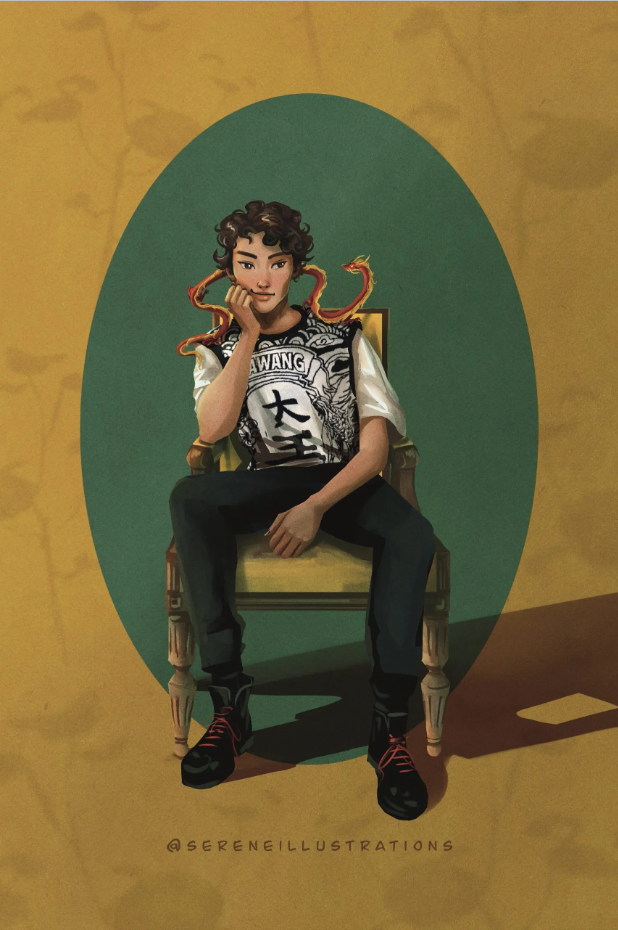
Chinese New Year by Serene Chan
Male Mulan & Mushu by Serene Chan

COLLABORATE WITH SERENE

I have a current collaboration with DrawaDot, where I created a piece celebrating the Lunar New Year and the concept of celebration. All proceeds of this project go toward supporting emerging artists who are striving to kick-start their art careers.

I also have a super fun collaboration with Toronto Pearson Airport coming up. So if anyone is flying to Toronto… they might just see my artwork in Arrivals in a couple of months!

My hope is that my art will inspire others to appreciate the many traditions and celebrations of Asia, and help people develop a child-like wonder everyone is capable of experiencing when viewing the world. Between just you and me, I’m in the process of illustrating a self-published book that promotes both mental health and an Asian festival.

For anyone who wants to stay updated on my work and give feedback on what they’d like to see, I encourage you to sign up for my newsletter! I send monthly updates of new art, art processes, shop updates, and painting tips/tricks. If you come along on my journey, I promise you’ll find art that helps people become daydreamers and find a sense of belonging in this world.

Website: sereneillustrations.com

Instagram: @sereneillustrations 

Related Articles

Elegant Cinematic Wedding Thumbnail HD 169 (4)-png

News

Việt Nam Vô Địch: The Phenomenon of “Đi Bão”

“Đi bão! Đi bão!” “Việt Nam vô địch, Việt Nam vô địch!” Chanted the brewing crowd filling Vietnam’s streets after the nation won the AFF Cup.

As the world witnessed the triumph of Vietnam’s soccer team, foreigners and tourists coming to Vietnam were captivated by something else, đi bão. 

The term đi bão is an Internet term that the Vietnamese people coined to describe a parade-like occasion to express national pride, the latest example being the AFF Cup celebration. Through the victory, the term has risen into international popularity as a cultural phenomenon in Vietnam. 

On the surface level, foreigners would witness Vietnamese people flooding the street on their motorcycles, cheering, and raising flags. Yet, in a deeper investigation, the term đi bão defies translation. To a Vietnamese, the definition of the term is as foreign to any expat, yet it invokes a meaning, a feeling, a glorious aspect of Vietnamese culture that anyone on this earth can understand as if it were their mother tongue. Pride. 

People flooded the streets at 1 A.M. to celebrate Vietnam winning the AFF Cup (Image Source: Báo Phụ Nữ)

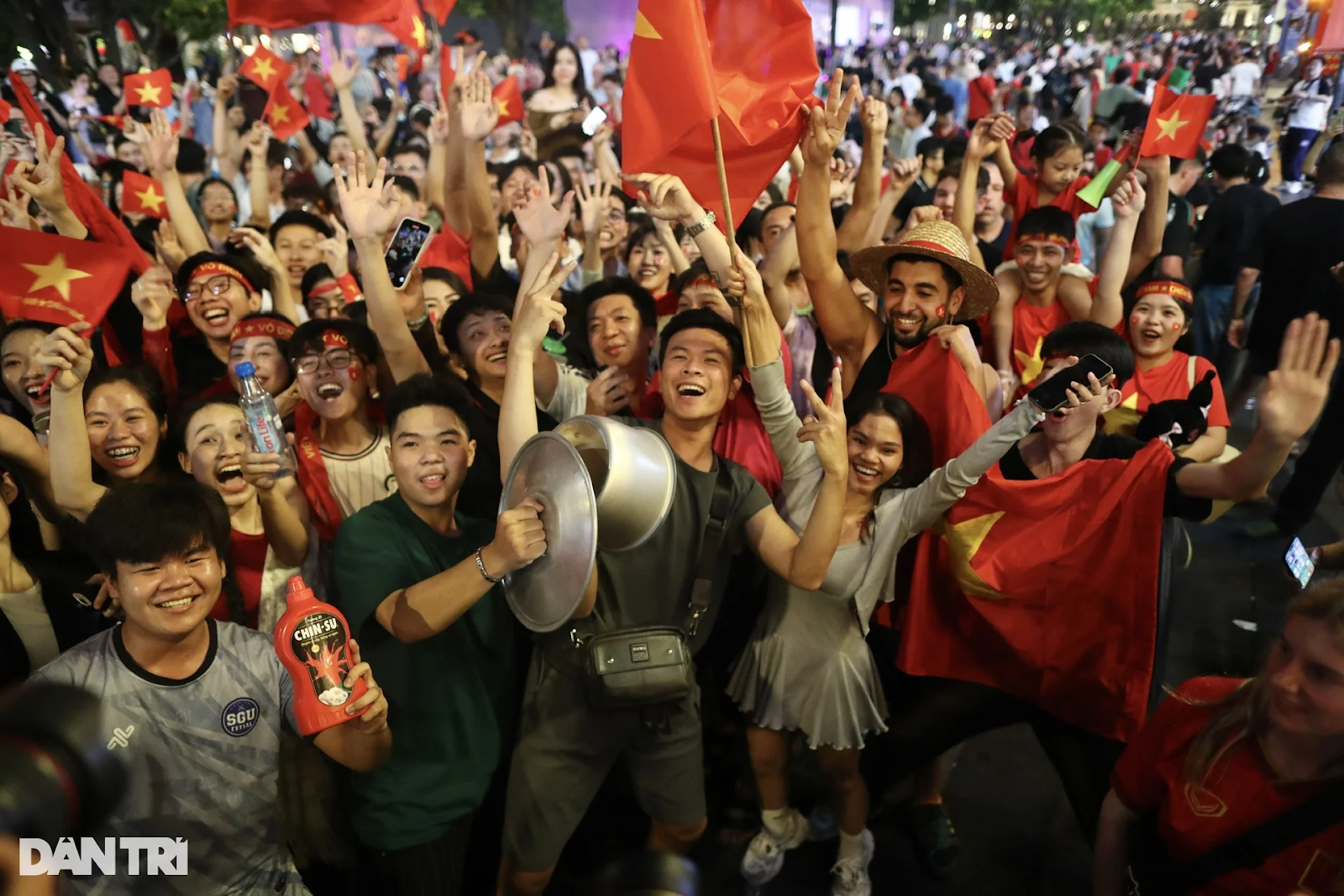
As the Vietnam soccer team won over Thailand in the AFF Cup, everyone knew what was going down. Silence. Then horns blared, motorbike engines revved, and metal clanged as thousands of flags were raised. Was it the spirit of football? Unlikely. What Vietnamese people love the most is a chance to gather and celebrate, cheering for their national flag. 

Pots and pans were used during ‘đi bão’ to support the cheering effort (Image source: Lao Động)
Thousands of Vietnamese rejoice as the match ends, signifying Vietnam’s triumph (Image Source: Hải Long, Dân Trí)

Đi bão is a one-night chance for the Vietnamese people to parade, to party, and to celebrate a collective victory of the nation. The people dressed in red with a smear of yellow makeup, the color of the Vietnamese flag, as bikers violated every traffic rule imagined. It didn’t matter, as everyone was in a sense of euphoria. Cheeky cardboard signs went up, shirts went off, and occasionally, a person too hyped for the occasion would lead the crowd’s chant.

The people of Hanoi raise their glasses and celebrate (Image source: Mạnh Quân, Dân Trí)
A son and dad celebrating Vietnam’s victory (Image source: Nam Anh, Dân Trí)
A man in a costume leads the crowd (Image source: VOV)

Đi bão beautifully reflects an element of Vietnam’s culture, the Vietnamese identity. The emotions and the experience transcend beyond any boundaries, borders, and football team. It was the loud sounds filled with excitement and pride that made the term đi bão so understandable and relatable. It was the collective joy that made even foreigners experience what it is like to be a Vietnamese for a night.

Tiến Linh [left], Duy Mạnh [middle], Xuân Son [right] in AFF Cup 2024 (Image source: Mạnh Quân, Dân Trí)

Tomo Credit headshots-3538-jpg

Awaken* newsletter

Transforming Access to Credit: A Conversation with Kristy Kim, Founder & CEO of TomoCredit

In this month’s edition of the Awaken* Newsletter, we speak with Kristy Kim, Founder and CEO of TomoCredit, a fintech startup focused on improving access to credit for underserved consumers. By using AI to evaluate real-time cash flow data rather than traditional credit scores, TomoCredit connects consumers with lenders.

Kristy discusses her journey as an immigrant, an Asian female founder, and an entrepreneur working to transform the financial industry. Through her leadership, TomoCredit aims to provide more people with better access to capital and lending opportunities.

Can you start by giving us an overview of your company and what you’re trying to solve?

Kristy Kim: Sure! At TomoCredit, our mission is to bridge the gap between underserved consumers and lenders using AI technology. We are focused on serving individuals who have been left behind by traditional financial systems, especially those without credit scores or with limited credit history.

There are millions of people in the U.S. who are underbanked, and the financial institutions that could potentially help them either don’t have access to their data or don’t understand their risk profile. We leverage AI to evaluate consumers based on their cash flow instead of relying solely on traditional credit scores. This enables us to match these individuals with lenders who are willing to serve them without taking on additional risk. Our platform helps both consumers and lenders—consumers get access to capital, and lenders expand their market in a low-risk way.

What motivated you to start TomoCredit?

As a first-generation immigrant from South Korea, I moved to the U.S. at eleven. In my early twenties, I faced the challenges of building my own credit history. After graduating from UC Berkeley, I worked in investment banking.

Despite having a stable income, I was denied an auto loan five times because I lacked a credit score. This experience highlighted a significant gap in the financial system, where many immigrants, young adults and many other underserved communities are excluded due to the absence of a credit history. After being turned down multiple times, I knew something had to change. I saw that the traditional credit system wasn’t serving millions of people, particularly immigrants, who had the ability to repay but lacked a credit history to prove it.

That experience of being excluded from the financial system really motivated me to find a way to help people like myself access the credit they needed. Determined to address this issue, I founded TomoCredit to provide credit solutions for those who, like me, struggle to access traditional credit avenues.

I wanted to create a system that didn’t rely on traditional credit scores but instead used alternative data, like cash flow, to assess creditworthiness. The idea was to connect underserved consumers to lenders in a way that wouldn’t increase their risk. TomoCredit was born out of this desire to make the financial system more inclusive—so others wouldn’t face the same rejections I did, and would have the chance to access capital and thrive.

As an immigrant founder, have you faced any challenges or biases in fundraising or building relationships with big institutions?

Kristy Kim: Yes, there are definitely challenges that come with being an immigrant founder, and at times, it can feel like an uphill battle. But, interestingly, my background has also played to my advantage.

As an immigrant, I have a unique lens on the problems facing underserved communities. I know firsthand what it’s like to struggle with the traditional credit system. I’ve faced the same barriers that many of our customers face, and that gives me an edge when I’m speaking to financial institutions. I’m able to say, “Look, I know my customers better than anyone else. These people are creditworthy, but they’re being overlooked by the traditional system.”

There is some bias, of course, especially when you’re dealing with legacy institutions, but I think they also recognize that I bring something different to the table—an intimate understanding of the market and the customers they often don’t have access to. Lenders are willing to listen because they know that by partnering with us, they can expand their pool of potential customers without taking on additional risk.

You’ve been in this industry for over five years now. What keeps you motivated despite the challenges you’ve faced?

Kristy Kim: That’s a great question. Honestly, the progress we’ve made keeps me motivated. Every year, I see the interest in our approach growing, and it reinforces that we’re heading in the right direction.

When we first started, it felt like I was an outsider trying to convince traditional financial institutions to embrace an entirely new way of evaluating credit. But now, year after year, we see more and more mainstream players realizing that there’s a huge market for underserved consumers—and that these consumers are creditworthy if we just use the right tools to understand them. It’s exciting to be at the forefront of this change.

For me, it’s not just about building a business—it’s about creating lasting impact. The U.S. consumer credit industry is worth over $4 trillion, and the fact that we are focusing on a largely ignored segment of that market feels like we’re making a real difference. And, of course, as a founder, seeing our technology evolve and improve with time and data is incredibly motivating.

How does your solution differ from other competitors in the market who are also targeting underserved consumers?

Kristy Kim: The key differentiator is that we don’t just rely on traditional credit scores to assess risk.

Our AI model is powered by cash flow data—essentially, we evaluate consumers based on their spending and income patterns, which gives a far more accurate picture of their financial health. Over the past five years, we’ve accumulated a wealth of data that allows us to refine our model, and with every new data point, we get better at underwriting.

Unlike competitors who may be using generic data or building from scratch, we have a more granular understanding of how underserved consumers behave financially. Additionally, the beauty of our system is that we’re not just looking at data from one financial institution—we’re aggregating data from multiple sources. Our customers might have accounts with multiple banks, and that gives us a fuller picture of their financial habits. In comparison, other companies might only have access to data from one bank, which limits their ability to assess risk accurately.

As a founder, what has been the most rewarding part of your journey so far, and what has been the hardest?

Kristy Kim: The most rewarding part has been seeing the validation from both the industry and our customers. When leaders of financial institutions tell me that TomoCredit makes sense, it’s incredibly validating. It’s a feeling of affirmation that, yes, we’re on the right path. But it’s also rewarding to see the real-world impact we’re having on people’s lives. We’ve helped thousands of people access capital who otherwise wouldn’t have had the chance.

On the flip side, the hardest part has been dealing with the mental burden of being a startup founder. When things are going well, it feels like everything is moving at full speed, but when challenges arise—whether it’s fundraising hurdles, market uncertainty, or hiring struggles—the pressure is immense. Unlike larger companies with more resources, startups have less margin for error. It can feel like one wrong move could jeopardize everything, and that can be emotionally exhausting. But it’s in those moments that you really find your resilience, and you learn that, no matter how tough it gets, you have to push forward.

As a seasoned founder, what key lessons from your previous startup experience have you applied to building TomoCredit?

When I launched my first company, I was in my early twenties, full of energy but lacking experience. It was a trial-and-error journey, where I learned a lot, but I quickly realized that having a clear vision and understanding the real impact you want to make is crucial.

Starting TomoCredit was a completely different experience. This time, I approached it with a clear strategy, having learned the importance of tackling a problem that I was personally passionate about. My previous startup experience taught me how to make more strategic decisions, prioritize what matters most, and stay resilient through the inevitable ups and downs of entrepreneurship.

What advice would you give to aspiring founders, particularly those who may be feeling discouraged after a tough year?

Kristy Kim: My advice would be to stay grounded in your purpose and conviction. It’s easy to get distracted by the ups and downs of the startup world, but at the end of the day, your mission should drive you more than the fear of failure or the setbacks you face along the way.

When I first started my company, it wasn’t about just building a business—it was about solving a real problem that I deeply cared about. The passion for the idea needs to be stronger than the fear of failure. Even if things don’t work out the way you hope, you can still be proud knowing that you tried to create something that could have made a real impact.

The most successful founders I know are the ones who are able to maintain a strong sense of purpose, even when it feels like everything is falling apart. If you believe in what you’re doing and are committed to the long-term vision, that will carry you through the hard times.

What are some recent key achievements or milestones that you’re excited to share?

Kristy Kim: Thanks for asking. First, our AI-driven platform continues to help underserved consumers access credit by using cash flow data to connect them with lenders.

We’ve also made significant strides in improving our underwriting capabilities by leveraging years of data to assess creditworthiness more accurately. This year, we paused issuing new credit cards to focus on refining our AI and underwriting technology. While we haven’t issued new cards yet, we’re still accepting customers and offering other financial services. Additionally, our partnerships with larger financial institutions are also growing, with increasing interest from major players. These collaborations are essential to our mission of expanding access to lending for underserved communities.

And lastly, on the team front, we’ve made several key hires, including the former CTO at Experian and the former CEO of LegalZoom. Their expertise in open banking and scaling high-growth companies will help us continue to expand our offerings and further our mission.

Looking ahead, what’s next for TomoCredit?

Kristy Kim: We’re expanding our offering, bringing more lenders into the network, and continuing to refine our AI technology to provide better risk assessments.

We’ve been growing the B2B side of our business over the last year, and we’re seeing significant interest from bigger players in the financial sector. We’re also planning to expand our product offerings to include more types of loans, like auto loans and mortgages, to help more customers get the access they need.

We’re also actively hiring, which is very exciting for us. We’re looking for a talented marketing person to help us build our brand and spread the word about what we’re doing. Our mission is to make financial access easier for everyone, and we’re excited to continue growing and impacting even more lives.


Kristy Kim’s journey proves that determination, a clear vision, and a deep understanding of your market can break through even the toughest barriers. At TomoCredit, she’s not just building a company; she’s seeking to reshape how credit is accessed, especially for those often left behind by traditional systems. Stay tuned for more updates on TomoCredit’s journey, and learn how they’re challenging the status quo while creating new opportunities for underserved communities.

Author: Donna Yu

24-10-05_JILLY-BING-jpg

News

Jilly Bing Brings Riley, the First Doll to Celebrate Mixed Asian Heritage and Diversity

Jilly Bing, the company known for the Jilly Doll and its mission to break down stereotypes about Asian American girls, is once again pushing boundaries for its community. Celebrating its heritage, Jilly Bing is expanding its collection with the Riley Doll, a new character designed to represent mixed Asian and Caucasian backgrounds.

A Founder’s Dream

Elenor Mak, the Chinese American founder of Jilly Bing, was inspired by her search for a doll that reflected her daughter’s heritage. This pursuit brought the Jilly Doll to life as a collection aimed at bringing representation to playtime, helping Asian children make sense of the world, their identities, and the roots of their traditions.

Elenor Mak, the Chinese American founder of Jilly Bing with the Riley Doll (Left) and the Jilly Doll (Right).(Image source: Jilly Bing)

Elenor Mak, the Chinese American founder of Jilly Bing with the Riley Doll (Left) and the Jilly Doll (Right).(Image source: Jilly Bing)

Mak stated to PR Newswire, “As the number of Americans identifying as mixed-race Asian grows, the Riley Doll offers children a reflection of their experiences, showing they can be 100% Asian, 100% Caucasian, and 100% themselves.”

From Dream To Reality

Riley is confident, loves snacks from her favorite Asian stores, and enjoys adventure. Mak continued, “The Riley Doll was created in response to strong consumer demand, as a mixed Asian doll was the top request from the Jilly Bing community. For so many of us, growing up meant feeling pressured to choose one side of our heritage. The Riley Doll is here to show kids they don’t have to choose—they can celebrate every part of who they are.”

The Riley Doll was created to help children celebrate their identity. (Image Souce: Jilly Bing)

The Riley Doll was created to help children celebrate their identity. (Image Souce: Jilly Bing)

The doll further propels Jilly Bing’s mission of bringing Asian American characters to life, representing the community’s diversity in backgrounds, appearances, interests, and personalities. Priced at $68, Riley is now available exclusively online at jillybing.com.

Featured Image Source: Jilly Bing

Headshot White copy-png

Stories

DJ Kim’s Legacy of Uplifting Founders Through Cherry Assistant

Not knowing what to do when starting his business, DhungJoo “DJ” Kim burnt through a whole sum of cash during his early days and later got himself in an environment full of volatility and bad actors. 

Yet after years of honing his entrepreneurial experience, DJ founded and grew RevGenius to a 30,000-member community at $1M ARR, sold three businesses, and helped over 50 business owners scale their companies with offshore staff.

Propelled by a passion for uplifting the community, he founded Cherry Assistant, a bridge dedicated to providing global talents for founders. 

Whether you are a young founder or a seasoned leader looking for something to kindle your entrepreneurial spirit, DJ’s story will redefine what it means to have a legacy that extends beyond business success.

An Entrepreneur Hero

DJ’s inspiration for entrepreneurship started with his admiration for his father, who had been an entrepreneur for over 30 years. As a child, he saw firsthand how his father had traversed challenges, empowered his team, and innovated his business to stay competitive. 

“He faced the ups and downs of the industry with resilience and dedication, which taught me the importance of hard work, adaptability, and long-term commitment,” DJ explains. 

DJ learned that entrepreneurship is more than starting a business but creating something that can evolve and endure the test of time. This drive nurtured DJ’s entrepreneurial spirit, invoking his desire to make an impact through his ventures. 

“His passion for his work, even after decades, has inspired me to build my path in business, with the same drive and perseverance,” DJ reflects.

His father's passion is what drives DJ to build his business.

His father’s passion is what drives DJ to build his business.

Shaky First Steps

Like many young founders, DJ was eager but inexperienced when starting his entrepreneurial journey. During his first years, he recalled wasting a lot of money for not knowing the fundamentals. 

DJ states, “We outsourced development to a team in India, only to realize that without the technical know-how to properly manage and guide the project, we were burning through cash with little return.”

These struggles were further burdened by DJ’s struggle to reconcile with his Asian heritage and the pressures of assimilating into a Western environment. As a Korean who immigrated to the US at a young age, DJ regularly felt he was losing parts of himself, specifically in spaces where Asian representation was lacking. Yet, these challenges also drove DJ to give the Asian community a turning point. 

“I want to create opportunities for others in the Asian community to embrace their identities fully and bring their cultural strengths into the business world,” he exclaimed. 

An Entrepreneur’s Passion

Startup was DJ’s passion even as early as his college days when he launched his first mobile app startup with an initial $250K raise. Transitioning from a startup incubator to co-founding RevGenius, DJ fostered a community with 30,000 members and hit $1M ARR in one year. 

Eager to expand and hone his experience in software, e-commerce, and B2C ventures, DJ moved to LA to explore crypto/Web3, where he found himself in an environment of bad actors and volatility. 

Looking back, DJ states “It tested my resilience and taught me the importance of diligence, research, and staying true to my ethical standards in any venture.”

This experience inspired DJ to found Cherry Assistant, a business dedicated to helping founders scale their companies with virtual assistants. 

Building Cherry Assistant was no simple feat. DJ has encountered numerous challenges in hiring offshore talent sifting through scams and dishonest individuals to identify reliable people. He understands that clients are wary of offshore workers as there is a misconception that these laborers are somehow ‘lesser’ or incapable. Hence, he made it his mission to show clients that there are hardworking, skilled professionals who simply happen to live in different countries.

He states, “I learned that, at its core, a community thrives on mutual benefit and authentic connections.”

Throughout DJ's business journey, he learned that community is core to success.

Throughout DJ’s business journey, he learned that community is core to success.

The Strength of a Community

During this journey of scaling Cherry Assistant, DJ found Asian Hustle Network (AHN). 

“AHN became instrumental in expanding my network, showcasing the power of community support in entrepreneurship,” DJ excitedly claimed.

As Cherry Assistant attracted many home cleaning businesses seeking offshore support, including one business owner who offered DJ mentorship, he decided to open his third business: a remote home cleaning company. Within just a year, DJ successfully scaled and sold it to a local entrepreneur thanks to AHN’s community. 

“Through AHN’s supportive community, I eventually found a local entrepreneur interested in buying the business. This network not only enabled me to close the deal but also highlighted the power of community and connection in the Asian business world,” DJ excitedly claimed.

A Vision to Help the Community

Focusing on scaling Cherry Assistant and his experiences building three businesses, DJ’s mission is to empower entrepreneurs and small business founders by providing them with the resources to achieve similar success.

DJ states, “With Cherry Assistant, my goal is to create a bridge for founders to access global talent, helping them streamline operations, save time, and focus on growth. This mission is personal to me as a Korean American, knowing firsthand the value of hard work, resilience, and the importance of leveraging opportunities.”

DJ’s vision is to foster a diverse and inclusive workforce, all while building a platform that provides businesses with skilled support. For the Asian community, this mission holds a greater significance in DJ’s heart.

“By sharing my experiences and the lessons I’ve learned, I hope to empower other Asians and Asian Americans to pursue their ambitions, leverage their networks, and give back to their communities,” DJ states.

DJ’s true legacy goes far beyond the success of his business—it lives in his unwavering passion to uplift and empower other founders.

Connect with DJ Kim

Instagram: @dhungjookim

Twitter: DJ Kim

LinkedIn: DJ Kim