News

February 6, 2025

SHARE:

The Ascension to Power

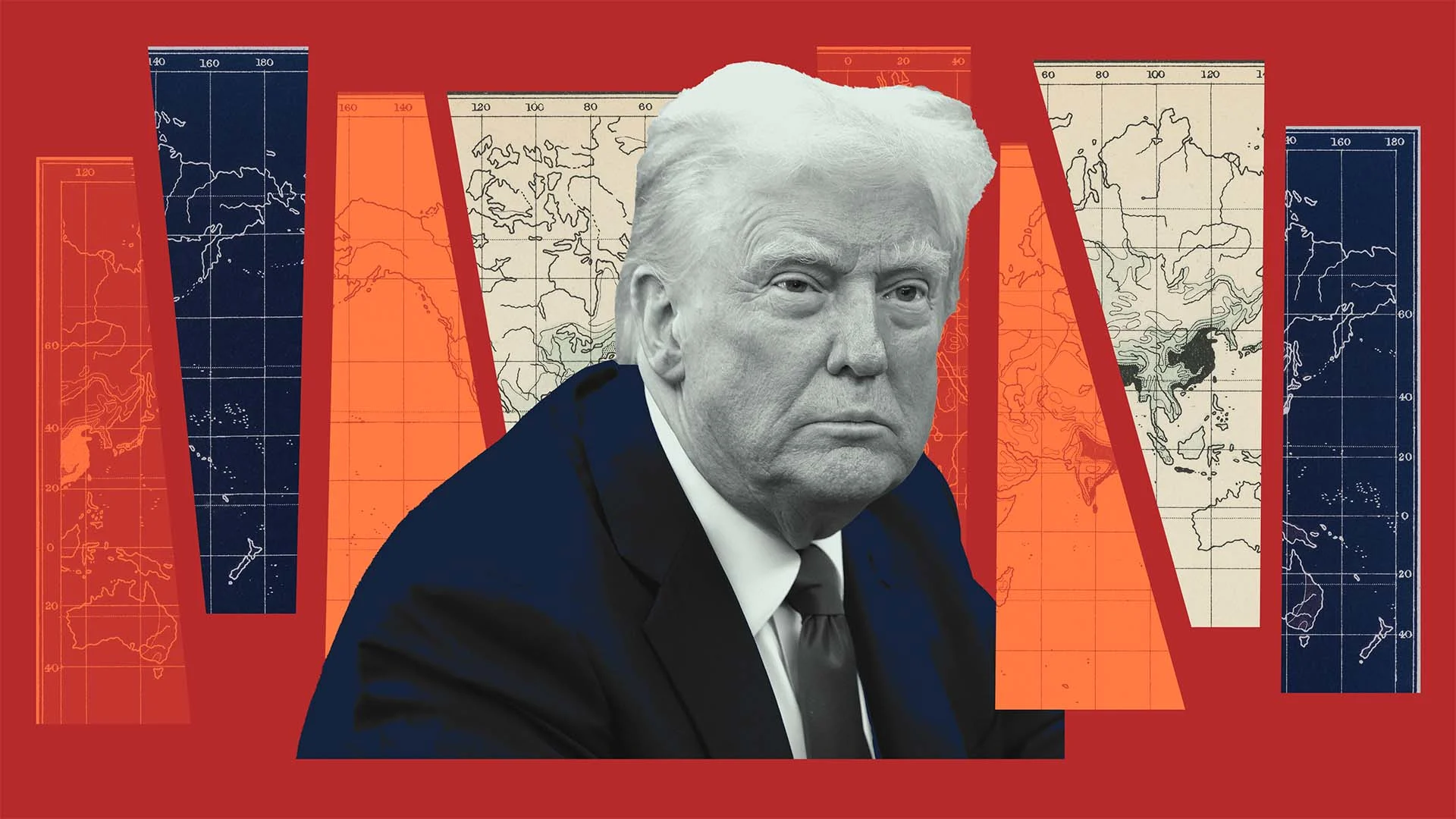
As Trump is re-elected, new reforms and policies are taking shape. Among them is his threat to impose a 25% tariff on Mexico and Canada, alongside a 10% tariff on China—claiming these countries allegedly failed to address illegal immigration and co-conspirators for illegal fentanyl distribution in the United States (US). 

Yet the article is not to stir political debate but to explore the ramifications of these tariffs on consumers and Asian countries. While many news outlets have focused on the potential setbacks in the affected countries, few have explored how others might either suffer or benefit from the situation. Hence, this piece shall highlight how Trump’s ascension to power might become the best opportunity for some Asian economies.

The Price of Tariffs

The Guardian defines a tariff as a tax imposed on foreign goods entering a country. As the world’s largest importer, the US brought in $3.2 trillion worth of goods in 2022, with imports from Canada, Mexico, and China totaling $1.2 trillion in 2023. Trump takes pride in this idea, believing the US government would receive more revenue through these tariffs, coining tariffs as the “most beautiful word in the dictionary” in an interview with Bloomberg. 

Brown University Professor of Economics Şebnem Kalemli-Özcan disagrees by arguing, “For many economists, tariff is actually the worst word in the dictionary.” She explains that ultimately American consumers and businesses will pay the price. As a trade-deficit nation, the US imports more than its exports. According to the Tax Policy Center, a 60% levy on Chinese goods accompanied by a 20% worldwide tariff could raise the costs for the average US household to up to $3,000 in 2025.

As companies face higher costs for goods, they often transfer those expenses to consumers through price increases. This can reduce consumer spending, which in turn lowers business investment and may lead to job losses.

Jason Miller, a professor of supply chain management at Michigan State University reaffirms such claims stating, “Because of the combination of these three countries, it’s going to be difficult to go down an aisle of a grocery store and not see some sort of inflationary effect.” Capital Economics projected that the newly announced tariffs could drive annual inflation up from 2.9% to as much as 4%.
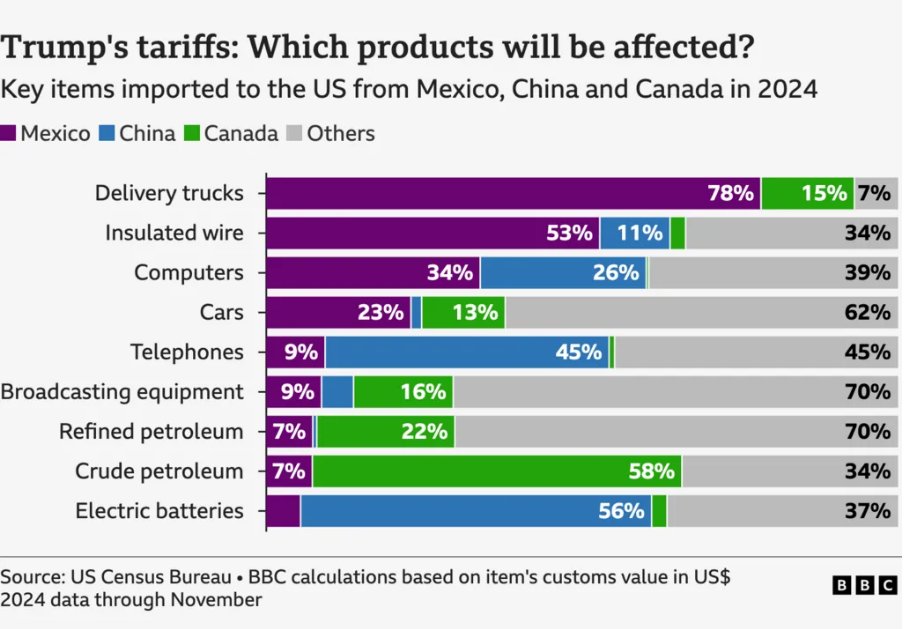
Products affected by Trump’s Tariffs (Image source: BBC)

Nevertheless, Trump’s tariff threats carry weight, as they could impose significant economic pressure on targeted countries, prompting businesses to relocate. According to the BBC, Chinese factories with 500 workers have shrunk to just 200 employees, while American buyers are already exploring alternative manufacturing hubs in neighboring regions outside of China.

Business owner Huang Zhaodong, who recently relocated his factory, told the BBC that customers had pressured him to move production overseas. He agrees with their concerns, estimating that a 10% tariff increase could cost him an additional $800,000 in earnings. “Manufacturing clothes in China under these tariff conditions is simply unsustainable,” he said.

A Victor Emerges

Cases like Mr. Huang’s have proved the challenges that Trump’s tariff has imposed on countries like China. The beginning of the Trump trade war has led businesses to flee to Southeast Asian nations, most notably Vietnam. 

While other Southeast Asian nations also benefit from shifting supply chains, Vietnam has emerged as a top destination due to its growing industrial capacity and strategic location. The country recently rose to become the Association of Southeast Asian Nations (ASEAN) champion with an estimated 40% of all ASEAN exports to North America being from the country alone. Though it is difficult to quantify how many businesses have relocated from China, BBC reports that major brands like Puma, Nike, and Adidas have already moved production to Vietnam. Sources from Vietnam Briefing indicate Intel and Samsung have rapidly ramped up their investment in Vietnam and are projected to reach $100 billion in revenue by 2050. Propelled by robust exports and foreign investments, Vietnam’s economy has recently grown by 7.09%, reaching $476.3 billion—outpacing the 5.05% expansion seen in 2023.

It is debatable whether Trump’s glare will graze upon this nation. Experts debate whether he will target Vietnam with tariffs, as his trade policies often focus on countries with a trade surplus. In 2024, Vietnam held the third-largest trade surplus with the United States at $104.6 billion, accounting for nearly 30% of its total exports. This substantial trade imbalance makes Vietnam a potential target for Trump’s tariff threats. In this scheme, the nation might experience radical changes due to trade balances, exchange rates, supply chains, and foreign direct investment (FDI). However, Vietnam is more likely to benefit from US-imposed tariffs. This prediction is supported by trends from Trump’s first term when the country experienced significant economic growth due to an influx of manufacturers and factories relocating to Vietnam. 

Despite lingering skepticism, Trump has maintained a favorable view of Vietnam. As early as 1980, Trump publicly opposed the Vietnam War and visited the country twice during his first term. His business ventures have also extended to Vietnam, with his organization partnering with Kinh Bac City Development Holding Corporation (KBC) to develop a $1.5 billion complex in Hung Yen Province. Meanwhile, his new confidante, Elon Musk, has positioned Vietnam a key production hub for SpaceX’s Starlink satellite internet project, shifting suppliers and manufacturing from Taiwan to Vietnam to reduce geopolitical risks.

Reversing these investments may be impractical or simply too late. The confidence that both Trump and Musk have placed in Vietnam highlights the country’s growing role in global supply chains. Amid rising geopolitical tensions, Vietnam’s diplomatic strategy—often referred to as the “bamboo policy” for its balance of resilience and adaptability—has strengthened its international position. As long as the country continues to wisely navigate political and diplomatic negotiations and steer clear of populist pitfalls, Vietnam is well-positioned to sustain its economic growth and global influence.

Related Articles

Image Source: Natalie Naudus

Uncategorized

This Mom Took a Career Switch and Is Now Making Six Figures as a Book Narrator

Natalie Naudus’ voice actor journey began when she realized that narrating audiobooks could be a promising career option. She found that audiobooks were one of the fastest-growing areas of content creation and that most of them were recorded by voice actors in high-quality at-home studios. 

The mother of two decided to pursue it as a new career because she believed that many aspects of the genre she cherished as a classical singer could be incorporated into this new line of work. She now earns six figures annually.

Natalie’s husband helped her set up a home studio. A platform called ACX, which connects narrators with authors, agents, and publishers, gave her her first book job. To make her name and voice more well-known within the community, she started going to events related to book narration. 

During the 2020 pandemic, she decided to share snippets of her book narrator life on Tiktok and Instagram. She wishes others could appreciate this profession as much as she does. This exposure increased her popularity and fan base. Book gigs from publishers who wanted to hire her to publish her works also began to flood in. With this strong online presence, she acknowledged it as one of the most important decisions she has ever made for her professional advancement.

Currently, she still manages to put in a productive 40 hours a week between recording, administrative duties and reading up on material for her next book. Major publishers typically offer her a starting rate of $225 per finished audio hour. 

After three years as a voice actor, she finally reached the six-figure mark in earnings and enabled her to purchase the land for their mountaintop home, as well as upgrade her recording booth.

Natalie had recorded almost 400 books over five years. She is also an award-winning audiobook narrator of more than 250 titles.  Her story shows that taking a chance on a new career path can pay off in ways one never expects.– “It was a difficult decision to give up my opera dreams. But I wouldn’t be where I am today if I hadn’t left it behind and taken this chance.” she tells CNBC’s Make It.

Source Image: Turis.app

Uncategorized

This CEO Transformed Lost Fishing Nets Into Sustainable One-Of-A-Kind Bikinis

Plastic pollution harms our planet and health, but thankfully, companies like Copenhagen Cartel are combating this environmental problem by converting lost or abandoned fishing nets into bikinis with a modern twist on an ancient textile tradition.

Copenhagen Cartel’s founder and ocean lover, Katrine Lee Larsen, was motivated to help mitigate the adverse effects of plastic use and came up with a “brilliant solution” destined to become a global superstar.

Launched in 2019, Copenhagen Cartel has produced swimwear and athletic wear from ocean waste plastic. The deadly ‘ghost nets’ that would otherwise waste away in the ocean and kill countless marine life can be put to good use in this way. Compared to making brand-new nylon, Copenhagen Cartel’s manufacturing process uses less energy and resources.

Larsen views each day as a fresh challenge while launching her own company. Moreover, as a true nature lover, she has been guided and helped by her purpose. She feels the entrepreneurial world is dominated by masculine values that leave little room for feelings and higher goals. However, her experience has shown that a focused, emotional strategy can be very beneficial. She believes a new era of entrepreneurs will emerge due to shifting to a mindset that values meaning over financial gain.

Larsen is an entrepreneur herself, and she has been through the experience of seeing the ocean being depleted of its resources. Despite this, she knows that there is still room for change, which drives her to continue to assist the environment and natural resources.

Image Source: Sean Berry

Uncategorized

Ann Mukherjee: First Woman of Color CEO of Liquor Brands Shares An Incredible Outlook To Grow

Indian American Ann Mukherjee CEO and chairman of Pernod Ricard, has been a model for success and women’s empowerment. At 56 years old, she is currently managing the world’s second-largest seller of wine and spirits and is also renowned for top-shelf liquor brands such as Absolut, Jameson, and Malibu. In an industry dominated by men, she is the first woman of color to hold the highest position for alcoholic beverage brands.

As soon as she assumed the position of CEO in 2019, she realized that there was a stereotype rooted in an exaggerated machismo of being a self-confident leader. After giving it some thought, she concluded that those beliefs were not only completely false but also destructive, so she chose to disregard them. 

Mukherjee thought the most challenging part of being a CEO was knowing when to ask for help or admit you couldn’t do it alone. She believes it is essential for a leader to accurately understand herself and her people and then learn from them. Although confident in her abilities, she also recognizes the importance of showing humility and honesty.

She also reveals how her failure became the key to her success. She has become more resilient because she has learned to change course when necessary and take advantage of setbacks to advance. And while also acknowledging her drawbacks, she stresses the value of accepting failures. 

Her one piece of advice for anyone just starting in their career is, “Do not worry about fitting in, and do not be afraid to speak up, because when you have confidence in yourself, anything is possible,” she shared with CNBC’s Make It.

Mukherjee is well aware that to be an effective leader, she must first be able to love herself without condition, taking into account all of her attributes, including her strengths, weaknesses, opportunities, and threats. And with that comes the realization that knowing one’s shortcomings can better help one deal with and overcome those. This is the only way for her to achieve genuine personal and professional development.

Image Source: Forbes

Uncategorized

Korean Startup Dongnae Makes Apartment Hunting More Affordable And Accessible

Its key product, Dongnae FLEX, offers short-term, fully-furnished rentals with low deposits, appealing to fresh graduates or travelers unable to cough up the hefty deposits typically required of Korea’s apartments.

Former WeWork executives Insong Kim and Korean-American Matthew Shampine founded Dongnae in 2020. They are “Making it a better experience for the brokers, for the landlords, and especially for the tenants,”  Shampine said in an interview.

Dongnae has welcomed local and global investors. Its $21m series A funding round in March included Lyft and Doordash backer NFX, Airbnb backer MetaProp, and Korea’s oldest investment fund Daol Investment and Hana Financial.

More than 80% of Korean household wealth is in real estate, but it’s increasingly harder to become a homeowner. In Seoul, South Korea’s capital and most populated city, the average apartment price doubled between 2017 and 2021.

The startup company began as a listing platform for renters to book agency visits, but it was unsuccessful. Shampine believes the business model’s early failure generated “good and healthy” but painful reflections. According to Forbes, conversations with customers, brokers, and team members on the ground informed Dongnae’s goal of “becoming the supply, instead of hunting for the supply.” 

The firm switched to serviced apartments in July 2021. At the end of its current investment, the business had 60 apartment buildings; now it has 80 across 12 Seoul districts.

Dongnae wants to offer more home services to its residents in the future, taking advantage of Korea’s booming market for furniture and other lifestyle goods.