News

February 6, 2025

SHARE:

The Ascension to Power

As Trump is re-elected, new reforms and policies are taking shape. Among them is his threat to impose a 25% tariff on Mexico and Canada, alongside a 10% tariff on China—claiming these countries allegedly failed to address illegal immigration and co-conspirators for illegal fentanyl distribution in the United States (US). 

Yet the article is not to stir political debate but to explore the ramifications of these tariffs on consumers and Asian countries. While many news outlets have focused on the potential setbacks in the affected countries, few have explored how others might either suffer or benefit from the situation. Hence, this piece shall highlight how Trump’s ascension to power might become the best opportunity for some Asian economies.

The Price of Tariffs

The Guardian defines a tariff as a tax imposed on foreign goods entering a country. As the world’s largest importer, the US brought in $3.2 trillion worth of goods in 2022, with imports from Canada, Mexico, and China totaling $1.2 trillion in 2023. Trump takes pride in this idea, believing the US government would receive more revenue through these tariffs, coining tariffs as the “most beautiful word in the dictionary” in an interview with Bloomberg. 

Brown University Professor of Economics Şebnem Kalemli-Özcan disagrees by arguing, “For many economists, tariff is actually the worst word in the dictionary.” She explains that ultimately American consumers and businesses will pay the price. As a trade-deficit nation, the US imports more than its exports. According to the Tax Policy Center, a 60% levy on Chinese goods accompanied by a 20% worldwide tariff could raise the costs for the average US household to up to $3,000 in 2025.

As companies face higher costs for goods, they often transfer those expenses to consumers through price increases. This can reduce consumer spending, which in turn lowers business investment and may lead to job losses.

Jason Miller, a professor of supply chain management at Michigan State University reaffirms such claims stating, “Because of the combination of these three countries, it’s going to be difficult to go down an aisle of a grocery store and not see some sort of inflationary effect.” Capital Economics projected that the newly announced tariffs could drive annual inflation up from 2.9% to as much as 4%.
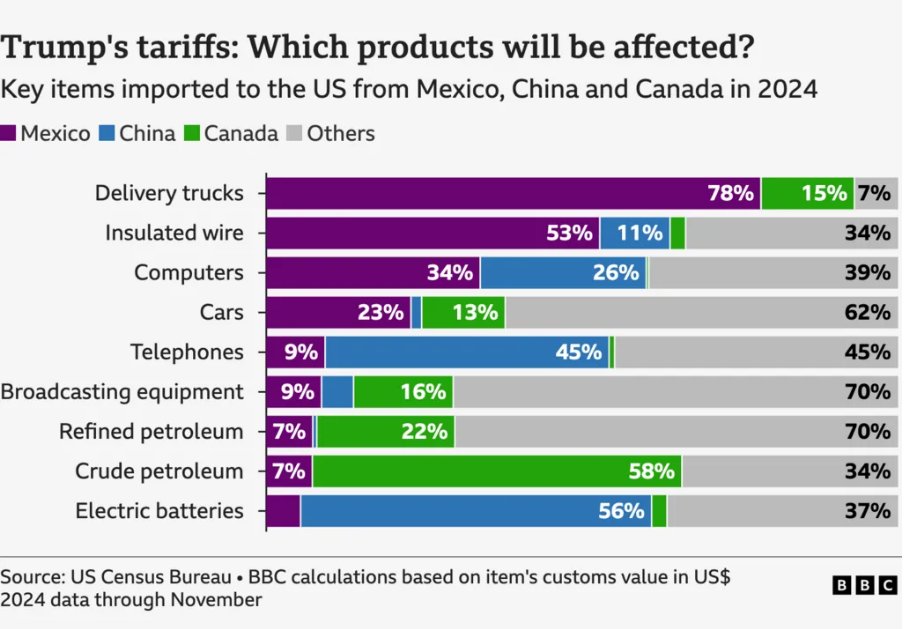
Products affected by Trump’s Tariffs (Image source: BBC)

Nevertheless, Trump’s tariff threats carry weight, as they could impose significant economic pressure on targeted countries, prompting businesses to relocate. According to the BBC, Chinese factories with 500 workers have shrunk to just 200 employees, while American buyers are already exploring alternative manufacturing hubs in neighboring regions outside of China.

Business owner Huang Zhaodong, who recently relocated his factory, told the BBC that customers had pressured him to move production overseas. He agrees with their concerns, estimating that a 10% tariff increase could cost him an additional $800,000 in earnings. “Manufacturing clothes in China under these tariff conditions is simply unsustainable,” he said.

A Victor Emerges

Cases like Mr. Huang’s have proved the challenges that Trump’s tariff has imposed on countries like China. The beginning of the Trump trade war has led businesses to flee to Southeast Asian nations, most notably Vietnam. 

While other Southeast Asian nations also benefit from shifting supply chains, Vietnam has emerged as a top destination due to its growing industrial capacity and strategic location. The country recently rose to become the Association of Southeast Asian Nations (ASEAN) champion with an estimated 40% of all ASEAN exports to North America being from the country alone. Though it is difficult to quantify how many businesses have relocated from China, BBC reports that major brands like Puma, Nike, and Adidas have already moved production to Vietnam. Sources from Vietnam Briefing indicate Intel and Samsung have rapidly ramped up their investment in Vietnam and are projected to reach $100 billion in revenue by 2050. Propelled by robust exports and foreign investments, Vietnam’s economy has recently grown by 7.09%, reaching $476.3 billion—outpacing the 5.05% expansion seen in 2023.

It is debatable whether Trump’s glare will graze upon this nation. Experts debate whether he will target Vietnam with tariffs, as his trade policies often focus on countries with a trade surplus. In 2024, Vietnam held the third-largest trade surplus with the United States at $104.6 billion, accounting for nearly 30% of its total exports. This substantial trade imbalance makes Vietnam a potential target for Trump’s tariff threats. In this scheme, the nation might experience radical changes due to trade balances, exchange rates, supply chains, and foreign direct investment (FDI). However, Vietnam is more likely to benefit from US-imposed tariffs. This prediction is supported by trends from Trump’s first term when the country experienced significant economic growth due to an influx of manufacturers and factories relocating to Vietnam. 

Despite lingering skepticism, Trump has maintained a favorable view of Vietnam. As early as 1980, Trump publicly opposed the Vietnam War and visited the country twice during his first term. His business ventures have also extended to Vietnam, with his organization partnering with Kinh Bac City Development Holding Corporation (KBC) to develop a $1.5 billion complex in Hung Yen Province. Meanwhile, his new confidante, Elon Musk, has positioned Vietnam a key production hub for SpaceX’s Starlink satellite internet project, shifting suppliers and manufacturing from Taiwan to Vietnam to reduce geopolitical risks.

Reversing these investments may be impractical or simply too late. The confidence that both Trump and Musk have placed in Vietnam highlights the country’s growing role in global supply chains. Amid rising geopolitical tensions, Vietnam’s diplomatic strategy—often referred to as the “bamboo policy” for its balance of resilience and adaptability—has strengthened its international position. As long as the country continues to wisely navigate political and diplomatic negotiations and steer clear of populist pitfalls, Vietnam is well-positioned to sustain its economic growth and global influence.
Related Articles

Image Source: Chinese Parade / Mark Andrew Boyer / KQED

News

Rich Ting Leads First San Francisco’s Chinese New Year Parade After Pandemic

Chinese American actor Rich Ting will serve as the grand marshal of San Francisco’s Chinese New Year parade in 2023.

The 42-year-old was reared by an athletic family, was born in Torrance, California, and spent time growing up in both Southern and Northern California.

Not only did he focus on being an athlete growing up, but also trained to be a Hollywood actor just what he always dreamed of. He made this goal come true by appearing in several films and TV shows, including Chicago P.D., NCIS: Los Angeles,  and Salt.

Succeeding Daniel Wu in leading the city’s Chinese New Year’s Year of The Rabbit parade, Rich stated “I am beyond words to express my gratitude for including me in such an iconic cultural celebration” in The San Francisco Standard.

The Chinatown exhibition will be celebrated for the first time since the pandemic with Harlan Wong serving as the parade’s director. Harlan Wong revealed that several rabbit sculptures will be placed throughout the city as part of the festivities and then sold at auction to benefit charities.

Michelle Yeoh, Jon Chu, and Mayor London Breed were hailed as grand marshals in prior years.

The Lunar New Year will be celebrated on January 22 at events hosted by the Chinese Chamber of Commerce, although festivities will get underway at Chinatown’s Flower Market on January 14.

On February 3, the Miss Chinatown Pageant will take place the day before the parade.

Image Source: Strait Times

Stories

What Motivated A Cleaner To Become Singapore’s Primech Services & Engineering CEO

Starting out poor and being dumped by a girl because she saw no better life with a cleaner is truly a successful and inspirational story for a man who now makes fortune.

Instead of getting frustrated, Vernon Kwek used his heartbreak and the discrimination he went through from his girlfriend who chose a university guy over him as a motivation of working hard and striving further in life.

The 48-year-old is now Singapore’s Primech Services & Engineering CEO who owns a 10% share in the company.

Simultaneously, Vernon also runs A&P Maintenance Services and Maint-Kleen, two other cleaning companies handling some of the biggest companies in Singapore, including Changi Airport Group, with over 3,000 employees under his power.

Vernon was born to a humble family. When he was barely 13 years old, he helped his father find a new job after losing the latter’s job as a salesman.

After his father was accepted as a cleaning supervisor, Vernon manifested his hard work and family-orientedness by helping his father in cleaning toilets and offices during the weekends.

A year after, he gave up school just to work as a full-time cleaner to help his family. Being a responsible teenager, he was shortly promoted to cleaning supervisor at the age of 14.

“I asked the manager if he was sure. My dad became a supervisor only when he was 40. I was only 14. But he said: ‘Don’t worry. You have your dad’s genes. He has leadership qualities, you should have the same too,’” Vernon shared in Strait Times

Later on, he was again promoted to a higher position as a senior supervisor until he finally became the company’s CEO.

Nevertheless, Vernon experienced many downfalls in his journey but never lost hope as he was determined to have a better life. Now, he is a successful family man with four kids.

Image Source: Weilyn Chong Linkedin

Stories

A College Freshman’s “Failure Class” Podcast Project Paved Her Way To Times Square

When Weilyn Chong’s name and photo appeared on a Times Square billboard from the Nasdaq Tower, it instantly went viral, inspiring many young Singaporeans to pursue entrepreneurial endeavors.

Weilyn acknowledges the value of entrepreneurship in Southeast Asia despite the fact that the majority of her work with founders is focused in the US.

Growing up, 20-year-old Weilyn Chong has lived from one place to another between Singapore, Hong Kong, and the Netherlands which made her immersed in varied cultures.

Weilyn’s global exposure enabled her to be more flexible in dealing with many kinds of people especially since their family annually joins in Singapore Global Network events.

Despite their frequent moves, Weilyn’s mother made sure to give them a strong sense of connection to their roots by taking them to see their grandparents, spending time with family, and eating Singaporean food. 

The Singaporean third-year economics student at Princeton University expressed how being among passionate individuals inspires her.

Weilyn started a podcast about women entrepreneurs with her failure project for “The Other ‘F’ Word” class when she was still a freshman, and she has since enjoyed it.

Together with her high school friend Ali Debow, she even converted it into a regular extracurricular activity by co-founding The Entrepre女ers Network, a podcasting startup that connects and promotes female entrepreneurs with topics including design, young changemakers, and Gen Z female founders.

Weilyn wants to increase the visibility of female business owners and give them connections opportunities. Her team has spoken with over 130 creators in a year and increased their listenership and social media reach to 30,000.

She said that they hope to get young females to dream of being an entrepreneur and understand that entrepreneurship doesn’t have to look a specific way.

Learning that bias happens between genders in the global arena as only 2% of total venture capital funding goes to women because they are women, she attended a conference put on by the Nasdaq Entrepreneurial Center (NEC) to address the complex issue of inequity in venture for entrepreneurs of color and women entrepreneurs.

There, she met people from the Center and expressed her interest to get involved in the work they do in any capacity. 

She was asked to join the NEC board in order to represent Generation Z and put a spotlight on young entrepreneurship.

“I grew up thinking those two things are mutually exclusive – either you do charity work or you make money. But what we’re seeing is that you can raise a lot of money and make a positive impact on the world,” she said on CNBC.

Image Source: Taho Klasiko

Stories

Former Teachers Went Outside of Their Comfort Zones, Found Success in MilkTea-Inspired Taho Shop

Both Filipino educators, Camille Ona and Marvin Paclibare found a different world and passion out of their classrooms during the pandemic as teachers-turned-entrepreneurs and founders of Taho Klasiko, a special milk tea-inspired taho shop.

Breaking free from their first-loved profession, the two sculpt their name as entrepreneurs who choose to walk into another path.

Marvin said that if not for the pandemic, he might still be teaching now just as he thought that he would forever be a teacher. He also added how he realized that there is a bigger world waiting outside teaching.

With people becoming more mindful of their health, especially during the onslaught of the pandemic, Marvin said that they eyed tendering a healthier version of milk tea.

The shop attained a grand slam as the two now earn 6-digit figures per month, an amount far way better than their incomes as teachers in the Philippines.

Camille mentioned in an interview that although they are still passionate about teaching, they just chose to be practical.

Despite entering the world of business, the owners are still having the vibe of teaching as entrepreneurs who are open to learning and improving their craft just like when they were still teaching.

They also shared that they hired working students to extend help to them. 

As a piece of advice, the former teachers said that would-be entrepreneurs should go outside of their comfort zones and open their ways to many opportunities.

“It’s not enough that you have a dream; you need to work hard to make it a reality,” Camille added.