News

February 6, 2025

SHARE:

The Ascension to Power

As Trump is re-elected, new reforms and policies are taking shape. Among them is his threat to impose a 25% tariff on Mexico and Canada, alongside a 10% tariff on China—claiming these countries allegedly failed to address illegal immigration and co-conspirators for illegal fentanyl distribution in the United States (US). 

Yet the article is not to stir political debate but to explore the ramifications of these tariffs on consumers and Asian countries. While many news outlets have focused on the potential setbacks in the affected countries, few have explored how others might either suffer or benefit from the situation. Hence, this piece shall highlight how Trump’s ascension to power might become the best opportunity for some Asian economies.

The Price of Tariffs

The Guardian defines a tariff as a tax imposed on foreign goods entering a country. As the world’s largest importer, the US brought in $3.2 trillion worth of goods in 2022, with imports from Canada, Mexico, and China totaling $1.2 trillion in 2023. Trump takes pride in this idea, believing the US government would receive more revenue through these tariffs, coining tariffs as the “most beautiful word in the dictionary” in an interview with Bloomberg. 

Brown University Professor of Economics Şebnem Kalemli-Özcan disagrees by arguing, “For many economists, tariff is actually the worst word in the dictionary.” She explains that ultimately American consumers and businesses will pay the price. As a trade-deficit nation, the US imports more than its exports. According to the Tax Policy Center, a 60% levy on Chinese goods accompanied by a 20% worldwide tariff could raise the costs for the average US household to up to $3,000 in 2025.

As companies face higher costs for goods, they often transfer those expenses to consumers through price increases. This can reduce consumer spending, which in turn lowers business investment and may lead to job losses.

Jason Miller, a professor of supply chain management at Michigan State University reaffirms such claims stating, “Because of the combination of these three countries, it’s going to be difficult to go down an aisle of a grocery store and not see some sort of inflationary effect.” Capital Economics projected that the newly announced tariffs could drive annual inflation up from 2.9% to as much as 4%.
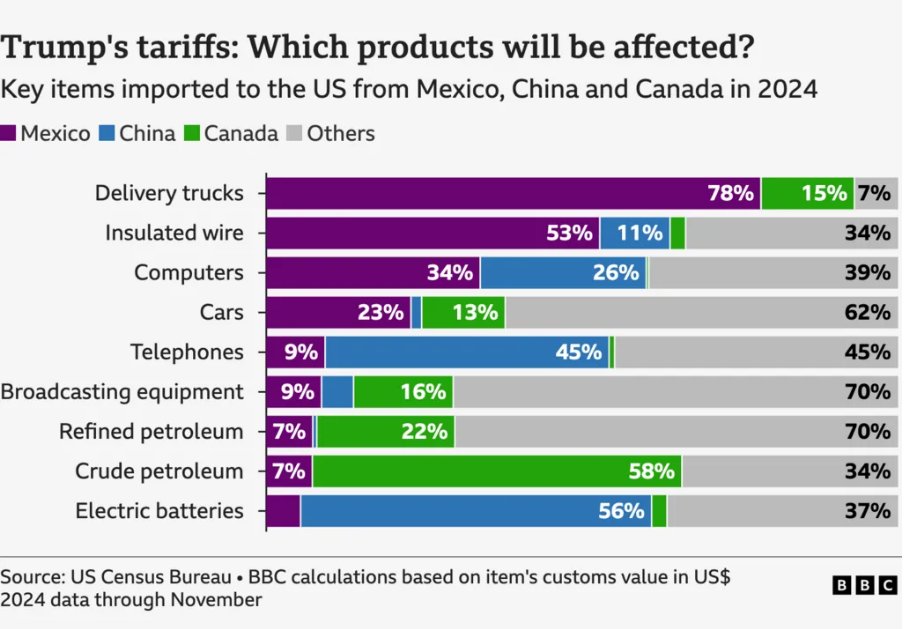
Products affected by Trump’s Tariffs (Image source: BBC)

Nevertheless, Trump’s tariff threats carry weight, as they could impose significant economic pressure on targeted countries, prompting businesses to relocate. According to the BBC, Chinese factories with 500 workers have shrunk to just 200 employees, while American buyers are already exploring alternative manufacturing hubs in neighboring regions outside of China.

Business owner Huang Zhaodong, who recently relocated his factory, told the BBC that customers had pressured him to move production overseas. He agrees with their concerns, estimating that a 10% tariff increase could cost him an additional $800,000 in earnings. “Manufacturing clothes in China under these tariff conditions is simply unsustainable,” he said.

A Victor Emerges

Cases like Mr. Huang’s have proved the challenges that Trump’s tariff has imposed on countries like China. The beginning of the Trump trade war has led businesses to flee to Southeast Asian nations, most notably Vietnam. 

While other Southeast Asian nations also benefit from shifting supply chains, Vietnam has emerged as a top destination due to its growing industrial capacity and strategic location. The country recently rose to become the Association of Southeast Asian Nations (ASEAN) champion with an estimated 40% of all ASEAN exports to North America being from the country alone. Though it is difficult to quantify how many businesses have relocated from China, BBC reports that major brands like Puma, Nike, and Adidas have already moved production to Vietnam. Sources from Vietnam Briefing indicate Intel and Samsung have rapidly ramped up their investment in Vietnam and are projected to reach $100 billion in revenue by 2050. Propelled by robust exports and foreign investments, Vietnam’s economy has recently grown by 7.09%, reaching $476.3 billion—outpacing the 5.05% expansion seen in 2023.

It is debatable whether Trump’s glare will graze upon this nation. Experts debate whether he will target Vietnam with tariffs, as his trade policies often focus on countries with a trade surplus. In 2024, Vietnam held the third-largest trade surplus with the United States at $104.6 billion, accounting for nearly 30% of its total exports. This substantial trade imbalance makes Vietnam a potential target for Trump’s tariff threats. In this scheme, the nation might experience radical changes due to trade balances, exchange rates, supply chains, and foreign direct investment (FDI). However, Vietnam is more likely to benefit from US-imposed tariffs. This prediction is supported by trends from Trump’s first term when the country experienced significant economic growth due to an influx of manufacturers and factories relocating to Vietnam. 

Despite lingering skepticism, Trump has maintained a favorable view of Vietnam. As early as 1980, Trump publicly opposed the Vietnam War and visited the country twice during his first term. His business ventures have also extended to Vietnam, with his organization partnering with Kinh Bac City Development Holding Corporation (KBC) to develop a $1.5 billion complex in Hung Yen Province. Meanwhile, his new confidante, Elon Musk, has positioned Vietnam a key production hub for SpaceX’s Starlink satellite internet project, shifting suppliers and manufacturing from Taiwan to Vietnam to reduce geopolitical risks.

Reversing these investments may be impractical or simply too late. The confidence that both Trump and Musk have placed in Vietnam highlights the country’s growing role in global supply chains. Amid rising geopolitical tensions, Vietnam’s diplomatic strategy—often referred to as the “bamboo policy” for its balance of resilience and adaptability—has strengthened its international position. As long as the country continues to wisely navigate political and diplomatic negotiations and steer clear of populist pitfalls, Vietnam is well-positioned to sustain its economic growth and global influence.

Related Articles

News

Tina Tang’s Inspiring Journey From Corporate Worker to Startup Founder

Tina Tang’s path to entrepreneurship is a captivating story of self-discovery and determination. Initially climbing the corporate ladder in IT Consulting, she soon realized that her true calling lay in the world of startups.

The turning point came when she embarked on her graduate school journey, where she felt the world open up before her, setting the stage for her entrepreneurial adventure. This pivotal moment led to the birth of Bristles, an innovative startup that has introduced a mobile app for DIY home projects.

Growing up, Tina found solace in expressing herself through art. Her parents spoke Cantonese at home, and when she started school, she didn’t know much English. Drawing helped her to express herself because it was easier for her than speaking.

Tina ended up with a career in engineering because she was good at math, but her creative side didn’t go away. Later on, when she worked with machine learning and computer vision, her artistic side came back.

Her background in IT Consulting equipped her with invaluable skills for her entrepreneurial journey. Tina’s proficiency in technical problem-solving was complemented by her newfound ability to understand clients’ pain points and devise tech-based solutions.

According to WRAL TechWire, Bristles came from Tina’s desire to bridge the gap between technology and creativity. She saw how AI could make art better, so she used machine learning and computer vision to help people express their creativity in home design.

Tina Tang’s journey from office worker to startup founder is an inspiring story about following your passions and trying something new. Her story serves as an inspiration for aspiring entrepreneurs or anyone interested in the stories behind successful businesses.

Featured Image Source: Linkedin

cosmetics design asia-png

News

Baemin Introduces Skincare and Makeup Brand Lazy Bee in Vietnam

South Korean delivery giant, Baemin, has expanded its business horizons by venturing into the world of beauty in Vietnam. The company recently unveiled its very own beauty brand, Lazy Bee, offering a range of skincare and makeup products. This strategic move helps Baemin in diversifying its services beyond food delivery while capitalizing on the growing popularity of K-beauty trends in Vietnam.

Lazy Bee’s product lineup consists of 11 items, including facial masks, lipsticks, and toner pads. The brand’s core mission is to provide accessible and effective beauty solutions tailored to the specific needs of Vietnamese consumers. With Vietnam’s humid climate and environmental factors affecting skin, Lazy Bee focuses on creating products that address these challenges. The brand’s formulations are enriched with natural ingredients, such as calendula and red ginseng, sourced from Korea to cater to the local climate and skin types.

In its current phase, Lazy Bee products are exclusively available through the Baemin app, catering primarily to customers in Ho Chi Minh City. Baemin is actively working to enhance the user experience within the app. Additionally, the brand is organizing on-ground events in Ho Chi Minh City, offering customers the opportunity to personally experience their beauty products.

Looking ahead, Lazy Bee has ambitious plans for expansion. The brand aims to extend its reach through online sales platforms like Lazada, Shopee, and TikTok Shop in the coming months. Furthermore, Lazy Bee intends to establish a physical presence by collaborating with beauty retail chains and convenience stores. The brand is set to broaden its footprint by entering the Hanoi market and offering nationwide shipping, firmly positioning itself as a contender in Vietnam’s dynamic beauty industry.

Featured Image Source: Tin Tuc

News

Naomi Osaka Breaks Her Silence About Mental Health Struggles in Sports

In a candid discussion on mental health in sports at the Billie Jean King National Tennis Center, the four-time Grand Slam singles champion Naomi Osaka shared her personal battle with depression and how it made her “very scared of social media.” She has been an outspoken advocate for mental health in sports, and her revelations shed light on the challenges athletes face both on and off the court.

Osaka’s journey to becoming a vocal advocate began with her withdrawal from the 2021 French Open due to depression and anxiety. This incident had a significant impact on the discourse surrounding mental health in sports, prompting a much-needed conversation. During the panel discussion, which included luminaries like Olympic swimmer Michael Phelps, U.S. Surgeon General Vivek Murthy, and Dr. Brian Hainline, Osaka discussed various aspects of mental health, including the role of social media.

Osaka admitted that somewhere along the line, she got very scared of social media. This fear highlights the immense pressure athletes face in the digital age, where the relentless scrutiny of their personal lives can exacerbate mental health struggles.

During her hiatus from tennis, taken for her mental well-being and the birth of her daughter, Shai, Osaka gained a new perspective on her career. She emphasized the need to cherish every moment in the sport she loves and encouraged others to reach out for support when facing mental health challenges. She revealed to ESPN that she has plans to play again at the Australian Open next year in January.

As Osaka continues to use her platform to promote change, the sports world is gradually recognizing the significance of prioritizing mental health alongside physical performance.

Featured Image Source: Naomi Osaka

News

Expanding the Legacy of a Family-Owned Chinese Restaurant Chain

In the heart of Los Angeles is a vibrant embodiment of the American dream—a dream realized through the culinary journey of a family-owned Chinese restaurant chain.

In the early 1960s, Kai Tai Chang and his wife, May, left Hong Kong for Los Angeles, seeking a better future. Kai Tai, driven by his unwavering work ethic, found opportunities in Chinatown’s food industry. He worked tirelessly, holding multiple jobs to support his family.

Kai Tai’s dedication led him to become a chef at the Phoenix Inn, a restaurant at Ord and New High streets. Over time, a strong friendship with the retiring owner paved the way for him to purchase the restaurant.

May Chang played a pivotal role as the welcoming face of the Phoenix Inn, forging personal connections with customers. For two decades, the Chang family thrived by prioritizing personalized service, valuing their staff, and offering delicious cuisine.

In 1997, the family expanded to Alhambra, introducing a unique addition to their menu—desserts, including classic Asian treats and fresh fruit options. Their commitment to culinary excellence, even sending Elaina to Le Cordon Bleu in Pasadena to hone her pastry skills, was rewarded with success.

Image Source: KTLA

Despite the challenges posed by the pandemic, Phoenix persevered with take-out and delivery services, expanding to its 13th location in San Diego in 2023. Nick Chang, the next generation, took the reins as president in 2021, committed to maintaining their high standards of quality and exceptional customer service as they continue to grow.

The Chang family takes pride in their legacy, built on a foundation of culinary excellence and heartfelt service, reflected in the glowing Phoenix signs that now shine beyond the Southland.

Featured Image Source: KTLA